Achates Power: the engine Aramco has been funding for 8 years
This one I’ll tell you backwards, because the conclusion is stronger than the opening.
When we published the Aramco DHE article a few weeks ago, we framed it as a new move. A brilliant move, but new. Aramco pulls a hybrid-purpose petrol engine out of thin air, develops it with Pipo Moteurs in France, takes a 10% stake in Horse Powertrain, and ties the future of combustion to the supply of Saudi crude.
That story didn’t begin a few weeks ago. It began in January 2018. At the North American International Auto Show in Detroit. Aramco Services brought to its stand a Ford F-150 fitted with a three-cylinder, 2.7-litre engine — no spark plugs, no cylinder head, no valves, with six pistons arranged in pairs of two. The engine was built by a San Diego company called Achates Power. And the kicker is that engine wasn’t a lab toy. It was the first opposed-piston gasoline compression-ignition engine installed in a road vehicle since World War II.
Read that again. Aramco has been funding a radical combustion engine for eight years. And nobody told you.
Let me walk you through this properly, because it has three layers that tie directly into everything we’ve covered in the NEC combustion hub.
What an opposed-piston engine is, in workshop language
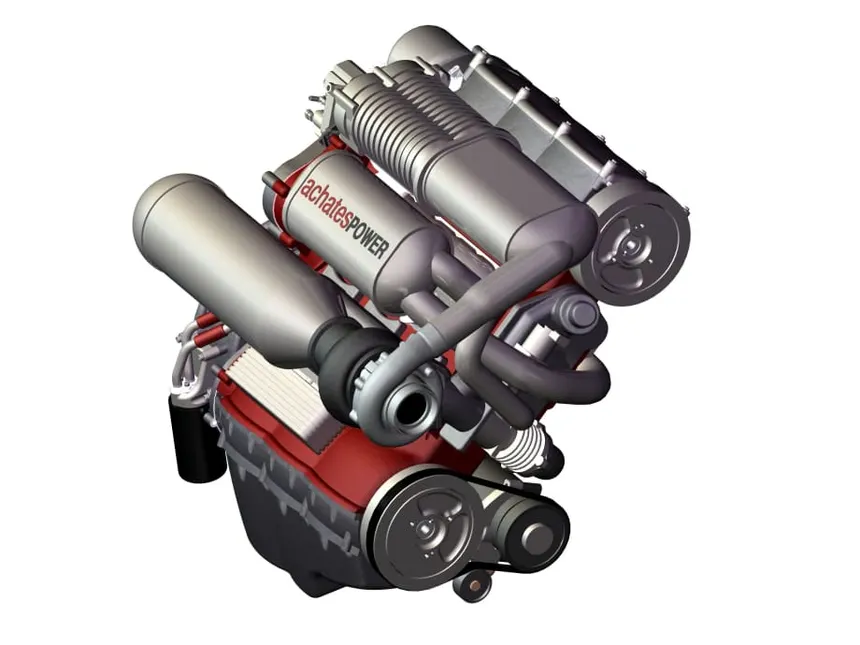
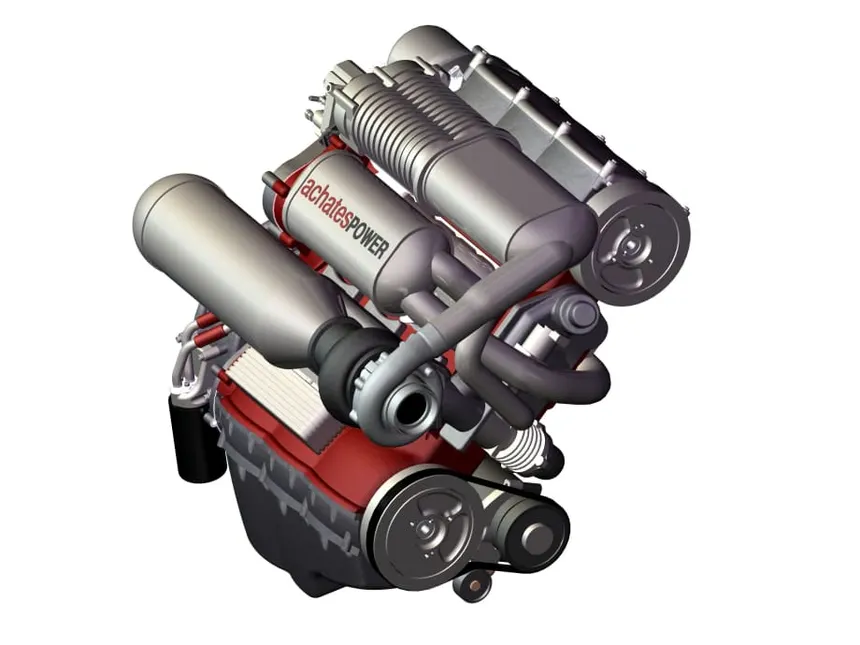
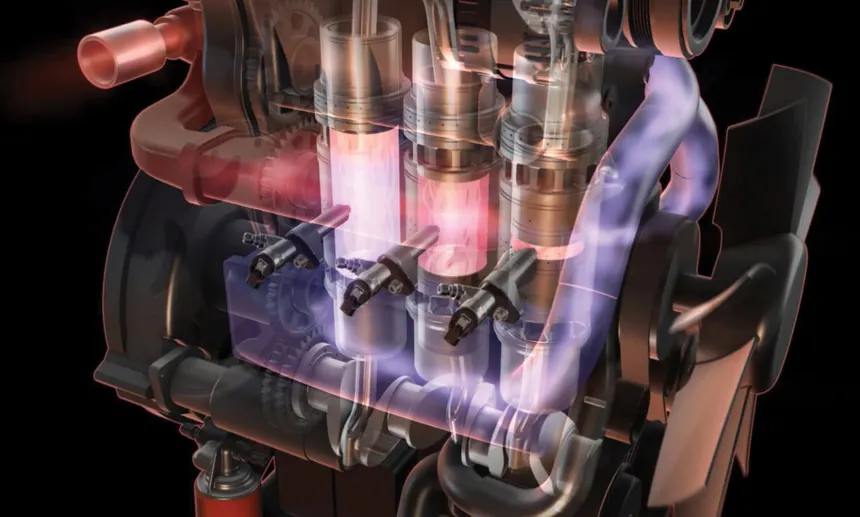
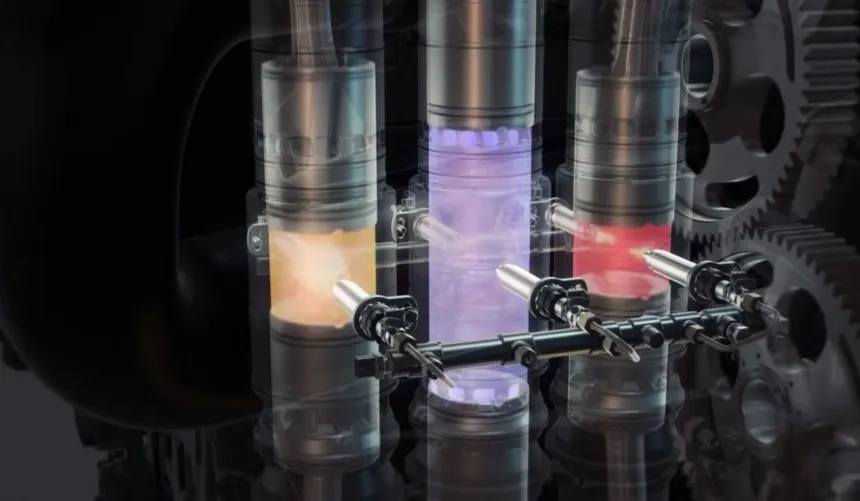
Start with the engine, because nothing else makes sense without it. An opposed-piston engine is exactly what the name says: two pistons facing each other inside a single cylinder, with no cylinder head between them. The combustion chamber forms in the space between the crowns of both pistons when they hit top dead centre simultaneously, travelling against each other.
That changes everything. Let’s break down what disappears and what remains.
What disappears. Cylinder head. Camshaft. Valves. Valve springs. Spark plugs (in the Achates case). The entire upper machinery of a conventional engine. A comparable supercharged V6 has roughly 60% more parts than an Achates of equivalent displacement. That’s pure industry. Fewer parts means lower manufacturing cost, fewer failure points, less maintenance.
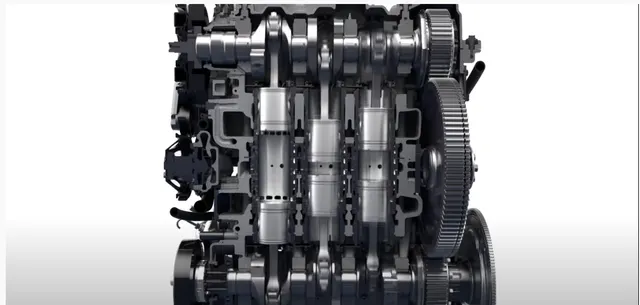
What remains. A horizontal cylinder, two opposing pistons, two crankshafts (one at each end of the cylinder), and ports cut directly into the cylinder wall: intake ports at one end, exhaust ports at the other. As the pistons separate downwards, they uncover the ports and the cylinder is scavenged. As they close back together, the ports are covered and the compression-ignition phase begins.
Does it run on a four-stroke cycle? No. It runs on a two-stroke cycle. One power pulse per crankshaft revolution, versus one every two revolutions in a conventional engine. On paper, that gives twice the power pulses. In practice, given the peculiar geometry of opposed-piston combustion, it delivers between 30 and 50% more thermal efficiency than a four-stroke of comparable displacement.
Forty-five percent brake thermal efficiency in the OPGCI gasoline-compression-ignition Achates 2.7L. For context: a conventional petrol engine sits between 25 and 30%, and the most efficient Toyota hybrid hits around 41%. Achates plays at the same level as the Chinese engines we covered in the combustion hub, but with a completely different architecture.
The history: two dead magnates and twenty-one years of R&D
The company was founded in 2004, in Sorrento Valley, San Diego, by two characters worth a paragraph. One was John Walton, direct heir to Walmart founder Sam Walton. The other was James Lemke, a career physicist. Walton put up the private capital. Lemke brought the technical concept. Both are dead today.
Why would a Walmart heir get into financing an opposed-piston engine in 2004, when the entire automotive industry was talking about hybrids and EVs? The answer is typically American. Walton flew combat aircraft before going into Walmart, and classical military aircraft used opposed-piston engines in certain models. He knew the architecture was sound, he knew modern industry had abandoned it, and he knew that if someone modernised it with 21st-century manufacturing, something interesting could happen. He died in 2005, in a light plane accident. Lemke carried on without him until his own death in 2018.
The company, today led by David Crompton (CEO since 2018), has spent twenty-one continuous years on R&D, developing three parallel engines. Each one with a serious customer behind it. Let’s tell each one.
The first one: the F-150 Aramco paid for
In 2016, Achates received a $9 million grant from the US Department of Energy’s ARPA-E programme to develop an OPGCI (Opposed Piston Gasoline Compression Ignition), a petrol engine using diesel-style compression ignition. Project partners: Delphi and Argonne National Laboratory.
In 2018, that engine landed inside a Ford F-150 demonstrator. And here enters the key piece of the story. Aramco Services, the American subsidiary of Saudi Aramco headquartered in Houston with a research centre in Detroit, signed a Joint Development Agreement with Achates. The F-150 was displayed on Aramco’s stand at the Detroit Auto Show in January 2018.
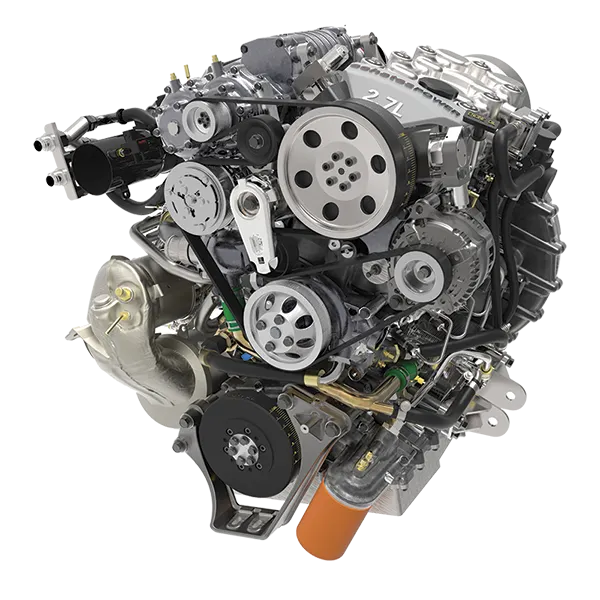
The verified engine specs. Three cylinders, 2.7 litres, 6 pistons, two crankshafts, no spark plugs, no cylinder head, no valves. 270 horsepower. 480 lb-ft of torque (other sources give 429 lb-ft, depending on development stage). 37 mpg CAFE on the combined cycle, equivalent to roughly 6.35 l/100 km. In diesel form, the same engine returns 42 mpg CAFE.
Put that in context. A 2018 Ford F-150 with the standard 2.7 EcoBoost V6 returned 22 mpg combined. The Achates F-150 returned 37. That’s 68% more range from the same fuel tank. Brake thermal efficiency figures: 45% Achates vs 25% standard F-150.
And the critical figure for the business case: Achates declared publicly that its engine would cost a thousand dollars less per vehicle than the conventional roadmaps Ford, GM and Stellantis were considering to meet CAFE 2025. It met CAFE 2025 with a five-mpg margin, according to technical director Fabien Redon.
Why would Aramco pour millions into something like this? To have an opposed-piston engine that burns conventional petrol with diesel-grade efficiency. Meaning: its petrol, sold from American pumps, delivers the same fuel economy as a European diesel. That kills the electrification argument in markets that won’t accept diesel. And at the same time, Aramco controls a technically differentiated engine no other oil major has in its portfolio.
If the move sounds familiar, it’s exactly the one Aramco unveiled six years later with the DHE. Except in 2018, the DHE didn’t exist yet. Aramco’s first real engine was the Achates 2.7L OPGCI. The DHE is the second generation of the same strategy.
The second one: the US Army tank
While the F-150 was simmering, Achates was also embedded in a much bigger military project. In September 2017, the US Army awarded Cummins a contract worth $47.4 million, with Achates Power as technology partner, to develop the Advanced Combat Engine (ACE) — the powerplant that would replace the Cummins VTA-903A 600-horsepower engine that Bradley Fighting Vehicles have carried since the 1980s.
Verified ACE specs. Four cylinders, 14.3 litres, opposed-piston diesel, 1,000 horsepower, 2,400 lb-ft of torque. 21% reduction in heat rejection versus today’s VTA-903A. 50% increase in power density. 13% reduction in fuel consumption. And, crucially, a modular and scalable family: 750-horsepower and 1,500-horsepower variants planned for different combat vehicle platforms.
In August 2021, the US Army renewed the contract. An additional $87 million through Other Transaction Authority, to push the ACE to Technology Readiness Level 6 — actual in-vehicle testing phase. The engine was installed in a Bradley demonstrator. Series production originally scheduled for 2024.
This deserves slow reading. When NEC publishes articles about Europe’s civilian electric transition, readers assume internal combustion is dying everywhere on the planet. But the world’s largest army has spent $134 million over the last eight years developing the most radical 21st-century combustion engine, to put it inside its tanks. And the engine is going to be built by Cummins, an Indiana company listed on the NYSE with a market cap above $50 billion.
European regulation doesn’t apply to military hardware. Climate policy doesn’t apply to military hardware. Electric transition doesn’t apply to military hardware. And there, precisely there, Achates has found its first real production-scale market.
The third one: the truck Walmart tested
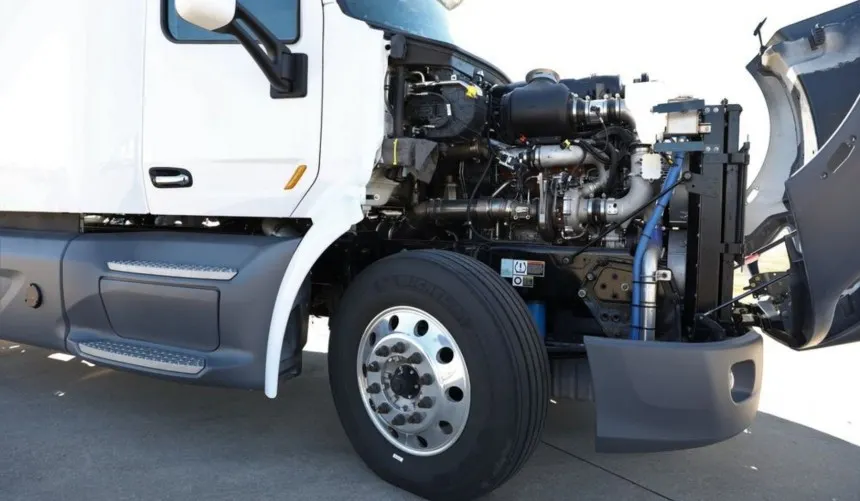
The third leg is heavy commercial. Achates develops a 10.6-litre opposed-piston diesel to replace long-haul truck engines. December 2020: the engine hits the ULNOx (ultra-low NOx) and reduced CO2 milestones simultaneously, using off-the-shelf aftertreatment, no exotic catalysts required.
The test mule for that engine is a Walmart-owned Peterbilt 579. Meaning: the engine the Walmart heir financed two decades ago is now being tested in a truck of the retail empire his family built. Narratively, that’s perfect.
And here’s the strongest figure. Achates has publicly declared, with data to back it up, that the 10.6L OP is the world’s first diesel engine to meet CARB near-zero 2027 emission regulations, years before they take effect. For the American heavy transport sector, that’s the difference between continuing to sell diesel engines or not.
One more detail. The licence for the opposed-piston engine in marine and military markets belongs to Fairbanks-Morse Defense, a 150-year-old company that already built opposed-piston engines for US Navy submarines through the Cold War. Meaning: the industrial chain to manufacture opposed-piston engines in the United States never disappeared. It was just dormant.
The link that closes the combustion hub
Now connect the dots.
Aramco invests in Achates since 2018 to have a radical combustion engine in an American pickup. Aramco invests in Pipo Moteurs in 2023-2024 to have its own combustion engine in Europe, which they call DHE. Aramco buys 10% of Horse Powertrain in December 2024 to have the European industrial manufacturing network. And, beneath all of that, it keeps funding the 10.6L OP for heavy transport while the military ACE marches toward production.
The DHE isn’t a standalone piece. It’s a piece inside a puzzle of five or six radical engines Aramco has been funding for a full decade. Each one for a different market. Each one with a different industrial partner. Each one outside European media focus.
The Chinese push thermal efficiency record figures on conventional petrol. Ferrari pulls oval pistons out of Honda’s drawer in a 2025 patent. And Achates has spent twenty-one years perfecting an opposed-piston architecture that already sits inside an American Bradley and a Walmart Peterbilt. Every relevant global player is doing the same thing: pulling weird combustion engine architectures out of drawers to dodge electrification regulation and dominate the parallel market where combustion is still the real standard.
The hard question NEC has to leave behind
If, by 2032, you’re driving your Chinese-built EV down a Spanish motorway and a Walmart truck from the United States overtakes you with an Achates 10.6L on board, who has won the combustion engine battle?
Hint: not Europe.
Second hint: NEC readers know how to answer that one alone. They’ve read six combustion hub articles already. This is the seventh, and the missing piece of evidence.
Aramco has been funding a radical combustion engine for eight years. Cummins has been building it. The US Army is going to put it inside its tanks. And Walmart is testing it inside its trucks. Internal combustion isn’t dying. It’s just changing address.
Check you’re still alive.
1 thought on “ACHATES POWER”