
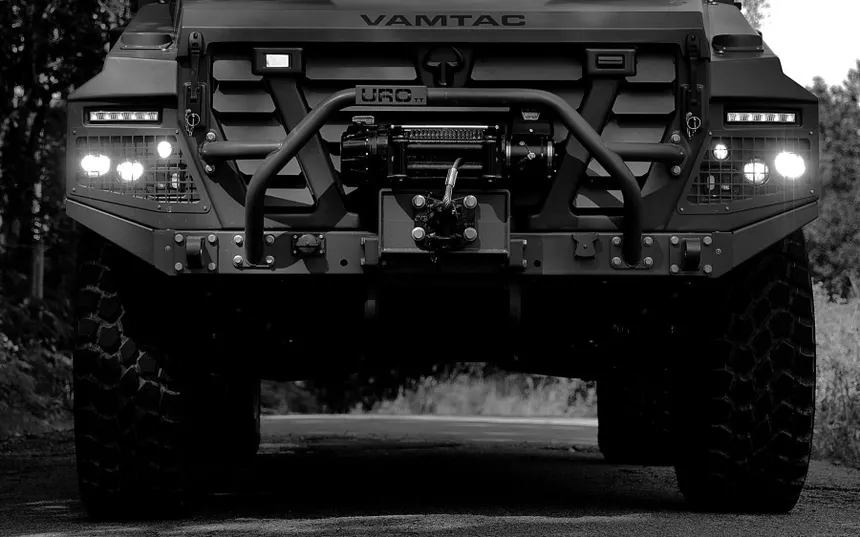
The VAMTAC AX4 isn’t a new truck. It’s a bet — and Urovesa just placed it in Paris
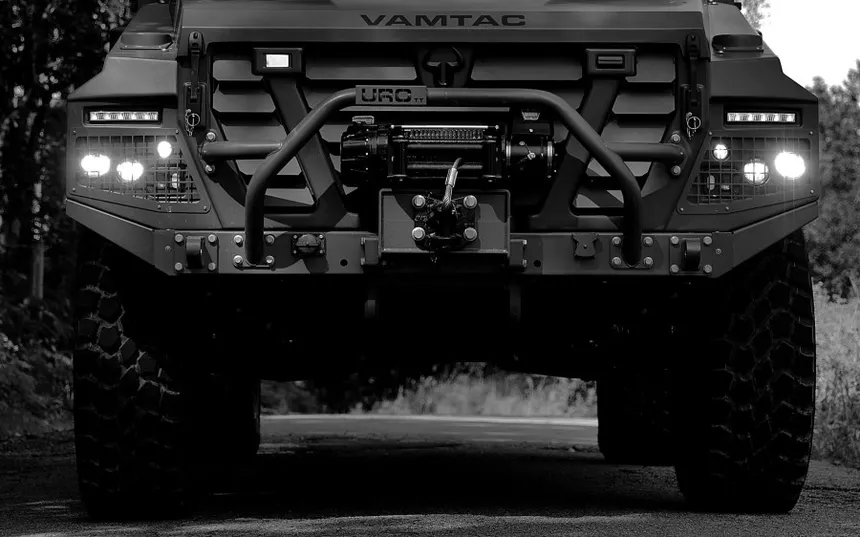
Jeremy Clarkson once said that the moment a company replaces a product everyone loves is the moment you find out what they’re really made of. He was talking about cars, but it applies just as well to military hardware. When a firm has spent three decades building essentially the same vehicle, better and better each year, and then suddenly rolls out something new, it isn’t because someone had a bright idea over coffee. It’s because the old vehicle, good as it was, had hit a wall.
That’s the story of the VAMTAC AX4, which Spanish manufacturer Urovesa unveiled at Eurosatory in Paris on 15 June. The press releases will tell you about the four tonnes of payload, the eleven seats, the modular armour. All true. None of it tells you what the vehicle actually means. Because the AX4 isn’t really about a truck. It’s about a family-owned company from Valga, in Galicia, deciding that its star product could no longer carry it where it wanted to go — and choosing to gamble its reputation on a clean-sheet replacement, right as Europe scrambles to rearm.
Let me walk you through it from three angles at once, because you can’t read this machine by staring at one side of it.
The ceiling the ST5 had quietly reached
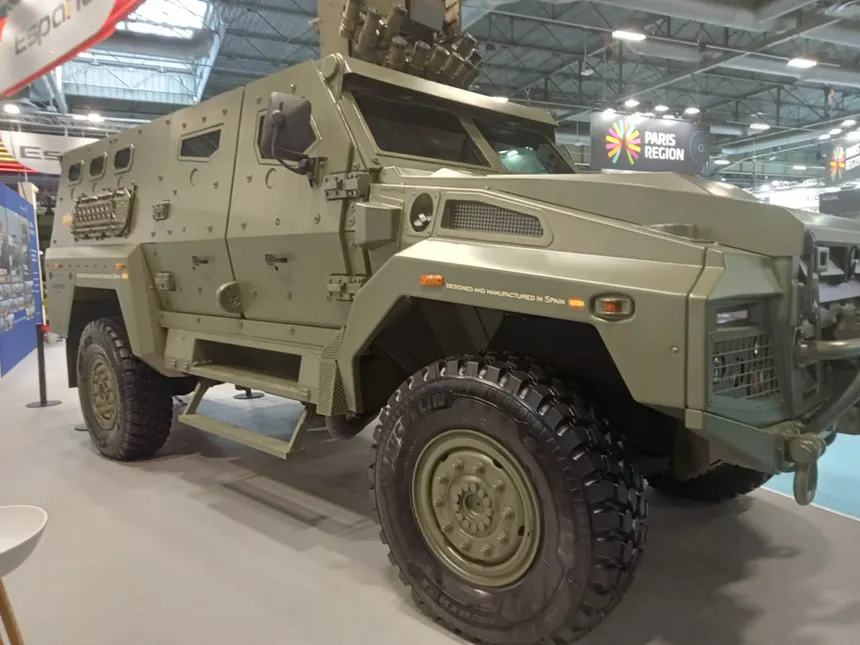
To get the AX4 you have to know where it comes from. The VAMTAC ST5 is the tactical 4×4 Urovesa has built since 2013, the mature evolution of a family that started back in 1998. It’s a proper bit of kit. More than thirty countries field it, the Spanish Army runs hundreds, and it earned its stripes the hard way — in actual operations, in genuinely nasty places. Spain signed a framework deal for up to 663 units between 2020 and 2025. You don’t land an order like that with a mediocre vehicle.
The ST5’s numbers, for the record: up to 2.5 tonnes of payload, a 5.3-tonne maximum weight, a six-cylinder turbocharged engine pushing somewhere between 187 and 245 horsepower depending on spec, and a 135 km/h top speed. Roughly 4.8 metres long, three to three-and-a-half tonnes empty. Solid. Proven.
But here’s the bit that matters, and it’s pure physics rather than marketing. The moment you want more armour, you add weight. And the moment you add weight, you eat into payload, into mobility, into range. It’s a permanent tug-of-war between protecting the people inside and keeping the thing nimble. The ST5’s chassis and running gear had a margin to play with. After thirty years of squeezing that platform, the margin was just about gone.
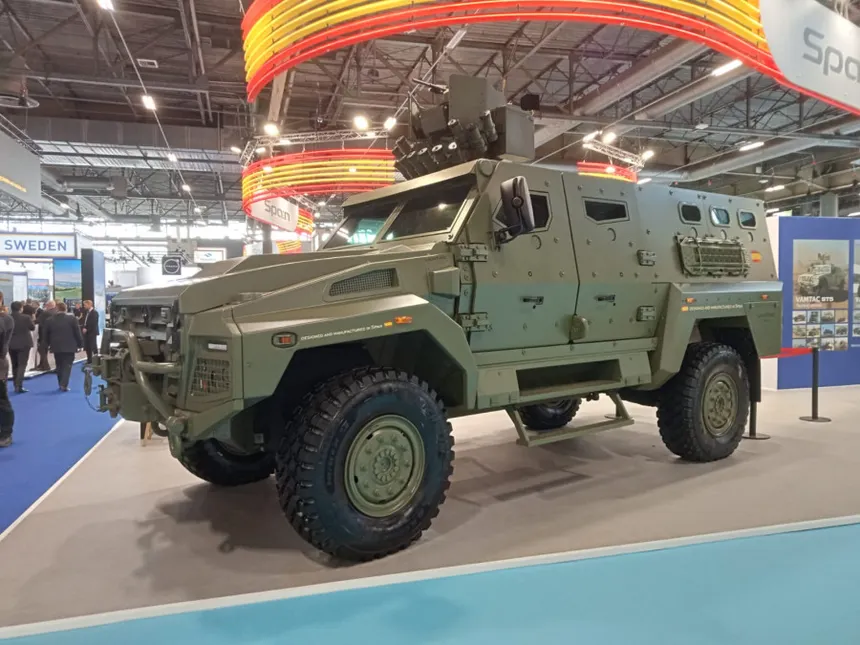
So Urovesa didn’t tweak the ST5 again — they’d done that a hundred times already. They sat down and designed a fresh platform from the floor up, one born to carry heavy armour without choking on it. That’s why the AX4 lifts payload to four tonnes and capacity to eleven occupants, driver included. It isn’t an ST5 on steroids. It’s a different animal.
The company frames it in a way I find telling: the AX4 sits “above” the ST5 and complements it, rather than replacing it. The ST5 lives on, and Urovesa insists it has plenty of road left. The AX4 slots in one rung higher, for missions that demand more protection and more capacity. Think of a toolbox that already works — you don’t bin it, you add a bigger wrench for the bolts the small one can’t grip.
The trade-off everyone faces, and where the craft shows
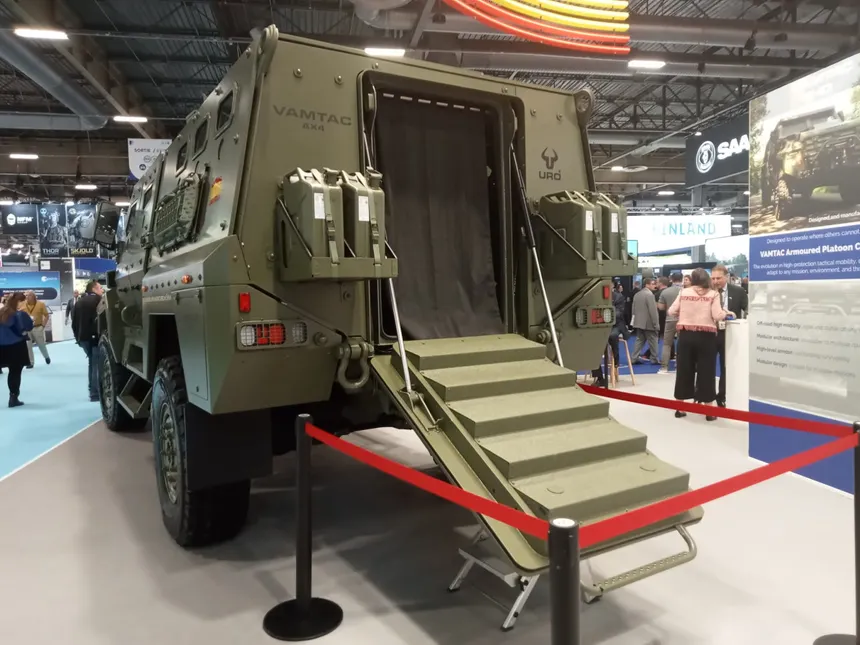
This is the part I like most, because it’s where the engineering actually lives. Urovesa’s people spelled it out in Paris without dressing it up: the central challenge of the project was raising payload and armour while keeping mobility. And that demands a relatively low centre of gravity, a balanced suspension, and the maximum possible traction.
Anyone who’s worked on a heavy vehicle knows what’s hiding behind that sentence. Raise the centre of gravity and the thing becomes lethal in corners and across broken ground — it rolls. And armour goes up high, because that’s where the plates protecting the crew sit. So you’re adding weight in exactly the spot that wrecks balance. The trick isn’t just bolting on armour. It’s bolting on armour while keeping the vehicle planted, with the suspension doing enough work that the extra mass doesn’t bite you every time you climb a slope.
For a sense of how brutal this trade-off is, look at what happened to the Humvee — the VAMTAC’s American cousin. When IEDs started raining down in Iraq, crews bolted armour kits onto vehicles never designed for them. The result? Weight ballooned so badly that 0–100 km/h took thirty-seven seconds. Thirty-seven. A bin lorry is quicker. Worse, the chassis began cracking under steel it was never meant to carry. That was the lesson the whole industry absorbed the hard way: armour bolted onto a platform that wasn’t built for it is a short-term fix and a long-term liability. Which is exactly why Urovesa didn’t reinforce the ST5. They designed the AX4 from scratch with armour baked into the equation from the first sketch. The difference between a patch and a proper weld.
The AX4’s protection, per Urovesa, is combined: ballistic, anti-mine and anti-IED. The platform also accepts additional armour, chiefly against mines — and that detail carries weight, literally and figuratively. Mine protection and ballistic protection don’t pull in the same direction. A mine attacks from below, with a savage blast wave punching up through the floor; there you need hull geometry, V-shapes to deflect the blast, and seats that soak up the shock so the troops don’t end up with shattered spines. Ballistic threats come from the sides; there you need plate. Building a vehicle that survives both without turning into a five-tonne brick that won’t move — that’s the real achievement.
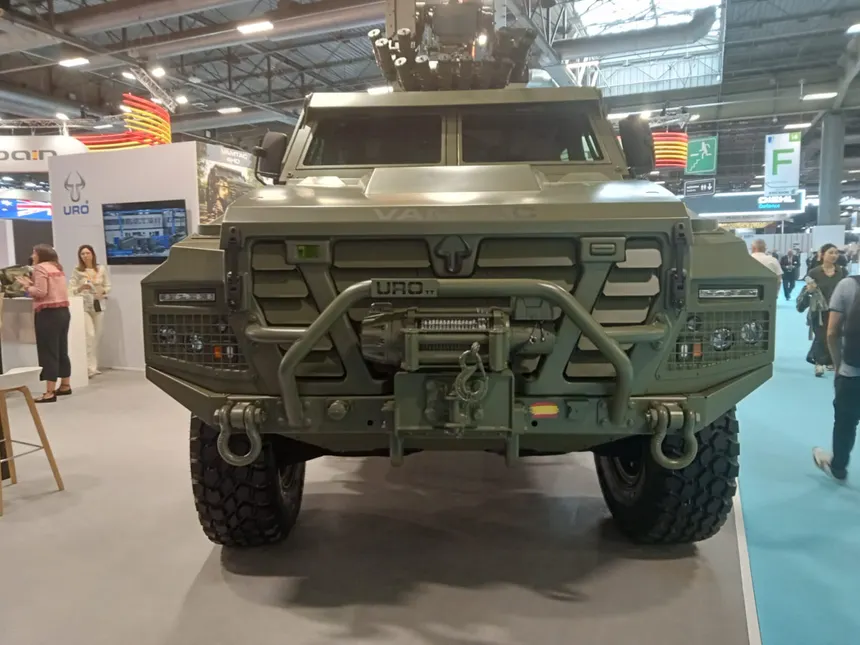
The remote weapon station perched on top, supplied by Spain’s EM&E, isn’t a gimmick either. It lets the gunner fire from inside the vehicle, protected, instead of leaning out of a hatch like something from a war film. But it comes at a price: it sits right at the top, and we’ve already covered what every kilo up high does to stability. That the AX4 carries that system without going wobbly is, once again, proof the platform was engineered to bear mass up high.
And the AX4 doesn’t arrive alone. Urovesa is already working on variants from the same playbook it used on the ST5: tactical ambulance, recovery vehicle, electronic warfare, command post, even a mortar carrier of larger calibre than the one the ST5 hauls today. That’s the whole point of a modular, scalable architecture — nail the base and you can hang whatever mission you need off it. The difference between building a truck and building a platform. A truck does one thing. A platform does whatever you ask.
One thing I won’t pretend about: as of today, Urovesa hasn’t published the fine print on the AX4. We don’t yet know the exact engine, the combat-loaded maximum weight, the final dimensions. They showed it in platoon-transport trim — eleven seats, EM&E remote weapon station up top — but the detailed spec sheet isn’t on the table yet. I’d rather tell you that than invent it. When the numbers land, we’ll cross-check them.
There’s another layer worth flagging, because it’s the sort of thing that never makes the photos but decides everything in the field. The traditional VAMTAC carried engineering touches that quietly set it apart: all-wheel drive that lets it keep rolling at full load resting on a single wheel without losing grip, the ability to be air-dropped at low altitude, to hang under a helicopter as an external load, to swallow military fuels derived from aviation kerosene, and to inflate or deflate its tyres from the driver’s seat. If the AX4 inherits that DNA — and every sign says it does, because it’s the house signature — then we’re talking about a vehicle that doesn’t merely survive the hit, it actually reaches where it’s sent. Plenty of armour exists that protects beautifully and then strands you in a wadi. The VAMTAC line never had that reputation, and that reputation is half of what Urovesa is selling.
Spain playing in a league it isn’t supposed to win
Here’s the angle almost nobody covers — the one that actually explains why this vehicle appears now rather than in five years.
Europe’s light armoured 4×4 segment is on fire. And it’s on fire largely because of one American vehicle eating everyone’s lunch: Oshkosh’s JLTV, the replacement for the old Humvee. Look at the tally. Lithuania finalised an order for 500 units and is now the largest operator in the world outside the United States. Belgium ordered 332. The UK, Slovenia, Montenegro — all signed up. The US has ordered north of 17,000. It’s a commercial steamroller, and Oshkosh is the third-largest land systems maker on the planet, behind only General Dynamics and BAE Systems.
With half of Europe rearming at speed over what’s happening on NATO’s eastern flank, light armoured vehicle programmes are multiplying. And there’s where Urovesa — a Galician firm turning over 122 million euros, a supplier to Spain’s armed forces since 1984 — spots an opening. The AX4 aims squarely at those upcoming European light-armour programmes. Unveiling it at Eurosatory, the shop window where every buyer with an open chequebook gathers, is no accident.
David versus Goliath? Partly. But the VAMTAC has three decades of proven reliability behind it, it’s in service across thirty-odd countries, and Urovesa is ploughing nearly 52 million euros into expanding its Valga site — new building, robotised warehouse, production lines, a fresh test track. You don’t make that kind of investment to stay home. You make it to fight abroad.
And there’s one argument that, in today’s Europe, weighs more than ever: industrial sovereignty. Buying a JLTV means buying American. Buying an AX4 means buying European, built in Galicia, with the supply chain and maintenance kept in-house. At a moment when much of the continent is questioning just how far it can lean on Washington for its defence, that’s no small thing. It might be the best card Urovesa is holding.
It helps that Urovesa isn’t a firm coasting on past glory. Just last October the Spanish Army formalised the purchase of two ST5 units in a specialised explosive-ordnance-disposal configuration for 1.4 million euros — small numbers, but the point is the cadence. The orders keep coming, the variants keep multiplying, and the company keeps the production line warm while it readies the next generation. The AX4 isn’t a Hail Mary from a manufacturer in trouble. It’s the considered next step from a builder that already has the room to take risks.
What’s actually on the table
So when you see the photo of the AX4 in Paris — remote weapon station up top, that purposeful, serious stance — don’t just see a truck. See a bet. A company that spent thirty years making the same vehicle better every year, that knew the road had an end, and that chose to design a clean-sheet platform to play in a league an American giant currently rules.
The AX4 might come good or it might come up short. Contracts will decide that, not trade shows. But the decision to try — to spend the money and stake the house’s reputation on a generational leap, just as Europe rearms — that decision is already made. And whichever way you look at it, it’s the kind of move that defines a company for the decade ahead.
Thirty years of VAMTAC to get here. Now we find out whether the market agrees.
1 thought on “VAMTAC AX4”