URO: The Spanish Factory You’ve Never Heard Of That Builds Tactical Vehicles For Thirty Countries
Three letters, zero recognition
In the English-speaking world, when someone says “Spanish car industry,” the answers are predictable. SEAT. Maybe Hispano-Suiza if the person reads about pre-war luxury. Pegaso if they know their Wifredo Ricart history. Spano if they follow exotica.
Nobody says URO. Outside specialist defence press and a handful of Top Gear armchair generals who remember the segment where Clarkson laughed at “the Spanish Humvee,” the name does not register.
And yet URO has been building heavy-duty 4x4s in Galicia for more than forty years. Its trucks and tactical vehicles serve in over thirty armed forces. The Spanish Army operates thousands of them. Morocco operates more. Portugal, Romania, New Zealand, Ukraine, the Dominican Republic, Saudi Arabia, Iraq. The list is real and it keeps growing.
A Spanish manufacturer that exports to thirty countries. That bills over one hundred million euros a year. That remains family-owned. That designs and assembles inside Spain. And that no one outside the defence press talks about.
That alone is a story worth writing.
A workshop, ten people, a forest fire problem
URO Vehículos Especiales S.A. was born in 1981 in Santiago de Compostela. There was no venture capital behind it. There was no regional government masterplan. There were ten people. Ten. And one engineer leading them: José Sierra Fernández, born in Viveiro, trained in Vigo, with previous experience at Barreiros, one of the very few real schools Spain ever had in heavy automotive engineering.
Sierra and his small team came out of IPV, Investigación y Proyectos de Vehículos Especiales, another Galician outfit that specialised in custom-bodied light commercial vehicles. They left and set up URO around a very specific market gap: northern Spain needed all-wheel-drive trucks for forest fire response, mountain logistics, and rural emergency work. The demand existed. Nobody was serving it properly. And Galicia had a deep tradition of building specialist forestry vehicles.
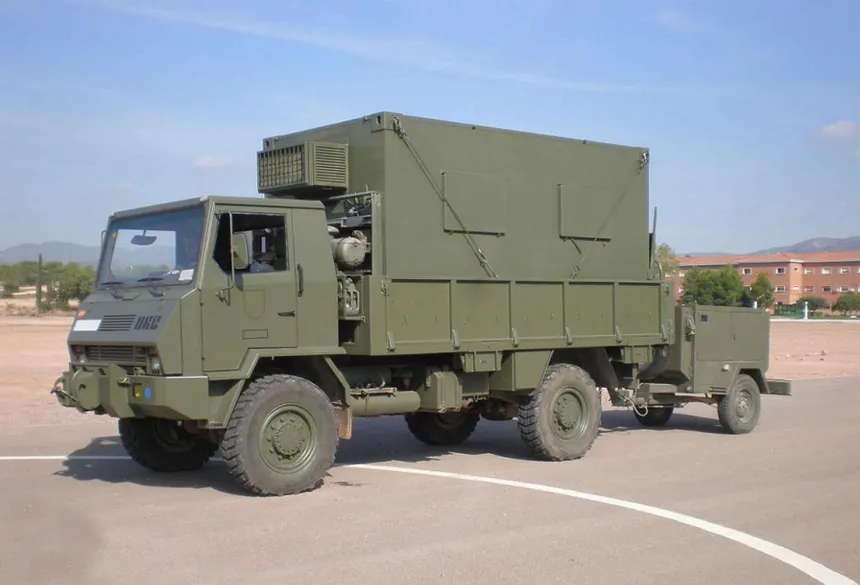
By 1983 they were in production. The first product was the TT URO, an all-terrain truck rated up to eighteen tonnes, designed for two parallel uses: forest firefighting and military logistics. Initial output was around twenty-five vehicles a year. The headcount was fifteen people in a small workshop.
To put that in perspective: imagine launching a heavy commercial truck brand with the staff of a mid-sized restaurant. No dealer network. No marketing budget. No export plan. Just the product, and word of mouth among Galician forestry services. And the determination to outlast everyone who said it wouldn’t work.
1984: the contract that defined everything
In 1984 something happened that would shape URO for the next four decades. The Spanish Ministry of Defence opened a competitive tender under the framework known as Declaración de Necesaria Uniformidad, essentially the official recognition that grants a supplier preferred status for the Spanish Armed Forces over multi-year periods. URO entered. URO won.
This is not a small detail. A Declaración de Necesaria Uniformidad is not a one-time order. It is the institutional key that opens sustained military procurement. And once a manufacturer holds it, it becomes credible for export to other armed forces internationally.
URO has been awarded five of these declarations over its history. Five. That is the institutional spine on which everything else was built.
The TT URO became the Spanish Army’s standard all-terrain truck. Short cab, long cab, double cab, flatbed, water tanker, crane configurations, artillery support versions, engineer corps versions, signals versions, military ambulance configurations. More than thirty-five years in continuous service with the Spanish Armed Forces. And exported to numerous foreign armies along the way.
Meanwhile the same chassis, in different colours and for different customers, was fighting forest fires in Galicia, in Asturias, in León, in Castile. The same machine running two different wars. The lethal one, and the salvific one.
1991: UROMAC and the quiet diversification
In 1991 URO created a subsidiary, UROMAC, in Castropol, Asturias. UROMAC builds forklifts, dumpers, and specialist mechanical handling equipment. The main customer was, again, the Spanish Army, which uses these machines in logistics, depot, and base operations. But UROMAC also opened a route into civilian industrial sales.
Why does this matter? Because it defines the Sierra philosophy. URO is not a company that bet everything on one product and prayed. It is a company that hunts for niches. Small, defined, specific niches. Military forklifts. Forest fire trucks. Tactical vehicles. Specialist industrial configurations. The same pattern repeats: find the segment that the big multinationals leave alone because the volume doesn’t justify their attention. Then occupy that segment.
And from inside the niche, endure. Grow. Export.
1998: VAMTAC and the leap forward
By the late nineties the Sierra family had identified another gap the Spanish Army needed filled: a tactical 4×4. Large, robust, powerful, but smaller and more agile than a full truck. A high-mobility tactical vehicle, in NATO terminology.
That is when the VAMTAC was born. Vehículo de Alta Movilidad Táctico. The product that would scale URO into something much bigger than a Galician truck builder.
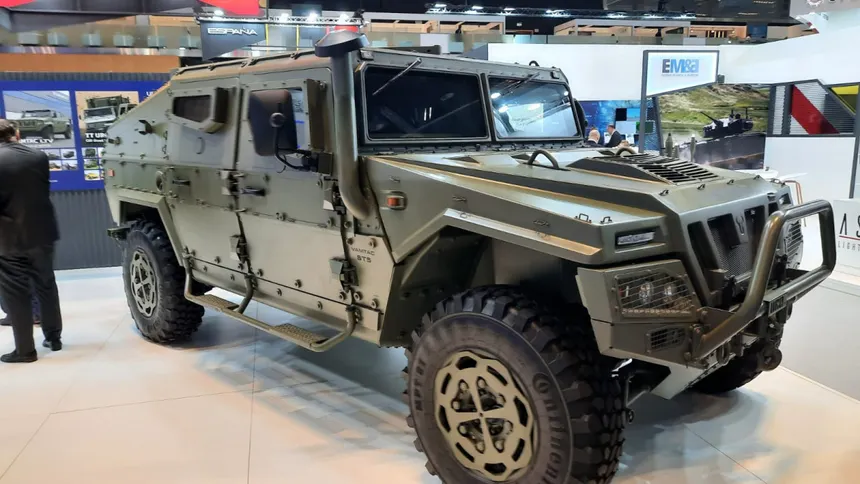
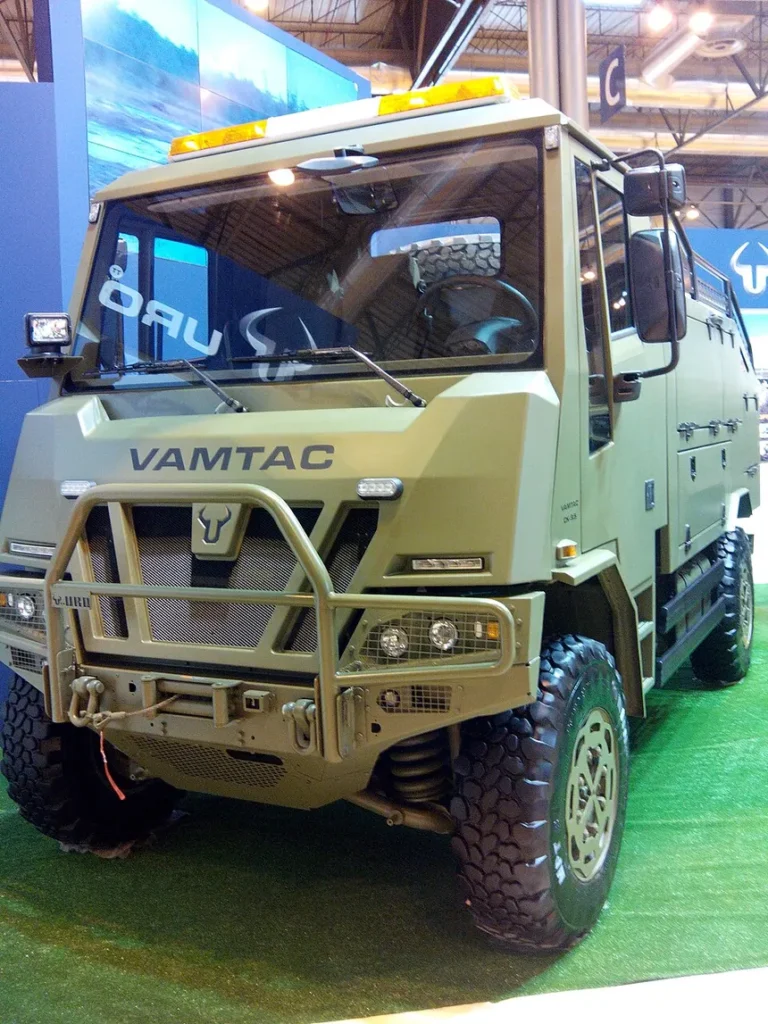
The VAMTAC deserves a dedicated piece, which is coming. But there are four things worth stating now so that you understand the scale of what we are talking about. First, the powertrain: a Steyr 3.2-litre six-cylinder turbo diesel with intercooler, producing between 188 and 272 horsepower depending on configuration, driving an Allison automatic transmission. Permanent four-wheel drive, 100% locking differentials front and rear, two-speed transfer case, independent suspension on all four corners. Second, the off-road numbers: unprepared fording depth of 1.5 metres, range up to 1,000 km on extended-tank versions, gross vehicle weight of 5.3 tonnes with up to 2.5 tonnes of payload. Third, the protection: the current ST5 generation can be specified with armour up to NATO STANAG 4569 Level 3, including a modular survival capsule, V-shaped underfloor mine deflector, blast-absorption structure, run-flat tyres, and Central Tyre Inflation System for variable pressure on the move. And fourth, the configurations: around twenty body configurations and seventy-five different applications on the same platform. Ambulance, command and control, anti-aircraft missile carrier, mortar carrier, chemical-biological-radiological detection, electronic warfare, anti-drone systems. One vehicle, dozens of missions.
That is the baseline. Since 1998, URO has produced more than six thousand VAMTACs. The Spanish Armed Forces operate more than a thousand. The vehicle has been exported to roughly thirty countries. It has seen real service in Afghanistan, Iraq, Kosovo, the Democratic Republic of Congo, Lebanon, and most recently Ukraine.
All designed and assembled in Galicia.
The crisis and the survival
The end of the first decade of the 2000s was brutal. Spanish defence budgets were frozen. Procurement tenders were delayed or cancelled outright. URO watched its revenue fall sharply at exactly the same moment half of Spanish industry was being dismantled or sold off.
A single sector figure tells the scale. Between 2007 and 2013, the Spanish motor industry lost 37% of its total revenue. Thirty-seven percent in six years. Across the wider Spanish industrial economy, 28% of jobs and 22% of companies disappeared in the same window. Those are the averages. For a family-owned specialist vehicle manufacturer whose primary client was the Ministry of Defence in a country slashing public spending, the hit was deeper and more concentrated than the headline numbers.
This is where the difference between a real company and a paper company becomes visible. URO held the line. No bailouts. No emergency financial restructuring. No fire sale to a foreign group.
And when the recovery came in 2013, URO did not settle for going back to the old volumes. They signed a six-year Framework Agreement with the Ministry of Defence, then announced a major industrial expansion. The historical factory at Polígono del Tambre in Compostela had become too small, and the surrounding industrial land had become too expensive. So they built a brand-new forty-thousand-square-metre facility in Valga, Pontevedra. Forty thousand. In the middle of post-crisis Spain.
The Valga plant can produce up to five thousand vehicles a year depending on contract load. It houses production, warehousing, in-house R&D, and a private test track. The original Compostela site continues to operate as the technical and aftermarket support centre.
That is not the behaviour of a company surviving by luck. That is the behaviour of a company that knows exactly what it is and where it is going.
The industrial philosophy: real local sourcing
Justo Sierra, the founder’s son and CEO since 2016, has been explicit about the philosophy in interviews. URO is an integration manufacturer whose strategic principle is local production with a genuine Spanish industrial signature. The workforce is largely drawn from Valga, Compostela, and the surrounding region. The cabs are built in Vigo and Lugo. The lower structural support is sourced within a five-kilometre radius of the plant.
Yes, some components come from abroad. The engines are Italian Iveco or Austrian Steyr units. Transmissions are Iveco, ZF, or Allison. But as Justo Sierra has stated publicly, those parts are never the soul of the vehicle. The soul is designed, integrated, and assembled in Galicia.
For anyone who has spent decades on industrial shop floors, this is not marketing language. It is a business decision that costs real money. Producing through a Galician supplier network is more expensive than buying pressed-steel components in Poland or Turkey. But it gives control. It gives quality consistency. It gives logistical independence. And in a defence company, it gives something invaluable: industrial sovereignty.
A military manufacturer dependent on foreign suppliers for its structural components is not sovereign. URO has decided, deliberately, that the soul of its vehicles will remain Spanish.
In a country that has watched factory after factory be hollowed out, that decision is news in itself.
Inside the plant
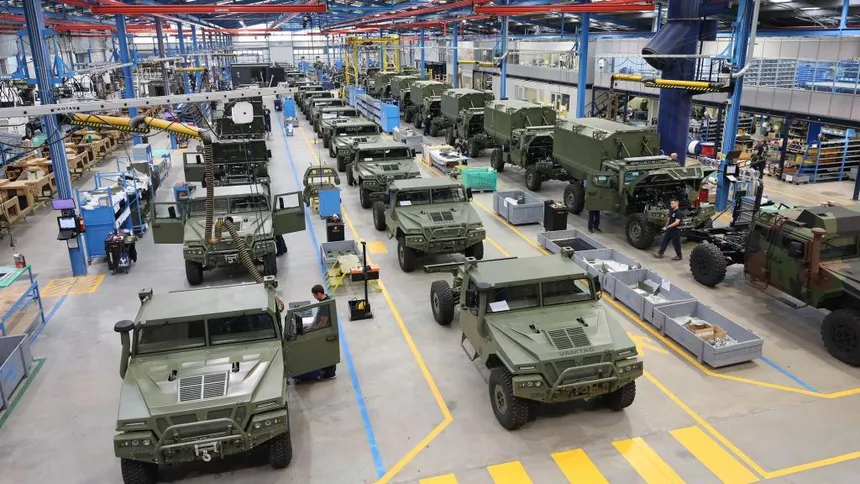
Anyone who has spent thirty years moving in and out of industrial sites learns to read a factory by smell before they read it by sight. The Valga plant is the kind of place that smells of three things at once: cold-cut steel coming off the press, MIG weld smoke around the chassis jigs, and hydraulic oil cut with solvent near the final inspection bays. It does not smell like a new car. It smells like metal that is still in the middle of becoming something.
The sound is also nothing like a passenger-car assembly line. There is no silent Kuka choreography painting bodies overhead. Valga is honest industrial noise: the bark of a pneumatic torque wrench locking a chassis bolt to spec, the tap of a panel-beater’s hammer correcting a body panel, the overhead crane swinging a Steyr cylinder head toward an assembly station, and the slow rumble of military-spec 37×12.5 R16.5 tyres rolling an unpainted VAMTAC across the shop floor toward the next bay. Underneath it all, the steady hum of compressors and a Galician radio station nobody turns up and nobody turns down.
The people building these vehicles are not interchangeable temp-agency profiles. They are certified welders, panel specialists with twenty years on the job, chassis fitters who know a specific torque value because they apply it forty times a day. Most of them live in Valga, in Compostela, in the surrounding Pontevedra villages. Their names never appear in the Ministry of Defence press release when a 200-million-euro contract is announced. But when a VAMTAC rolls out of the plant onto a military transporter, those are the hands that put it together.
That is what gets assembled in Galicia. Not just steel and weld. Trade craft.
What came next
In 2016 José Sierra handed operational leadership to his son Justo, taking the role of honorary president. Cecilia Sierra, daughter, joined the board as vice-president. Cristina Sierra, second daughter, as board secretary. A real family-owned operation with the next generation at the controls.
That same year the London Stock Exchange ranked URO among the one thousand European SMEs with the strongest growth projection. One of a thousand, in a continent of millions of small and medium businesses. A Galician defence-sector family company on a European growth list.
José Sierra Fernández died in July 2023, aged 82, after a long illness and just days after receiving the Empresario Galego do Ano award. In October 2024 he was posthumously awarded the Gold Medal of the Order of the Spanish Chamber of Commerce.
URO continues to operate. Justo Sierra at the helm. Record production. A 2025 contract with Romania for twenty-four units. An agreement with New Zealand for sixty units. Active deliveries to Ukraine. Open negotiations in the Middle East.
And the Valga plant keeps the rhythm. Steel, welding, integration, testing, delivery. Vehicle after vehicle.
Why this matters
There is no tragic narrative here. No story of a proud Spanish marque collapsing in front of foreign capital. URO is something rarer than that. It is the story of a Spanish company that entered one of the most demanding industrial sectors on earth, defence land vehicles, found its space, defended it, expanded it, survived a brutal financial crisis, exported to thirty countries, and is still standing. Family-owned. Galician. Operational. Unsold.
For anyone who has worked the floor in heavy industry, that achievement registers differently. You know what it costs to build a heavy-vehicle manufacturer without a Fiat, a Volkswagen, or a sovereign wealth fund behind you. You know what it costs to compete against Mercedes-Benz, Iveco, Oshkosh, and KMW with a product designed in Compostela and assembled in Valga. And you know what it means to win national tenders against them on technical merit.
What strikes me most about URO is not the VAMTAC itself. It is the silent, sustained, four-decade decision to keep building in Galicia with Galician suppliers. To resist the relocation pressure that has gutted so much of European heavy industry. To keep the soul of the vehicle at home.
That kind of decision, in this part of the world, has become almost extinct. And when it happens, we usually fail to put a face to it. We fail to put a name to it. We fail to learn anything from it.
URO does not need anyone to rescue it. What it needs is for the rest of us to know it exists.
Check you’re still alive.