BMW 507: The Most Beautiful Car BMW Ever Built Almost Killed the Company
Walk into any decent auction in Monterey or Pebble Beach and one of these things will cross the block for two million dollars. Minimum. The Surtees car went for nearly five. People queue up for the privilege of bidding on something that lost BMW about a grand on every single one they sold.
That’s not a metaphor. That’s the actual ledger. And the part that gets left out of every glossy retrospective is that this car, this thing now treated as a sacred relic of postwar European design, was a commercial disaster so total that it dragged the entire company within a hair of being swallowed by Daimler-Benz in 1959.
Here’s the story without the Elvis filter.
The American who oversold
Max Hoffman was the importer who built half the European sports car market in the United States by sheer force of personality. He’s the man who told Mercedes-Benz to build a road-going version of the 300 SL race car. He was right about that one. By 1954 he’d turned his attention to BMW, a company barely surviving on motorcycle sales, the Isetta bubble car, and a clutch of heavy luxury saloons no German could afford.
Hoffman walked into Munich with a proposition. BMW would build an open two-seater on the bones of the 502 saloon, drop in the company’s new aluminum V8, and price it at around $5,000. He’d personally take 1,000 units a year off their hands. The board agreed.
This is where the trouble starts and an engineer can see it from across the room. A distributor promises you a thousand cars a year of something that doesn’t exist yet, has to be designed from scratch, will be hand-built in a factory that’s barely solvent, and needs to compete head-on with the most glamorous car on the market. You accept. In 2026 that conversation doesn’t happen. But this was a BMW desperate enough to believe in miracles, and Hoffman traded in miracles.
Goertz, the industrial designer who’d never drawn a car
The first body designs came from Ernst Loof internally. Hoffman saw them and refused to import the car if it looked like that. So he brought in his own man: Albrecht Graf von Goertz, a German émigré working under Raymond Loewy in New York. Goertz had drawn pens, furniture, household goods, helped on Studebakers. He had never designed a complete automobile.
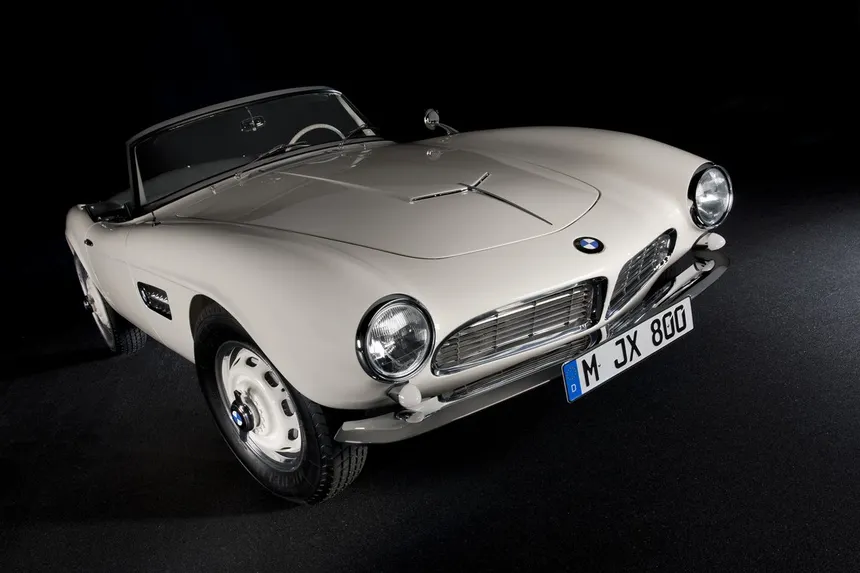
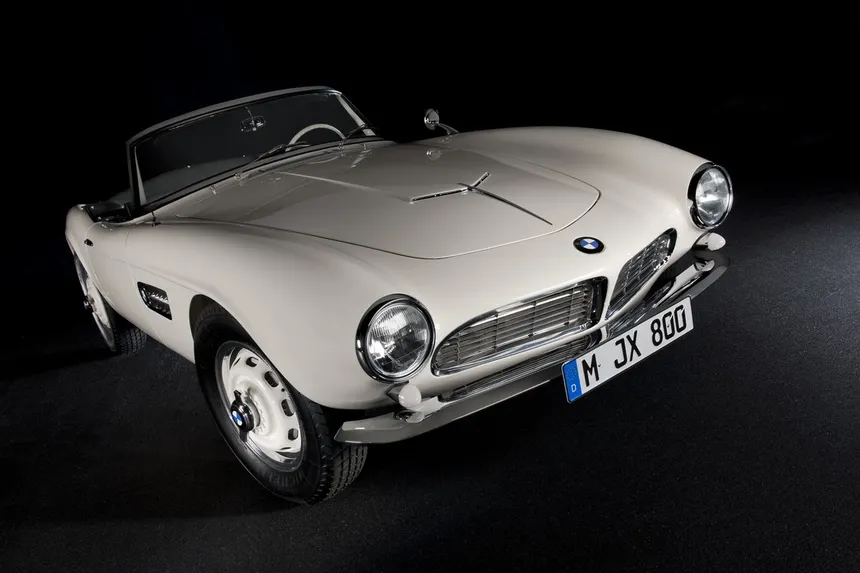
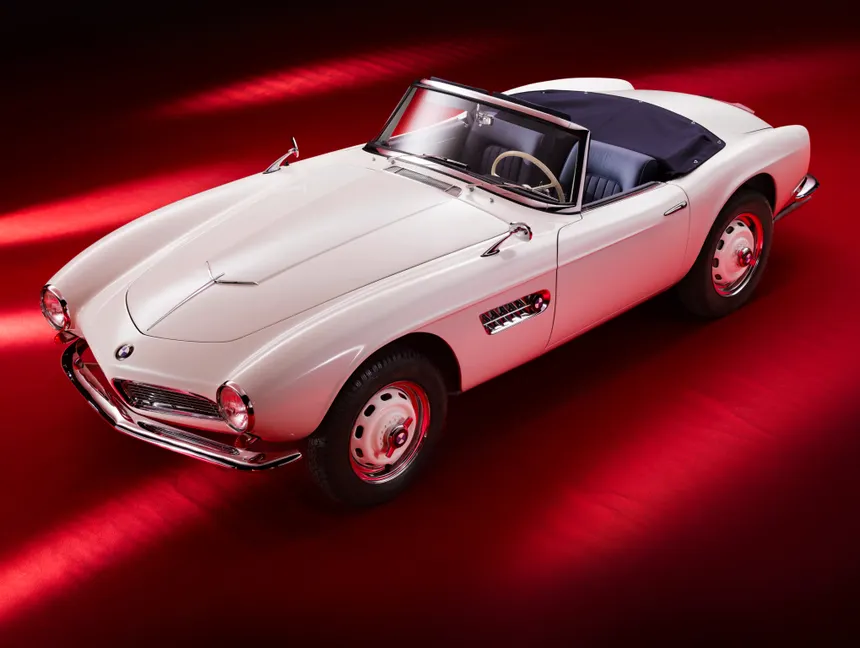
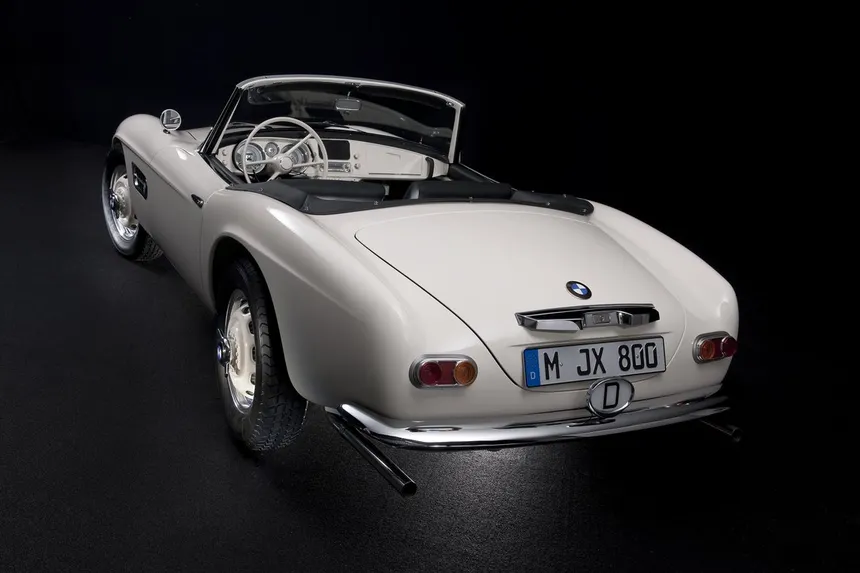
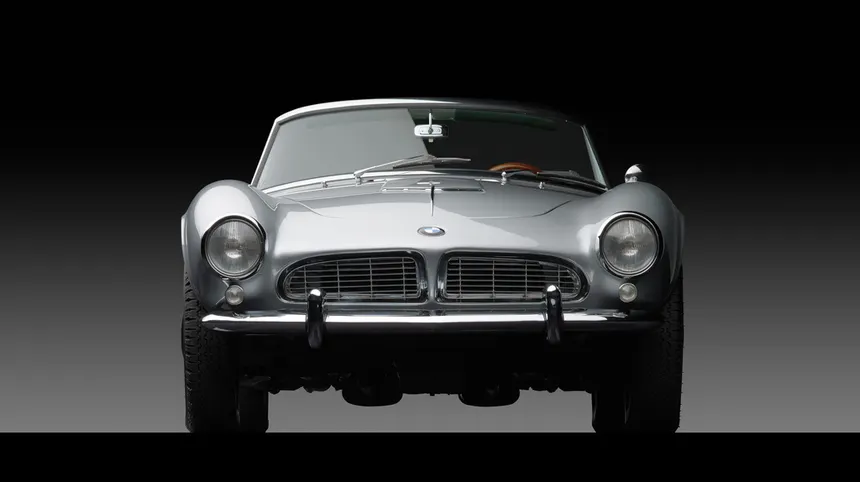
That’s exactly why it worked. Give a blank sheet of paper to someone without the bad habits of the trade and occasionally you get something the industry would never dare draw itself. The 300 SL was theater. Gullwing doors, racing pedigree on every panel, you could hear it before you saw it. The 507 went the other way. A hood that runs forever, the kidney grille pressed low and wide, a beltline that travels the whole car without a single nervous tick, and gill vents behind the front wheels that became BMW DNA forever. Top Gear’s Chris Harris once said the 507 is one of the few cars whose proportions are so right that you can’t even argue with them. That’s about the shape of it.
The beauty isn’t opinion. The beauty is geometry. Where the car gets into trouble is everywhere you can’t see.
The aluminum V8 nobody else had
Under the hood lived the M507. An all-aluminum V8 derived from the unit BMW had introduced in the 502 saloon in 1954, when most European manufacturers were avoiding eight-cylinder engines because of crippling displacement-based road taxes. The 507 version ran 3,168 cubic centimeters, pushrod-operated overhead valves, dual Zenith 32NDIX two-barrel carburetors, a 7.8:1 compression ratio. The output was 150 horsepower DIN at 5,000 rpm.
A hundred and fifty horsepower in 1956 was real money. But it wasn’t 215 horsepower, which is what the Mercedes 300 SL was making with its mechanical fuel injection. And the BMW weighed around 1,330 kilograms. Period road tests in Motor Revue clocked 0 to 100 km/h in 11.1 seconds and a top speed of 196 km/h with the standard 3.70:1 final drive. The Gullwing did the same sprint in 8.8 seconds and pushed past 240 km/h. Same era, similar money. The math didn’t work.
There’s another angle to this that the British buff books of the period kept pointing out. The cars Hoffman was supposedly trying to leapfrog at the cheap end of the market — the Triumph TR3, the MGA, the Austin-Healey 100/6 — weren’t just cheap. They were also genuinely quick for the money and had real motorsport pedigree on both sides of the Atlantic. A TR3 cost about a third of what the 507 ended up retailing for and would run with it down a country lane. So at one end the BMW had the Gullwing eating it for performance, and at the other end it had British metal undercutting it on price by miles. There was no middle ground left for the 507 to occupy. It was the right car aimed at a hole in the market that didn’t actually exist.
The chassis was a shortened 502 platform with torsion-bar independent front suspension, a live rear axle located by a Panhard rod and a transverse A-arm, also sprung by torsion bars. The four-speed gearbox sat in the center of the tunnel rather than bolted to the engine, elastically mounted on the frame between the seats. That decision lets you mount the V8 lower and put the driver closer to the front axle. It also tells you the engineers had transmission-vibration problems they couldn’t solve any other way. You don’t separate the gearbox from the bellhousing unless you’ve already tried everything else. Brakes were 11.2-inch Alfin drums all round, with front Girling discs optional toward the end of the production run.
John Surtees got his 507 as a gift from Count Agusta after he won the 1956 500cc World Motorcycle Championship on the MV. He kept it the rest of his life. He also worked with Dunlop to develop disc brakes for the front, and eventually had discs on all four corners. When the world’s only seven-time motorcycle world champion and future Formula 1 champion is upgrading the brakes on his road car, that’s a hint about the production specification.
When the math broke
Now the part the gloss leaves out.
The 507 didn’t reach showrooms at $5,000. It launched at $9,000 and ended its run at $10,500. Effectively Gullwing money for a slower, less prestigious, less developed car. Hoffman walked away from his thousand-unit commitment. BMW was left with a roadster being beaten into shape one aluminum panel at a time, losing roughly a thousand dollars on every example that left the building.
Run a car company that’s already underwater because nobody in postwar Germany is buying luxury saloons and your micro-car only sells in numbers that pay the rent, and now your halo product is bleeding cash on every sale, and you end up where BMW ended up in late 1959. Daimler-Benz tabled an offer to absorb the entire company. It was the small shareholders who killed the deal at the annual general meeting in December ’59, organizing themselves in revolt against the board’s recommendation. The 507 didn’t save anyone. The 507 was part of the reason the rescue was needed in the first place.
Between 1956 and 1959, BMW built 254 of them. Forty-three Series I cars, with the 110-liter fuel tank mounted behind the seats — a tank so large the cabin smelled of gasoline whenever the top was up, and there was barely any room left for luggage. The rest were Series II, with the tank relocated and the dashboard reworked. Two hundred and fifty-four cars. Goertz wanted to draw the most beautiful car in the world. Hoffman wanted to sell a thousand a year. BMW wanted to live. Only one of those wishes came true.
The paradox of the money-losing icon
Here’s the twist that no accountant could have priced in.
The car that almost bankrupted BMW is the car that gave the company a soul. Forty years later, when the brand was strong enough to do whatever it wanted, BMW’s designers and engineers looked back at exactly one car when they wanted to make a statement. The Z8, built from 1999 to 2003 with the S62 V8 from the M5 E39 underneath, is not “inspired by” the 507. The Z8 is the 507 BMW could build once it had the money to do it properly.
And the difference isn’t just under the hood, although jumping from 150 to nearly 400 horsepower ends that argument before it starts. The difference runs through the entire car. The 507 ran on a shortened 502 ladder frame with a live rear axle hung from torsion bars, drum brakes that wouldn’t stop you down a proper Alpine descent without protest, and a gearbox elastically mounted in the tunnel because bolting it to the engine sent vibration straight to the lever. The Z8 is built around an extruded-aluminum spaceframe MIG-welded by hand at Dingolfing, MacPherson struts up front, a five-link multilink rear, brakes lifted straight from the 750i — the calipers and discs designed to slow a two-tonne saloon, so they have plenty in reserve here — and the V8 mounted behind the front axle line to get the 50:50 weight distribution BMW had been chasing for years. The Getrag six-speed manual bolts straight to the engine without the elastic mounts and the kludges. Four decades of accumulated engineering experience between the two cars, and every single decision shows it.
There’s one detail worth a quiet smile. The 507 already had rack-and-pinion steering in 1956, when most large-engined cars of the era still used worm-and-roller setups. The Z8 was the first BMW V8 to use rack-and-pinion, which the 5 Series, 7 Series and E39 M5 had all foregone in favor of recirculating ball. The 507 was ahead of its time on certain decisions. It just didn’t have the budget to carry that thinking through the rest of the car.
Henrik Fisker drew the Z8 openly and unapologetically as a tribute, and Pierce Brosnan drove it as James Bond in The World Is Not Enough in 1999.
Between the Z8 and the 507 sits every roadster BMW has built since the late 1990s. The Z3, the Z4 in all its generations, even some of the design language that survives into the current M roadsters. All of it traces back to a German industrial designer working in New York who’d never drawn a car before, sketching on Hoffman’s promise that there’d be a thousand buyers waiting.
Goertz didn’t only draw the 507. The 503 grand tourer, launched at the same Frankfurt show in 1955, was also his pen. The 503 sold roughly 400 units — almost twice the 507’s volume — but it shared the same fundamental problem: it cost too much to build and not enough buyers existed at that price point in postwar Europe. Both cars were technical exercises that BMW couldn’t afford to keep making. Years later, Goertz also drew the original Datsun 240Z for Nissan, which became one of the best-selling sports cars of the 1970s. He proved he could design a commercial hit when the brief was right. The brief on the 507 was never right.
Before the 507, BMW was a competent maker of engines, motorcycles and middle-class saloons. After it, the company had something that wouldn’t show up on a balance sheet for another forty years: an aesthetic identity worth quoting from.
What you learn looking at one today
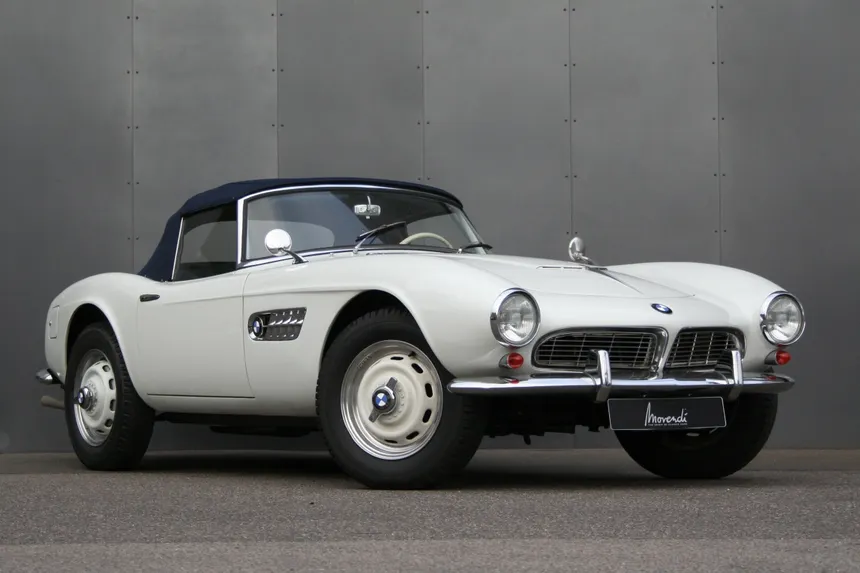
I’ve not had a 507 on a lift. Few people my age have. But I’ve seen them up close at concours and I’ve spoken with people who have done the work, and the report is consistent. This is not a fast car. This is a car you drive well. The drum brakes, until Surtees and a few others fitted Girling discs up front, reminded you it was 1956 every time you arrived at a corner with too much road behind you. The rack-and-pinion steering, on the other hand, was as good as anything from the era. And then there’s the engine. Which is where the 507 wins you over for good.
Here’s why it sounds the way it sounds, because that’s the part of the story you can only understand from underneath the hood. The 507 V8 runs an aluminum block and aluminum heads. Its direct rival, the 300 SL Gullwing, ran a cast-iron block. Before you turn either key, that material choice already separates them sonically. Aluminum resonates higher, transmits crankshaft pulses differently, sings rather than thuds. Put on top of that the fact that the BMW breathes through two Zenith 32NDIX twin-barrel carburetors — four throats feeding eight cylinders, hand-tuned to a fare-thee-well — while the Mercedes ran Bosch direct mechanical fuel injection. That’s the bigger difference and you can hear it from across a car park. Injection meters fuel electromechanically, pulse by pulse, in a dry, deterministic rhythm. A carburetor sucks fuel through depression created by the intake stroke itself. The induction note of a pair of Zeniths under load, with the hood up at the side of the road, is that almost-organic gulping sound of air rushing through the throats at whatever rate the engine demands. Injection is clinical. Carburetors breathe.
Add to that a 90-degree V8 with a cross-plane crank, an irregular firing order across the two banks, and a 1950s exhaust system with none of the computer-modeled resonators or particulate filters that modern V8s wear like a muzzle. The result is a deep, ragged, harmonically dirty bass note with an uneven pulse at low revs that smooths out and gains a metallic edge as you climb past 4,000 rpm. Not the brittle scream of a modern European V8. Not American muscle either. Something in between, German, well-mannered but unmistakably mechanical. If you want to hear it, find footage of the BMW Museum 507 at idle. When both Zeniths open together, you understand the rest of the story.
You also understand why they didn’t buy it. Because next to a 300 SL with Bosch fuel injection, gullwing doors, a Mille Miglia win in the donor car’s history and the same sticker price, the 507 was the connoisseur’s choice. And connoisseurs are not a sales channel. Not in the 1950s. Not at that price.
Some cars make money and some cars buy time. The 507 lost both in its own era. But time, patient as it is, has handed it everything back. It is now one of the most valuable production cars in the world. The only reason is what Albrecht Goertz saw on a blank sheet seventy years ago.
Check you’re still alive.