
Marcos Mantis: I Held One of Britain’s Strangest Cars and Never Knew It
Here is a thing about plywood. During the Second World War, the de Havilland Mosquito — one of the fastest aircraft in the sky — was built largely from it. Wood, glued and shaped by people who understood that light, stiff and cheap could beat heavy and expensive if you were clever enough. Keep that idea in your head, because it explains a British car company most people have never heard of, and a car that a small boy once owned as a die-cast toy without having the faintest idea what it was. That boy was me. The toy was a Corgi. And the car it copied turns out to be one of the oddest machines Britain ever built.
I never collected toy cars. I had hundreds of them, but a collection is something you protect. Mine lived on the floor, paint chipped, wheels bent from being launched into skirting boards. They were things to play with for hours, not things to display. When I grew up, my mother gave the whole battered mountain of them to charity so other kids could play with them too. No drama, no nostalgia, no boxes saved. Most of them I couldn’t name today if you paid me. But one of them, a strange angular coupé, I had to look up forty years later just to find out what on earth I’d been holding. It was a Marcos Mantis. And the name hides a trap, because there were two completely different cars that wore it.
Two men, one name, a sheet of plywood
Marcos was never a normal manufacturer. The name is simply the surnames of its two founders welded together: Jem Marsh and Frank Costin. Mar-Cos. If Costin rings a bell, it should — he came from the same aerodynamic bloodline as the “Cos” inside Cosworth. These were people who understood airflow and who built sports cars on a budget that would make most engineers weep.
For years, the company’s signature was structural heresy. Marcos cars rode on chassis made of marine plywood, with fibreglass bodies on top. That Mosquito logic again: a light, stiff monocoque made of wood, cheap to build, surprisingly effective. The Marcos GT carried the firm through the 1960s on exactly that recipe — a low, sleek coupé offered through a range of engines, from small Ford Kent and Crossflow fours to Volvo and Triumph sixes, and very often sold as a build-it-yourself kit so that buyers could dodge purchase tax and assemble the thing in their own garage. That kit-car culture is central to understanding Marcos: this was never a company with deep pockets and a glossy dealer network. It was a small workshop full of clever people making striking cars out of unglamorous materials, selling them however they could.
But the car that matters here is the one named after an insect — and the reason it’s worth your time is that there were two of them, and they shared nothing but a badge. One was a racing prototype built to chase Le Mans. The other was a four-seat family GT. Same name, opposite intentions, and four decades of people quietly confusing the two ever since.
The first Mantis: a one-off spaceship that raced once and gave up
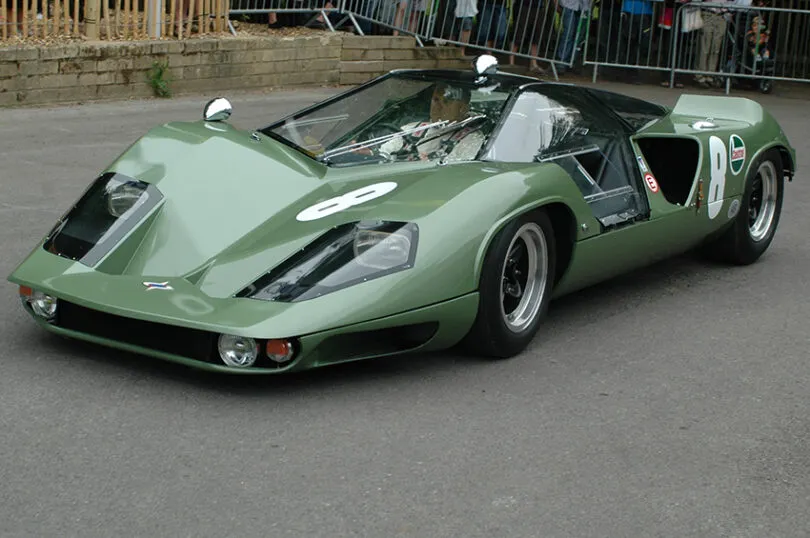
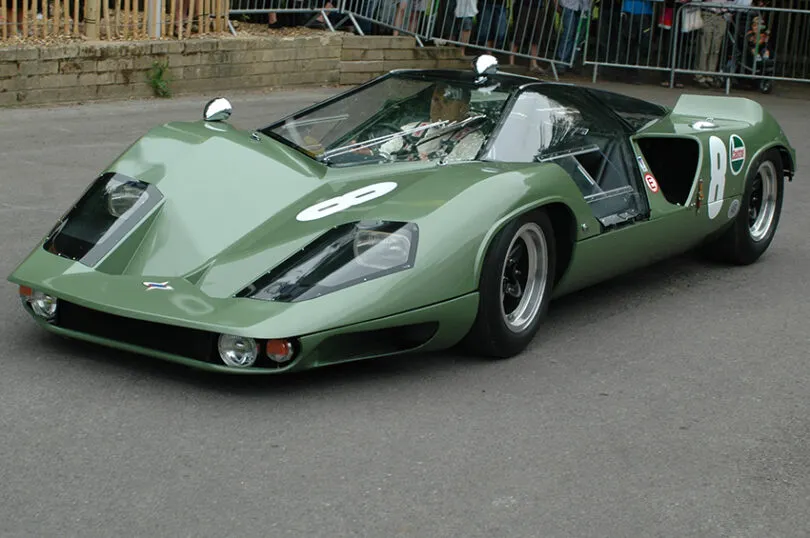
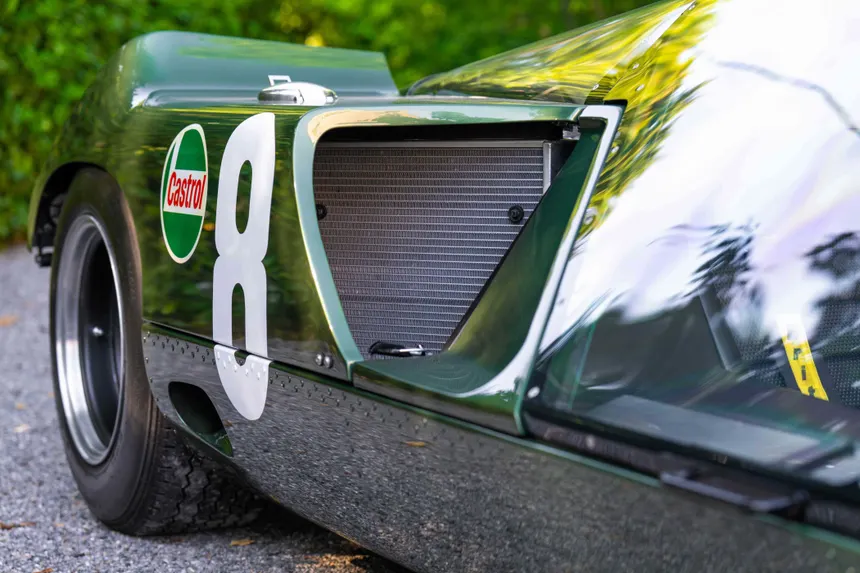
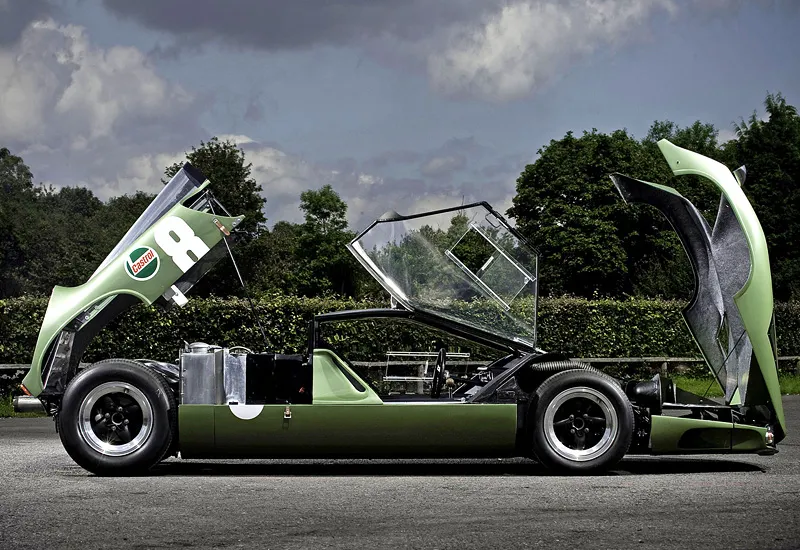
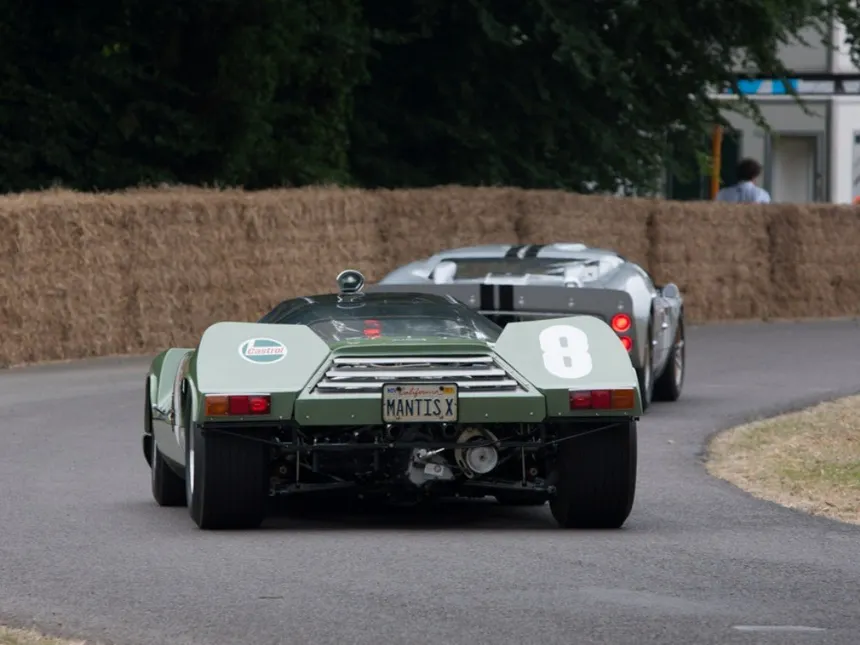
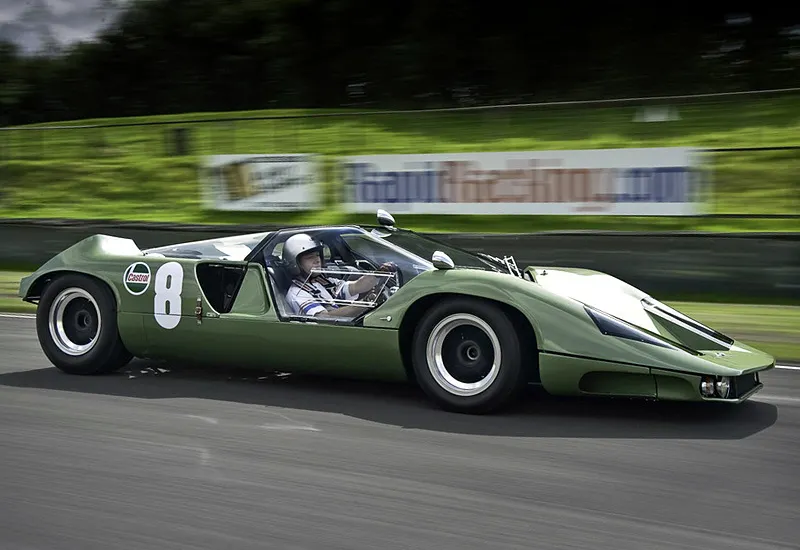
In 1968 came the Mantis XP. Not a road car. A mid-engined sports-racing prototype, built for the three-litre class with dreams of Le Mans. The Adams brothers, Dennis and Peter, styled it, and the result looked like it had landed rather than been built: sharp angles everywhere, a Perspex canopy over both cockpit and engine, side-mounted tanks, semi-gullwing doors. Underneath all that science-fiction sat — naturally — a stressed plywood monocoque.
The engine was the headline. A three-litre Repco-Brabham V8, a genuine Formula 1 unit, which legend says Jem Marsh bought from Jack Brabham over a meal in a Chinese restaurant after an earlier deal for a BRM fell through. Hewland five-speed transaxle, full independent racing suspension. On paper, a giant-killer.
Exactly one was built. It raced exactly once: the 1968 Spa-Francorchamps 1000km. The rain was apocalyptic. Water flooded into the cockpit — they tried to fix it mid-race by drilling holes in the floor to let it drain out — the rear-mounted alternator soaked through, and the engine began to misfire. To add insult, the near-two-metre-tall Jem Marsh had to rip the upholstery out of the seat just to fit inside. It retired. That was the entire racing career of the Mantis XP: one start, one retirement, nothing more.
The plan had been bigger. The car was conceived for Group 6 prototype racing and aimed squarely at the 24 Hours of Le Mans, the great stage where a tiny British outfit might embarrass the giants. But Le Mans 1968 was postponed from June to September because of the student riots and general strikes that paralysed France that spring, and by the time the rescheduled race came around the Mantis was no longer in a position to run it. The Repco F1 engine eventually came out and a Buick V8 went in — the same basic unit that would later become the famous Rover V8 — and the car was sold to an American enthusiast, road-registered, and effectively retired into legend. It still exists, a single eccentric relic that occasionally surfaces at events like the Goodwood Festival of Speed, where it stops crowds for looking like nothing else on the lawn.
A wonderful story. But that wasn’t my toy.
The second Mantis: the ugly one you could actually buy
In 1970, Marcos recycled the name for something utterly different. Codenamed the M70 and sold as the Marcos Mantis 2+2, this is the car Corgi modelled, the one I owned without knowing.
It was the only four-seater Marcos ever made — a strange leap for a company built on lightweight two-seaters. The plan was to fill a precise gap in the market. Above it sat the Jaguar E-Type 2+2 at around £2,700, cramped for the money. Below it sat the Rover P6 3500 at £1,999, sensible to the point of dullness. The Mantis aimed straight between them: roomier than the Jaguar, more characterful than the Rover, priced at roughly £2,550 at launch.
Dennis Adams styled it again, this time as a freelancer, alongside Brian Cunnington, an engineer fresh out of Lotus where he’d worked on the Elan coupé and +2. Cunnington turned it into something genuinely buildable, with a square-section tubular chassis, in barely over a year with a team of seven to ten people. Technically it was clever — the body managed a drag coefficient that Hagerty puts at 0.35, respectable for 1970. The trouble is that all that slipperiness was wrapped in one of the most argued-over shapes in motoring history.
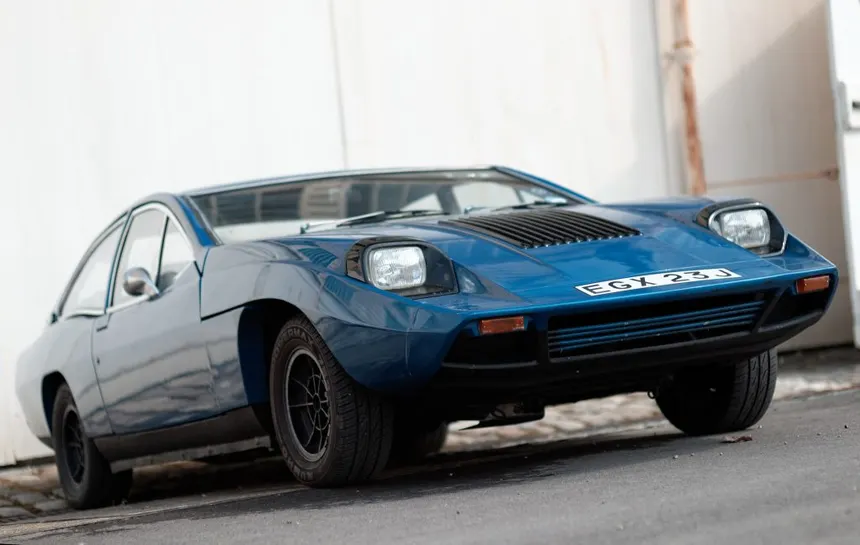
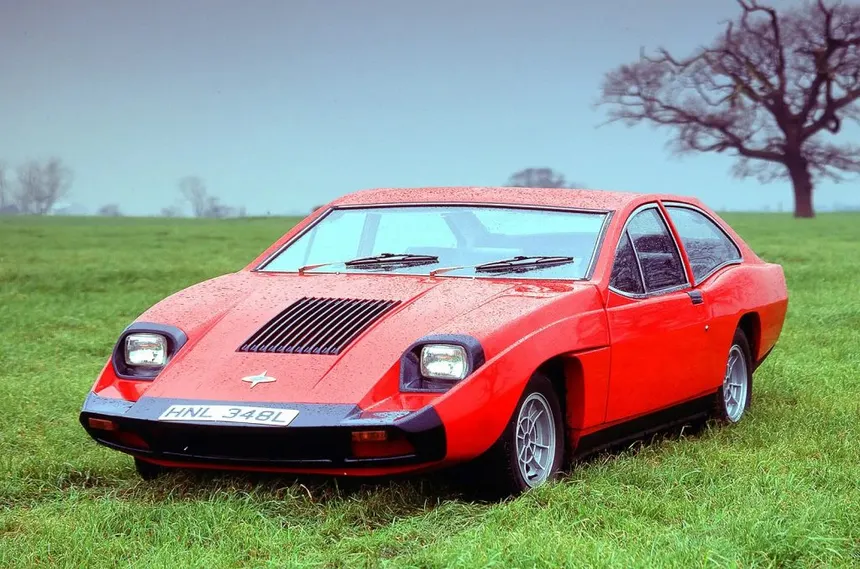
Because the Mantis M70 is ugly. Properly, famously ugly, the kind that earns a permanent place on every “worst-looking cars ever” list. A wedge with a wavy waistline, a fastback roof, a chopped tail, side glass curved a touch too much. Proportions at war with each other. Whichever angle you choose, something refuses to agree. And yet it has the gift that profoundly ugly cars possess: you cannot forget it.
Beneath the skin lived the Triumph 2.5 PI — the Lucas fuel-injected straight-six from the TR6 — mated to a Triumph four-speed gearbox with overdrive. Somewhere around 145 to 150 horsepower depending on the source, good for roughly 125 mph and a 0-60 of about eight seconds. Suspension derived from the three-litre Marcos, with a Ford Capri rear axle. Nothing revolutionary, but sound.
How it died: the new factory that swallowed everything
The Mantis appeared at the Earls Court Motor Show in October 1970 to a reception best described as divided. Some found it too futuristic; others simply found it grotesque. But orders came in, and the start was reasonable. The looks weren’t the killer.
Encouraged by a promising order book, Marcos made a decision in 1970 that proved fatal: moving the factory from Bradford-on-Avon in Wiltshire to a larger plant in Westbury, aiming for six to ten cars a week with a big slice destined for the United States. On paper, expansion. In reality, the relocation crippled production at precisely the wrong moment. Add trouble with the main US importer and a broad collapse in the British market, and the storm closed in from every side. The cost of developing the Mantis, the half-finished move and the sales that never quite caught fire arrived together. In 1972 the original Marcos went into receivership. Between 1972 and 1981, not a single car left the company.
The Mantis M70’s final tally? Thirty-two cars, built across 1970 and 1971. That was the entire reign of the only four-seat grand tourer Marcos ever dared to make. The strange part: all thirty-two sold. Selling the few they built was never the problem — building enough of them to make the project viable was.
Ugly enough to be immortal
Here’s the twist that time has played on the Mantis. In 1970 its looks were a liability — a reason buyers hesitated, a reason the motoring press raised eyebrows at Earls Court. Half a century later, that same awkwardness is exactly why anyone remembers it at all. A pretty, well-resolved 2+2 from a tiny British maker would have vanished without trace, one more forgotten footnote among dozens of fibreglass specials that came and went in that era. The Mantis didn’t vanish, because you genuinely cannot un-see it.
That’s the quiet lesson buried in this car. Marcos spent its whole existence doing the unconventional thing: wood where everyone else used steel, kits where everyone else sold finished cars, a Formula 1 V8 bought over dinner, a four-seater from a two-seater specialist. Most of those gambles cost the company dearly. The plywood was eventually abandoned for steel and the firm staggered through bankruptcies and revivals for decades before finally closing for good in 2007. But the willingness to build something nobody else would build is the only reason the name still means anything to enthusiasts today. The Mantis is the purest distillation of that — a commercial failure that became culturally unkillable precisely because it refused to look like everything else.
When Marcos came back from receivership in 1981, it returned to what it knew: lightweight two-seaters, the Mantula and later the LM and Mantara cars, eventually a new Mantis in 1997 that shared nothing but the name with the M70. The four-seat experiment was never repeated. Thirty-two cars, one moment of family-GT ambition, and then back to the small, light, strange coupés that were the company’s real soul.
What’s left
Thirty-two cars. A name shared with a racing spaceship that ran once in the Spa rain and quit. A company that built with plywood and was named after two surnames jammed together. A car so ugly that the ugliness became its one unbeatable feature — the guarantee you’d never mistake it for anything else.
And somewhere in all of that, a Corgi model that a boy hurled into a skirting board without the slightest idea he was holding a reproduction of one of Britain’s true oddities. That toy went to charity, into the hands of another child who wouldn’t know either. I find I like that. The Mantis, a car almost nobody gave a chance, kept being played with in other hands long after the factory shut its doors. It may be the closest the thing ever came to being a sales success.
I don’t collect things. Hundreds of toy cars passed through my hands and I gave every one away without a second thought. But there’s one I had to hunt down four decades later just to learn what it was. And it turned out to be this one. The ugly one. The strange one. The one that raced once and surrendered. The Marcos Mantis.
The Corig toy Marcos “XP” was one of my first small toy vehicles of this type that lead to eventually a collection of 500. I had an orange one with the smoothe rear engine see through yellow cover. It was well played with and one of my favorites until it was so beat up the two halves came a part. It was glued back together. I had always thought it was a Lesney Matchbox model. It wasn’t until recently I found out it was in fact a Corgi. My collection of 500 is gone now lost when my childhood home got destroyed. I never forgot this toy. I have since required a Corgi like the one I had back then. I didn’t know it was a real vehicle either. Now I would like to have one made like it to drive in real life but we will see if I can make that happen.
Thanks for sharing your story, Azlan. It’s amazing how a small toy can leave such a lasting mark. Sorry to hear about your collection, but glad you could keep the memory alive.Best Regards!!