The 426 Hemi: The Engine That Defined the American Muscle Car
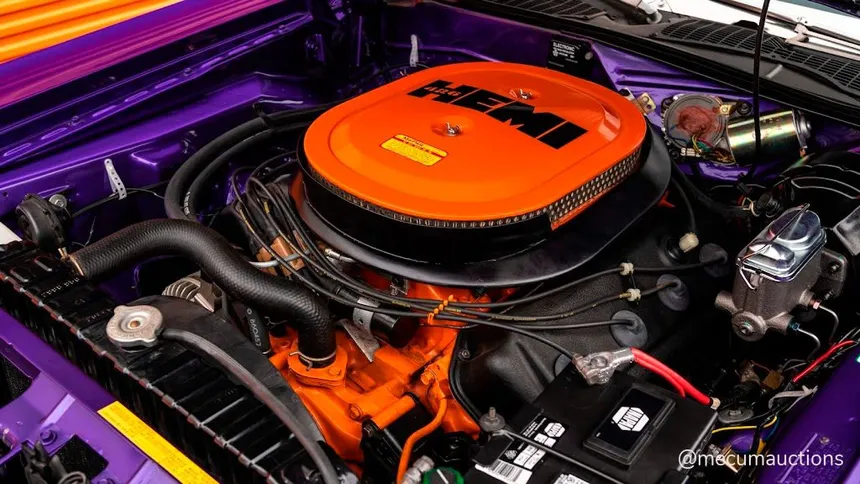
Some engines exist. Others become legends. The Chrysler 426 Hemi is not simply a cast iron block with eight cylinders. It’s a symbol, a declaration of war on asphalt, a cultural artifact that permanently changed how the world understands the term “American power.” If the Muscle Car has a heart, that heart beats with the irregular, brutal rhythm of a Hemi.
At the Engine’s Syndicate, we don’t catalogue mediocre engines. Only those that changed everything get a seat at the table. And the 426 Hemi didn’t just mark an era — it defined one entirely.
The Origin: NASCAR and the Need to Win
The story of the 426 Hemi begins in competition. Chrysler had a problem in the early 1960s: Ford and General Motors were dominating NASCAR with increasingly large and aggressive engines. Chrysler’s answer wasn’t incremental. It was nuclear.
In 1964, Chrysler’s engineering team unveiled a completely new engine. The name “Hemi” wasn’t marketing or whimsy — it referred directly to the hemispherical combustion chamber geometry, which allowed larger valves to be placed at opposing angles, radically optimizing gas flow compared to conventional designs of the era.
The result was immediate and devastating. At the 1964 Daytona 500, Plymouths and Dodges equipped with the new Hemi swept the competition. Richard Petty won the race and dominated the season. The message was clear: Chrysler was back, and it had come back swinging.
NASCAR, in one of those moves only motorsport can produce, banned the engine the following year for being too competitive for the spectacle. Chrysler withdrew from official competition in protest. The 426 Hemi had already become a legend before it ever reached the street.
From Track to Street: The Street Hemi
In 1966, Chrysler made a decision that would change American automotive history: homologating the 426 Hemi for production vehicle use. This wasn’t a simple process. The pure competition engine was too aggressive for daily use — it needed to be adapted without losing its character.
The Street Hemi, as the road version became known, arrived with an official 425 horsepower rating. And here’s where the story gets interesting: that number was deliberately conservative. Insurance companies of the era had begun raising premiums for high-powered vehicles, and manufacturers quickly learned to “round down” their official figures. Contemporaries estimated the actual engine produced between 500 and 550 horsepower. Some period preparers, with the dynamometers of the era, recorded even higher numbers.
What was official and verifiable was the torque figure: 490 lb-ft at 4,000 rpm. A number that even today, in the era of turbocharged engines and electrics, commands respect.
The Architecture That Made the Difference
To understand why the 426 Hemi was so revolutionary for its time, you need to understand the engineering that made it unique. The hemispherical combustion chamber wasn’t new — Chrysler had used similar designs in the 1950s — but the 426 took the concept to another level.
The intake and exhaust valves were placed on opposite sides of the chamber, at an angle, allowing considerably larger valve diameters than in inline valve designs. Larger valve diameter means greater gas flow, which in turn means more power at high rpm.
The spark plug sat at the geometric center of the hemispherical chamber, ensuring uniform and efficient flame propagation. This contributed to more complete combustion, more power, and — surprisingly for an engine of these characteristics — exceptional durability when properly maintained.
The block was cast iron, massive and heavy by modern standards, but incredibly robust. Cylinder walls were thick, crankshaft journals enormous, mains generous. This was an engine designed to survive the brutality of competition and adapt to street use.
The Cars That Carried It
There’s no short list of vehicles that bore the 426 Hemi badge. From the Dodge Charger to the Plymouth Barracuda, through the Road Runner and the Dodge Super Bee, virtually every serious Muscle Car of the late 1960s could be ordered with the Hemi as an option — and it was the most expensive option in the catalog.
The Plymouth Barracuda ‘Cuda Hemi of 1970 is probably the most coveted today. With minimal production — it’s estimated that only 652 units were built with the Hemi engine that year — it has become one of the most desirable collector cars in the world. Examples in good condition have reached auction prices exceeding one million dollars.
The Dodge Charger R/T Hemi of 1968-70 is perhaps the most culturally recognized. The Charger’s silhouette with the double-bubble hood and functional air intakes has become an icon of American design. That this silhouette housed a 426 Hemi only added dimensions to the legend.
The Plymouth Road Runner Hemi deserves special mention for its philosophy. The Road Runner was born as an affordable alternative to the Muscle Car — no unnecessary luxury, just power and relative lightness. Putting a Hemi in that package was almost a statement of principles: you don’t need leather and wood to go fast.
On the Drag Strip: Total Domination
If the Hemi shone in NASCAR before being banned, drag racing became its permanent home. In the late 1960s and early 1970s, Hemi-equipped Mopars dominated quarter-mile competitions systematically.
The reason was simple: the enormous torque and the engine’s ability to withstand aggressive preparation made it ideal for acceleration competition. While other engines gave way under extreme preparation, the Hemi asked for more. Larger carburetor, more aggressive camshaft, free-flow exhaust — the engine responded to each modification with more power.
Quarter-mile times for well-prepared street Hemis were in the 13-second range. With moderate preparation, into the 12s. Professional competitors of the era ran under 10 seconds with engines derived from the production Hemi.
The End of an Era and the Birth of a Myth
The production history of the 426 Hemi is surprisingly brief: only from 1966 to 1971. The oil crisis, tightening emissions regulations, and rising insurance costs for high-powered vehicles ended the original Muscle Car era, and the Hemi was among the first casualties.
The last production year, 1971, coincided with the general reduction in compression ratios to accommodate the unleaded gasoline beginning to take hold. The 1971 engines were technically less powerful than the 1970 units, though they were still extraordinary machines by any standard.
Chrysler would attempt to revive the Hemi name in the 2000s with the modern 5.7 and 6.1-liter HEMI. They’re good engines, powerful and reliable. But they’re not the 426. The name works because of the original’s weight, not by comparable merits of its own.
The Legacy: Beyond the Car
The cultural impact of the 426 Hemi transcends the automotive world. It has appeared in music, in films, in American literature. The Muscle Car culture of the 1960s, with the Hemi as its mechanical heart, became literary and cinematic material in a way that no European engine has ever achieved. When collectors discuss the “big three” of original Muscle Cars, the Hemi always heads the list.
There’s something almost philosophical in this engine’s story. Born to win in competition, banned for being too good, brought to the street against all commercial logic, dominated its era, disappeared too soon, and today is worth more than when it was new. It’s the perfect narrative of an object that can only be understood in retrospect.
In purely mechanical terms, the 426 Hemi was not the most refined engine of its era, nor the most efficient, nor even the most technologically advanced in every respect. But it was the most honest. There were no subterfuges in its design: it was an engine built to produce maximum power with available technology, without compromise, without apology.
That’s what makes it immortal.
Pingback: VW Golf GTI W12-650: Bentley Engine, Lamborghini Axle, 201 mph
Pingback: Ford Boss 302 vs Boss 429: Two Race Engines, Two Wars, One Legendary Era