
AC Schnitzer Goes Dark: The Art of Making a BMW More BMW
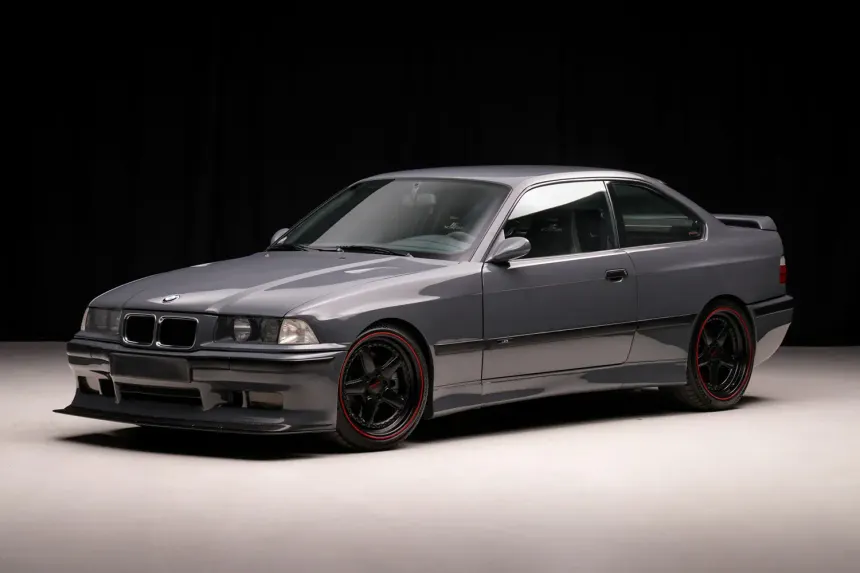
You slide under an M3 E36 and something feels off. Not wrong — different. The exhaust mounts sit where they should not sit on a factory car. The suspension bushings are denser than anything BMW ever fitted at the plant. The subframe has reinforcements that do not appear in any workshop manual from Munich. And when you fire it up, the engine does not sound like a standard S50. It does something better. It pulls clean from the bottom, no flat spots, none of that hesitation at 3,500 rpm that every mechanic who has lived inside an E36 knows too well.
That car had a plaque in the engine bay with a serial number and a name: AC Schnitzer. And I had it in my hands.
Very soon, that plaque will no longer be made. The Kohl Group announced in March 2026 that AC Schnitzer will cease all activity as a tuning parts manufacturer before the year is out. Thirty-nine years. Three world speed records. The technical pedigree of a team that won Le Mans. And now, a press release about certification costs and young people who no longer buy sport exhausts.
This is not about nostalgia. This is about understanding what disappears when someone who could improve a BMW better than BMW is gone.
AC — Two Letters From a Licence Plate
Aachen. Licence plate code: AC. The name was that simple and so was everything they did. Willi Kohl and Herbert Schnitzer founded the company in 1987, but the story goes further back. Brothers Josef and Herbert Schnitzer had been racing BMWs since the 1960s — Josef won the German touring car championship in 1966 with a 2000ti he had prepared himself. In 1967, they founded Schnitzer Motorsport in Freilassing, Bavaria. From there, the record grew until it became hard to summarise.
Roberto Ravaglia took the 1987 World Touring Car Championship in a Schnitzer-run E30 M3. Five victories at the Nürburgring 24 Hours — the 1998 win with a 320d diesel remains one of the most improbable feats in European endurance racing. And in 1999, the big one: Le Mans. Winkelhock, Martini and Dalmas crossed the line in a BMW V12 LMR operated by Schnitzer Motorsport. BMW has won Le Mans exactly once. It was with Schnitzer.
When Kohl and Schnitzer opened the road car division in Aachen, the idea was to transfer all of that knowledge into cars you could register and drive every day. Not stickers. Not fibreglass spoilers. Engineering proven in competition, homologated for the street, backed by warranty. The first car was the ACS7, based on the E32 7 Series, shown at Frankfurt in 1987. And from day one, the rule was clear: if a part has no technical reason to be there, it does not get fitted.
2.5 Litres From the S14 — Before BMW Got There
The 1989 ACS3 Sport, based on the E30 M3, was the car that put AC Schnitzer on the serious tuning map. They took the naturally aspirated 2.3-litre S14 four-cylinder and bored it to 2.5 litres. Nearly 245 horsepower from a displacement BMW themselves had not yet reached. AC Schnitzer got to 2.5 litres from the S14 before Munich released the Sport Evolution. A workshop in Aachen extracted more from the S14 than BMW’s entire development division. Let that sit for a moment.
The full package included suspension lowered 20 mm with bespoke spring rates, multi-piece alloys, a stainless steel exhaust with rectangular tips, and even the single-wiper conversion lifted straight from the DTM M3s. All homologated. All warrantied. All fitted to a car you could take to the shops on Monday and to the track on Saturday.
The CLS — The E36 That Asked Nobody’s Permission
Then came the E36 M3. And here the story gets personal.
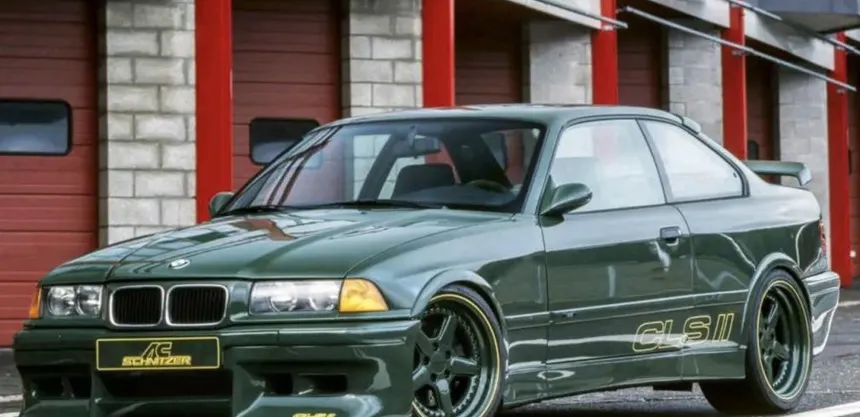
The ACS3 CLS — Coupé Lightweight Silhouette — arrived in 1993 and was something else entirely. Not an improved M3. An M3 rethought from scratch with a competition mindset and a road-legal outcome. They stripped 160 kilograms using carbon-Kevlar panels on the bonnet, bumpers and widened wings that gave it a presence no other E36 has ever had. Inside, bucket seats, a Schnitzer steering wheel, carbon where plastic used to be, and nothing that did not earn its place.
The European 3.0-litre engine — 286 horsepower standard, not the 240 from the neutered American spec — climbed to 320 horsepower with revised intake, hotter cams and a full exhaust system. Adjustable suspension. Uprated brakes. Zero to 100 in 5.5 seconds. Top speed of 275 km/h. And a production run so small the exact numbers are not even clear — some sources suggest single digits. In December 2025, one sold at auction for over $150,000.
That is the kind of car that came into my workshop. Not a BMW with extras. A BMW someone had rethought from the foundations. The suspension was not lower — it was recalibrated with circuit logic. The exhaust was not louder — it moved gases more efficiently. The engine did not jerk — it delivered torque exactly where you needed it. Every component fitted with the next as though they had grown together. It was not tuning. It was engineering with a signature.
331.78 km/h — When Nardò Spoke With an Aachen Accent
AC Schnitzer sold parts, but what it really sold was technical credibility. And credibility is proved at the limit.
In 2005, the Tension Concept based on the M6 E63 debuted at Frankfurt. A 5.0-litre V10 pushed to 552 horsepower. A carbon fibre aero kit designed solely for top speed. Weeks later, they took it to the Nardò bowl and clocked 331.78 km/h. The fastest road-legal BMW on the planet. Only 50 Tension Street units were produced — the conversion cost €43,900, not including the M6 base car that already listed at €156,300.
Two years later, back to Nardò: the GP3.10 GAS POWERED, a 335i Coupé E92 with a 552 hp V10 running on LPG. 318.1 km/h. World record for the fastest liquefied petroleum gas car. And in 2009, the third mark: 288.7 km/h with the ACS3 3.5d diesel. Three world records in four years across three completely different fuel types — petrol, LPG, diesel. No other tuner on the planet has a résumé like that.
ACL2 — 570 Horsepower Shoehorned Into an M235i
Geneva, 2016. AC Schnitzer rolls out the ACL2 and the tuning world stares. The recipe: rip out the M235i engine, drop in the M4’s 3.0-litre twin-turbo S55, push it to 570 horsepower and 740 Nm, fit a Drexler differential with variable locking from 25 to 95 percent, carbon ceramic brakes with six-piston calipers, bodywork widened by 140 mm with functional air outlets, height-adjustable Clubsport suspension. All packed into a 2 Series.
Zero to 100 in 3.9 seconds. Top speed of 330 km/h. AC Schnitzer valued it at €149,000 and declared it a one-off, not for sale. The individual components were available to buy. In 2017, an ACL2 based on the M2 took the Nordschleife record for a road-legal BMW: 7:25.8.
It was the last concept that still breathed the original philosophy. Competition poured into a road car. No filter. No permission asked.
M5 G99 Touring — 810 Horsepower as a Farewell
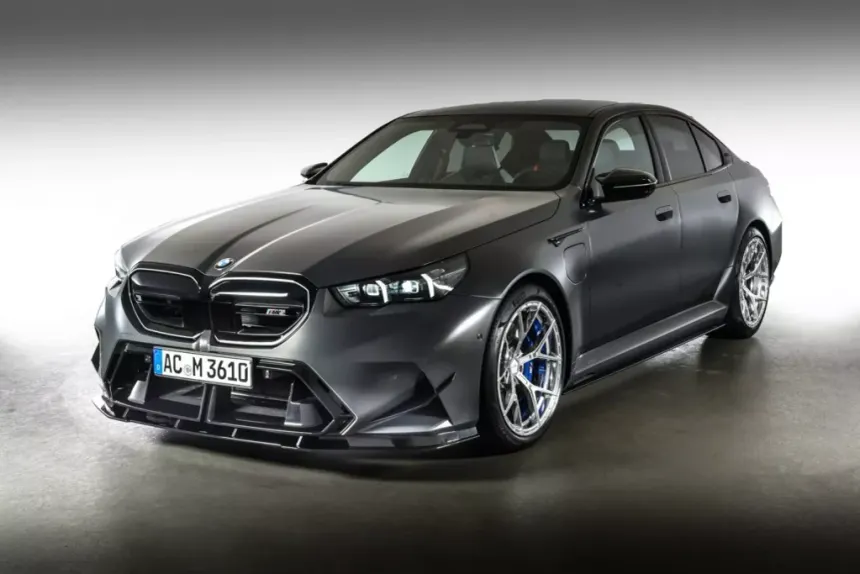
In 2025, with the shutdown already on the horizon, AC Schnitzer unveiled what is probably its last serious piece of work: the package for the BMW M5 G99 Touring. The 4.4-litre twin-turbo plug-in hybrid V8 goes from 727 factory horsepower to 810, touching only the combustion side — the 197 hp electric motor stays untouched. Full aero: splitter, side skirts, three-piece diffuser, roof spoiler. Forged AC6 wheels in 21 inches, new design. Suspension dropped 20 mm. Exhaust with four 110 mm carbon-tipped outlets.
810 horsepower in an estate. With a three-year warranty. That was AC Schnitzer right to the end.
The Truth BMW Will Not Tell You
Rainer Vogel, managing director of the Kohl Group, gave the official reasons and they are real: parts homologation in Germany takes so long that AC Schnitzer reached the market eight or nine months behind competitors from other countries. Add American tariffs, skyrocketing raw materials, volatile exchange rates, suppliers going under, and a German market that has been shrinking for four years. All true.
But the real reason runs deeper. And you will not read it in any official BMW statement.
Modern cars are no longer open platforms. They are closed ecosystems. The BMWs of the 1990s let you inside the engine, the ECU, the suspension, the aerodynamics. The BMWs of 2026 have proprietary software, encrypted CAN networks, and warranty policies that detect and penalise any unauthorised modification. The space that used to belong to the tuner now belongs to the manufacturer. BMW created M Performance. Mercedes absorbed AMG. Audi internalised RS.
BMW did to its cars what Apple did to the iPhone: lock the system so only they can operate inside it. And the people who improved their product got shut out.
AC Schnitzer did not close because it did poor work. AC Schnitzer closed because BMW decided nobody was going to improve their cars better than they could.
Schnitzer Motorsport Was Already Dead
There is a detail that gets lost in all of this. Schnitzer Motorsport — the family’s original racing team, the one that won Le Mans, the one that stacked 25 WTCC race victories, the one that dominated with E30 M3s in the DTM — was already gone. BMW ended its relationship with the team in December 2020 after more than half a century together. Charly Lamm, the soul of the operation, had died unexpectedly in January 2019. In 2021, Schnitzer Motorsport entered liquidation.
The competition arm died in 2021. The road car arm dies in 2026. The entire Schnitzer legacy — track and tarmac — wiped out in under a decade.
What Stays
The Kohl Group is looking for a buyer for the brand. Inventory sells through the end of the year. Warranties hold beyond 2026.
But do not kid yourself. Even if someone buys the name, the AC Schnitzer you and I knew is not coming back. The one from the 1990s. The one with the CLS and its Kevlar panels. The one with the 2.5-litre S14 that got there before BMW. The one that broke records at Nardò on three different fuels. That AC Schnitzer needed open platforms to exist, and those platforms no longer exist.
When you see an E36 with a catalogue body kit, you think of tuning. When you see an AC Schnitzer from the 1990s, you see a civilised race car. The difference is in the quality of every part, the coherence of the whole, the discipline of knowing exactly where to stop. That is what disappears.
The M3 E36 that came through my workshop is still out there somewhere. With its denser bushings, its more efficient exhaust, its engine that pulled clean. That car does not need AC Schnitzer to keep existing to prove what it was. It already proved it. Every time someone starts it, it proves it again.
AC Schnitzer goes dark. The art of making a BMW more BMW stays in the cars that already exist. And in the hands of those of us who were lucky enough to work on them.
Check you’re still alive.Compartir