
Alfa Romeo 147 GTA: Busso’s Final Symphony Crammed Into a Hot Hatch
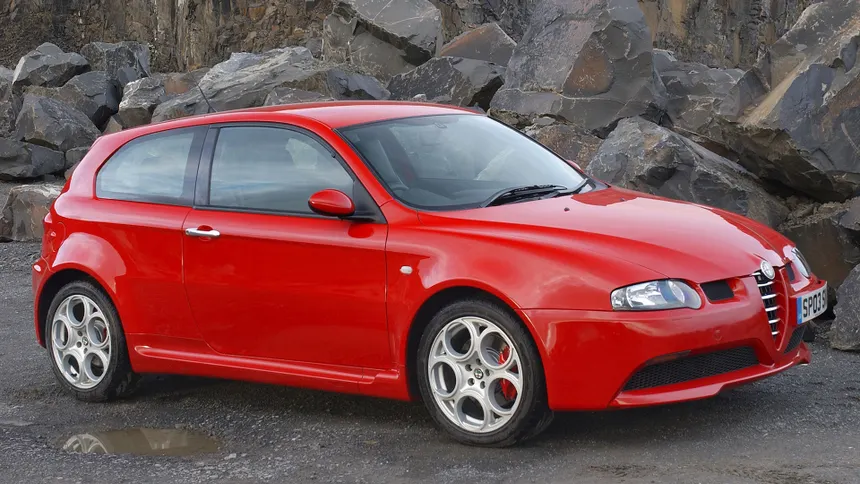
Some cars exist because a spreadsheet said they should. Others exist because someone in an engineering meeting lost their mind for just long enough that nobody could stop them. The Alfa Romeo 147 GTA belongs firmly in the second category. A 3.2-liter naturally aspirated V6, mounted transversely, sending 250 hp to the front wheels of a compact hatchback weighing around 3,000 lbs. No all-wheel drive. No limited-slip differential from the factory. No safety net.
On paper, it reads like an engineering miscalculation. On the road, it sounds like the voice of God filtered through six chromed intake runners.
The heart: 3,179 cc of legend
The engine that defines the 147 GTA is not just any powerplant. It is the Busso V6 in its final and most powerful road-going form — nicknamed “Bussone” (Big Busso) by the Alfa Romeo engineers who built it. A 60-degree V6 with an all-aluminum block and heads, dual overhead cams per bank, four valves per cylinder, and variable intake timing. Displacement of 3,179 cc from a 93 mm bore and 78 mm stroke. Compression ratio of 10.5:1. Engine management via Bosch Motronic ME7.3.1 with drive-by-wire throttle.
The numbers: 250 hp (247 bhp / 184 kW) at 6,200 rpm and 221 lb-ft of torque at 4,800 rpm. For context, the 2002 Audi S3 produced around 225 hp. The Volkswagen Golf R32 made 241 hp but needed Haldex all-wheel drive to put it down. The Mk1 Ford Focus RS managed 215 hp. The 147 GTA outgunned them all — and did it with a naturally aspirated engine that climbed to 7,000 rpm with the conviction of a finely tuned instrument.
What no spec sheet can convey is the sound. The Busso V6 does not roar, bark, or growl. It sings. EVO Magazine called it “the most glorious-sounding six-cylinder road engine ever.” Italian Alfa enthusiasts named it “Il Violino di Arese” — the Violin of Arese, after the Alfa Romeo factory where the engines were assembled. That was not a marketing nickname. It was a technical description disguised as poetry.
Every single one of these engines was hand-assembled at the Maserati Research Centre in Modena. From there, they were trucked to the Fiat Group factory in Pomigliano d’Arco, Naples, for installation. A hand-built V6 assembled by Maserati technicians, stuffed into a five-door hatchback that competed against Golfs and Focuses. That is the kind of madness only Alfa Romeo can execute with a straight face.
Americans never got the 147 GTA through official channels — Alfa Romeo had pulled out of the U.S. market in 1995 and would not return until the 4C arrived in 2015. But the 25-year import rule means early examples are now becoming eligible for import, and a handful have already made it stateside. If you have ever wondered what all the fuss was about, the answer is under the hood.
The platform: a shortened 156 on steroids
The 147 GTA shared its platform with the Alfa Romeo 156, with the wheelbase shortened by roughly 4 inches behind the front seats to create hatchback proportions. Front suspension was MacPherson struts with lower wishbones mounted to an auxiliary crossmember, offset coil springs, and an anti-roll bar. Rear suspension used trailing arms on an auxiliary subframe with coil springs and anti-roll bar.
For the GTA, Alfa Romeo stiffened everything. Reinforced lower crossmember, specific dampers with revised steering geometry, fluid-dynamic bushings, lowered springs, and a stiffer stabilizer bar. Steering was set at just 1.75 turns lock-to-lock — an extremely direct ratio that made the car feel almost nervous in response to any wheel input.
Design-wise, Walter de Silva and Wolfgang Egger at Alfa’s Centro Stile widened the body by about 1.4 inches over the standard 147 (0.6 inches per side) to fit 225/45R17 tires. The GTA was 1.7 inches longer and 1.2 inches lower. Flared fenders, deep side skirts, a front bumper with larger intakes and canard-style spoilers, a rear diffuser, and twin exhaust outlets. Restraint masking aggression. Quiet menace.
The elephant in the room: front-wheel drive with an open diff
This is where the story gets interesting — and where Alfa Romeo proved that bravery and common sense do not always share a table.
250 hp through the front wheels. No limited-slip differential. No AWD. The Golf R32 used Haldex-based 4Motion to distribute its 241 hp across four tires. The Focus RS Mk1 at least packed a Quaife LSD to manage its 215 front-wheel hp. The 147 GTA arrived with a conventional open differential and absolute faith that the driver would figure it out.
The result was predictable: massive understeer when pushed hard into corners. The weight of the V6 hanging over the front axle, combined with zero torque management between wheels, turned limit-driving into a constant negotiation exercise. Front tires gave up before the engine did. Torque steer was real. Corner-exit traction was an act of faith.
Was it a flaw? Depends on who you ask. German engineers would call it a concept failure. Alfisti would call it character. The truth is that both were right.
Alfa Romeo briefly offered an LSD as an option, and larger front discs were also offered before becoming standard equipment. But the real solution came after production ended, when the Torsen Q2 differential — originally developed for the Alfa GT 1.9 JTDm — became the most popular aftermarket upgrade for the GTA. The Q2 transformed the car: reduced understeer, virtually eliminated torque steer, and allowed much earlier throttle application on corner exit. Most surviving 147 GTAs now have a Q2 or Quaife unit installed. And it is not just about handling: the original open diff had a reputation for breaking and destroying the gearbox casing in the process.
Inside: function with Italian flair
The GTA’s cabin did not reinvent the wheel, but it dressed it in leather. Sport seats with reinforced lateral bolstering held the driver firmly enough during the lateral forces the chassis allowed before understeer took over. Leather on seats, steering wheel, and shift knob. Instrumentation was dominated by the tachometer in the center of the gauge cluster — exactly where it belongs in any car where the engine is the entire reason for buying it.
The center console housed Alfa Romeo’s Connect infotainment system, a 5-inch screen with satellite navigation and hands-free phone capability — cutting-edge technology for 2002. Trunk space was 9.9 cubic feet, which was nobody’s idea of practical. But nobody bought a 147 GTA for cargo capacity.
What was most telling about the interior was what was absent: no driving mode selectors, no configurable displays, no engine map options. The car started and delivered everything it had, all the time, with no electronic filters deciding how much power you deserved. The mechanical transparency was absolute. Every engine vibration, every gear change, every steering reaction reached the driver without translation. That was already unusual in 2002. Today it is virtually impossible to find.
The competitive landscape: hot hatch wars of 2002
To understand what the 147 GTA meant in its era, you need to look at the cars it was up against and what each one stood for.
The Volkswagen Golf R32 (Mk4) was Germany’s sensible answer: 241 hp from a 3.2-liter VR6, Haldex-based 4Motion AWD, DSG dual-clutch available. Tremendously capable, technically flawless, and with the personality of a scientific calculator.
The Ford Focus RS Mk1 was the street fighter: 215 hp from a turbocharged four-cylinder, front-wheel drive with a Quaife LSD, track-oriented suspension. Brutal in the right hands, but with refinement that left something to be desired.
The Audi S3 (8L) delivered 225 hp from a 1.8-liter turbo with quattro AWD. Competent, predictable, built with Swiss-watch precision. And with Swiss-watch excitement.
Then there was the 147 GTA. More powerful than all of them. Lighter than the Golf R32. With an engine that sounded better than anything VAG, Ford, or any other manufacturer could stuff into a compact car. And with a chassis that, without the Q2, reminded you every 150 feet that the Italians prioritize emotion over preventive engineering.
In contemporary group tests, the 147 GTA typically lost on lap times to the Golf R32 and Focus RS. But no journalist who drove it could stop writing about the engine. Because tenths of a second on a stopwatch fade from memory. The sound of a Busso V6 at 6,500 rpm does not.
For American readers, none of these rivals were sold in the U.S. either — the Golf R32 only arrived as a Mk5 in 2008, and the Focus RS did not land stateside until the Mk3 in 2016. The 147 GTA era represented a golden age of European hot hatches that America simply never got to experience new. The 25-year rule is gradually changing that, and early 2002 GTA examples are now becoming eligible for import. If you are looking for a driving experience that nothing in the current new-car market can replicate, this is where to start.
Production numbers: rarity by the digits
Alfa Romeo unveiled the 147 GTA at the Paris Motor Show in October 2002, alongside its bigger sibling, the 156 GTA. Production ran from 2002 through October 2005. In that period, exactly 5,029 units of the 147 GTA were built, of which 1,004 were equipped with the Selespeed automated manual transmission — a single-clutch robotized gearbox that aged poorly in both mechanical reliability and reputation.
The vast majority came with the six-speed manual, universally considered the only acceptable transmission for this car. The Selespeed was slow, jerky in traffic, and expensive to repair. If someone ever offers you a 147 GTA Selespeed at a bargain price, there is a reason.
The GTA was not a commercial blockbuster — 5,029 units over three years do not make boardroom executives celebrate. But it is precisely that limited production, combined with the Busso engine and its unfiltered character, that has turned the 147 GTA into a modern classic with steadily appreciating values.
The death of the creator
The story of the Busso V6 cannot be told without its final chapter.
Giuseppe Busso was born in Turin on April 27, 1913. He studied industrial design at the Polytechnic University of Turin. His career began at Fiat’s aeronautical engine department in 1937. In January 1939, he joined Alfa Romeo. In 1946, Enzo Ferrari hired him as technical director — Busso was instrumental in developing the Colombo V12, Ferrari’s very first engine. He returned to Alfa Romeo in 1948 and stayed until his retirement in 1977, participating in the creation of the 1900, Giulietta, Giulia, 1750, 2000, and Alfetta.
His most enduring creation was the V6 that bears his name. Designed in the early 1970s, it debuted in the 1979 Alfa 6 as a 2.5-liter 12-valve unit. Over 27 uninterrupted years of production, it evolved through the GTV6, 75, 164, 155, 156, GTV, Spider, 166, 147 GTA, and finally the GT. The final 3.2-liter version was Euro 4 compliant — it could have stayed in production longer. British engineering firm Cosworth attempted to purchase the Arese assembly lines. Alfa Romeo refused to sell.
The last batch of Busso V6 engines rolled off the Arese production line on December 31, 2005.
Giuseppe Busso died on January 3, 2006, in Arese, at the age of 92. Three days after his engine ceased production.
At his funeral, hundreds of owners of Busso-powered Alfas arrived and, as the coffin left the church, started their engines and revved them in unison. The final standing ovation for the man who had given their cars a voice.
No marketing slogan will ever top that moment.
What remains: a car without a successor
The Alfa Romeo 147 GTA was a flawed car. Its weight distribution was front-heavy. Its stock differential was inadequate. Its factory brakes were subpar. Its front tire consumption was obscene — some owners reported just 4,000 miles of life. Its timing belt service exceeded $1,200. Its front wishbones surrendered around 70,000 miles. Its Selespeed was a lapse in judgment.
And absolutely none of that matters.
Because the 147 GTA had something no rival could match: an engine that turned every single mile into a sensory experience. It was not the fastest. It was not the best in corners. It was not the most reliable. But it was, without question, the one that made you feel most alive every time you turned the key.
In an era where modern hot hatches produce 300, 400, even 500 hp through turbocharged four-cylinders with electronic assistance and all-wheel drive, the 147 GTA represents an extinct philosophy. Atmospheric power. Natural sound. Unfiltered character. 5,029 units of a car that probably should not have existed, powered by an engine designed by a man who worked with Enzo Ferrari and who died three days after his final creation stopped breathing.
The Violin of Arese no longer plays on the assembly lines. But each of those 5,029 hatchbacks that rolled out of Pomigliano d’Arco remains a living instrument.
Check you’re still alive.