
Alfa Romeo 155: The Ugly Duckling That Won Where Nobody Expected
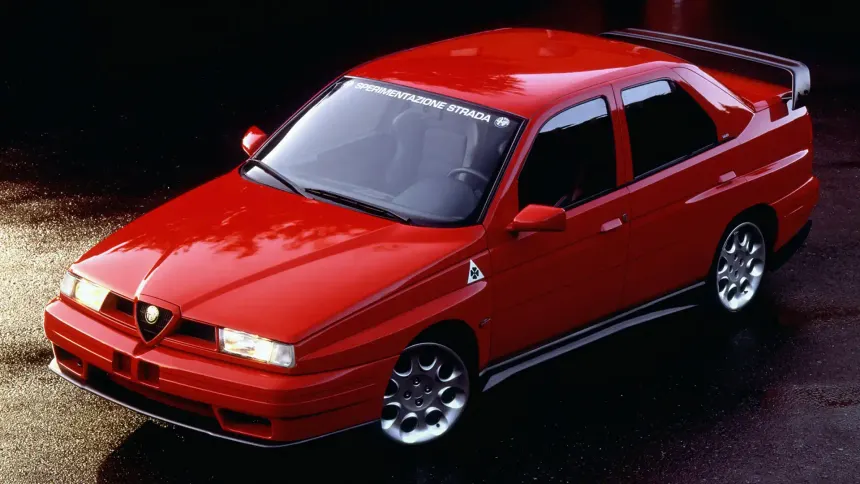
Some cars are born as heroes. Others are born under suspicion and have to prove — on the street and on the track — that they deserve to exist. The Alfa Romeo 155 belongs firmly in the second category. It was the first Alfa developed entirely under Fiat’s control. It was the car that abandoned the rear-wheel-drive layout that had defined the brand for decades. It was built on a platform shared with the Fiat Tempra and Lancia Dedra. And it was received by Alfa enthusiasts with reactions ranging from quiet disappointment to open hostility.
Its own development engineer, Sergio Limone from Abarth, reportedly called it “il brutto anatroccolo” — the ugly duckling.
And yet, that ugly duckling went on to become one of the most successful touring car platforms of the 1990s, winning championships in Italy, Germany, Spain, and the United Kingdom. But that is another story — the DTM story — which we will tell in a separate article. This is the story of the road car. The car that took all the punches and laid the groundwork for everything that came after.
Context: Fiat buys Alfa Romeo and rewrites the rules
To understand the 155, you need to understand the moment. Alfa Romeo was acquired by the Fiat Group in 1986. The last car independently developed by Alfa was the 75 (sold as the Milano in the United States): rear-wheel drive, transaxle layout with engine in front and gearbox on the rear axle — a mechanically brilliant configuration inherited from the 1972 Alfetta. The 75/Milano was a car with character, identity, and unmistakable Alfa soul.
The 155 was the opposite of all that. Unveiled in January 1992 in Barcelona and publicly launched at the Geneva Motor Show in March 1992, the 155 (internal code Type 167) was based on the Fiat Group’s Tipo Tre platform — the same one underpinning the Fiat Tempra, Lancia Dedra, and Lancia Delta. Front-wheel drive. Transverse engine. Conventional sedan architecture. For purists, it was a betrayal.
Exterior design came from I.DE.A Institute — not from Alfa Romeo’s Centro Stile. The result was angular, clean, and aerodynamic (a drag coefficient of 0.29 was excellent for the era), but it lacked the visceral personality that Alfisti demanded. The rising beltline allowed a 525-liter trunk — generous, practical, and completely irrelevant for anyone seeking driving excitement. The 155 appeared to be, in essence, a Fiat sedan wearing an Alfa Romeo badge.
For American readers, the 155 has particular relevance as a historical bookend. Alfa Romeo pulled out of the U.S. market in 1995, and the 155 was never officially sold stateside. The last Alfa Americans could buy new was the 164, which shared the 155’s 2.5-liter Busso V6 in a larger, more luxurious package. The 155 represents the transitional period that most American enthusiasts never witnessed — the years when Alfa was finding its footing under Fiat’s corporate umbrella, trying to reconcile its sporting heritage with platform sharing and cost efficiency. Understanding the 155 is understanding why the 156 that followed was such a revelation — and why Alfa’s eventual return to the U.S. with the 4C and Giulia carried so much weight.
But appearances can deceive. And underneath that corporate skin, there was more than the brochure suggested.
The engine range: from Twin Spark to Busso V6
The 155 was offered with a broad range of powertrains spanning from the mundane to the genuinely stimulating.
At the base were the four-cylinder Twin Spark units: a 1.6-liter making 120 hp (16-valve, Series 2), a 1.7 making 115 hp (8-valve, Series 1), a 1.8 making 129 hp (8v) or 140 hp (16v), and a 2.0 making 143 hp (8v) or 150 hp (16v). The Series 1 eight-valve engines were chain-driven units descended from the Lampredi twin-cam tradition; the Series 2 sixteen-valve units switched to belt drive. All were competent, reliable engines with the metallic Twin Spark character, but without the emotion expected from an Alfa.
Diesel options included a 1.9 TD making 92 hp and a 2.5 TD making 125 hp in selected markets.
But the heart of the street range was the 2.5 V6. Derived from the 3.0-liter V6 in the Alfa Romeo 164, this 2,492 cc version of the Busso V6 produced 166 hp at 5,800 rpm. It was not the most powerful Busso variant — not by a long shot — but it gave the 155 a soundtrack that justified the Biscione shield on the grille. The 2.5-liter V6 maintained the 60-degree architecture with dual overhead cams per bank but with 12 valves (two per cylinder). Smooth, musical, and capable of giving the 155 a character that the four-cylinder models simply could not match.
The Q4: a Lancia Delta Integrale in a business suit
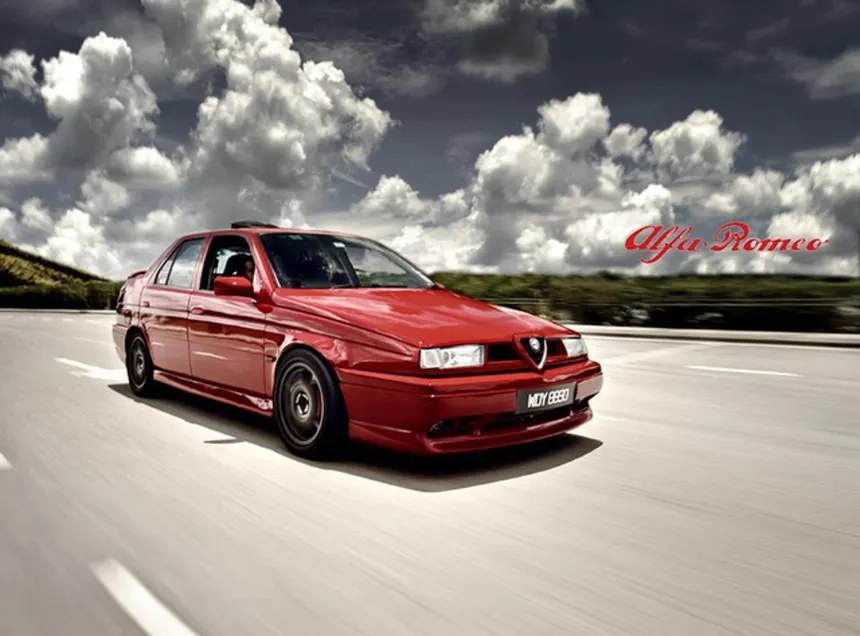
And then there was the model that transformed the 155 from a discreet sedan into a genuine performance weapon: the 155 Q4.
The Q4’s spec sheet is essentially the Lancia Delta Integrale‘s drivetrain transplanted into a sedan body. A 2.0-liter 16-valve turbocharged engine producing 190 hp at 6,000 rpm and 219 lb-ft of torque at 2,500 rpm — the same Lampredi turbo block that won six World Rally Championships with the Delta. Five-speed manual transmission. And a permanent all-wheel-drive system with three differentials: open at the front, epicyclic with Ferguson viscous coupling at the center, and Torsen self-locking at the rear. Exactly the same configuration as the Integrale.
Curb weight: 3,064 lbs. 0-62 mph: 7.0 seconds. Top speed: 140 mph. Electronically adjustable suspension available with two modes: automatic and sport.
Only 2,701 Q4 units were built, making it the rarest and most sought-after version of the road-going 155 range.
Driving a 155 Q4 was not like driving an Integrale — it was heavier, longer, more stable, with more communicative steering and less nervous corner behavior. The Integrale was a homologated rally car for the road; the 155 Q4 was a sports sedan with a rally car’s drivetrain. The difference is subtle but important. The Q4 invited fast driving with less drama and more confidence. Torque delivery from 2,500 rpm made rolling acceleration punchy and immediate, and the permanent AWD system meant all that shove reached the pavement with an effectiveness the front-drive 155s could only dream of.
The driving character: what it actually felt like
The standard front-wheel-drive 155 was a car that neither excited nor offended. Steering was precise but light — some described it as disconnected. The chassis, derived from the Tipo Tre platform, was competent in most situations but lacked the tactile feedback that drivers of previous Alfas expected. The step from the 75/Milano — with its transaxle layout, near-perfect weight distribution, and direct mechanical connection between driver and road — to the front-drive 155 was a measurable descent in sensory experience. The Alfisti were not imagining things: the car was genuinely less exciting than its predecessor in daily driving.
Where the 155 did shine was in pragmatism. It was more spacious than the 75, easier to park, with a substantially larger trunk and more reasonable maintenance costs. The Twin Spark engines were reliable and economical. The driving position was correct. Visibility was excellent. It was a car that did its sedan job well without apologizing for not being a sports car.
The 2.5 V6 changed the equation. The sound of the Busso transformed every drive into something special — not with the intensity of the 164’s 3.0-liter, but with enough character to remind you that you were in an Alfa and not a Tempra. Power delivery was smooth and linear, without surprises, inviting you to climb the rev range just to hear the V6 transition from a deep purr to a sharp howl as the needle approached redline.
And the Q4 was another dimension entirely. With the AWD system planting it on the asphalt and the turbo pushing from low down, the 155 Q4 was capable of surprising drivers of theoretically superior machines. It did not have the agility of a BMW M3 E36, but it had traction, torque, and rally-bred mechanicals that on wet or twisty roads turned it into a quiet weapon. In the American context, think of it as the sedan equivalent of what the Subaru WRX STI would later represent — a rally-derived AWD sedan that punched well above its visual weight class.
Special editions: Zagato, Silverstone, and the Abarth Stradale
Alfa Romeo did not leave the 155 range without interesting variants, though nearly all had extremely limited production.
Zagato produced two special versions: the 155 TI.Z in 1993, based on a 170 hp Twin Spark engine with more muscular bodywork, and the 155 GTAZ in 1995, which used the Q4’s 2.0-liter turbo engine uprated to 215 hp. Both were built in minimal numbers and most were exported to Japan, where the market for special Alfas had insatiable demand.
The Silverstone edition (known as Formula in continental Europe) was a homologation variant created so Alfa Romeo could compete in the British Touring Car Championship with a specific aero kit. It was based on the 1.8 eight-valve Twin Spark with slightly increased power, available in Alfa Red or black with unpainted bumpers. Its most distinctive features were the unique front and rear spoilers — the rear with adjustable angle of attack.
And then there was the most ambitious and frustrating project: the 155 Stradale, designed by engineer Sergio Limone at the Abarth workshop. Based on the Q4 and its drivetrain, the Stradale had a stripped interior, a competition-inspired body kit with a generous rear wing, and the ambition to be the definitive street 155. Exactly one unit was built before the project was abandoned due to high manufacturing costs. A one-off that represents what the 155 could have been if Fiat had opened its checkbook.
The 1995 facelift: wide body and lessons from racing
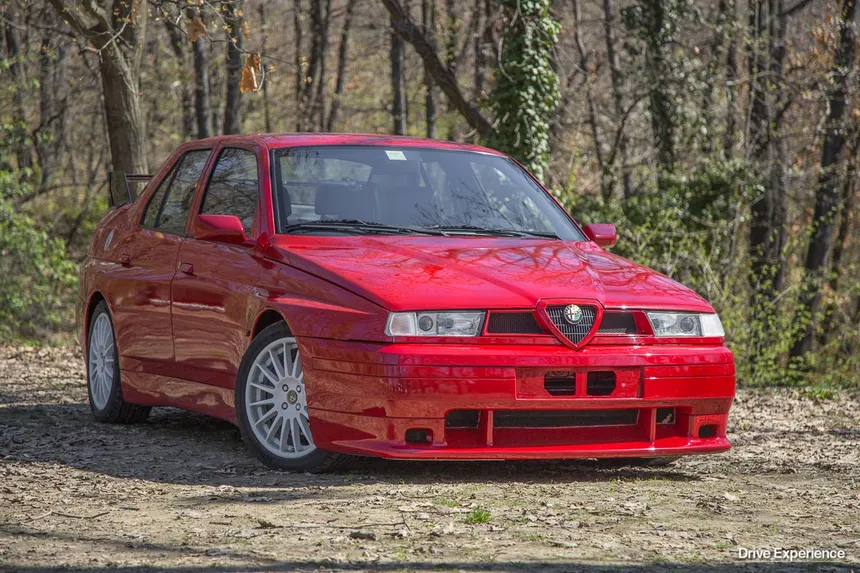
In 1995, the 155 received a substantial update that directly incorporated experience from competition. The Series 2 brought widened bodywork with more generous front fender flares and smoothed rear arches — the pronounced lips of the original gave way to cleaner surfaces. Front and rear track widths were increased. Steering was revised based directly on racing experience.
Four-cylinder engines migrated to 16-valve versions with belt-driven timing. The interior received material and equipment upgrades. Several Sport Packs were available including a competition-inspired body kit, side skirts, and 16-inch Speedline wheels in black or graphite. The luxury-oriented Super trim came with wood inserts and silver-painted alloy wheels.
The Q4 was discontinued with Series 2, but the 2.5 V6 continued in wide-body form. Production of the 155 ended in 1998, after 195,526 units, when it was replaced by the 156 — a car that represented such a quantum leap in quality and design that it made the 155 look like a product from a different era.
The real legacy: what nobody wants to admit
The Alfa Romeo 155 was not a great car. It was a competent, respectable sedan with strong powertrains at the top of the range and a Q4 that was genuinely special, but it could not escape the shadow of its shared platform, corporate design, and the perception that it was nothing more than a Fiat wearing Alfa clothing.
But the 155’s legacy is not in its road-car spec sheet. It is in what it made possible.
The 155 was the car Alfa Romeo took to the German DTM in 1993 and used to humiliate Mercedes, BMW, and Opel on their own soil. The Q4 was the laboratory that proved all-wheel drive worked for Alfa in competition. The Tipo Tre platform, however corporate, turned out to be a base that allowed radical racing modifications. And the 2.5-liter Busso V6, in competition trim, became a 420 hp monster revving to 11,500 rpm that sounds like nothing you have ever heard.
The road-going 155 was the necessary sacrifice for the 155 V6 TI DTM car to exist. It was the ugly duckling that made the swan possible.
195,526 units of a car that almost nobody remembers fondly. But without which, Alfa Romeo’s greatest racing story of the 1990s simply would not have happened.
Check you’re still alive.