
AMG: From a Garage in Burgstall to Devouring Mercedes from Within
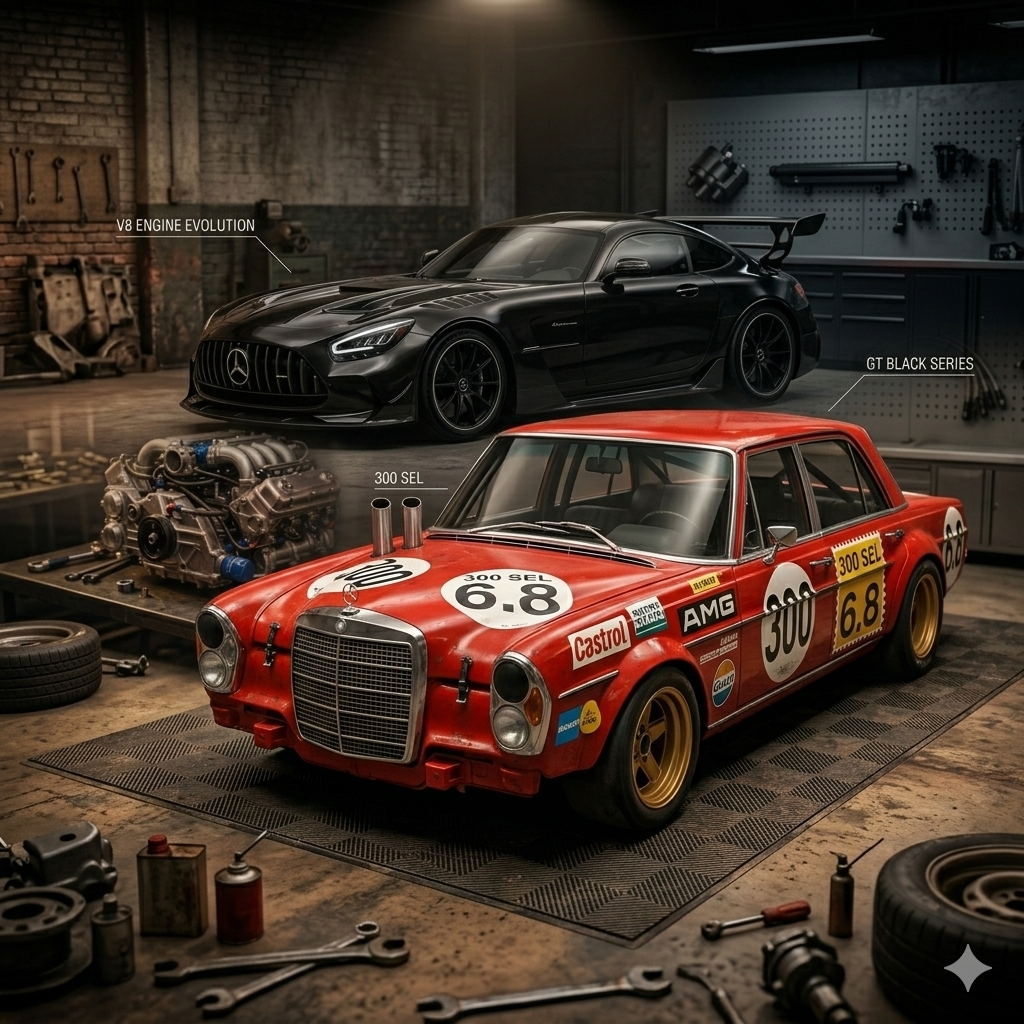
The Story of Two Engineers, a Rented Apartment, and the Red Pig That Changed Everything
Every empire starts somewhere small. Apple started in a garage. Amazon started in a bedroom. And AMG — the division that now defines what “performance” means for the world’s oldest car manufacturer — started in a rented apartment in Burgstall, Germany, with two ex-Mercedes engineers, a lathe, and a dangerous idea.
The idea: that Mercedes-Benz, the brand synonymous with dignified luxury, with executive sedans and dignified silence, could be made to go fast. Really fast.
The name AMG stands for three things: Aufrecht, Melcher, and Großaspach — the surnames of founders Hans Werner Aufrecht and Erhard Melcher, plus Aufrecht’s birthplace. It is, in the most literal sense, a personal enterprise — two men’s names etched permanently into one of the most prestigious performance brands in automotive history.
This is the story of how they did it.
Chapter 1: The Beginning — Burgstall, 1967
Hans Werner Aufrecht and Erhard Melcher met at Daimler-Benz in the early 1960s, where they worked as engineers in the motorsport division. When Mercedes withdrew from racing following the devastating 1955 Le Mans disaster, the competition department was effectively mothballed. But Aufrecht and Melcher’s passion for performance couldn’t be extinguished by corporate decisions.
In 1967, they officially founded AMG in Aufrecht’s home — technically, a rented apartment in the small town of Burgstall an der Murr, near Stuttgart. Their first project: modifying Mercedes-Benz engines for racing applications.
The operation was tiny. Melcher handled engine development while Aufrecht managed the business side. They worked evenings and weekends while maintaining their day jobs. The “factory” was essentially a living room with machine tools.
But the engines they built were exceptional. Word spread through the racing community that two ex-Mercedes engineers in a rented flat were building some of the fastest Mercedes powerplants in Germany.
Chapter 2: The Red Pig — Spa, 1971
The moment AMG became famous wasn’t planned. It wasn’t part of a marketing strategy. It was a 6.8-liter V8 in a car that looked like it belonged in a government motorcade.
In 1971, Aufrecht and Melcher entered a modified Mercedes-Benz 300 SEL 6.3 in the 24 Hours of Spa-Francorchamps — one of the most demanding endurance races in Europe. The car was a full-size luxury sedan, weighing nearly two tons, running against purpose-built racing cars. It was painted in a distinctive red livery, earning it the nickname “Rote Sau” — the Red Pig.
The engine had been bored out from 6.3 to 6.8 liters, producing approximately 428 hp. The car carried the number 35, driven by Hans Heyer and Clemens Schickentanz.
Against all logic and probability, the Red Pig finished first in class and second overall — behind only a much lighter, purpose-built Ford Capri racer. A two-ton luxury sedan, prepared by two engineers working from a rented apartment, had beaten dedicated racing machinery at one of Europe’s most punishing circuits.
The result sent shockwaves through the motorsport world. Overnight, AMG went from unknown tuning shop to legitimate performance engineering firm. The phones started ringing. And they never stopped.
Chapter 3: Growth — From Tuner to Manufacturer
Through the 1970s and 1980s, AMG grew steadily, building its reputation on individual customer cars and racing projects:
The Affalterbach Move (1976)
AMG relocated to Affalterbach, a small town near Stuttgart that would become permanently associated with the brand. The new facility provided the space needed for larger-scale engine building and vehicle modification.
The Hammer (1986)
AMG’s most famous creation of the 1980s was the 300E 6.0 AMG, known as “The Hammer.” AMG shoehorned a 5.6-liter (later 6.0-liter) DOHC V8 into the compact W124 sedan — years before Mercedes themselves attempted the same with the 500E.
The Hammer was claimed to be the fastest sedan in the world at the time, capable of exceeding 300 km/h. It featured AMG’s signature four-valve-per-cylinder head conversions and was built entirely at Affalterbach. The car was a sensation: a mid-size Mercedes that could outrun a Lamborghini Countach from 100 to 190 km/h.
The Hammer also introduced the iconic 17-inch AMG Aero 1 “Hammer” wheels — one of the most recognizable aftermarket wheel designs ever created.
Customer Cars and Racing
Throughout this period, AMG offered a comprehensive catalog of modifications for virtually every Mercedes model — from subtle engine tuning and exhaust upgrades to complete wide-body conversions for the W126 coupés. Some of these wide-body kits now command over €700,000 at classic car auctions.
AMG also continued racing, with particular success in touring car competitions. Their expertise in engine development and chassis tuning made AMG-prepared Mercedes competitive against purpose-built racing cars.
Chapter 4: The Cooperation Agreement (1990)
The relationship between AMG and Mercedes-Benz had always been complicated. AMG was, technically, an independent company modifying another manufacturer’s products — sometimes to the detriment of warranty claims and dealer relationships.
In 1990, this changed. AMG and Mercedes-Benz signed a cooperation agreement that formalized the relationship. AMG would have access to Mercedes’ technical data and development resources. In return, Mercedes gained a semi-official performance division without having to build one from scratch.
This agreement was transformative. It allowed AMG to move from a small-batch modifier to a genuine performance brand, with cars that could be ordered through Mercedes dealerships and maintained by authorized workshops.
Chapter 5: The Acquisition (1999–2005)
In 1999, DaimlerChrysler AG (as it was then known) purchased 51% of AMG’s shares, bringing the tuner officially under the Mercedes corporate umbrella. Hans Werner Aufrecht retained 49% and remained involved in the company’s direction.
In 2005, Mercedes acquired the remaining shares, making AMG a wholly-owned subsidiary. Aufrecht’s racing division was spun off into HWA AG (Hans Werner Aufrecht), which continued to manage Mercedes’ motorsport programs independently.
The full acquisition marked the beginning of AMG’s transformation from specialty tuner to mainstream performance brand. Models like the C63, E63, and S63 would bring AMG performance to thousands of customers worldwide — a far cry from the hand-built, one-at-a-time operations of the Burgstall era.
Chapter 6: The One Man, One Engine Philosophy
One element of AMG’s identity survived the corporate absorption: the “One Man, One Engine” philosophy.
Every AMG engine is hand-assembled by a single technician from start to finish. Each engine bears a plaque with the builder’s signature — a personal guarantee of quality and a link to the craft traditions that defined AMG from the beginning.
This isn’t marketing theater. The process takes significantly longer than automated assembly and requires technicians with years of specialized training. It’s expensive, it’s inefficient by modern manufacturing standards, and it’s one of the reasons AMG engines maintain their reputation for character and quality.
The Affalterbach facility where these engines are built has become a pilgrimage site for Mercedes enthusiasts — a place where the tradition of Aufrecht and Melcher’s hands-on engineering philosophy lives on in every signed engine plaque.
Chapter 7: The Engine Legacy
AMG’s history can be traced through its engines — each generation defining an era:
The V8 Era (Pre-2000s)
Hand-built, naturally aspirated V8s with AMG’s signature multi-valve heads. The Hammer’s 6.0-liter and the various M119-based engines established AMG’s reputation for brutal, linear power delivery.
The M156 — The Last Great NA V8 (2006–2015)
The first engine designed entirely in-house by AMG: a 6.2-liter naturally aspirated V8 producing up to 510 hp (in C63 Black Series specification). The M156 powered the CLK 63, C63, SL 63, E63, and SLS AMG. Its metallic bark at full throttle remains one of the most distinctive engine sounds ever produced.
The M177/M178 — The Biturbo Era (2014–Present)
AMG’s 4.0-liter twin-turbo V8, still hand-built under the “One Man, One Engine” philosophy. Powering everything from the C63 to the AMG GT Black Series (720 hp with flat-plane crank). The engine that brought AMG into the modern performance era without sacrificing character.
The M139 — The World’s Most Powerful Four-Cylinder (2019–Present)
A 2.0-liter turbo four producing up to 421 hp — the most powerful series-production four-cylinder engine in history. Used in the A45 S and CLA 45 S, it brought AMG performance to a new, younger audience.
The Future: Electrification
AMG’s partnership with the Mercedes F1 team has produced the AMG One’s F1-derived hybrid powertrain and the E Performance plug-in hybrid system used in the GT 63 S E Performance. The transition to electrification is underway, but AMG has committed to maintaining performance character — even if the soundtrack changes.
AMG by the Numbers
| Milestone | Detail |
|---|---|
| Founded | 1967, Burgstall an der Murr |
| Founders | Hans Werner Aufrecht, Erhard Melcher |
| Moved to Affalterbach | 1976 |
| Cooperation agreement with Mercedes | 1990 |
| 51% acquisition by DaimlerChrysler | 1999 |
| Full acquisition | 2005 |
| First in-house engine (M156) | 2006 |
| DTM Championships | Multiple (1988, 1991, 1992, 1994, 1995…) |
| F1 involvement | Engine supplier, later works team (Mercedes-AMG Petronas) |
| Iconic models | Hammer, CLK GTR, SLS AMG, AMG GT, AMG One |
Why AMG Matters
AMG matters because it proved that passion can become an institution without losing its soul.
The journey from a rented apartment in Burgstall to the engine supplier of a seven-time Formula 1 World Championship-winning team is one of the most extraordinary stories in automotive history. At every step — from the Red Pig at Spa to the Hammer on the Autobahn to the AMG One at the Nürburgring — AMG has maintained the core belief that Aufrecht and Melcher established in 1967: that a Mercedes should be capable of more than its badge suggests.
Today, AMG is a global brand generating billions in revenue. Every Mercedes model from the A-Class to the S-Class has an AMG variant. The “One Man, One Engine” philosophy continues. The signed engine plaques still ship from Affalterbach.
And somewhere in the DNA of every AMG engine — whether it’s a 421 hp four-cylinder or a 1,049 hp F1 hybrid — there’s a trace of two engineers in a rented apartment, building something they weren’t supposed to build, because they believed Mercedes deserved to go faster.
Aufrecht. Melcher. Großaspach. From a garage to the world.
What’s your defining AMG moment? The Red Pig at Spa? The Hammer? The Black Series? The AMG One? Every enthusiast has one.
Pingback: Mercedes SL 500 R129: The Last No-Compromise Mercedes Roadster
Pingback: Mercedes-AMG One: The F1-Powered Hypercar That Took 5 Years to Deliver