
Anatomy of a Swap: What Nobody Tells You Before Opening the Bonnet
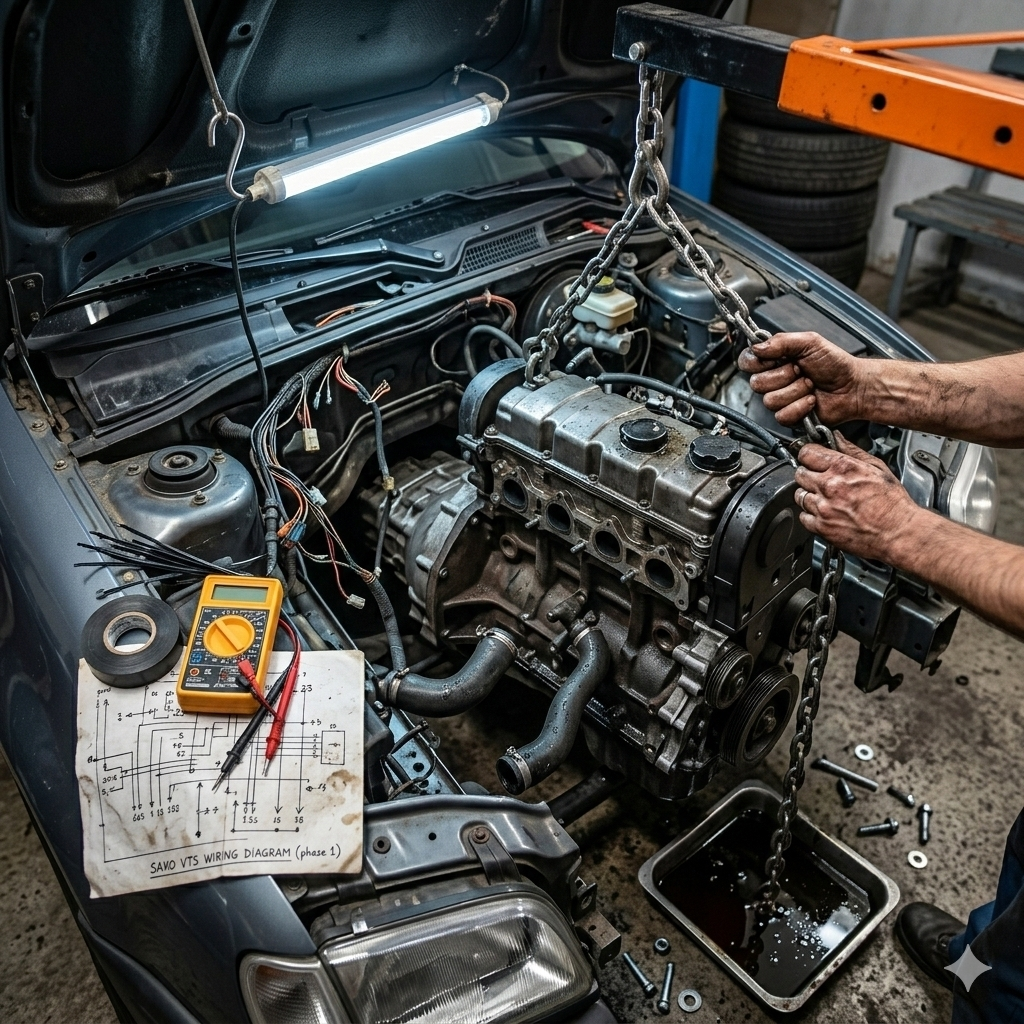
First Things First: Where I’m Coming From
I’m going to start this article with something you don’t see much on the internet: honesty about my level.
I’m not a professional engine builder. I don’t have a workshop with a twin-post lift and a dyno. What I do have is thirty years of industrial mechanical experience spanning automotive diagnostics, automation, robotics, and currently assembling train doors at Stadler Rail. I’ve been getting my hands dirty with engines since I was 11, done diagnostics, stripped and rebuilt complete powertrains, and had my fair share of minor swaps. But I’m not going to sit here and deliver a masterclass on something I’m still learning.
What I am going to do is tell you what I’ve learned — sometimes the easy way, often the hard way — about what an engine swap actually involves. The things YouTube videos cut in editing. The problems forums mention in passing as if they were trivial. The costs nobody puts on the spreadsheet.
And I’m going to document my own projects in this section, step by step, including the cock-ups. Because I’m getting back in the mud, and I believe the best way to contribute isn’t by lecturing from a podium, but by sharing the real process. With transparency. Without pretending to be something I’m not.
With that said, let’s get into it.
What Is a Swap, Really?
Seems obvious, but it’s worth defining because the word gets thrown around for everything. An engine swap is replacing a vehicle’s original power unit with a different one. We’re not talking about replacing a blown engine with an identical unit — that’s a replacement. A swap means fitting something the car never came with from the factory: more cylinders, a different architecture, another manufacturer, another technology.
And this is where it stops being a pretty video with epic music and becomes an engineering problem with multiple interconnected variables that, if you don’t think through all of them before starting, will think for you when the car’s on stands and the engine’s dangling from the hoist.
Variable 1: Engine and Chassis — The Question You Don’t Ask
The first decision seems straightforward: “I want to put engine X in car Y.” But before falling in love with the engine, you need to ask a much less sexy question: does it fit?
I don’t just mean whether it slots between the rails. I mean the whole package. An engine isn’t a block floating in a vacuum. It comes with accessories — alternator, air conditioning compressor, power steering pump, water pump — that need space and can foul against the chassis, subframe, rails, steering column, firewall, or strut towers.
And the engine needs mounts. The original engine’s mounting points are where they are for a reason: weight distribution, torsional rigidity, alignment with the transmission. If the new engine doesn’t share those points, you need to fabricate adapter mounts. And those mounts aren’t two plates welded by eye: they need to absorb engine vibrations, handle inertia torque, and maintain powertrain alignment with millimetre precision. A poorly designed or executed mount can generate vibrations that destroy the transmission, bushings, and even the body shell over time.
Something I’ve learned from experience: measure three times before buying the engine. And when you think you’ve measured enough, measure again with the accessories fitted. That alternator you didn’t account for can be the difference between a clean swap and having to cut a rail.
Variable 2: The Transmission — The Marriage Nobody Plans
The engine is the star, but the gearbox is what makes everything work. And the most common mistake I see in swap projects is treating the transmission as secondary, as if any gearbox will mate with any engine.
It won’t. The gearbox needs to be compatible with the engine on several levels. The bell housing bolt pattern must match, or you’ll need an adapter plate — a custom-machined piece that aligns the primary shafts of engine and gearbox. The gear ratios must make sense with the new engine’s power and torque range. And the gearbox must handle the torque: fitting a 400 Nm engine to a gearbox designed for 200 Nm is a death sentence with a variable execution date.
But it doesn’t end there. If you change the gearbox, you potentially change the differential, driveshafts, the entire transmission length, and the gear lever position in the cabin. An engine swap can end up being a complete powertrain swap.
My advice from the trenches: if a motor-gearbox combination has been done before on your platform, use it. Don’t be the first person to marry two components nobody has married before, unless you have a generous budget and high tolerance for frustration.
Variable 3: Engine Management — Where Swaps Go to Die
If there’s one point where more swap projects stall, get abandoned, or turn into nightmares, it’s electronics. And it’s exactly the point that gets the least attention in forums and videos.
A modern engine doesn’t run without its brain: the ECU (Engine Control Unit). The ECU manages injection, ignition, emissions, idle, throttle response, and dozens of sensors monitoring everything from coolant temperature to crankshaft position.
When you do a swap, you have essentially three options for engine management:
Option A: Bring the donor engine’s original ECU with its wiring harness. The most direct option if engine and ECU come from the same donor vehicle. But “direct” doesn’t mean “easy.” The engine wiring harness is integrated with the donor vehicle’s general harness — instrument cluster, immobiliser, diagnostic system. You need to separate engine signals from body signals, resolve the immobiliser (which won’t recognise your recipient car’s key), and adapt connectors to the sensors and actuators of the car you’re installing the engine in. In Subarus, for example, the engine wiring isn’t a separate harness: it’s integrated with the entire body wiring, turning any swap into a large-scale electrical project.
Option B: Use a standalone ECU. A standalone unit like Megasquirt, Link, Haltech, or Ecumaster is a programmable unit you configure for your specific engine. It’s the cleanest option long-term: you’re free from original ECU compatibility issues, the immobiliser, and crossed signals. But you need engine mapping knowledge, or need to pay someone who has it. And it’s not cheap: a quality standalone plus professional mapping can easily exceed €1,500-2,500.
Option C: Rewire the recipient car’s original ECU. If the new engine is from the same family and the ECU can manage it with reprogramming, this can be the most economical option. But it’s very specific: it only works when there’s real compatibility between the existing ECU and new engine, which severely limits possible combinations.
A piece of advice I was given years ago that turns out to be one of the most useful truths in mechanics: “the wiring harness is half the swap.” It sounds like an exaggeration until you’ve spent three weeks hunting why the engine starts but won’t rev past 2,000 RPM, and you discover a 58-tooth crankshaft position sensor is connected to an ECU expecting a 36-tooth signal.
Variable 4: Cooling — The Oversight That Leaves You Stranded
Your car’s original radiator was sized to dissipate heat from a specific engine, with specific power output, under specific driving conditions. If you fit an engine with more power, more displacement, or a turbo the original didn’t have, the stock radiator probably won’t cope.
And the radiator isn’t the only component in the cooling system. Hoses need to reach the new engine’s connections, which probably won’t be in the same position as the originals. The thermostat needs to be compatible. The fan must move sufficient air, which may require switching from a mechanical viscous fan to an electric one, or adding a second fan. And if you’re thinking about an intercooler for a turbocharged engine, that’s an entirely separate cooling system with its own space, piping, and airflow considerations.
I’ve seen swap projects where the engine starts, runs, makes spectacular power… and after 15 minutes of city driving the temperature shoots up like a rocket because nobody thought about cooling until the engine was already in. Plan your cooling before you plan your exhaust. The exhaust will make noise if it’s wrong. The cooling will kill your engine if it’s wrong. There’s a difference.
Variable 5: Braking — The One Everyone Forgets Until It’s Too Late
While we’re talking about things people skip: brakes. If you’ve just added 50% more power to your car, the brakes that were adequate for the original engine are now potentially inadequate. This doesn’t necessarily mean a full big brake kit — though that might be warranted for serious builds — but at minimum you need to assess whether your brake bias, pad compound, fluid spec, and disc condition are up to the task of repeatedly decelerating a car that now accelerates significantly harder than it was designed to.
This is also a homologation consideration in Spain: if you upgrade the brakes, that’s another reform code, another conformity report, another line on the budget. But it’s also a safety consideration that transcends paperwork. No amount of horsepower matters if you can’t stop.
Variable 6: The Real Budget — The Spreadsheet That Hurts
Here I’m going to be brutally honest, because this is what I wish someone had told me before starting.
An engine swap has three budgets: the one you plan, the one you need, and the one you actually spend. All three are different, and the third is always bigger than the other two.
The engine: Depends enormously on what you’re after. A used engine with gearbox from a breaker’s can be €500-2,000. A rebuilt or prepared engine can multiply that by three or ten.
Mounts and mechanical adaptations: Mount fabrication, bell housing adapter if needed, custom exhaust, subframe modifications. You’re looking at €500-2,000 in parts and labour, minimum.
Electronics: Adapted harness or standalone + mapping: €500-2,500.
Upgraded cooling: Higher-capacity radiator, hoses, fans: €200-800.
Legalisation: As we covered in the ITV and homologation article, between conformity reports, engineering projects, fees, and paperwork, you could be looking at an additional €500-3,000.
And then there are the unexpected costs. Because there are always unexpected costs. The driveshaft that doesn’t arrive. The hose that doesn’t exist in any catalogue. The sensor that’s been discontinued. The part you order online that arrives wrong. Add 20-30% contingency on top of your estimated budget, and you’ll probably still fall short.
A “simple” swap — engine from the same family, same platform, compatible gearbox — can be done for €3,000-5,000 all-in if you do the mechanical work yourself. A cross-brand or cross-architecture swap can easily shoot past €8,000-15,000.
If those figures scare you, that’s not meant to discourage you. It’s meant to help you plan with your feet on the ground.
What I’m Going to Document
As I said at the start: I’m getting back in the mud. NEC has its own active projects, and we’re going to document every step here in Builds & Swaps. Not as a tutorial of “do this and it’ll turn out perfect,” but as an honest workshop diary.
I’ll show the measurements I take and the ones I forget to take. The parts that arrive right and the ones that need returning. The calls to the engineer asking “is this homologable or am I making it up as I go?” The real hours, not the Instagram hours. And the real costs, not the mates-rates costs.
Because I believe what’s missing on the internet isn’t more gurus. What’s missing is people who say “look, this is what happened to me, this is what I learned, and this is what it cost me.” Nothing more pretentious than that.
If you’re thinking about a swap, stick around. We’re going through this together.