
BMW M3 E46 CSL: The M3 BMW Didn’t Want to Sell to Just Anyone and Now Commands a Fortune
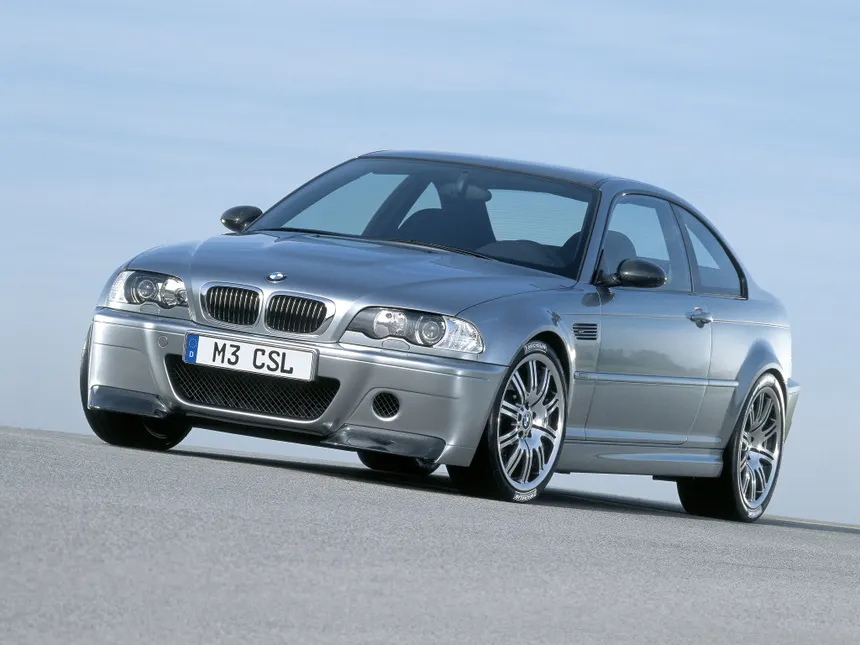
The Philosophy of Subtracting When Everyone Else Adds
In 2003, the automotive world was completely obsessed with adding. More power, more technology, more equipment, more weight, more of everything. Manufacturers competed to see who could cram more gadgets, more driver assistance systems, more creature comforts into their vehicles. Customers wanted luxury, and the industry delivered it by the truckload.
BMW made a decision that went against all commercial logic: create an M3 where the strategy was exactly the opposite. Instead of adding, they would remove. Instead of making the car more comfortable, they would make it less comfortable. Instead of targeting the mass market, they would build something only true enthusiasts could appreciate.
The result was the M3 CSL (Coupé Sport Leichtbau, meaning Coupé Sport Lightweight in German), a car that weighed 240 lbs less than the standard M3 and offered a driving experience so pure, so direct, so unfiltered that it frightened the uninitiated and made purists weep with joy.
It wasn’t a comfortable car. It wasn’t a practical car. It wasn’t a car for grocery runs or school pickups. It was the M3 that BMW always wanted to build but never dared to sell to the masses. And that decision not to compromise it for the general market is exactly what makes it the most valuable M3 in history today.
Subtraction Engineering: The Obsessive Art of Removing Grams
BMW M GmbH engineers received a mandate that sounded simple but was extraordinarily difficult to execute: reduce weight without compromising structural rigidity or safety. They couldn’t just randomly remove parts. Every gram eliminated had to be analyzed to ensure it didn’t negatively affect the car’s dynamic behavior.
What followed was a methodical, almost pathological obsession with every gram of the vehicle.
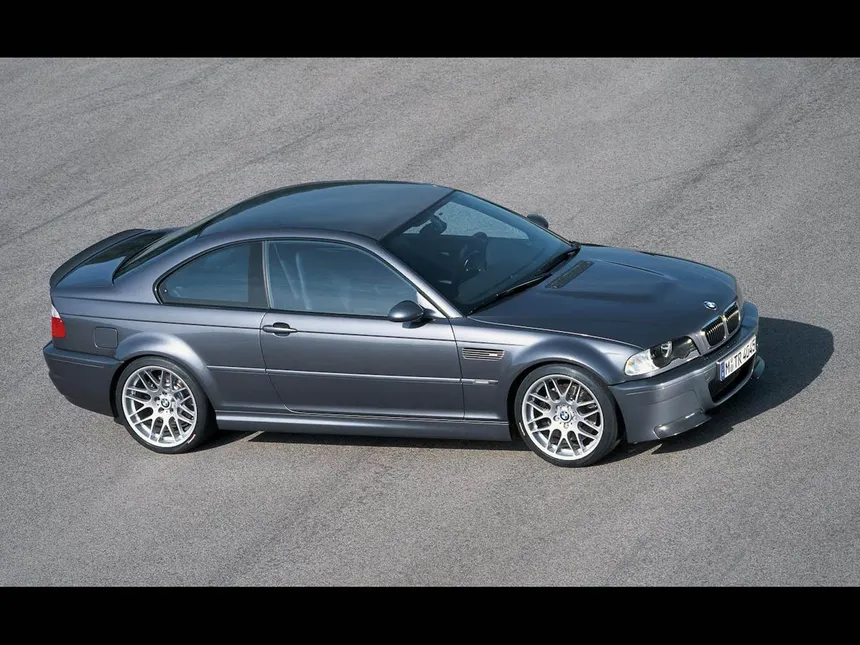
What Disappeared From the Standard M3
The list of deleted equipment reads like a cruel joke to any modern luxury car buyer:
Navigation system: Completely deleted. Buyers of a €90,000 car would have to use paper maps or their memory.
Air conditioning: Deleted as standard. BMW offered it as a no-cost option for those who wanted it, but the factory configuration was without it. The message was clear: if you want comfort, perhaps this isn’t your car.
Power seats: The comfortable power-adjustable seats from the M3 were replaced by carbon fiber buckets without electric adjustment. They were lighter, held you better in corners, but adjusting them required brute force and patience.
Sound insulation: Drastically reduced. The CSL let in much more engine noise, road noise, and wind noise. For BMW, this wasn’t a defect; it was a feature. You wanted to hear the engine, didn’t you?
Rear window: The rear glass was replaced with a thinner, lighter piece. A few more grams eliminated.
Glovebox: The conventional glovebox disappeared, replaced by an open carbon fiber compartment. Lighter, but your documents would fly out if you opened the windows.
Rear speakers: Deleted. The audio system was reduced to minimum functionality.
Luxury floor mats: Replaced with lighter, more basic pieces.
Interior door pulls: Replaced with cloth straps that saved a few more grams.
What Was Gained With Exotic Materials
Equipment deletion was only half the equation. BMW also incorporated materials that in 2003 were exclusive supercar territory:
Carbon fiber hood (CFRP): The entire hood was manufactured in carbon fiber, saving 13 lbs over the front axle. This reduction in unsprung mass directly improved steering response.
Carbon fiber roof: The roof panel was manufactured in CFRP (carbon fiber reinforced plastic), saving another 13 lbs at the car’s highest point, significantly lowering the center of gravity.
Supersprint titanium exhaust: The exhaust system incorporated titanium components that reduced additional weight while improving gas flow.
Optional ceramic brakes: For those who wanted to go further, BMW offered ceramic brakes that eliminated an additional 15 lbs of unsprung mass, further improving suspension response.
The result of all this reduction exercise: 3,053 lbs dry. For a coupe of its size, with a 3.2-liter inline-six engine and all mandatory safety equipment, it was an extraordinary figure that embarrassed many supposedly more radical sports cars.
The S54 Engine: When 360 HP Feels Like Much More
The heart of the CSL was the legendary S54 engine, but not in its standard configuration. BMW had modified several aspects to extract more power and, more importantly, to completely change the delivery character.
The CSL’s S54 developed 360 hp at 7,900 rpm, 17 hp more than the standard M3. Maximum torque rose slightly to 273 lb-ft. But the raw figures don’t tell the complete story of what BMW did with this engine.
The Modified Intake System
BMW eliminated the traditional variable intake VANOS system from the intake camshaft and replaced it with a more aggressive system with fixed-profile cams optimized for high rpm. This meant the engine lost some flexibility at low revs but gained a much more explosive character in the upper rev range.
The resulting power delivery was harsher, less civilized, completely different from the standard M3. Where the normal M3 was a versatile athlete, the CSL was a specialized sprinter. It gave you nothing free below 4,500 rpm, but when you reached that zone, the engine awakened with violence that pinned you to the seat.
Direct Comparison: M3 vs CSL
| Specification | M3 E46 | M3 CSL | Difference |
|---|---|---|---|
| Power | 338 hp @ 7,900 rpm | 360 hp @ 7,900 rpm | +22 hp |
| Maximum torque | 269 lb-ft @ 4,900 rpm | 273 lb-ft @ 5,000 rpm | +4 lb-ft |
| Dry weight | 3,296 lbs | 3,053 lbs | -243 lbs |
| 0-60 mph | 4.8 seconds | 4.5 seconds | -0.3 s |
| Power-to-weight ratio | 9.7 lbs/hp | 8.5 lbs/hp | -1.2 lbs/hp |
| Top speed | 155 mph (limited) | 155 mph (limited) | – |
The improvement of 1.2 lbs/hp may seem modest on paper, but translated to road sensations it was transformative. The CSL felt like a car from a completely different category than the standard M3.
The SMG II Gearbox: The Most Controversial Element
BMW made a decision that continues generating heated debate more than 20 years later: the M3 CSL would only be available with the SMG II sequential gearbox. There was no conventional manual transmission option.
This decision was purely ideological. BMW considered the SMG to be the future, that automated sequential shifts were faster and more effective than any human with a clutch pedal. They wanted the CSL to be a technological showcase, not a concession to the past.
The Problem: Nobody Knew How to Use It
The SMG II was an extraordinarily capable transmission… in the right hands and in the right mode. The problem was that most owners never learned to extract its potential.
In automatic mode (D mode), the SMG was clunky, slow, indecisive, and frustrating. Shifts came at inopportune moments, the gearbox hesitated before downshifting, and the overall experience was disappointing. Many owners, accustomed to using their cars in automatic mode, concluded that the SMG was garbage.
Reality was different. In manual mode with the S6 program activated (the most aggressive), the SMG transformed into something brutal. Shifts completed in 80 milliseconds, with such violence they slammed your back against the seat. Downshifts came accompanied by a perfect throttle blip that produced exhaust explosions. It was an absolutely addictive experience.
The problem was that accessing that level of performance required knowing the car, using the correct modes, and driving aggressively. In calm daily driving, the SMG was objectively worse than a conventional automatic or traditional manual.
Period forums were full of complaints from frustrated owners. Today, many purists consider the lack of manual option the CSL’s only flaw. Others argue that the SMG, used properly, added to the car’s radical character.
The Sound: 8,000 RPM of Mechanical Ecstasy
If there was one thing all period owners and journalists agreed on, it was the CSL’s S54 sound. The freer exhaust, combined with reduced sound insulation and intake system modifications, produced a mechanical symphony that many consider the best ever to come from an inline-six.
From idle to 4,000 rpm, the engine sounded contained, almost civilized, with a deep murmur that barely hinted at what was coming. From 4,000 rpm, the sound began its transformation. The tone rose, became more metallic, more urgent.
At 6,000 rpm, the engine entered its magic zone. The sound became a mechanical howl, a mixture of intake sucking air furiously and exhaust releasing pressurized gases. The inline-six harmonics aligned perfectly.
At 8,000 rpm, just before fuel cutoff, the CSL sounded like a GT racing car. It wasn’t marketing exaggeration or the illusion of a smitten owner. It was engineering applied to human emotions, a sound specifically designed to provoke a visceral response in the driver.
Why the CSL Commands What It Commands Today
In 2003, the M3 CSL had a price of approximately €90,000, a considerable premium over the standard M3 that hovered around €65,000. Early owners had to negotiate hard with dealers to secure one of the 1,383 units produced.
Today, a CSL in good condition, with reasonable mileage and complete documentation, easily exceeds $160,000. Exceptional examples with low mileage, impeccable service history, and desirable configurations have surpassed $220,000 in private transactions and auctions.
Adjusting for inflation, the CSL cost approximately $130,000 in today’s money when new. The best examples are now worth nearly double. It’s extraordinary appreciation for a car that’s barely 20 years old.
The Factors Explaining This Appreciation
Genuinely limited production: 1,383 worldwide units isn’t exaggerated marketing. It’s a real figure meaning there are very few CSLs available for the thousands of collectors who want them.
The last “pure” M3: The CSL represents the end of an era. Subsequent M3s incorporated more electronics, more driver aids, more compromise with comfort. None has been as radical, as focused, as free of concessions as the CSL.
Unique philosophy in BMW M history: BMW M has produced many special cars, but none has applied the subtraction philosophy so extremely. The CSL has no equivalent before or after.
Universal recognition from specialized press: Since its launch, the CSL has been consistently voted the best M3 in history and one of the best driver’s cars of its generation. This reputation has only grown with time.
Modern drivability: Unlike many classics that feel outdated on modern roads, the CSL remains exciting, competent, and relevant when you drive it today. Its performance hasn’t aged as much as its reputation has grown.
The Legacy: Purity as a Risky Commercial Philosophy
The BMW M3 E46 CSL represents an unrepeatable moment in automotive history. It was the result of a business decision that would be unthinkable today: build a car knowing most of the market wouldn’t understand it, wouldn’t appreciate it, and wouldn’t buy it.
BMW proved it knew exactly how to build the perfect M3, the M3 the engineers always dreamed of, without the concessions the marketing department normally imposed. It also proved, with sales figures, that the mass market didn’t want that car.
Every subsequent M3 has been more powerful. Every subsequent M3 has been faster. Every subsequent M3 has been more technological, more comfortable, more versatile. No subsequent M3 has been purer.
The CSL wasn’t a massive commercial success, and it never intended to be. It was exactly what it needed to be: a monument to unfiltered driving that only a few could appreciate when it was new. Those few are now guardians of an automotive philosophy the modern market has abandoned.
When you drive a CSL today, you’re not handling a car. You’re experiencing a manifesto, a statement of principles about what a sports car can be when you decide not to make concessions.
And that manifesto, like all objects of conviction, only gains value with time.
Is the CSL the best M3 in history or is nostalgia deceiving us? Does paying more than double its original price make sense? Leave us your opinion in the comments.
Article published on Not Enough Cylinders – The blog where gasoline and strong opinions flow equally.