
BMW M8 E31: The Secret Supercar BMW Built, Hid in a Basement, and Denied for 20 Years
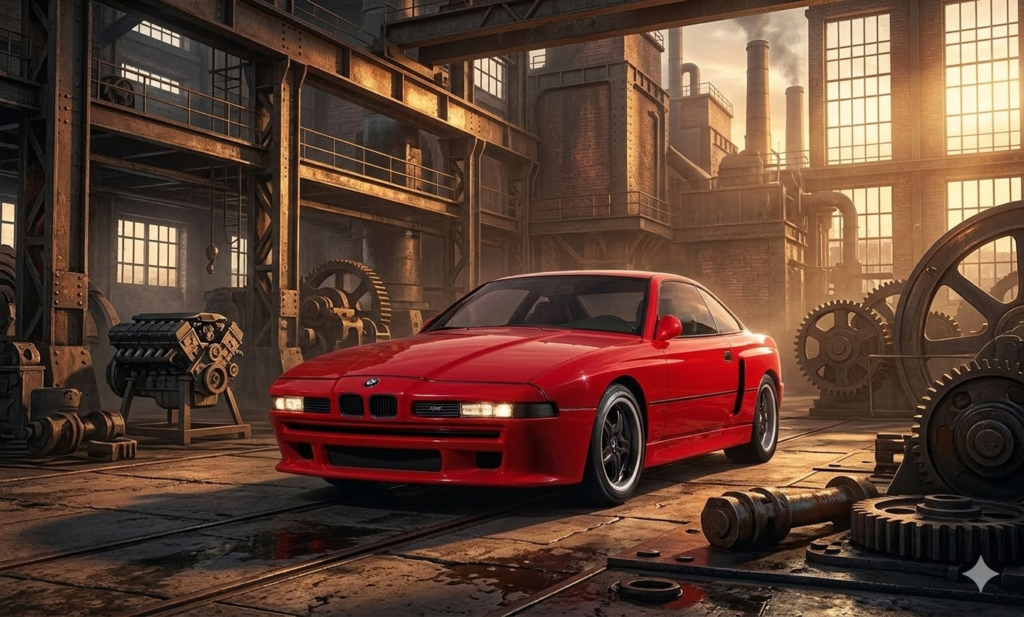
In the early 1990s, a group of engineers at BMW Motorsport secretly built the most powerful car the company had ever conceived. A naturally aspirated 6.1-liter V12 producing 640 hp, carbon fiber intake with twelve individual throttle bodies, six-speed manual gearbox, lightened bodywork with fiberglass and carbon panels, and a total weight under 3,197 lbs. They painted it red. They tested it on closed circuits. They never gave it road approval.
And then they hid it in a basement.
For nearly 20 years, BMW publicly denied the car existed. They even claimed the prototype had been dismantled. That was a lie. The car was intact, stored at BMW M GmbH’s facilities, waiting for someone to decide the world was ready to know its story.
That moment arrived in 2010, when BMW finally unveiled the prototype at the BMW Museum in Munich. The reveal was ironic in its context — the event was for launching BMW’s i sub-brand and its electric mobility strategy. Surrounded by electric prototypes and speeches about efficiency, someone decided to roll out the most savage car BMW had ever built. The irony was perfect.
Context: the 8 Series and BMW’s ambition
To understand the M8, you need to understand the 8 Series. The BMW E31 was a monumental project — development began in 1981 and the car did not debut until the 1989 Frankfurt Motor Show. It was among the first production cars designed entirely using CAD. Its drag coefficient of 0.29 was exceptional for the era. The E31 was impressive on paper: a V12 engine, active rear-wheel steering, an obsessively crafted cabin, and a low, aggressive body. It was developed under R&D chief Wolfgang Reitzle and reflected his ambition.
But on the road, the 850i disappointed. It was aloof — easy to admire, hard to love. The 300 hp V12 was smooth but uninspiring. The car weighed between 3,946 and 4,134 lbs depending on specification — mass that buried any serious sporting pretension. Sales fell short of expectations, hurt by the early 1990s global recession and the Gulf War energy crisis.
For American enthusiasts, the E31 occupies a unique place: it was sold in the U.S. as the 840Ci and 850Ci/CSi, and remains one of the most beautiful BMWs ever made. But most Americans never knew that BMW had a secret version with more than twice the power of the 850CSi sitting in a locked room in Germany.
The team: the men behind the secret
The M8 project was not formally authorized as a production program. It was an internal BMW Motorsport initiative — an engineering exercise driven by the passion of a handful of people who wanted to prove what a BMW could be when all restrictions were removed.
Key names: Paul Rosche, BMW M’s legendary engine designer responsible for the turbo four that won the F1 championship with Brabham, the E30 M3 engine, and virtually every significant M powerplant; Gerhard Richter, chassis specialist; and Karl Heinz Kalbfell, then chairman of BMW Motorsport.
The stated objective: build a BMW faster than a Ferrari. The direct target was the Ferrari F40 — the fastest car in the world at the time.
The engine: S70, 6,064 cc, 640 hp
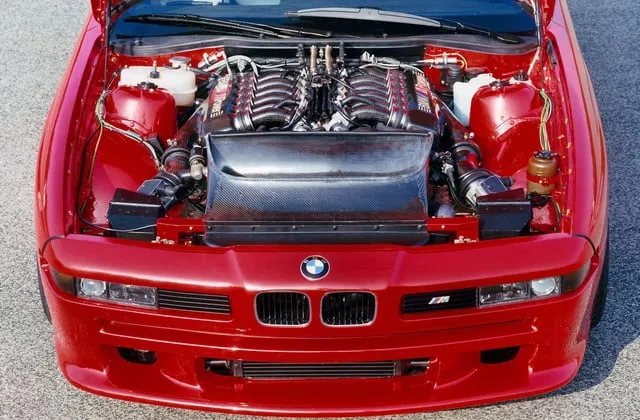
Paul Rosche took the standard 5.0-liter M70 V12 from the 750i — an engine producing 296 hp that was, generously speaking, mediocre — and transformed it into something unrecognizable.
The M8’s engine, internally designated S70 (or S70/1 depending on the source — the nomenclature is deliberately confusing, possibly to hide development costs within the 850CSi budget), increased displacement to 6,064 cc with an 86 mm bore and 87 mm stroke. Where the M70 had a single cam per bank and 24 valves, the S70 carried dual overhead cams per bank and 48 valves. Twelve individual throttle bodies with roller valves replaced conventional butterflies, allowing unrestricted airflow at full load. The complete intake manifold was manufactured from carbon fiber. BMW’s VANOS continuously variable valve timing was integrated. Compression ratio: 11:1.
Official figures from BMW M: 640 hp and 479 lb-ft (650 Nm). The actual power output was kept secret for two decades — before the 2010 reveal, estimates circulated between 550 and 600 hp. When BMW finally published the real numbers, the 640 hp figure made clear this engine would have made the M8 the most powerful production car in the world in 1992.
Three S70 engines were built. Only one was installed in the car.
And here is the connection that elevates this story: the M8’s S70/1 was the direct foundation upon which Paul Rosche developed the McLaren F1’s S70/2. Same bore, same stroke, same displacement, same VANOS system, same individual throttle bodies. The engine of the most important road car of the 20th century was born in the basement of a prototype that BMW swore did not exist.
The chassis: half E31, half race car
The engineers did not stop at the engine. The standard E31 weighed nearly two tons. The M8 needed radical weight loss.
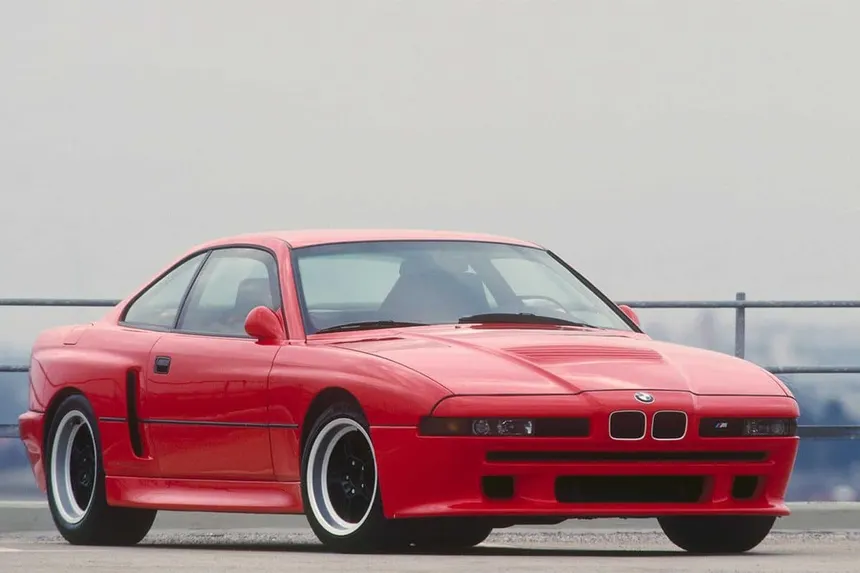
Doors, hood, and trunk lid were manufactured in glass-reinforced plastic (GFK). Side windows were Plexiglass. The 17-inch wheel spokes carried carbon fiber coating. The interior was stripped: lightweight bucket seats up front, rear seats and audio system eliminated. The result: a weight under 3,197 lbs (1,450 kg), a reduction of nearly 990 lbs from the standard E31.
A crucial structural modification was the addition of fixed B-pillars — the standard E31 had a pillarless hardtop coupe design that was elegant but structurally compromised. The M8 needed the additional rigidity to withstand the forces a 640 hp engine would impose on the chassis.
The pop-up headlights were eliminated. Instead, lights were integrated directly into the bumper, allowing a one-piece hood with no additional gaps creating aerodynamic drag — a critical detail for a car aimed at exceeding 186 mph. Engine and differential oil coolers were relocated to the rear, with narrow air intakes in the bodywork behind the doors.
Performance: numbers that were never official
BMW never conducted official performance testing on the M8. But the development team’s estimates are clear: 0-62 mph in approximately 4.2 seconds and a top speed exceeding 186 mph — potentially reaching 199 mph (320 km/h).
For 1992, those numbers would have been devastating. The Ferrari F40 did 0-62 in 3.8 seconds and reached 201 mph — but it was a turbocharged, uncompromising machine with no creature comforts. The M8 was a grand tourer with leather seats, air conditioning, and a naturally aspirated V12.
The M8’s throttle was mechanical — direct cable to the engine, not the electronic drive-by-wire system used in the rest of the E31 range. Twelve individual throttle bodies connected by cable to the right foot. Response was instant, visceral, analog. It was the same philosophy that Gordon Murray would later demand for the McLaren F1: the driver commands, with no electronic intermediaries.
The cancellation: money, fear, and the McLaren ghost
The M8 was canceled before reaching production. The reasons were multiple.
First: the early 1990s global recession. BMW was in a difficult financial period. 8 Series sales were below expectations. Producing an extremely expensive flagship on an underperforming platform was commercially senseless.
Second: cost. To be viable, the M8 was estimated to need a price tag double that of the most expensive Porsche 911 Turbo of the era. The bodywork changes from the 850CSi were extensive and would have required expensive new production tooling.
Third — and this is the one nobody says out loud: the M8 at 640 hp would have eclipsed the McLaren F1. The F1, while not a BMW project, carried a BMW engine and served as a technology showcase for the brand. Having a “production” BMW outpower the car being sold as the fastest in the world would have created a marketing contradiction that was difficult to manage.
The compromise was the 850CSi, launched in 1992 with a domesticated V12 — the S70B56 making 380 hp from 5.6 liters. An excellent car, but light-years from what the M8 could have been. The 850CSi kept the pillarless design, pop-up headlights, luxury interior, and a weight near 3,968 lbs. It was a fast grand tourer. The M8 would have been a supercar disguised as a grand tourer — a completely different category.
An internal BMW press release dated April 1991 proves the project had already been canceled by that point. The document, signed by Thomas Gubitz, head of product communications, describes “a coupe from BMW Motorsport GmbH as a particularly high-performance sports car.” It does not call it M8. Does not mention the 8 Series. Includes no photographs. Was available only in German, not the customary multiple languages. It was, by all accounts, an obituary written with the discretion of someone burying something that was never supposed to see daylight.
The prototype was stored. BMW ordered all evidence concealed. It was publicly stated that the car had been dismantled. The lie held for nearly two decades.
What could have been: a rival without precedent
If the M8 had reached production in 1992-93, its market position would have been unique. At 640 hp, it would have been the most powerful production car in the world — surpassing even the McLaren F1, which would not arrive until 1993 with 618 hp (and which, ironically, carried an engine derived from its own).
Its natural rivals would have been the Ferrari 456 GT (442 hp, naturally aspirated V12) and the later Ferrari 550 Maranello (485 hp). Against both, the M8 would have held a substantial advantage in raw power. The Porsche 911 Turbo (993) would not arrive until 1995 with 408 hp — it was not even on the horizon.
The question nobody can answer is how it would have driven. With 640 hp, rear-wheel drive, no traction control (the throttle was mechanical, with no electronic intervention), a weight of 3,197 lbs, and 1992-era tires… it would have been a savage car. The 850CSi was already known for a playful rear end at the limit; the M8, with nearly double the power, would have required a serious driver. Not a grand touring driver. A real driver.
For the American market, the M8 would have been a revelation. In 1992, the most powerful car you could buy in the U.S. was the Dodge Viper with 400 hp — and that was considered dangerously powerful. A BMW grand tourer making 640 hp would have rewritten every comparison test that year. The fact that America’s 8 Series enthusiasts — and there are many, with a dedicated and passionate community — never got to experience this version remains one of the great what-ifs in BMW’s American history.
The legacy: from the basement to Le Mans
The M8 never existed as a production car. But its engine changed automotive history.
The M8’s S70/1 was the direct foundation of the McLaren F1‘s S70/2 — the engine many consider the greatest road-going V12 ever built. Same architecture, same bore and stroke, same VANOS system, adapted by the same Paul Rosche for a mid-rear installation instead of a front-longitudinal one. Without the M8, the F1’s engine would have taken years longer to develop — if it had been developed at all.
And the chain did not stop there. The S70/2 derived from the M8’s engine also powered the BMW V12 LMR — the prototype that won the 24 Hours of Le Mans in 1999, giving BMW its first outright victory at La Sarthe.
A secret prototype that BMW hid in a basement spawned the engine of the most important road car of the 1990s and a Le Mans victory. The M8 never won anything. Never competed. Never sold. But its DNA won where BMW never dared take it.
One car. Red. Hidden 20 years. And a legacy worth more than any sales figure.
The BMW M8 E31 is the most important car BMW never sold. Not because of what it was — a single prototype that never left the development phase — but because of what it made possible. Every time a McLaren F1 sells for $20 million, every time someone watches an F1 GTR cross the line at Le Mans in footage from 1995, every time someone pulls up a sound clip of an S70/2 V12 at full throttle and feels the hairs on their neck stand up — they are hearing the echo of a red prototype that BMW hid in a basement and pretended never existed.
The bean counters killed the M8. But Paul Rosche’s engine outlived every spreadsheet, every sales forecast, and every corporate decision that tried to bury it.
Check you’re still alive.
Pingback: McLaren F1: The Purest Car Ever Built — Full Technical History