
Cadillac Escalade: America’s Rolling Throne
The SUV That Shouldn’t Have Worked
Some cars are born from a vision. Some are born from engineering. And then there’s the Cadillac Escalade, which was born out of pure, unadulterated panic.
The year is 1998. Lincoln has just launched the Navigator, the first full-size luxury SUV, and they are selling every single unit they can build. Ford has struck gold: take a Ford Expedition, throw in some leather, wood, and a $50,000 price tag, and people will line up to buy it.
At General Motors, the alarm is screaming red. Cadillac has nothing to offer. Nothing. The brand that called itself the “Standard of the World” had no answer for a Lincoln on big wheels.
The solution was as desperate as it was effective: they took a GMC Yukon Denali, slapped a Cadillac badge on it, swapped the grille, added some leather, and rushed it to market in less than ten months. Ten months. That’s not product development; that’s an act of survival.
The first 1999 Escalade was, let’s be honest, a fraud. Critics tore it apart. It was a Yukon in disguise, with an interior that didn’t justify the markup and an exterior that barely differentiated itself from the base product. Specialized journalists called it the laziest car Cadillac had built since the Cimarron.
And yet… it sold.
The Second Generation: When the Escalade Found Its Soul
If the first generation was an act of desperation, the second generation (2002) was an act of genius.
GM finally got it: the Escalade couldn’t just be a Yukon with makeup. It had to be the Yukon that the Yukon dreamed of being. And that’s where everything changed.
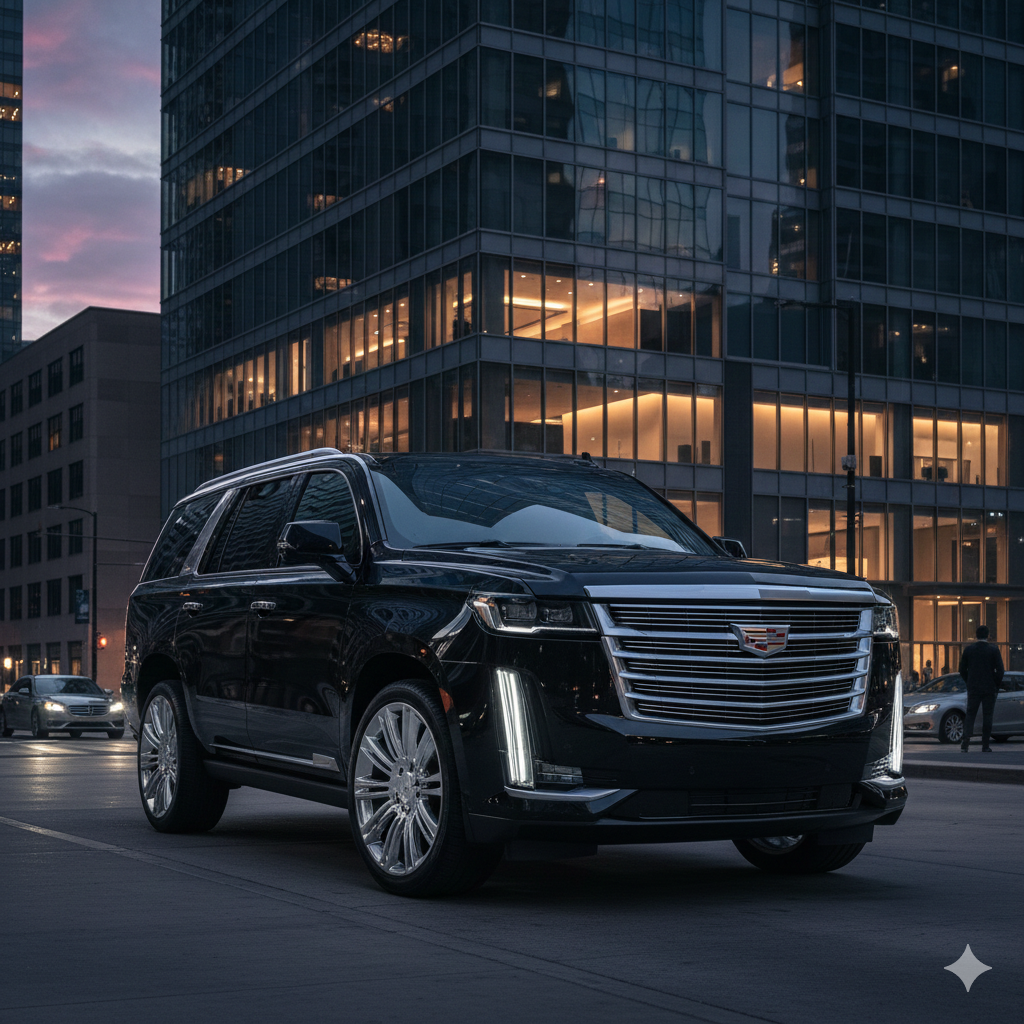
The design was completely new. Aggressive, imposing, with a vertical grille that screamed “get out of my way” without needing the horn. The engine was a 345 hp 6.0L Vortec V8, enough to move its nearly 6,000 lbs with authority. The interior, finally, lived up to the crest: hand-stitched leather, real wood, and a Bose sound system that turned the cabin into a concert hall.
But what truly launched the Escalade into the stratosphere wasn’t engineering. It was culture.
The Escalade and Hip-Hop: A Perfect Marriage
You cannot tell the story of the Escalade without talking about hip-hop. And you cannot talk about early 2000s hip-hop without mentioning the Escalade.
The timing was perfect. The second-gen Escalade hit the market just as hip-hop was becoming America’s dominant cultural force. Jay-Z, Notorious B.I.G., 50 Cent, Ludacris, Lil Wayne—they all drove Escalades. Not because Cadillac paid them (at least not at first), but because the Escalade embodied exactly what hip-hop celebrated: visible success, tangible power, and an absolute refusal to apologize for it.
The Escalade is mentioned in more than 250 hip-hop songs. It has more shout-outs in music than any other vehicle in history. That’s not a minor stat: it means the Escalade transcended being a product to become a cultural symbol.
In MTV and BET music videos, the Escalade was omnipresent. Usually black, usually on 24-inch rims or larger, usually with tint so dark it was illegal. The message was clear: “I’ve arrived. Don’t ignore me.”
The relationship between the Escalade and hip-hop was so potent it changed who bought Cadillacs. For decades, the typical Cadillac customer was over 60. The Escalade sent that average age into a nosedive. Suddenly, 25-year-old athletes, 30-year-old rappers, and 35-year-old entrepreneurs wanted a Cadillac. Not a DeVille. Not a Seville. An Escalade.
Numbers of the Beast
To understand the magnitude of the Escalade, you have to look at the figures: The Escalade generates approximately 25-30% of Cadillac’s total profits as a single model. The profit margin per unit is estimated at over $20,000, one of the highest in the industry. In its best years, Cadillac sold more than 35,000 Escalades annually in the U.S. alone, with an average price exceeding $100,000 for current versions.
The Escalade ESV (long-wheelbase) and the Escalade-V (high-performance) have pushed prices into territory once reserved for European brands. A 2024 Escalade-V exceeds $155,000 before options. That is Porsche Cayenne Turbo and Range Rover territory. And people buy them without blinking.
Evolution: From Truck to Throne
Every generation of the Escalade has represented a significant leap:
- First Generation (1999-2000): The Yukon in a borrowed suit. 5.7L Vortec V8. Mediocre interior. But it established the name.
- Second Generation (2002-2006): The awakening. Bespoke design. 6.0L V8. Interior worthy of the price. The Escalade EXT—a luxury pickup on the Avalanche platform—was a wonderful madness that nobody asked for but many people bought.
- Third Generation (2007-2014): Refinement. 403 hp 6.2L V8. Magnetic Ride Control—the same magnetic suspension as the Corvette. The first Escalade you could drive on a European highway without feeling (completely) out of place.
- Fourth Generation (2015-2020): Technology. CUE infotainment (hated by many, but a touchscreen pioneer). The first Escalade that truly tried to compete with the Germans in interior refinement. It didn’t quite get there, but it got close.
- Fifth Generation (2021-Present): The masterpiece. A 38-inch curved OLED screen spanning the dashboard. 420 hp 6.2L V8 or a 3.0L Duramax inline-6 diesel. Super Cruise—hands-free semi-autonomous driving. AKG Studio Reference with 36 speakers and 28 channels. And the Escalade-V: a 682 hp supercharged V8 in a 6,200 lb SUV. It is the most glorious insanity GM has produced this century.
The Escalade-V: When Sanity is Optional
The Cadillac Escalade-V deserves its own paragraph because it represents exactly the philosophy that makes the American automobile great: “Because we can, we must.”
Is it reasonable to put a 682 hp supercharged engine in an SUV that weighs nearly 3 tons? No. Is it necessary for a seven-passenger family car to do 0-60 in 4.4 seconds? Absolutely not. Is it an absurd piece of engineering art that makes you smile every time you hit the gas? Without a doubt.
The engine is the LT4, a 6.2-liter supercharged V8 derived from the Corvette Z06. It produces 682 hp and 653 lb-ft of torque. Those numbers, in a three-row SUV, are a statement of intent that needs no translation: this is America, and here, we go big or we go home.
The exhaust on the Escalade-V has a setting Cadillac discreetly calls “V-Mode.” In practice, it sounds like someone put a dragster inside a closet. Your neighbors will hate you. Your passengers will love you. It’s an acceptable trade-off.
Why the Escalade Matters
The Escalade matters because it proved something the European auto industry never wanted to accept: luxury doesn’t have a single definition.
To Mercedes, luxury is refinement, silence, and discretion. To BMW, it’s dynamic performance and driving purity. To Rolls-Royce, it’s exclusivity and craftsmanship.
For the Escalade, luxury is presence. It’s entering a parking lot and making sure everyone knows you’ve arrived. It’s having more space than a Manhattan apartment. It’s being able to carry seven people, their luggage, and a sound system that produces more decibels than a live concert. It’s not apologizing for taking up space.
The Range Rover tries to be discreet. The Mercedes GLS tries to be sophisticated. The BMW X7 tries to be sporty. The Escalade doesn’t try to be anything other than what it is: the biggest, loudest, most excessive, and most unapologetically American vehicle you can buy.
In a world of identical SUVs trying to be everything to everyone, that is priceless.
The Escalade as the Heir to Classic Cadillacs
There is a direct thread between the 1959 Eldorado with its massive tail fins and the 682 hp Escalade-V. It is the same DNA expressed in different eras.
The classic Cadillacs said: “I am the standard of the world, and I don’t apologize for it.”
The Escalade says the exact same thing. Only now, it says it with a supercharged V8, a 38-inch screen, and the backing of 250 hip-hop songs as its soundtrack.
At its core, the Escalade is the only modern Cadillac that understands what Cadillac was. Not a discreet car for people who want to look rich without drawing attention. But a rolling declaration that excess, when executed well, is a legitimate form of luxury.
The quintessential American truck. The throne on wheels. The ultimate in purposeful excess.
And yes, the 682 hp is absolutely necessary. Because if you’re going to take up that much space, you might as well do it with authority.
Not Enough Cylinders — Where cars are respected, or they aren’t mentioned.
Pingback: Cadillac History: The Rise and Fall of the Standard of the World