
DODGE CHARGER: The Flop That Became a Legend
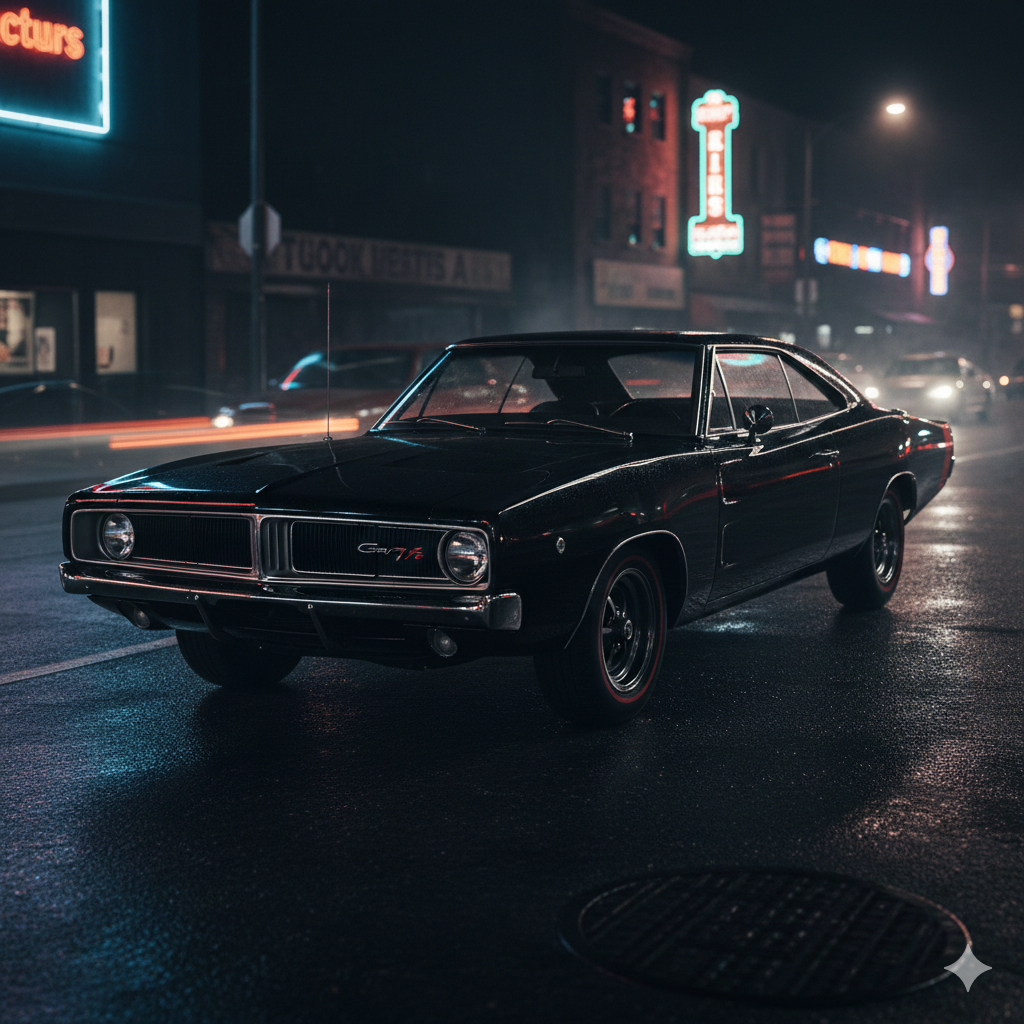
There is a delicious irony in the history of the Dodge Charger: the car that now stands as the quintessential American muscle car started as a commercial disaster.
The first 1966 Charger was… weird. It featured a pronounced fastback, fold-down rear seats, and a design critics described as “awkwardly futuristic.” Dodge sold 37,344 units—a respectable figure, but well below expectations. For comparison, the Pontiac GTO was selling twice as many, and the Ford Mustang was moving ten times that volume.
Chrysler had a problem: they had built a car people admired but didn’t buy.
1968: The Year Everything Changed
The Dodge design team, led by Carl Cameron and Bill Brownlie, went back to the drawing board with one mission: create the most aggressive muscle car ever seen.
The result was the 1968 Charger.
They stripped away everything non-essential. It had tight, straight lines, a “hidden” grille that vanished into the darkness, and “flying buttress” C-pillars that looked wind-tunnel tested (even though they barely were). The profile was so clean the car looked like it was moving while standing still.
The Charger R/T (Road/Track) came standard with the legendary 375 HP 440 Magnum. For those who wanted more, there was the 426 HEMI churning out 425 HP. To put that in perspective, a base 2026 Porsche 911 produces 379 HP.
Bullitt: 10 Minutes That Created a Myth
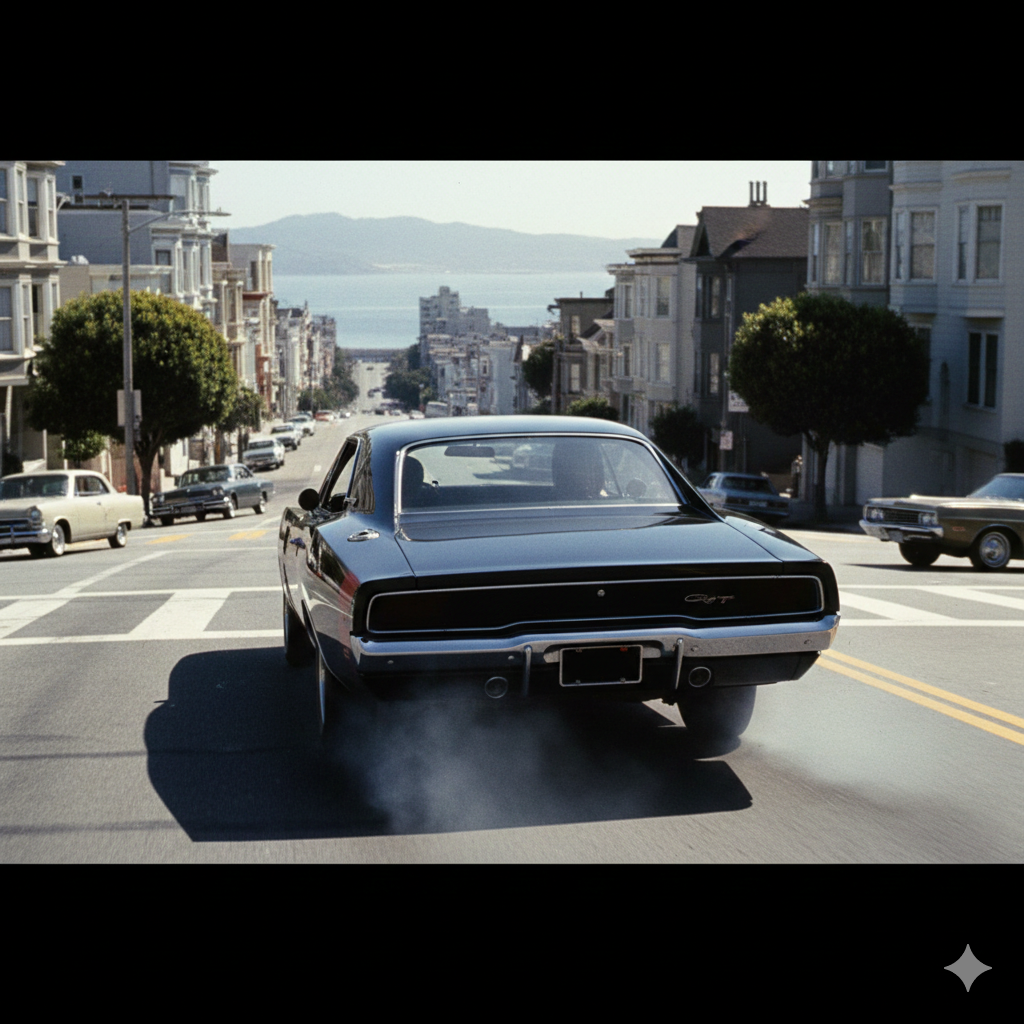
On October 17, 1968, Bullitt premiered starring Steve McQueen. The car chase lasts exactly 10 minutes and 53 seconds: McQueen in a Highland Green Ford Mustang GT 390 Fastback pursued by two hitmen in a Tuxedo Black Dodge Charger R/T 440.
That sequence changed cinema forever. Before Bullitt, car chases were theatrical and obviously fake. After Bullitt, every action movie wanted its own “moment.” Fast & Furious doesn’t exist without this film.
The Charger was the villain—black, menacing, and roaring like a demon. It lost the chase, but it won the culture war. Everyone remembered the Charger.
Disturbing Fact: Two Chargers were used for filming. One was so badly damaged it was crushed immediately. The other vanished. In 2017, a researcher reportedly found remains of the second Bullitt Charger in a Mexican scrapyard, though the story remains a subject of debate among enthusiasts.
The Dukes of Hazzard: 300 Sacrificed Chargers
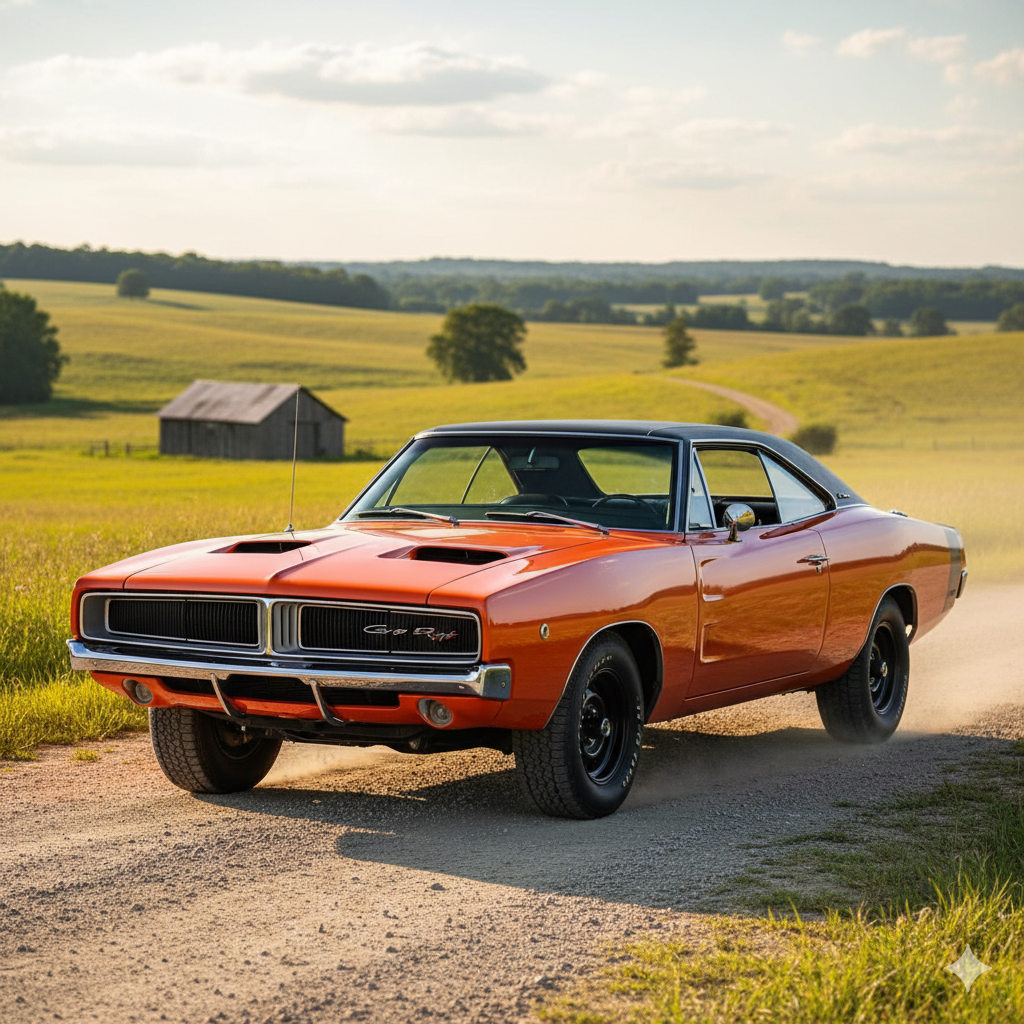
If Bullitt created the myth, The Dukes of Hazzard turned it into a religion. Between 1979 and 1985, the show featured the “General Lee,” a 1969 Charger painted orange with a Confederate flag on the roof and “01” on the doors.
The General Lee jumped. A lot.
Every jump destroyed a car. Suspensions collapsed, chassis buckled, and cars were rendered useless after a single take. Production destroyed approximately 309 Chargers from the 1968–1970 era. At the start, they paid $500 per car; by the end, they were paying $25,000 for shells in any condition.
The Result: A clean 1969 R/T today costs between $80,000 and $150,000. Part of that price is pure scarcity; Hollywood destroyed the rest for our entertainment.
The Evolution: 1966–1970
- 1966 (The Experiment): Polarizing fastback design with hideaway headlights and a full-length taillight. 37,344 units.
- 1967 (Minor Refinement): Redesigned grille and the 440 Magnum becomes available. Sales plummet to 15,788 units. Chrysler hits the panic button.
- 1968 (The Revolution): The “Coke Bottle” redesign by Bill Brownlie. Total sales: 96,108 units. An icon is born.
- 1969 (Perfection): Introduction of the divided grille and the 440 “Six Pack” (390 HP). This is the year used for the General Lee.
- 1970 (The Swan Song): Introduction of the “loop bumper” chrome wrap-around grille. High-impact colors like “Plum Crazy” take center stage.
Technical Specs: By the Numbers
| Model | Engine | HP | Torque | 0-60 mph | 1/4 Mile |
| R/T 440 | 7.2L V8 | 375 | 480 lb-ft | 6.5s | 14.0s |
| R/T HEMI | 7.0L V8 | 425 | 490 lb-ft | 5.3s | 13.5s |
| 440 Six Pack | 7.2L V8 | 390 | 490 lb-ft | 6.0s | 13.7s |
| Daytona | 7.0L HEMI | 425 | 490 lb-ft | 5.5s | 13.3s |
The Charger Daytona: Extreme Aero
In 1969, Dodge wanted to dominate NASCAR. The standard Charger was beautiful but aerodynamically disastrous at 200 mph. The solution was the Daytona: a 19-inch nose cone and a 23-inch tall rear wing.
It was the first car to officially break the 200 mph barrier in NASCAR history (Buddy Baker, Talladega, 1970). Only 503 units were built for homologation. Today, they fetch between $300,000 and $900,000.
Curiosities and Secrets
- The HEMI Guarantee Trick: HEMIs came with a very limited warranty. Dealers often “tuned” the carburetors before the first test drive, effectively bumping the “official” 425 HP to nearly 500 HP in reality.
- The Underrated Output: Chrysler intentionally underrated the HEMI’s horsepower to keep insurance premiums lower for buyers.
- The Rare Hue: “Plum Crazy Purple” was only available for one year (1970). Today, a Plum Crazy R/T carries a roughly 30% price premium.
- Steve McQueen’s Personal R/T: McQueen liked the movie car so much he bought a 1968 Charger R/T for his personal use after filming Bullitt. Its current whereabouts are unknown.
The Controversy: Greatest Muscle Car or Overrated Movie Star?
- The Critics: Argue that the Charger is famous for its film roles rather than technical superiority. They point out the GTO and Chevelle were often better built and that a street-driven HEMI was a maintenance nightmare.
- The Fans: Point to the 1968–1970 “Coke Bottle” styling as the pinnacle of automotive design and argue that cultural impact is a merit in itself.
My Take: The Charger is a fascinating case of art elevating engineering into myth. Is it technically the “best”? Maybe not. Is it the most culturally significant? Without a doubt.
Current Market (2026 Estimates)
- Base 1968 Charger: $35,000 – $55,000
- Charger R/T 440: $70,000 – $120,000
- Charger R/T HEMI: $150,000 – $250,000
- Charger Daytona HEMI: $500,000 – $1,000,000+
Conclusion: The Car Hollywood Built
The 1966–1970 Dodge Charger proves that a great product can fail if it lacks the right context. Without Bullitt, the Charger might be a footnote. With it, it became the most legendary villain in cinema. Without the Dukes, it might be affordable; with them, it’s a six-figure relic.
For Discussion: If a modern streaming giant made a series today with a Pontiac GTO as the hero car, would GTO prices skyrocket to Charger levels? Or is there something inherently “cinematic” about the Charger’s design that can’t be replicated?
Pingback: The 426 Hemi: The Most Legendary Muscle Car Engine Ever Built
Pingback: Ford Torino Talladega 1969: Historia y Guerras Aero