
The World’s Ugliest Car Just Smoked a Porsche at Le Mans
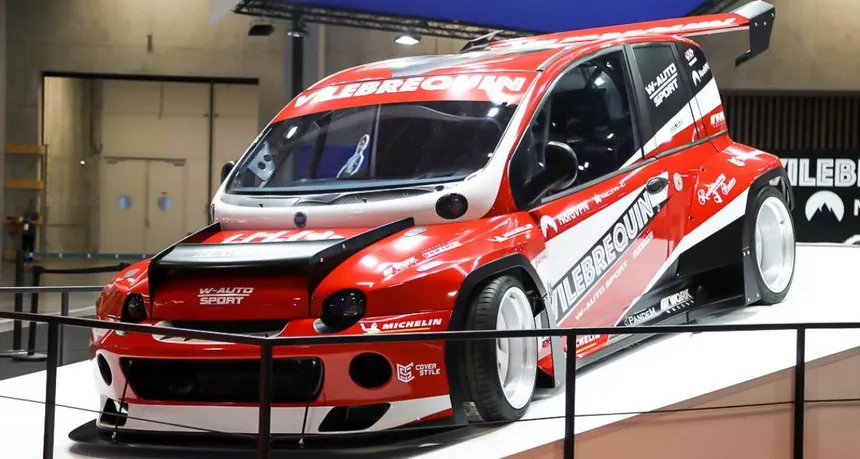
The Fiat 1000Tipla: A 1,294 HP Corvette-Powered Multipla Built with Crowdfunding Money, Japanese Aero, and Absolutely Zero Shame
Section: Builds & Swaps | Not Enough Cylinders
There are very few things the entire automotive world agrees on. BMW purists and JDM fanboys rarely see eye to eye. Tesla bros and V8 die-hards occupy different planets. But there’s one universal truth that transcends every automotive tribe on Earth: the Fiat Multipla is the ugliest car ever made.
The Telegraph ranked it #2 on their 100 Ugliest Cars list. Car Throttle readers crowned it the undisputed champion of automotive hideousness. The Sunday Times compared it to the Elephant Man — a genuinely clever and spacious interior, tragically trapped inside a body that makes you want to walk instead.
So naturally, two French YouTubers decided to drop a supercharged Corvette V8 in one, build 1,294 horsepower, and send it to nearly 182 mph down the Mulsanne Straight at the 24 Hours of Le Mans.
They called it the 1000Tipla. And it’s the fastest, most absurd, most gloriously unhinged minivan that has ever existed.
Americans, meet the car you never knew you needed to know about.
The $50,000 Joke That Raised $1.2 Million
For context: the Fiat Multipla was never sold in the United States. It’s a six-seat compact MPV that Fiat made from 1998 to 2010 — shorter than a VW Golf but wider than a Mercedes S-Class, with three seats across in both rows. Think of it as a miniature minivan with a face that only a mother could love, if the mother was also visually impaired.
In September 2020, Sylvain Lévy and Pierre Chabrier — the creators of Vilebrequin, one of France’s biggest automotive YouTube channels — launched a crowdfunding campaign on the French platform KissKissBankBank. The pitch was simple: buy a Fiat Multipla and build it to 1,000 horsepower.
The fundraising goal was €50,000 (roughly $55,000 at the time).
They raised €1,096,111. From 19,000 backers.
What started as an internet joke now had the budget of a serious racecar build. And Sylvain and Pierre, who’d bought a random Multipla online expecting to make a funny video, suddenly had the responsibility of delivering a car worthy of 19,000 people’s trust and money.
What followed was a two-and-a-half-year build that involved elite French motorsport fabricators, a legendary Japanese bodykit designer, a tire manufacturer as a major sponsor, and a car that would eventually lap the Le Mans circuit during its 100th anniversary celebration.
The American Donor: A Wrecked Corvette C7 Z06
The first engineering reality check was obvious: you can’t make 1,000 HP work on a Fiat Multipla chassis. The original platform, based on Fiat’s Bravo/Brava semi-spaceframe architecture, was designed for a maximum of 186 HP from the 1.9 JTD diesel. Multiplying that by seven requires a fundamentally different approach.
Vilebrequin found the answer in a shipping container from the United States: a crashed Chevrolet Corvette C7 Z06. The Z06’s beating heart is the LT4 — a 6.2-liter supercharged V8 making 650 HP stock, paired with an eight-speed automatic transmission and a lightweight aluminum chassis designed for serious performance.
The plan: use the entire Corvette as the mechanical foundation and mount the Multipla’s body on top. Sounds straightforward on paper. It wasn’t.
W Auto Sport, the build shop, handled the mechanical integration. They reinforced the structure with tubular elements, adapted the body mounting points to the Corvette’s frame, and replaced the factory suspension with competition coilovers. What emerged was neither Multipla nor Corvette — it was something entirely new wearing one car’s face and carrying another’s guts.
For American readers who know their Corvettes: imagine gutting a Z06 and then disguising it as the world’s ugliest European family van. That’s the 1000Tipla.
From 650 to 1,294 HP: Building the Beast
The LT4 is already a formidable engine straight from General Motors — aluminum block, 6.2 liters, Eaton 1.7-liter supercharger, direct injection, variable valve timing. In factory spec, it makes 650 HP and 650 lb-ft.
But 650 isn’t 1,000. And Vilebrequin hadn’t raised a million euros to come up short.
W Auto Sport attacked every internal component. New crankshaft — fitting, since “vilebrequin” literally means “crankshaft” in French, and also the name of the YouTube channel. New injectors. Modified supercharger for increased boost. Custom engine maps developed specifically for the project.
When dyno day arrived, the car had to be partially disassembled just to fit on the rollers. The repeated high-power runs actually damaged the dyno itself and required repairs before testing could continue. The power level was so extreme that it broke the measuring equipment.
The verdict: 1,294 HP and 1,166 lb-ft of torque.
That’s 29.4% over the stated goal. The speedometer indicated 237 mph during testing, though that figure needed track confirmation.
For perspective: a Ferrari 812 Superfast makes 789 HP. A Lamborghini Aventador SVJ makes 770 HP. A Dodge Viper ACR — the pinnacle of American V10 performance — makes 645 HP. The ugliest minivan ever built outguns all of them. Combined, nearly.
Japanese Style on Italian Ugly: Rocket Bunny and Work
If the mechanicals were American, the aesthetics were going to be Japanese.
Vilebrequin reached out to Kei Miura, founder of Rocket Bunny (TRA Kyoto) — one of the most respected bodykit designers on the planet. Miura has created iconic widebody kits for the Toyota GT86, Nissan 370Z, BMW E36, and dozens of other platforms. Designing a custom widebody for a Fiat Multipla was probably not on his professional bucket list.
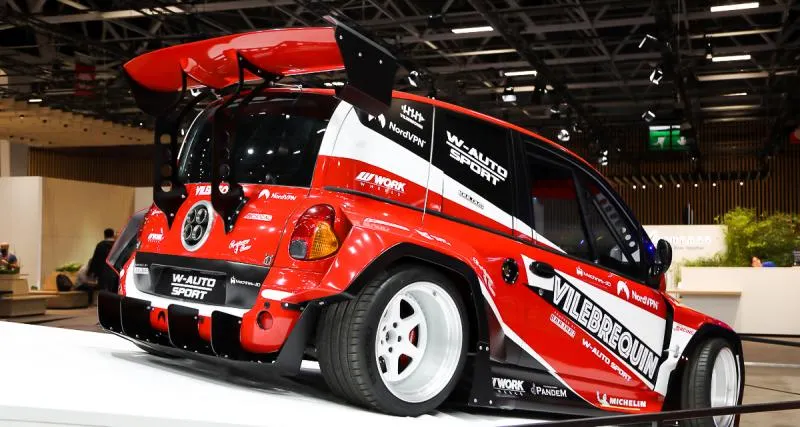
The result is a bespoke kit that transforms the Multipla from “grocery-getter for European families” to “something that might have raced in DTM if DTM had completely lost its mind.” Massive fender flares, functional air intakes, and a rear wing that belongs in a different aeronautic dimension. The exhaust is a quad-tip center-exit setup reminiscent of Pagani’s design language — four chrome tips that not only evacuate the V8’s gases but generate a measured 129 decibels. For reference, that’s louder than a rock concert at full volume, and it’s why the car is banned from most French circuits under standard noise regulations.
The wheels are Work — manufactured exclusively for the project. The tires are Michelin Pilot Sport 4S in specific sizes — Michelin being a project sponsor, providing premium rubber for a car that, honestly, represents everything a premium tire brand’s marketing department should want to avoid associating with.
The livery went through multiple iterations. Initially blue and yellow as a nod to Michelin, it was changed to red, white, and black after internet backers expressed their displeasure. Crowdfunding democracy applies to paint colors too.
Le Mans: When the Multipla Conquered the Mulsanne
On June 4, 2023, the 1000Tipla made its track debut at Magny-Cours during an event called, perfectly, the Merguez Tuning Show. It ran, it worked, and it was fast.
Three days later, something happened that nobody could have predicted when Sylvain and Pierre bought a Multipla online in 2020.
On June 7, 2023, during the Centenary edition of the 24 Hours of Le Mans, the 1000Tipla performed demonstration laps on the Circuit de la Sarthe. The same asphalt that has been graced by the Porsche 917, the Ford GT40, the Audi R18, the Toyota GR010. And now, a Fiat Multipla with a Corvette engine.
To film the event, a Porsche 997 Turbo built to GT2 RS specifications — approximately 750 HP — served as the camera car, equipped with $75,000 worth of filming gear. The plan was for the Porsche to run ahead and capture footage of the Multipla in action.
The Multipla left the Porsche behind on the first acceleration.
Sylvain took the wheel for the first four laps. On his first pass down the Mulsanne Straight — the same straight where Le Mans prototypes hit 210+ mph — the Multipla registered 174 mph in sixth gear. Over the following laps, speeds climbed slightly, but both drivers were more struck by the car’s instability than its velocity. At high speed, the body wasn’t rigid enough for the power, and lateral movements were deeply unsettling.
Pierre drove the next four laps, also touching 174 mph despite a gearbox issue and escalating interior temperatures. After eight laps — roughly 62 miles of circuit — the passenger window had started detaching from the frame and the 21-gallon fuel tank was bone dry.
Top speed recorded: 181.8 mph (292.6 km/h).
A Fiat Multipla. At 181.8 mph. At Le Mans.
The Espace F1’s Spiritual Successor
There’s one inevitable comparison for the 1000Tipla, and it’s the 1994 Renault Espace F1 — another European people carrier turned into a weapon of mass acceleration. The Espace F1 used the Williams FW14 Formula 1 chassis with a 3.5-liter V10 making 820 HP, wrapped in a Renault Espace body shell. It was presented as a technological demonstration — pure corporate showmanship.
But there was a fundamental difference: the Espace F1 required a full technical crew to start it. It was, in essence, an F1 car in a minivan costume.
The 1000Tipla can be started by one person. It has Apple CarPlay. It can run on a circuit without an army of engineers. It is, within the limits of a car that produces 129 decibels and empties 21 gallons of fuel in 62 miles, a functional vehicle.
And that makes it, in some ways, more impressive than the Espace F1. It’s not a corporate concept built by a marketing department with an unlimited budget. It’s the result of a joke, a community of 19,000 people, and two guys who refused to accept that “putting 1,000 HP in a Multipla” was just a meme.
In October 2025, the 1000Tipla returned to Le Mans as the official Pace Car for GP Explorer 3, an event that brings internet creators together for Formula 4 racing. Sylvain Lévy drove the laps with Pierre Fillon — president of the Automobile Club de l’Ouest, the organization that runs the 24 Hours of Le Mans — riding shotgun.
The president of endurance racing’s most prestigious institution, sitting in a 1,294 HP Fiat Multipla. The circle was complete.
Why Americans Should Care About the 1000Tipla
You’ve never seen a Fiat Multipla in person. It was never sold here. But the 1000Tipla’s story transcends borders because it represents something universal: the garage builder’s ethos at internet-era scale.
In America, the spirit of turning something absurd into something fast lives in every barn-find Chevelle with a big-block, every LS-swapped Miata, every turbo K-series Civic that embarrasses supercars at the dragstrip. The 1000Tipla is that same spirit — amplified through the lens of European car culture, French humor, Japanese design, and American muscle.
It also sits in excellent company within the pantheon of absurdist performance vehicles: alongside the Ford SuperVan, the Renault Espace F1, the various V8-swapped Priuses that populate YouTube, and — in our own Builds & Swaps section — the DOP Motorsport twin-engine VW Lupo that runs 7.71 in the quarter-mile.
These are the builds that remind us why we love cars. Not because they make sense. But because they make us feel something.
Technical Specifications: Fiat 1000Tipla by Vilebrequin x W Auto Sport
| Specification | Detail |
|---|---|
| Visual base | Fiat Multipla (Type 186, 1st generation, 1998-2010) |
| Mechanical base | Chevrolet Corvette C7 Z06 (salvage) |
| Builders | Vilebrequin (Sylvain Lévy + Pierre Chabrier) + W Auto Sport |
| Engine | GM LT4 6.2L supercharged V8 (Eaton blower) |
| Stock power (Corvette) | 650 HP / 650 lb-ft |
| Tuned power | 1,294 HP / 1,166 lb-ft |
| Transmission | 8-speed automatic (Corvette origin) |
| Drivetrain | RWD |
| Chassis | Corvette C7 Z06 aluminum + tubular reinforcement |
| Suspension | Competition coilovers |
| Bodykit | Kei Miura / Rocket Bunny (Japan), bespoke design |
| Wheels | Work (Japan), exclusive to project |
| Tires | Michelin Pilot Sport 4S (project-specific sizes) |
| Exhaust | Quad-tip center-exit (Pagani-inspired) |
| Weight | ~3,086 lbs (1,400 kg) |
| Noise level | 129 dB |
| Recorded top speed | 181.8 mph / 292.6 km/h (Le Mans, June 2023) |
| Dyno indicated speed | 237 mph / 381 km/h (unconfirmed) |
| 0-60 mph | ~2.5 sec (estimated) |
| Funding | Crowdfunding: €1,096,111 (~$1.2M) / 19,000 backers |
| Public debut | Paris Motor Show (Mondial de l’Auto), October 2022 |
| First track outing | Merguez Tuning Show, Magny-Cours, June 4, 2023 |
| Le Mans | Centenary edition demo, June 7, 2023 |
| Latest appearance | GP Explorer 3, Le Mans Bugatti, October 2025 (Official Pace Car) |
Project Timeline
| Date | Milestone |
|---|---|
| 2017 | Sylvain Lévy and Pierre Chabrier launch the Vilebrequin YouTube channel |
| Sept. 2020 | Crowdfunding on KissKissBankBank. Goal: €50K. Result: €1.09M from 19,000 backers |
| 2020-2021 | Wrecked Corvette C7 Z06 acquired from the US. Bodykit design with Kei Miura (Rocket Bunny) |
| 2021-2022 | Build at W Auto Sport. Engine prep, chassis integration, Work wheels, Michelin tires |
| Oct. 2022 | Unveiled at Paris Motor Show. Jean Todt (ex-Ferrari F1 boss) visits the stand |
| Feb. 2023 | Dyno day: 1,294 HP / 1,166 lb-ft confirmed |
| June 4, 2023 | First public track outing: Merguez Tuning Show, Magny-Cours |
| June 7, 2023 | Demo laps at Le Mans (Centenary). Top speed: 181.8 mph (292.6 km/h) |
| Oct. 2025 | Official Pace Car at GP Explorer 3 with ACO president Pierre Fillon on board |
Original feature by Not Enough Cylinders for the Builds & Swaps section. Data verified through Motor1.fr, Carscoops, L’Argus, AutoHebdo, 24h-lemans.com, ItalPassion, CarMag, and the original KissKissBankBank campaign page.
Know a build that deserves the Builds & Swaps treatment? Hit us up.