
Fiat Multipla: The World’s Ugliest Car That Was a Misunderstood Genius
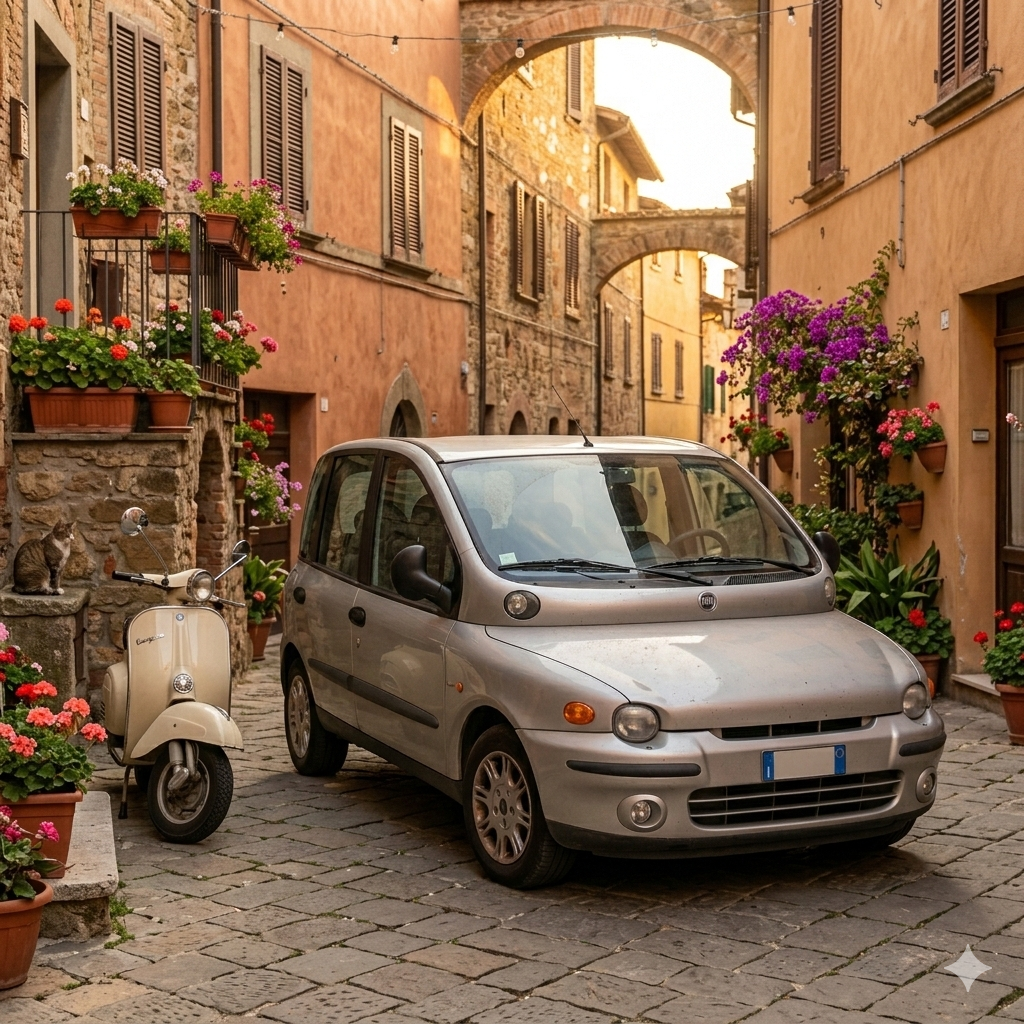
There are cars that when you first see them make you think: “This is a design mistake.” The 1998 Fiat Multipla provoked that reaction across practically the entire planet. It was repeatedly voted the ugliest car ever made. It became a meme before the word meme existed. Its front end looked like the result of a collision between two different cars that decided to stay together for the children’s sake.
And yet, the Multipla was one of the smartest, most functional, and most revolutionary cars of its era. And for those of us with eyes that see beyond the surface, its design holds a crushing logic that most people never bothered to understand.
The Design: Method in the Madness
The Multipla’s design was the work of Roberto Giolito, the same designer who years later would create the adorable 2007 Fiat 500 that everyone loves. The irony is delicious: the man who designed the world’s ugliest car also designed one of its most beautiful. And far from being accidental or contradictory, both designs share the same fundamental philosophy: form follows function with absolute courage.
Giolito wasn’t crazy. The Multipla had an extremely specific and challenging design brief: create a car capable of transporting six people in two rows of three genuinely usable seats, with a maximum width not exceeding the 1.87 meters needed to navigate the narrow alleys and parking spaces of Italian cities. Additionally, it had to offer exceptional driver visibility and interior versatility never seen in a car its size.
The solution was radical. Instead of making a tall, narrow minivan like the competition, Giolito opted for a dual-level front structure that broke every aesthetic convention of the time. The lower section housed the main headlights and mechanical elements. The upper section, separated by a plastic band running the vehicle’s entire perimeter, contained small additional lights and ventilation ducts.
This intermediate band wasn’t an aesthetic whim or an execution error. It was a packaging engineering solution: it housed the main electrical wiring and climate control ducts, freeing precious interior space that would otherwise have been impossible to utilize. Every centimeter of the Multipla was thought through, calculated, and justified by a functional reason.
The visual result was undeniably shocking. The car appeared to have two faces superimposed, as if someone had cut the upper half of one vehicle and glued it onto the lower half of another. But functionally, it was brilliant: visibility from inside was panoramic, almost bubble-like. Space for six adults was genuinely comfortable, not like those emergency third-row seats that nobody with legs can actually use. And all this in a length of just 3.99 meters, shorter than a contemporary Volkswagen Golf.
The Chassis: Invisible Innovation
One of the Multipla’s least known and most innovative aspects was its structure. Contrary to what many assumed, the Multipla didn’t directly use the Fiat Bravo/Brava platform, though it shared some components with that family. It was actually built on a bespoke semi-spaceframe chassis, a technical solution more typically associated with sports cars than family minivans.
This semi-tubular chassis concept offered several fundamental advantages. It allowed far greater design flexibility than a conventional platform, facilitated the use of high-strength steels to reduce weight without compromising safety, and most importantly for the Multipla concept: it provided a completely flat floor without the central transmission tunnel that intrudes in most front-wheel-drive cars. This flat floor was essential for the three front seats to be genuinely usable rather than merely a marketing curiosity.
Interior: Where the Genius Became Evident
If the exterior was controversial, the interior was where the Multipla won absolutely every battle against its detractors. The 3+3 layout meant three individual front seats and three rear seats, all independent, all reclining, and all completely removable without special tools.
The interior could be configured in dozens of different ways: six full-use seats, five seats with enlarged trunk by removing one rear seat, four seats with generous cargo area, or even as a light van with all rear seats and the front center seat removed. The versatility was genuine and practical, not theoretical.
The dashboard was centrally mounted, a design concept that anticipated trends by a decade. Instruments were grouped in a pod above the steering column. The gear lever was positioned on the dashboard rather than the floor, a decision that completely freed the space between the three front seats and allowed unobstructed passage from one side of the cabin to the other.
Material quality was surprisingly good for a Fiat of the era, a period when the Italian brand didn’t exactly enjoy the finest reputation for interior finishes. The seats were genuinely comfortable even on long-distance journeys. The boot, with all six seats in use, was admittedly small, but with the rear row removed, it transformed into an enormous and accessible cargo area.
The Mechanics: Honest and Efficient
Under the hood, the Multipla offered a deliberately sensible engine range that didn’t pretend to be exciting but rather functional. The most popular was the 1.6 16V petrol producing approximately 103 hp, sufficient to move the roughly 1,300 kg car with dignity if not sportiness. Also available was the excellent 1.9 JTD turbodiesel with 105 hp, a common-rail unit providing generous low-end torque ideal for a family car frequently carrying six occupants and luggage.
The most innovative option was the compressed natural gas (methane) bipower version, making the Multipla one of the first genuinely viable eco-friendly cars in the European market, years before sustainability became a mandatory sales argument. The natural gas tanks fitted perfectly beneath the semi-spaceframe’s flat floor, stealing not a single centimeter from cabin or boot space. An elegant integration solution that went completely unnoticed by the general public because of that impossible front end.
The suspension used MacPherson struts at the front and a torsion beam at the rear. It wasn’t a car for racing and never pretended to be, but its dynamic behavior pleasantly surprised anyone who gave it a chance: the center of gravity was low for a minivan thanks to the chassis layout, and the generous track widths provided cornering stability you simply didn’t expect from a car that looked like that.
The Reception: Equally Hated and Loved
When the Multipla debuted at the 1998 Geneva Motor Show, reactions reached an extreme polarization with no possible middle ground. The specialist press split violently between those who considered it an unforgivable aesthetic disaster and those who recognized its functional genius as a triumph of honest industrial design. Awards reflected this schizophrenic duality: it won best family car awards from publications like Top Gear, while simultaneously being voted the ugliest car in practically every popular poll.
Sales were reasonably good in Italy, where automotive culture is historically more receptive to daring designs and where the Multipla’s functionality on the narrow urban streets of Rome, Naples, or Florence was immediately evident to any driver. In the rest of Europe, sales were more modest, inevitably hampered by a design that many potential buyers simply couldn’t accept even after sitting inside.
In 2004, Fiat succumbed to commercial pressure and significantly redesigned the front end, softening the lines, eliminating the dual band, and giving it a much more conventional and anonymous appearance. Ironically, the original “ugly” version is now the most sought-after and valued by collectors and enthusiasts, while the 2004 “pretty” version is universally considered a cowardly concession to aesthetic conformism.
The Engine Swaps: When Enthusiasts Give It Wings
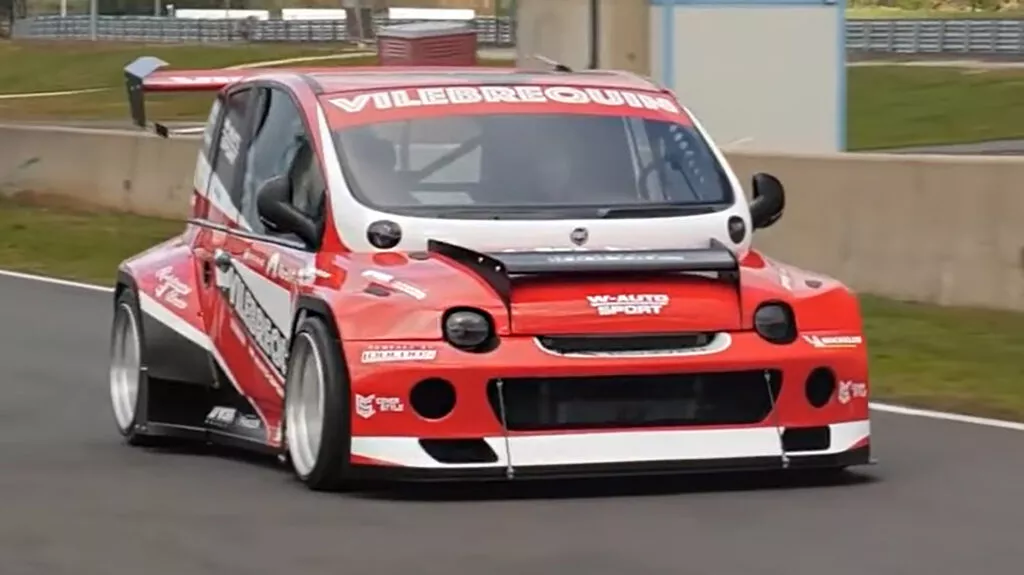
The Multipla enthusiast community has produced some truly demented modification projects that elevate the car to legend status in European tuning culture. The best documented are the work of Polish and British mechanics who decided to exploit the Multipla’s semi-spaceframe chassis possibilities to create absolutely ridiculous family sleepers.
The most famous verified project is a Multipla that received the Fiat Coupé’s 2.0 20V Turbo five-cylinder engine, a relatively feasible swap because the Fiat engine family shares certain mounting dimensions. The result is a family minivan with over 200 hp and a five-cylinder sound that nobody expects to hear coming from a Multipla. Photographic documentation and testimonials exist on forums like PistonHeads confirming at least one example with a front-mounted intercooler peeking beneath the bumper and twin exhaust outlets.
Another project confirmed by the online community is a Multipla fitted with the legendary Alfa Romeo V6 Busso engine transplant, a surgical engineering operation that turns the Multipla into something defying all logic: a six-seat minivan with the sonic heart of an Alfa Romeo GTV.
These projects represent everything that makes car culture great: limitless creativity, mechanical humor, rebellion against convention, and pure passion for engineering as a form of personal expression.
I Actually Like It: Defending the Indefensible
I’m going to say something that will probably cost me followers: I like the Multipla. I find its design honest, brave, and coherent with its purpose. In a world of cars that all look alike, designed by the same aerodynamic optimization software and approved by the same marketing focus groups, the Multipla had the almost kamikaze courage to be different.
It wasn’t different by accident. It wasn’t different through incompetence. It was different because function dictated form with brutal honesty, making no concessions to buyer vanity or market conformism. Every controversial line on the Multipla has an engineering reason for being. Every centimeter of that strange design is optimized for real-world use by real people. And that, for anyone who understands industrial design beyond magazine covers, is infinitely more respectable than a beautiful car that sacrifices functionality for aesthetics.
The Multipla proved that the automotive industry can be brave. That a manufacturer can risk being ridiculed to maintain the integrity of a design that prioritizes people over appearance. In a world obsessed with the superficial, the Multipla was the car that said: “I don’t care what you think about how I look. Sit inside and tell me if it works.”
Legacy: More Influential Than You Think
The Multipla ceased production in 2010, and Fiat has never produced a direct successor. But its influence runs deeper than it appears at first glance. The three-front-seat concept reappeared years later in vehicles like certain experimental Tesla configurations. The idea of a compact minivan with genuine space for six influenced the development of a generation of vehicles that prioritized interior space over conventional proportions.
Today, the original Multipla has become a cult car with a growing community. Prices are beginning to rise modestly, especially for well-preserved first-generation examples with the original front end. There are dedicated fan clubs, annual meetups, and an online community that defends the car with a passion its detractors will never understand, because they never took the trouble to sit inside.
The Fiat Multipla was the car that dared to be ugly in order to be brilliant. And nearly thirty years later, its audacity remains fresher and more relevant than any generic SUV sold at a dealership today.
Pingback: Fiat 1000Tipla: 1,294 HP Corvette-Powered Multipla at Le Mans