Ford Boss 302 vs Boss 429: Ford Built Two Race Engines for Two Different Wars. And Won Both.
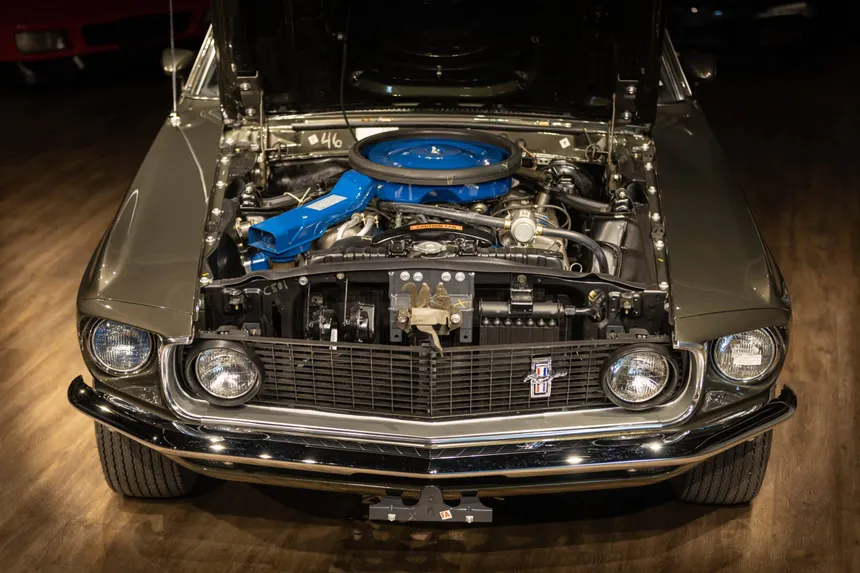
In 1969, Ford presented the world with two of the most radical engines it had ever installed in a road car. Both carried the “Boss” name. Both lived in the Mustang. Both existed for reasons that had very little to do with selling cars to the public and everything to do with winning championships.
But that’s where the similarities end.
The Boss 302 and Boss 429 are, in essence, two completely opposing engine philosophies compressed under the same hood with the same last name. One was a high-revving engine for twisting road courses. The other was a semi-hemispherical giant built to dominate banked superspeedway ovals at 200 mph. One was born to kill the Camaro Z/28 through Trans-Am corners. The other was born to kill the Chrysler 426 Hemi on the straights of Daytona.
This is the story of the two wars Ford fought simultaneously in 1969, and the two engines it built to win them.
The Context: Ford in 1968 Was Losing on Every Front
By late 1968, Ford’s competition situation was uncomfortable on multiple simultaneous fronts.
In Trans-Am — the road racing series contested mostly on technical, twisty circuits with a 5-liter displacement limit — Chevrolet dominated with the Camaro Z/28. The Z/28 used the 302 Camaro, an engine specifically designed for that series, with free-flowing heads and a high-revving nature that worked perfectly on a road course. Ford’s Mustang, with its restrictive Windsor heads, had no competitive answer.
In NASCAR, the story was different but equally frustrating. Chrysler had been crushing everyone for years with the 426 Hemi — the legendary semi-hemispherical engine that produced absurd power figures that rival manufacturers simply couldn’t counter. Ford needed an engine capable of competing with the Hemi on the banked superspeedway ovals of Daytona and Talladega.
Two wars. Two completely different types of track. Two completely different types of engine.
Ford made a bold decision: build both simultaneously, and sell both in the street Mustang to satisfy each series’ homologation requirements.
THE BOSS 302: The Engine That Cheated Better Than Anyone
The Genesis: Cleveland + Windsor = Something That Didn’t Exist
Ford’s Trans-Am problem was technical and specific. SCCA regulations limited displacement to exactly 5 liters — the 302 cubic inches of the Ford Windsor were perfect in that regard. The problem was that the era’s Windsor block used cylinder heads with small valves and restrictive ports that severely limited airflow and therefore high-rpm power.
Ford had in development a new engine, the 351 Cleveland, which used a revolutionary head design: canted valves tilted at different angles for intake and exhaust, creating a semi-spherical combustion chamber with significantly better airflow. The 351 Cleveland wouldn’t be in production until 1970. But the heads already existed.
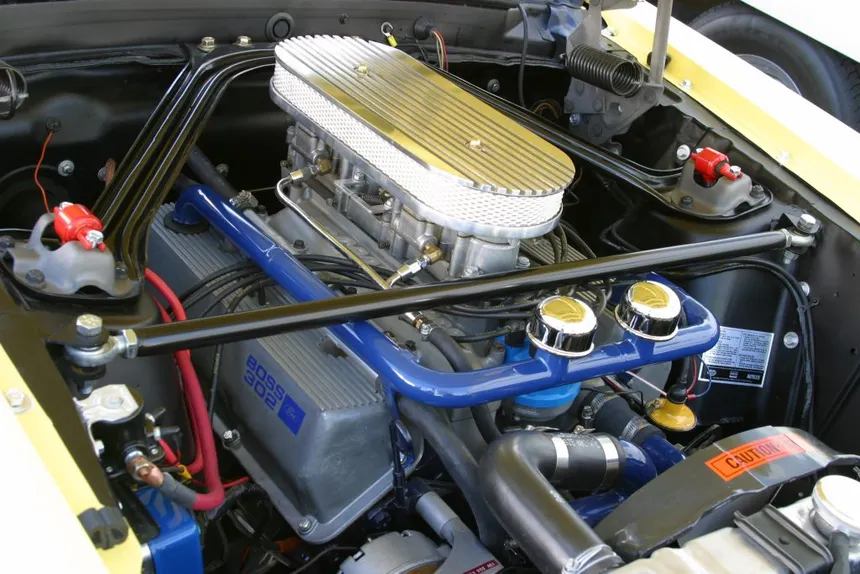
The Ford engineer who solved the problem probably deserved a raise he never received: he confirmed that the 351 Cleveland’s head bolt pattern was the same as the Windsor 302 block’s. Not identical — the coolant passages needed minor modification — but compatible. The solution was to join what had never been joined before: Cleveland heads on a Windsor 302 block.
The result was the Boss 302. An engine that technically didn’t exist, built from two different engine families, that would turn out to be exactly what Ford needed to compete in Trans-Am.
The Specifications: A Small Block That Thought Big
- Displacement: 302 cubic inches (4.9 liters)
- Configuration: Small-block V8, OHV
- Cylinder heads: Canted-valve 351 Cleveland type, modified
- Intake valves: 2.23 inches (enormous for a 302)
- Exhaust valves: 1.71 inches, sodium-filled for cooling
- Camshaft: Competition profile with solid lifters
- Crankshaft: High-strength forged steel, cross-drilled (1969), eliminated in 1970 for improved reliability
- Connecting rods: 289 Hi-Po type, reinforced, capable of handling ~8,000 rpm
- Block: Four-bolt main caps, screw-in freeze plugs, higher nickel content for enhanced strength
- Carburetor: 780-CFM Holley four-barrel
- Compression: 10.5:1
- Declared output: 290 hp at 5,200 rpm and 290 lb-ft at 4,300 rpm
- Real output: Period dynamometer data suggests 310-390 hp depending on configuration
It also incorporated a rev limiter mounted in the fender well that cut ignition at 6,150 rpm on street cars. Race cars naturally removed it, and the engine’s real safe-rev ceiling in track configuration was around 7,500-8,000 rpm.
In Trans-Am: 1969 and 1970
The Boss 302 debuted in Trans-Am in 1969. The first season was challenging: tire trouble with the Firestones used and a pit stop operation that Roger Penske — running the Camaro Z/28s — had refined to near-military precision left Ford at a disadvantage despite the engine’s competitiveness. Parnelli Jones and George Follmer drove the Bud Moore team’s Boss 302 Mustangs aggressively but without enough fortune for the title.
In 1970, everything changed. The Bud Moore team switched to Goodyear tires, refined pit procedures, and ran Parnelli Jones consistently at the front. The result was the capture of the Trans-Am manufacturers’ championship, taking it away from Chevrolet. Ford had won the first war.
Race-spec Boss 302 engines, freed from street component restrictions, produced around 470-500 hp at over 7,500 rpm using dual Holley Dominator carburetion and complete internal preparation. They were engines that never existed in a street car but could only exist because Ford built enough street examples to satisfy SCCA homologation requirements.
THE BOSS 429: The Trojan Horse of Daytona
The Genesis: Killing the Hemi
If the Boss 302 was an exercise in clever engineering, the Boss 429 was outright industrial warfare.
Chrysler’s 426 Hemi had dominated NASCAR since the mid-60s. Its hemispherical combustion chamber design — practically identical in principle to what was used in World War II aircraft engines — allowed enormous gas flow, high effective compression ratios, and power figures its rivals simply couldn’t match. In NASCAR configuration, the Hemi produced numbers that made Ford engineers pale.
Ford responded with the 385-series big block family, introduced for 1968. The 385-series 429 was a modern design, with a 90-degree bank angle and near-square dimensions (4.36-inch bore by 3.59-inch stroke). But the standard production version, while powerful, didn’t have the characteristics NASCAR demanded.
Ford engineers developed a special 429 variant with completely new aluminum cylinder heads using “crescent”-shaped combustion chambers — a modified version of the hemispherical principle that Ford called “semi-hemi.” The valves were staggered at angles, the chambers were deep, and valve area was massive. The heads used the “dry deck” method — no conventional head gaskets, with individual O-ring seals for each cylinder, oil passage, and coolant passage. They were technically the most advanced cylinder heads Ford had ever put on a production engine.
The problem was NASCAR regulations: to race an engine, you had to have installed it in at least 500 production cars sold to the public.
The Solution: The Mustang That Didn’t Fit
Here’s the most amusingly complex technical problem of the Boss 429: the engine was so large it didn’t fit in a standard production Mustang.
The Mustang’s shock towers — integral parts of the front structure — directly interfered with the Boss 429’s massive aluminum cylinder heads. It wasn’t a matter of centimeters — the engine simply didn’t go in.
Ford solved this by shipping partially assembled Mustangs from the Dearborn plant to Kar-Kraft, a specialty contractor in Brighton, Michigan, already experienced from their work preparing the Le Mans-winning Ford GT40s. At Kar-Kraft, a substantial body modification was performed: the shock towers were removed and replaced with specifically designed and reinforced pieces that gave the engine room while maintaining structural integrity. The battery was relocated to the trunk. The front suspension geometry was completely redesigned.
Every Boss 429 leaving Kar-Kraft carried an identification plate on the driver’s door with its KK (Kar Kraft) number. KK #1201 was the first. KK #2558 was the last.
The Specifications: The Beast in Street Clothes
- Displacement: 429 cubic inches (7.0 liters)
- Configuration: Big-block V8, 385 series
- Cylinder heads: Aluminum, crescent semi-hemispherical chamber, dry-deck method
- Sealing system: Individual O-rings per cylinder (no conventional head gasket)
- Main bearing caps: Four-bolt
- Crankshaft: High-strength forged steel
- Connecting rods: Forged steel
- Carburetor: 735-CFM Holley four-barrel
- Compression: 10.5:1 (street version)
- Declared output: 375 hp at 5,200 rpm and 450 lb-ft at 3,400 rpm
- Estimated real output: Around 500 hp in street configuration, over 600 hp in NASCAR spec
The Boss 429 was only available with a four-speed manual transmission. No automatic option. No air conditioning option — the oil cooler and engine size made it impossible. It was a car compromised in everything that wasn’t performance.
The Irony: A Race Engine That Hated Stop Lights
Here’s one of the most fascinating and ironic details of the Boss 429: at a stoplight, the 428 Cobra Jet would beat it.
The Boss 429 was a high-rpm engine designed for banked superspeedways where engines work at sustained speed for hours. Its camshaft profile was softened for street use (a milder cam was paired with a smog pump to satisfy emissions regulations), and the engine only began to reveal its true character above 4,500-5,000 rpm. At low revs, it was surprisingly lazy for its displacement.
Drag strip drivers of the era discovered a paradox: they had under the hood an engine designed to produce over 600 hp in NASCAR configuration, but in the first quarter-mile of the drag strip it behaved with less vigor than a smaller-displacement Cobra Jet. The initial valve springs in early 1969 cars were even incorrect — cutting ignition at 4,500 rpm instead of the specified 6,000 — and many owners had to return to the dealer for correction.
But on a road course, on twisty pavement, with the engine working in its optimal range, the Boss 429 revealed what it was: an extraordinary machine that had simply been born for a different war than the stoplight one.
In NASCAR: 26 Wins in 1969
The Boss 429’s true dominance happened where it was designed to perform: NASCAR. In the 1969 season, David Pearson captured the driver’s championship with 11 wins using the engine in Ford Talladega and Mercury Cyclone Spoiler IIs. Ford and Mercury cars equipped with the 429 accumulated 26 victories during that season — a result that proved the engine had achieved its purpose.
The problem was that Dodge responded with the Charger Daytona, equipped with the 440 Hemi and radically aggressive aerodynamics, and Chrysler remained a real threat. For 1971, NASCAR banned all “exotic engines” — including Chrysler’s Hemi and Ford’s Boss 429 — and the era of the homologation special ended abruptly.
The Boss 429 disappeared. Ford built 859 cars in 1969 and 500 in 1970. Total: 1,359 units. One of the rarest and most expensive Mustangs to find today.
Two Engines, One Lesson
The combined story of the Boss 302 and Boss 429 is, in reality, a story about the nature of competition engineering itself.
Ford didn’t build a versatile engine that could compete in Trans-Am and NASCAR simultaneously. It built two completely different engines, each optimal for its specific discipline, and sold them through two variants of the same car to satisfy the homologation requirements of two different rule sets.
The Boss 302 was sharp, precise, high-revving, designed for corners and instant response. The Boss 429 was massive, brutally powerful at high rpm, designed for endless straights and sustained velocities.
Both were, in their context, perfect. The first for road courses; the second for ovals. And the street buyer who acquired one or the other was taking home, whether they knew it or not, an engine designed to win under specific conditions they might never experience.
My Final Manifesto
The Boss 302 and Boss 429 are, for me, the clearest example of what it means to engineer with purpose.
We live in an era where performance cars try to be everything to everyone. They must be fast on track but comfortable on the highway. They must have 600 hp but consume 8 liters. They must be sporty but fit five passengers and their luggage. The mediocrity of permanent compromise, disguised as versatility.
Ford in 1969 didn’t think that way. Ford in 1969 asked: “What war is this engine for?” And it built a different engine for each answer.
The Boss 302 was the answer to Chevrolet on the technical road courses of the SCCA. It wasn’t good for NASCAR — it didn’t have the displacement or the right characteristics. It didn’t try to be.
The Boss 429 was the answer to Chrysler on the NASCAR superspeedway ovals. It wasn’t brilliant at a stoplight — it wasn’t designed for standing starts. It didn’t pretend to be.
Two engines. Two wars. Two victories.
In engineering, as in life, there is a price to pay for trying to be everything to everyone: you end up being brilliant at nothing. Ford in 1969 understood that. And it manufactured two legendary engines because it had the courage to say: this one is for this, and that one is for that. And I make no apologies.
Specialization is the gateway to excellence. Versatility, poorly understood, is the gateway to mediocrity.
The Bosses knew it. And they won.
Which one would you choose? The road-course Boss 302 or the NASCAR Boss 429? And do you think anyone in today’s market would dare to launch two engine variants this way to homologate in two different series simultaneously?