
GTA Motor Competición: The Spanish Team That Turned Asphalt Into an Engineering Lab
By Not Enough Cylinders
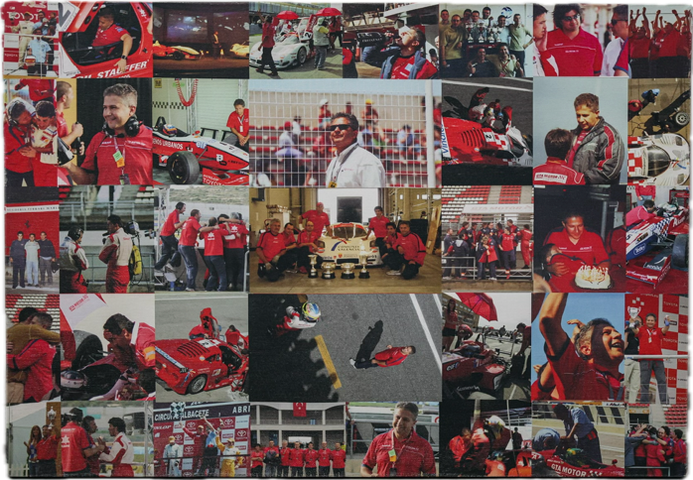
Some teams win championships. Some teams produce champions. And some teams, when they disappear from the paddock, leave a gap that nobody quite manages to fill. GTA Motor Competición was all three at once — and on top of that, it had the particular distinction of closing its doors not through failure, but because its founder had decided to build a supercar from scratch in a garage in Valencia. That tells you everything you need to know about how things worked there.
The Beginning: A Hyundai Dealership and a Lot of Ambition
The official story starts in 1998, in Torrente, Valencia. But the real story started earlier, when Domingo Ochoa worked as a mechanic under Toni Lozano, the respected Valencian tuner who for decades was the benchmark for private motorsport in Spain. That was where Ochoa learned what it means to prepare a race car with limited resources and maximum demands — an education that, without anyone realising it at the time, was shaping the founder of one of the most influential teams in Spanish motorsport history.
In the mid-90s, Ochoa opened a Hyundai dealership in Torrente. Not exactly a romantic motorsport dream, but it was the economic lever and the way in. When the Korean brand launched the Hyundai Accent Cup in 1998, Ochoa entered as a team for the first time, competing under the Escudería Bengala licence. The result that first year was immediate: third in the drivers’ championship with Andrés Martín Rovira at the wheel.
Hyundai Accent Cup: Winning from Day One
That first season revealed something that would define GTA throughout its entire history: the ability to arrive, prepare properly, and always be at the front. Not through budget — Ochoa always ran one car while rival teams ran two or three — but through work and preparation.
Over the following years, GTA won races in every single season it competed in the Hyundai Cup, rotating drivers and building a track record that the official results pages never fully captured. They took two or three runners-up titles depending on the season, and — perhaps the last thing anyone expected from a one-make series — they won the Hyundai 4-Hour Endurance twice. A race that demands more than outright pace: it demands management, strategy, and a car that holds together. Three things GTA knew how to do.
The Hyundai Cup was also the setting for the first on-track battles that would come to define the team. In one-make racing, when the cars are identical and you’re always at the front, sooner or later someone is going to put you in the barriers. That’s the logic of the grid.
Ochoa kept the Hyundai programme running until 2002, by which point the team was simultaneously managing the SEAT León Supercopa, Spanish Formula 3 and the GT programme with the Venturi 400. The Hyundai was the smallest piece of the puzzle, and something had to give.
SEAT León Supercopa: The Runner-Up Titles That Hurt
Before the Mosler, before Borja García dismantled statistics in F3, GTA fought a quiet war in one-make racing that deserves its own chapter.
In the SEAT León Supercopa, Ochoa arrived with his usual approach: one car, immaculate preparation, win. In the early years the team ran Alfredo Mostajo as lead driver. Mostajo was quick — quick enough that GTA found itself in the usual position as the season closed: fighting for the title with everything on the table at the final round.
The last race of that season was at Montmeló, where the championships typically ended, usually in the first week of November. The maths were simple: finish in the points and the title was GTA’s. The team qualified third or fourth, moved to the front, and then — on the run to the start-finish line on the very first lap — a driver from the rival team drove into the back of them and flipped the León. Race over. Championship over. The title went to someone who, without that incident, had no mathematical chance of taking it.
The following year, Lucas Guerrero took over. That season — Ochoa thinks it was 2003 — played out differently but ended the same way. Guerrero was the driver with the most race wins in the entire championship. Not the runner-up through bad luck: genuinely the fastest man in the field. But across a long season he made errors of his own that cost him points, and those points were the difference. No dirty tricks that time. Just the reality of a championship where one mistake can cost everything.
Two seasons. Two runners-up finishes. Two completely different ways of losing. But one constant: while rival teams ran two and three cars, GTA always ran one. When you’re working with one car and everyone else has three, every single result you produce carries proportionally more weight. That’s part of the story too.
Spanish Formula 3: Eight Seasons in the Mix
In 2001, GTA entered the Spanish Formula 3 Championship — the first season of the series under GT Sport’s organisation. The team arrived with Lucas Guerrero and Marcel Costa, finishing seventh in the teams’ standings. Not a year of titles, but not a blank year either: Costa gave the team a win at Jarama, the first single-seater victory in GTA’s history. A start that already said something about what was coming.
The Mid-Season Miracle
In 2003, something happened in Spanish motorsport that people who saw it still talk about. At mid-season, GTA signed a young Valencian driver who had been racing in the Nissan 2000 Formula and hadn’t quite broken through yet: Borja García.
What followed defies statistics. The championship had 16 races. Borja joined GTA for the second half and won 7 of the 8 races he entered. In the one he didn’t win, he was second. Not a single result outside the podium in eight starts. The problem was that the first half of the season no longer counted for him, and despite that total dominance he finished third in the championship. The title was out of reach because of the calendar, not because of the talent.
If that half-season had been a full one, the title would have been a mathematical formality. That’s how good the technical package Ochoa had built was — and how good the driver he’d signed was.
2004: The Championship Taken at Montmeló
In 2004, Borja García stayed at GTA. Full season. And the championship once again looked possible right until the final weekend.
The situation was identical to the León: finish in the top three at the last race and the title was GTA’s. The venue, as always, was Montmeló. On the opening lap, five cars came together. Borja was one of them. Race over, championship over.
Ochoa has a name for that circuit: his cursed track. But bad luck doesn’t repeat itself three times in exactly the same way at exactly the same venue. There’s a pattern there, and in the paddock, people noticed.
In 2005, Borja García left for Racing Engineering, where he won the championship backed by access to the F2 programme they offered. GTA stayed in F3 with Manuel Giao and spent the season fighting Borja wheel-to-wheel for the title. Runner-up again. No incidents this time. Just two good cars, two good drivers, and one championship.
The Iberian Trophy: A Title That Doesn’t Show Up in the Record Books
Within the structure of the Spanish F3 championship, there was an internal distinction for Iberian drivers: the Iberian Trophy, which combined results from races held in Spain and Portugal — including the Estoril rounds — within the European F3 Open framework. A championship within the championship, with its own classification.
GTA won it. The driver was Borja García. It doesn’t appear in most databases because it was an internal distinction with minimal media coverage, but it was real — and it was another title for the team’s record.
The Year They Sent a Driver to History
2008 was probably the most extraordinary season in GTA’s history as a talent factory.
The team entered three drivers in the Spanish F3 Championship: Jaime Alguersuari, Jimmy Auby and Nil Montserrat. Alguersuari was simultaneously racing in British F3 with Carlin as a Red Bull Junior and could only make six of the seventeen Spanish rounds due to schedule clashes. He won three of those six. The best win-to-start ratio in the entire championship.
In the final teams’ standings, GTA finished second with 90 points, 44 behind Campos Racing.
There’s a detail that barely surfaces in any archive, and which Alguersuari himself recounted in an interview years later: he was the first driver ever to win at the Valencia Street Circuit — the track that would later host the European Grand Prix. The F3 race ran before the circuit’s Formula 1 debut. Alguersuari won it in a GTA car. His words: “At the Street Circuit I won with the GTA team, from this land, and we were the first to do it.”
Red Bull rewarded his progress with a test in the RB4 at the Idiada circuit. In July 2009, he made his Formula 1 debut at the Hungarian Grand Prix with Toro Rosso, becoming the youngest driver to start an F1 race at that point — 19 years and 125 days. A record that only Max Verstappen would break later.
Merhi, de Villota, Jordá and the Rest
At the Valencia street round in 2008, GTA also gave a race seat to Roberto Merhi as a guest. Merhi reached Formula 1 in 2015 with Manor Marussia. One more career quietly set in motion.
María de Villota deserves her own paragraph. Daughter of F1 driver Emilio de Villota, María raced for GTA in 2003, finishing thirteenth in the championship. What came after made her a symbol far beyond motorsport: first Spanish woman to start the Daytona 24 Hours, first to race in the WTCC, first to take pole position in the Ferrari Challenge, test driver for Marussia F1 in 2012. She died on 11 October 2013, aged 33. The final corner before the finish line at the Jarama Circuit bears her name.
Carmen Jordá was personally presented by Ochoa as GTA’s F3 driver in December 2008. She later became Head of Alpine F1 Academy. The team’s alumni also include Mathias Lauda — son of three-time world champion Niki Lauda — and Marc Gené, who raced in Formula 1 with Minardi, went on to become an official Porsche factory driver, and today is an official Ferrari Ambassador.
The Rolex Series and the American Prologue
Before the Mosler era, GTA had already been to the home of American motorsport. In the late 1990s, Ochoa served as team manager for the structure that Paco Ortí assembled in Valencia, building the Porsche GT2s used in various national and international championships. The work was impeccable: they won the Porsche Challenge and world titles in the GT2 class, and in 1999 that same operation competed in the Rolex Series — the American endurance series that includes the Daytona 24 Hours — and took the title. Ochoa built the cars. Ochoa ran the strategy. The trophies exist.
He walked away from that structure in early 2000 and focused on what was being built in Torrente. The next American chapter for GTA would come with another American car — one he didn’t build, but one he knew how to drive fast.
The Mosler MT900R: The Team to Beat. And How They Tried to Stop It
In 2006, Ochoa bought a Mosler MT900R and formed the pairing that would define GTA’s GT era: Lucas Guerrero and Manuel Giao for that first season, with José Manuel Pérez Aicart coming into the rotation later.
The Mosler is one of those cars that motorsport history has filed badly. Pure American, built by Mosler Automotive in Riviera Beach, Florida, with a philosophy of mathematical brutality: minimum mass, maximum power. The name breaks down as Mosler, Trenne — Rod Trenne, the engineer who designed it, previously of Corvette C5 fame — and 900, the target weight in kilograms. In competition, the car actually hit 890 kg. Not a marketing claim. An engineering reality.
Engine: 5.7-litre GM LS6 V8 derived from the Corvette Z06, mid-mounted. Gearbox: ZF transaxle, the same type Porsche used. 450 hp in restricted trim. 0-100 km/h in 3.1 seconds. Over 320 km/h flat out. The car had won the GTS class at the 2003 Daytona 24 Hours and dominated the British GT Championship that same year with three consecutive one-twos to open the season. More racing versions were built (50) than road cars (35). It was a race car with a number plate, not the other way around.
The Dominant Years: 2006, 2007, 2008
With that Mosler, GTA Motor Competición was the team with the most race wins in the Spanish GT Championship for three consecutive seasons: 2006, 2007 and 2008. They never won the overall title in any of those three years — the reasons for that came from outside the circuit — but nobody on the grid matched GTA’s consistency.
The runners-up results are on the record: Guerrero and Giao in 2006, Guerrero and Pérez Aicart in 2007. In 2008 the team also ran a then-unknown Roberto Merhi alongside a Madrid-based gentleman driver, winning a couple more races with him at the wheel.
In the International GT Open — the European extension of the format that launched in 2006 — the most celebrated victories came at Valencia, Monza, Istanbul and Paul Ricard. The Istanbul double in 2006 was particularly striking: Guerrero and Pérez Aicart won both races of the weekend against Ferrari F430 GT2s, Porsche 911 GT3-RSRs and the full establishment of European GT racing.
The Trip to Maranello
There’s a specific moment when Domingo Ochoa knew the war was officially declared.
It was in Italy. In Maranello. One of his drivers wanted to buy a Ferrari for the following season, and Ochoa went along to the meeting. Across the table were Marc Gené and Antonino Coletta, head of the GT programme at Ferrari factory. Coletta had no idea that the man sitting in front of him was the owner of the Mosler that had been making his life difficult across the European GT calendar. And without knowing it, Coletta tore into them.
From that moment, Ochoa knew exactly what was coming.
The Triple Fix at Montmeló
It came at the final round of the 2007 International GT Open, at Montmeló. Ferrari had 17 factory cars on the grid, the backing of one of the most powerful brands in world motorsport, and the full weight of their prestige on the line in the first European GT championship of its kind. And a small private team from Torrente, Valencia, with an American car that barely anyone had heard of, was beating them in races.
The response came on three fronts simultaneously.
First: the organisers extended the race from 2 hours to 2 hours 10 minutes. Ten minutes that looked like a detail but weren’t — in fuel management terms, those were precisely the ten minutes that forced GTA to make a third pit stop while their rivals stayed on two. Ten minutes engineered for one team.
Second: the final-round championship handicap — an additional 20 seconds during the driver change stop, applied as a consequence of having won the previous round — was enforced. Stacked on top of the third stop, it completely changed the strategy window.
Third: two Drive Through penalties, ostensibly for exceeding pit lane speed limits. The problem: the GTA Mosler had an electronic speed limiter locked at 60 km/h in the pit lane. Physically impossible to exceed. Ochoa proved it in the formal protests. The stewards accepted the technical argument. It didn’t matter — the time was already gone.
That’s the asymmetry that sporting regulations have never properly solved: if you’re penalised, you serve it and lose the time. If you prove the penalty was wrong, they acknowledge it. But the laps you lost don’t come back. Between the three actions, GTA lost approximately two minutes of race time while running within seconds of their main rival.
Earlier in the same season, at Donington, another Ferrari had driven into them while being lapped. No points. In Valencia, after GTA had destroyed the field in qualifying, Ferrari pulled their spare parts trucks out of the circuit on Saturday as a pressure play on the organisers.
Ferrari couldn’t afford to lose with 17 official cars, the full infrastructure of a Fiat Group manufacturer and the first European GT championship in play, against a private team from Torrente with an American car nobody knew. The problem was that on track, the private team from Torrente was faster.
The Turning Point
After Montmeló, Ochoa made a decision. He wasn’t going to keep competing in an environment where the result depended on forces that had nothing to do with lap times. If they were faster and still couldn’t win, the answer wasn’t to protest louder. It was to build something that nobody could disqualify by changing the rules — because nobody else would have one.
That moment is where the GTA Spano begins.
Superleague Formula: When Football Got Behind the Wheel
In 2008, GTA Motor Competición took on the management of two entries in the Superleague Formula — the strangest single-seater championship in the history of motorsport, where every car raced under the colours of a football club. GTA’s two cars ran as Sevilla FC and Tottenham Hotspur.
Every car in the Superleague Formula used the same chassis and the same 4.2-litre V12 by Menard Competition Technologies producing 750 hp. No technical advantage possible. Just drivers, team and strategy — the kind of environment where GTA had always known how to compete.
The opening round was Donington Park, 31 August 2008 — the first race in the championship’s entire history. Driving for Sevilla FC was Borja García, the same driver who five years earlier had joined GTA mid-season and won 7 of 8 races. In Race 1, García finished tenth with mechanical issues. That result, through the championship’s reversed grid format, put him near the front for Race 2.
Before the second race, a massive storm hit Donington. The circuit flooded. Drivers with far more single-seater experience made mistakes. García didn’t. He drove from near the front, picked his way through the standing water and won Race 2 — the first competitive victory in Sevilla FC’s history in single-seater motorsport. The only Spanish football club on the entire grid, run by a team from Valencia.
Final standings: Sevilla FC tenth with 262 points, Tottenham eleventh with 257. Not numbers that dazzle on paper. But in a field of 17 technically equal teams in the championship’s inaugural season, that win at Donington in the rain doesn’t disappear.
The End: Not a Closure, a Transformation
In 2009, GTA Motor Competición left the single-seater championship mid-season. Not due to results — due to resource reallocation. The GTA Spano had been taking shape in parallel for years, and building a supercar from scratch required exactly the kind of technical knowledge that a decade of competition in single-seaters, one-make series and GT racing had accumulated.
The personnel who had prepared Moslers for the Spanish GT, tuned F3 cars at Jerez and on the Valencia street circuit, and built race cars to compete in the most demanding European series passed to work on Spain’s first supercar of the 21st century. The team didn’t close. It transformed.
The Legacy: A School Without a Diploma
GTA Motor Competición’s formal record might not look spectacular at a glance. No F3 title. No GT championship. But that reading is both superficial and wrong.
GTA Motor Competición won races in every single championship it ever entered. The Hyundai Cup, the SEAT León Supercopa, Spanish F3, the Spanish GT, the International GT Open, the Superleague Formula. Every one. With the budget of the small teams and the results of the big ones. Always with one car fewer than the competition. Always building against the current.
Through the team passed Jaime Alguersuari (F1 with Toro Rosso, 46 Grands Prix, 31 points), Roberto Merhi (F1 with Manor Marussia), Borja García (Spanish F3 champion, Spanish GT champion), Marc Gené (F1 with Minardi, official Porsche factory driver, today Ferrari Ambassador), Carmen Jordá (Head of Alpine F1 Academy), Mathias Lauda (son of three-time world champion Niki Lauda), María de Villota, and a list of drivers who went on to relevant careers across European motorsport.
And it was also, without anyone ever saying so out loud, the proof that from Torrente, Valencia, you could compete on equal terms with any team on the national and European circuit. And that the knowledge built up year after year in pit lanes and paddocks across the continent was worth more than winning races. It was worth building a car that today, as the Spano E&D, is attempting to break 400 km/h on the longest straight in Spain.
The workshop in Torrente fell silent. But the garage where the GTA Spano was born would never have existed without it.
Not Enough Cylinders — Motorsport without filters.