Hispano-Suiza in the Air: The Spanish Engines That Ruled the Skies of the Great War
When the world’s greatest pilots chose a Spanish heart for their war machines
The Engine That Changed the War
In September 1914, with Europe burning in the First World War, a member of the Spanish Royal House visited the Hispano-Suiza factory in Barcelona. The conversation with Marc Birkigt and Damián Mateu was direct: Spain needed its own aviation engines.
What nobody imagined was that from that suggestion would emerge the most important engine of the air war.
In just seven months, Swiss engineer Marc Birkigt designed from scratch a V8 aviation engine that broke every convention. On May 12, 1915, engine serial number 3747 passed a 12-hour endurance test. On July 27, Captain Eduardo Barrón flight-tested it at Cuatro Vientos airfield, with King Alfonso XIII watching.
The French, desperate to find an engine that could compete with the Germans, evaluated the Spanish design. They subjected it to a 5-hour certification test. It passed. They demanded a special 10-hour test. It passed. Then 20 hours. It passed. Finally, 50 hours of continuous mechanical torture.
It passed everything.
From there, fourteen French companies, one British, one American, three Italian, and one Japanese began manufacturing Hispano-Suiza engines under license. By the end of the war, nearly 50,000 units had been produced in twenty-one factories around the world. The heart of Allied aviation beat in Spanish.
The Technical Revolution: Why the Hispano V8 Was Different
To understand the impact of the Hispano-Suiza engine, you need to understand what came before. In 1914, Allied aircraft relied on rotary engines: the entire engine rotated around the crankshaft. They were light, but they had serious problems. Power was limited to about 130 HP because they couldn’t cool adequately while spinning. The gyroscopic effect made aircraft difficult to control. And they consumed absurd quantities of castor oil, which sprayed from the exhausts and covered the pilot.
The Germans, meanwhile, had adopted water-cooled inline engines like the Mercedes D.III producing 160 HP. They were heavier, but more powerful and controllable. By mid-1916, their Albatros D.I fighters were slaughtering Allied aircraft.
Birkigt’s V8 changed everything. Its innovations were radical:
Monobloc aluminum block. The cylinders weren’t separate pieces bolted to a crankcase—they formed a single block cast in light alloy. This dramatically reduced weight: the complete engine weighed just 150 kg, compared to 200-250 kg for competitors.
Screwed-in steel liners. Instead of cast iron cylinders, Birkigt designed threaded steel liners that screwed into the aluminum block. This allowed exceptional heat transfer and durability that rotary engines couldn’t match.
Direct-drive overhead camshaft. The valves were actuated directly by the camshaft, without rockers or pushrods. The result was an engine that could rev higher without losing reliability.
Forced pressure lubrication. Oil reached all critical components via a pump, not by splash as in earlier designs. This allowed operation in any flight attitude—critical for a combat fighter.
The power-to-weight ratio was 1 HP per kilogram, exceptional for its time. The Hispano-Suiza 8A produced 150 HP. Later versions reached 220 HP (8Be) and finally 300 HP (8F) while maintaining the reliability that pilots loved.
René Fonck, France’s greatest ace with 75 confirmed kills, put it clearly: “With the arrival of the Hispano-Suiza engine at the front, we achieved air supremacy and thanks to it we maintained it until the end.”
The Aircraft That Won the War
The Hispano-Suiza engine wasn’t just a brilliant piece of engineering. It was the heart of the best Allied fighters.
SPAD S.VII: The First Strike
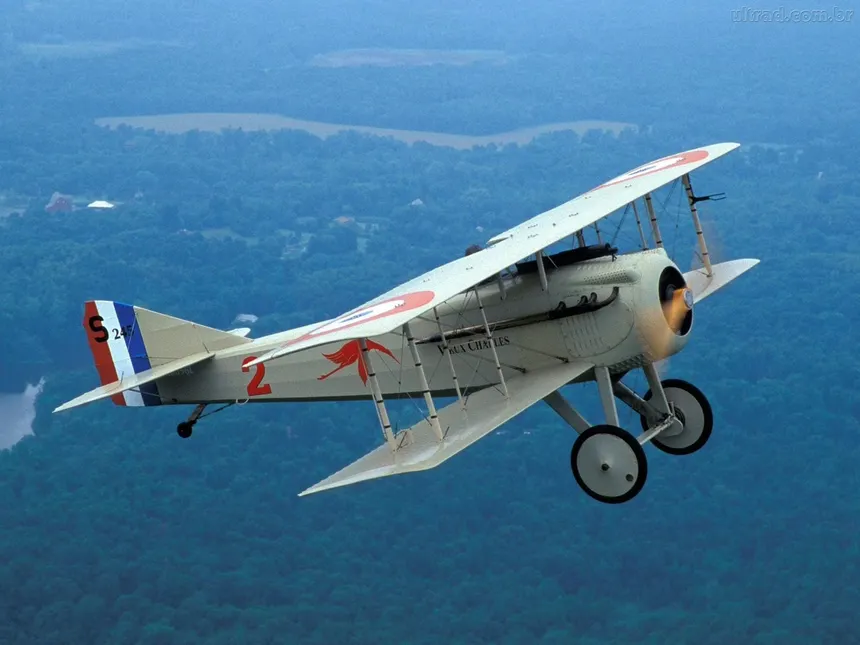
The SPAD VII first flew in April 1916 and entered combat in August. It was exactly what the Allies needed: a fighter capable of facing the German Albatros on equal terms.
With its Hispano-Suiza 8A engine producing 150 HP (later the 8Ab with 180 HP), the S.VII reached 192 km/h, climbed to 3,000 meters in 15 minutes, and was extraordinarily robust. Unlike the fragile Nieuports, the SPAD could dive at full speed without risk of the wings tearing off.
More than 6,000 SPAD VIIs were built. They flew with French, British, Belgian, Italian, Russian, and American squadrons. It was the fighter that ended German air superiority.
SPAD S.XIII: The Dominator
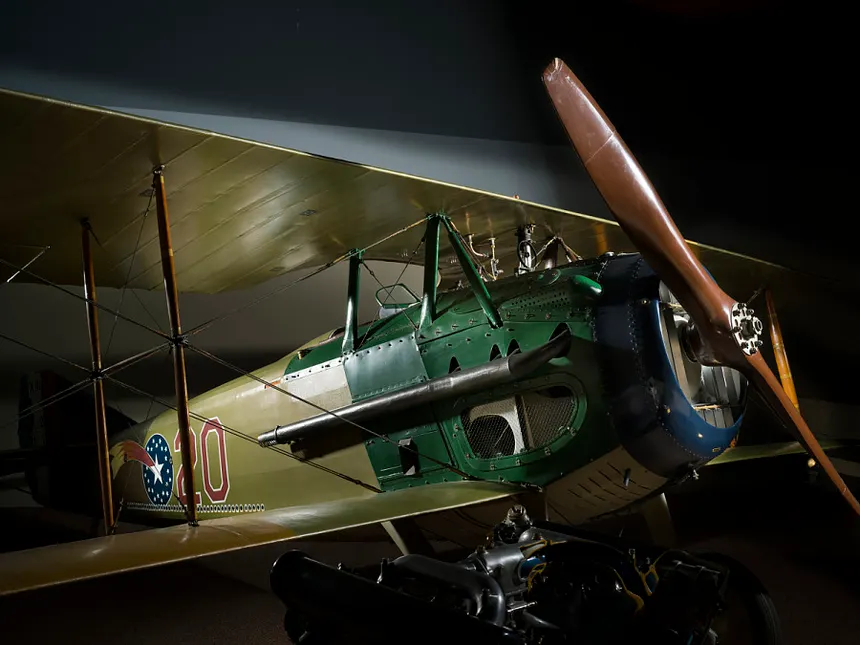
If the S.VII balanced the scales, the S.XIII tipped them decisively toward the Allies.
It first flew on April 4, 1917, and entered service in late May. It was larger than the S.VII, with greater wingspan and two Vickers machine guns instead of one. The engine was the Hispano-Suiza 8Ba producing 220 HP, enabling speeds of 225 km/h.
The S.XIII was faster than the British Sopwith Camel and the German Fokker D.VII. It was an exceptional weapons platform: stable, accurate, capable of absorbing damage. Pilots loved it.
8,472 SPAD XIIIs were built, with orders for another 10,000 cancelled when the war ended. It was one of the most-produced aircraft of the conflict.
Royal Aircraft Factory S.E.5: The British Workhorse
The British also adopted the Spanish engine for their best fighter of the war. The S.E.5a, powered by a license-built Hispano-Suiza 8 made by Wolseley (known as the Viper), was the perfect complement to the agile but difficult Sopwith Camel.
While the Camel was a beast that killed novice pilots with its tendency to spin, the S.E.5a was stable, predictable, and fast. British aces accumulated dozens of victories in it.
The Storks: The Legendary Squadron
No unit better embodies the Hispano-Suiza engine era than Groupe de Combat 12, known as “Les Cigognes” (The Storks).
The squadron took its name from the emblem of Alsace, the French province occupied by Germany that the pilots dreamed of liberating. Each escadrille in the group painted a different stork on their aircraft fuselages.
And no stork flew higher than Georges Guynemer.
The Hero of France
Georges Marie Ludovic Jules Guynemer was born on December 24, 1894, in Paris to an aristocratic family. Through his mother’s line, he descended from Kings Louis XIII and Louis XIV. He was a sickly young man, rejected five times for military service due to his frail constitution.
But Guynemer was stubborn. He managed to enlist as a mechanic in November 1914. Through sheer determination, he got accepted for pilot training. In June 1915, he joined Escadrille MS.3, which would later become the Storks.
What followed was a meteoric career. Guynemer developed innovative combat tactics, closed to suicidal distances to ensure his shots hit, and accumulated victories at a rate that made him a national celebrity.
In October 1916, he received his first SPAD VII with a Hispano-Suiza engine. With it, the Storks would earn their second squadron citation. By the end of 1916, his personal score reached 25 victories and he was promoted to lieutenant.
On February 8, 1917, flying his SPAD VII, Guynemer became the first Allied pilot to down a heavy Gotha bomber. His most glorious month was May 1917, when he shot down seven enemy aircraft. On May 25, he downed four in a single day, earning him the Legion of Honor.
In July, he began flying the SPAD XII, an experimental fighter armed with a 37mm cannon that fired through the propeller shaft. He called it his “avion magique.” On July 27, he downed an Albatros, and the next day a DFW. Guynemer became the first French ace to reach 50 victories.
But the war was consuming him. Tuberculosis, combat stress, constant mechanical problems, and bad weather that prevented flying affected his morale and health. In photographs from August 1917, Guynemer looks like an old man of 22.
The Last Flight
On September 11, 1917—a cold, cloudy Tuesday—Guynemer took off from Saint-Pol-sur-Mer at 8:35 AM in his SPAD S.XIII number S.504. Sub-lieutenant Bozon-Verduraz flew as his wingman.
They crossed the German lines near Langemarck, hunting for prey. What happened next remains a mystery.
German testimony, provided after the war, states that Lieutenant Kurt Wissemann of Jasta 3 shot him down over Poelkapelle. Wissemann died 17 days later in combat, taking the details to his grave.
Guynemer’s body was never found. The artillery bombardments that devastated the area in the following days pulverized any remains. France mourned its lost hero.
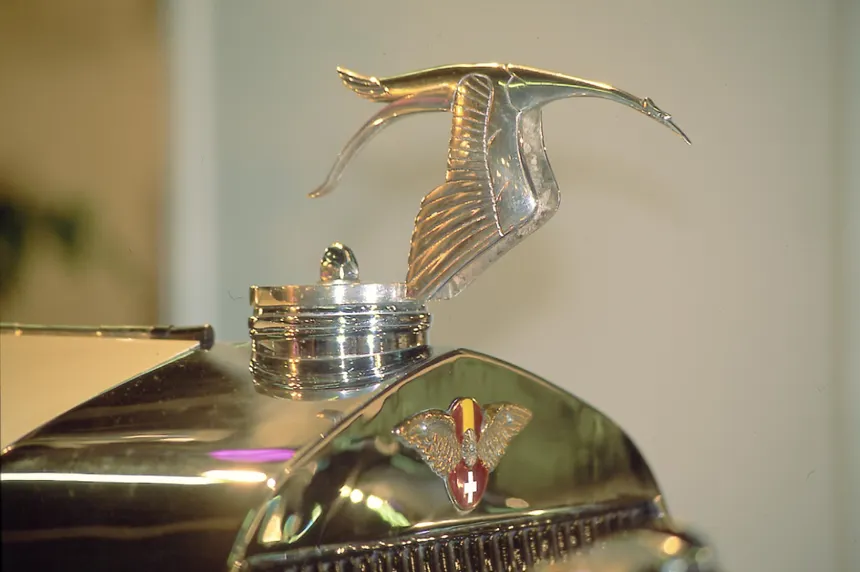
Marc Birkigt, the engineer who had given Guynemer the engine with which he conquered the sky, felt the loss personally. After the war, he commissioned sculptor François Bazin to create a hood ornament for Hispano-Suiza cars: a stork in full flight, wings extended forward.
It was the emblem of Guynemer’s squadron. A silent tribute from an engineer to a pilot who trusted his life to a heart from Barcelona.
More than a century later, the stork remains the symbol of Hispano-Suiza.
Jesús del Gran Poder: The Flight That United Two Worlds
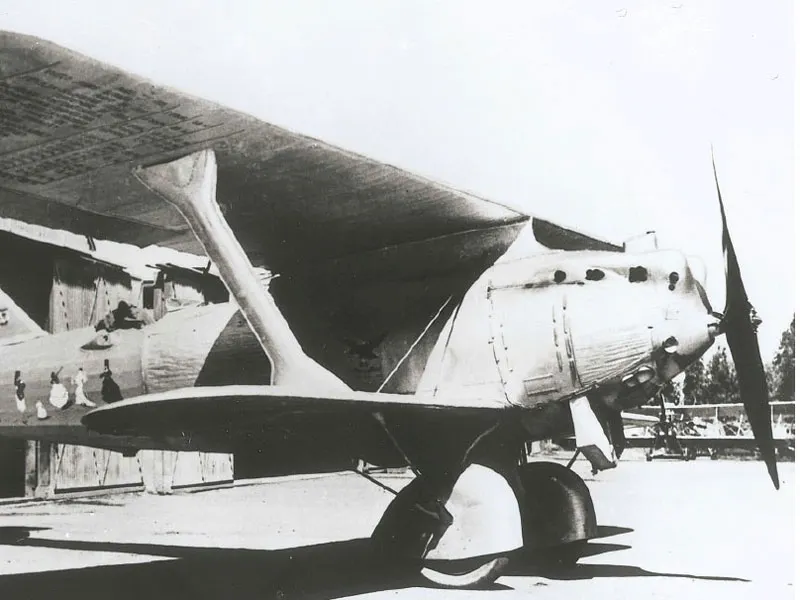
Ten years after Guynemer’s last flight, a Hispano-Suiza engine made history again. But this time not in war. This time in peace.
In the early morning of March 24, 1929—Palm Sunday—Captain Ignacio Jiménez and Captain Francisco Iglesias took off from Tablada airbase in Seville in a Breguet XIX biplane christened “Jesús del Gran Poder” (Jesus of the Great Power).
The aircraft carried a Hispano-Suiza 12Lb engine producing 600 HP, a direct evolution of the war’s V8, now configured as a V12 for long-distance flight.
The mission was ambitious: break the world record for straight-line distance. They carried 5,320 liters of fuel and flew for 43 hours and 50 minutes, covering 6,550 kilometers from Seville to Bahia, Brazil.
Congratulatory telegrams arrived from all over Spain. The King and Queen, the Cardinal of Seville, manufacturers CASA and Breguet, Hispano-Suiza itself with Marc Birkigt at the helm. Even Charles Lindbergh sent his recognition.
But the most emotional came from Colonel Kindelán, chief of Military Aviation: “Your magnificent feat makes proud the Aviation of Carrillo, Boy, Salgado, Loriga, and so many heroes. Engine, airplane, arm, and heart entirely Spanish. Long live Spain.”
From Bahia, Jiménez and Iglesias continued a 22,000-kilometer journey across Latin America: Rio de Janeiro, Montevideo, Buenos Aires, Santiago de Chile, Lima, Panama, Guatemala, Havana. They were received as heroes at every stop, feted by presidents and crowds.
The Jesús del Gran Poder is preserved today at the Air Museum in Madrid. Its Hispano-Suiza engine, the heart that beat for more than 121 hours over three continents, remains intact.
The 12Y: The Engine That Won World War II (For Others)
In the 1930s, Hispano-Suiza developed the next generation of aviation engines: the 12Y, a 36-liter liquid-cooled V12 that would produce up to 1,100 HP in its final versions.
The 12Y powered the best French fighters of the era: the Morane-Saulnier M.S.406 and the Dewoitine D.520, the aircraft that tried to stop the Luftwaffe in 1940.
But the most extraordinary story of the 12Y didn’t happen in France.
In 1935, Soviet engineer Vladimir Klimov traveled to France to acquire the manufacturing license for the engine. The Russians called it the M-100 and produced it in industrial quantities. From it, they developed the VK-105, which would power the Yakovlev fighters (Yak-1, Yak-3, Yak-7, Yak-9) and Lavochkins (LaGG-1, LaGG-3), plus the Petlyakov Pe-2 bomber.
129,000 VK-105 engines and variants were built.
Think about that for a moment. Every Yak that defended Stalingrad, every Pe-2 that bombed German lines, every LaGG that covered the skies over Kursk, carried inside it the direct descendant of the engine Marc Birkigt designed in Barcelona in 1914.
The Spanish heart beat on the Eastern Front throughout World War II.
The HS.404 Cannon: The Ultimate Weapon
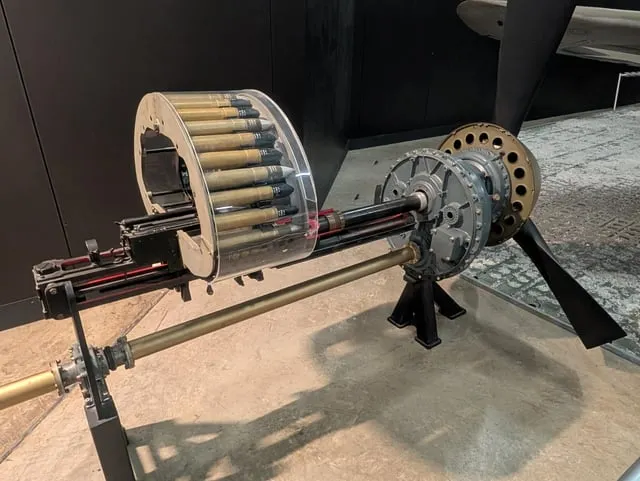
But Marc Birkigt didn’t only design engines.
In the mid-1930s, Hispano-Suiza developed the HS.404, a 20mm automatic cannon that would revolutionize aircraft armament. It fired 130-gram projectiles at 840-880 meters per second, with a rate of fire of 600-850 rounds per minute.
The design was brilliant: a recoil mechanism that absorbed the brutal kick of each shot, allowing installation in light aircraft without destroying the structure. And it had a unique feature: it could be mounted between the cylinder banks of a V12 engine, firing through the hollow propeller shaft. It was the “moteur-canon” that Guynemer had dreamed of with his SPAD XII.
When World War II broke out, Britain acquired the HS.404 license. The Battle of Britain proved that the eight .303 caliber Browning machine guns on Spitfires and Hurricanes were insufficient against armored German bombers. Real firepower was needed.
The HS.404, produced as the Hispano Mk.II, became the RAF’s standard weapon. Four 20mm cannons replaced the eight machine guns on Hurricane Mk.IICs. Later Spitfires carried two cannons supplemented by machine guns. The Beaufighter, Typhoon, Tempest, Mosquito: all fired Hispano cannons.
The irony is delicious: every Spitfire that defended London, every Typhoon that strafed German columns in Normandy, every Mosquito that hunted night bombers over England, fired a weapon designed in Barcelona.
The United States also obtained the license but never managed to produce a reliable version. American engineers couldn’t replicate the quality of the original design, and the American M1/M2 cannon earned a reputation for unreliability. In the end, the USAAF kept Browning .50 caliber machine guns on their P-51 Mustangs while British Spitfires outgunned them with Spanish cannons.
The Silenced Legacy
Why does almost nobody know this?
The answer is uncomfortable. Spain was neutral in both world wars. Then came the Civil War, the dictatorship, international isolation. And France, which had built its aviation industry on Spanish licenses, had little interest in acknowledging that its most important engine wasn’t French.
But facts are facts.
The Hispano-Suiza V8 was the most important aviation engine of the First World War. The nearly 50,000 engines produced under license in 21 factories worldwide powered more than 14,000 SPAD VIIs and S.XIIIs, thousands of British S.E.5as, and dozens of other aircraft types.
The 12Y and its Soviet VK-105 descendants added nearly 130,000 more units, powering the fighters that won the war on the Eastern Front.
The HS.404 cannon armed virtually every RAF fighter during World War II.
Marc Birkigt, the Swiss genius who chose Spain as his home, created the technology that allowed the Allies to win air dominance in two world wars.
And Guynemer’s stork, the symbol of a French pilot who flew and died with a Spanish engine, still adorns Hispano-Suiza cars a century later.
The Air Museum: Where the Past Breathes
If you want to see this history with your own eyes, the Air Museum in Madrid preserves the Jesús del Gran Poder with its Hispano-Suiza 12Lb engine intact. There are also examples of SPAD VIIs, original V8 engines, and period documentation.
At the Musée de l’Air et de l’Espace in Paris sits Guynemer’s SPAD S.VII S.254, the aircraft in which he shot down 19 enemies. Its Hispano-Suiza engine remains installed.
At the National Air and Space Museum in Washington, there’s a Hispano-Suiza 12Ycrs engine, the descendant of the V8 Birkigt designed in Barcelona.
These are fragments of a history that should be taught in Spanish schools but is barely known. The story of how engineers in Barcelona created the heart of Allied aviation and changed the course of two world wars.
The Sky Remembers
The pilots who flew with Hispano-Suiza engines knew what they had. Guynemer, Fonck, Nungesser, Baracca, Rickenbacker: the greatest aces of the First World War trusted their lives to an engine designed in Spain.
Decades later, Yak and LaGG pilots at Stalingrad and Kursk depended on direct descendants of the same design.
Spitfire pilots over the English Channel fired Spanish cannons at German bombers.
Spain was neutral. But its technology won wars.
And when you look up at the sky and see an aircraft pass overhead, remember: there’s a real chance its ancestors carried a Spanish heart.
If this article made you feel something, share it. If it taught you something, come back. And if you made it this far, check you’re still alive.
Pingback: Hispano-Suiza: Europe's kings chose this over the Rolls-Royce