
I’m the One Paying for Ecology… Twice Over. The Green Scam Nobody Talks About
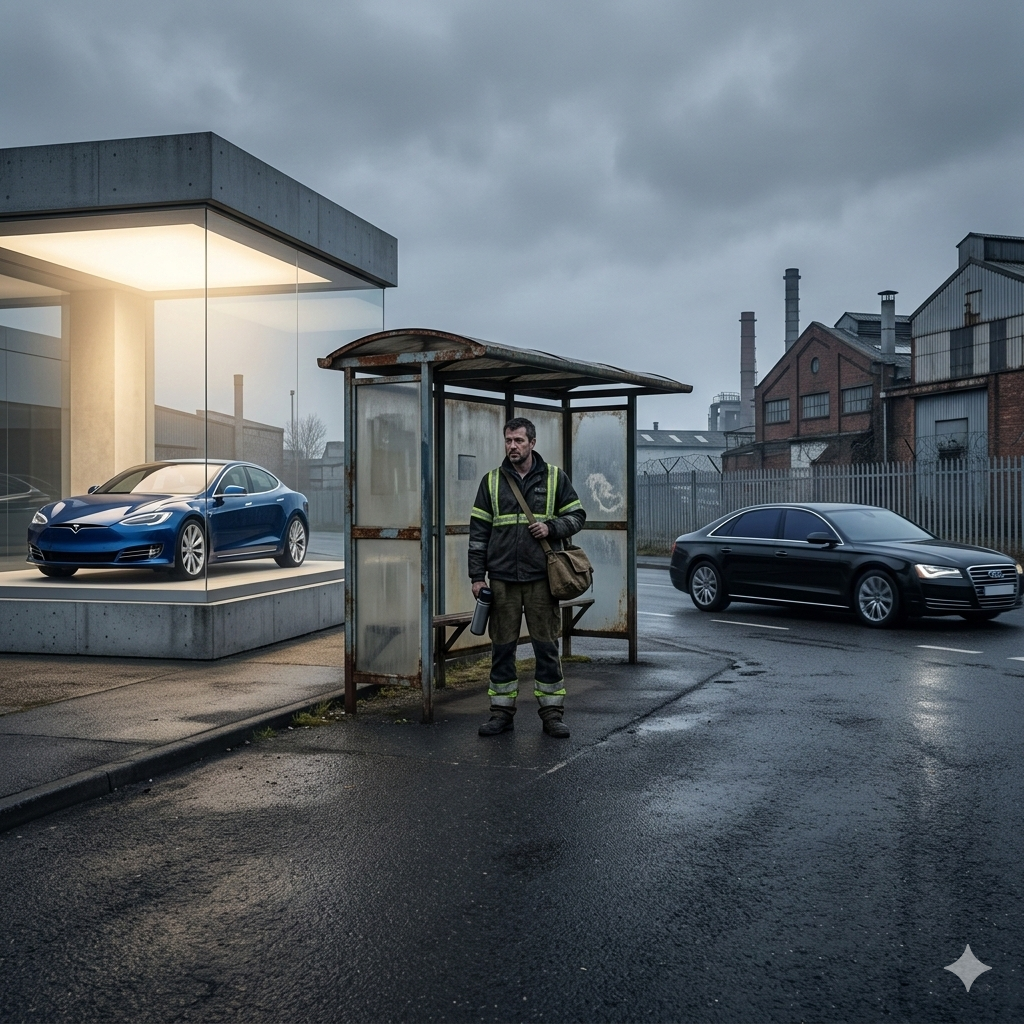
Welcome to the Ecological Circus
They’ve told you a beautiful story. The planet is dying, you’re the one to blame, and the solution requires you to empty your bank account. First through taxes, then by buying what they tell you to buy. They don’t ask nicely: they suffocate you until you have no choice left. And meanwhile, the people who write the regulations travel in chauffeur-driven official cars, and the automakers pass every penny of their compliance costs straight on to you, the buyer, as if they were doing you a favour.
Let me be absolutely clear before we go any further: I’m not against protecting the environment. I am against the institutional hypocrisy that has turned the ecological transition into a hidden tax on the working class. I am against the fact that environmental responsibility falls — always, systematically, without exception — on the same person: you and me.
The Double Payment: Taxes on One Side, Commercial Coercion on the Other
Let’s break down the two channels through which ordinary citizens bankroll the ecology agenda out of their own pockets.
Channel one: taxation. Every time you fill your tank, a significant portion of what you pay is tax. Special hydrocarbon duties, VAT charged on top of the duty itself — yes, you pay tax on tax, that’s not an invention, it’s the actual fiscal structure — plus various surcharges and levies. The same applies to your electricity bill, where regulated charges and levies make up a considerable share of what you pay each month. These taxes are justified, among other things, by the ecological transition. That money is supposedly invested in infrastructure, in transport alternatives, in making it feasible for you to live without depending on a private car. The question is: where is that investment? Do you see it reflected in your daily life?
Channel two: commercial coercion. Increasingly restrictive European emissions regulations, low-emission zones that ban you from driving your car into the city, environmental labels that classify your vehicle as if it were an environmental criminal — it’s all engineered to push you toward one specific product: the electric car. But here’s where it gets interesting from an economic standpoint. The emissions standards are imposed on manufacturers. The fines for exceeding CO2 limits are levied on manufacturers. But does anyone genuinely believe that manufacturers absorb those regulatory costs out of their profit margins? Nobody who has ever set foot in a dealership. Manufacturers pass the normative cost through to the final vehicle price. Always. Without exception. Every euro that the EU fines or threatens to fine a manufacturer translates into a price increase paid by the buyer. You. Me. The worker who needs a car to get to their job.
And there you have the double payment. First you fund the ecological transition with your taxes. Then you fund it again by buying a more expensive product because the regulations the manufacturer must comply with are baked into the sticker price. The citizen pays twice. The politician pays nothing. The manufacturer pays nothing.
The Brands Don’t Lose: You Do
Let’s dwell on this point, because it’s the heart of the debate and the one that stings the most.
When the European Union tightens CO2 emission limits for carmakers, it establishes a penalty system for non-compliance. The political logic says this pressures brands to build cleaner cars. Real-world economic logic says something very different: the brands transfer the cost to the consumer.
How? In several ways. The most obvious is the general increase in new vehicle prices. If building a car that meets the regulation costs more, the car costs more. No mystery there. The second is the progressive elimination of affordable models. Fewer and fewer new cars are available below certain price thresholds because margins cannot absorb the costs of electrification or hybridisation in budget segments. The third is the strategy of pushing electric and plug-in hybrid sales at inflated prices that carry a higher margin than their combustion equivalents.
The net result is that the citizen who needs a car — and in countries with geographical dispersion and deficient public transport, most citizens need a car — pays more for it. They pay the cost of the ecological transition that brands do not absorb. They pay for the technological innovation that brands develop with public subsidies — that is, with more taxpayer money — and then sell at market price. The manufacturer doesn’t lose. It adapts its business model, raises prices, reshapes its lineup, and keeps billing. The one who loses is the buyer.
And if you decide not to buy a new car because you can’t afford it, the regulatory machinery penalises you anyway. Low-emission zones that prevent you from driving. Parking restrictions. Road tax increases for older vehicles. You’re penalised for not being able to afford the car they want you to buy. It’s a perfect trap: either you pay, or you’re punished.
Subsidies: The Mirage Nobody Can Actually Afford
Here’s another element of the circus: public subsidies for electric vehicle purchases. In theory, these incentives exist to make electric mobility accessible. In practice, they function as a discount for people who could afford the car anyway, and as an indirect gift voucher for the manufacturer, who maintains or raises the price knowing the state will cover part of the gap.
Think about it objectively. If an electric car costs significantly more than its combustion equivalent, a subsidy of a few thousand euros doesn’t change the equation for a working family. The deposit is still steep. The finance payments are still high. And the uncertainty around long-term maintenance costs — particularly battery replacement — remains. The subsidy doesn’t democratise access: it disguises the price difference just enough for the political narrative to claim that “help is being provided”. But the average worker still can’t afford the car.
And where does the money for those subsidies come from? Public budgets. That is, your taxes. You’re paying again. You pay taxes that fund subsidies that benefit wealthier buyers and manufacturers who don’t lower their margins. It’s a circular system where the average taxpayer’s money flows upward, not downward.
And if you’re a self-employed professional or small business owner who needs a van for work, the situation is even worse. Electric alternatives in commercial vehicles are scarce, expensive, and have ranges that don’t cover the real needs of delivery or technical service in dispersed areas. But the circulation restrictions hit you just the same. You pay the same tax, receive the same pressure, and don’t have a viable alternative that fits your professional activity.
Public Transport: The Solution Nobody Truly Wants to Implement
If the real objective were to reduce private transport emissions, the most effective, most equitable and most logical solution would be public transport that actually works. Not that exists on paper. That actually works.
You want me to leave the car at home? Fine. Give me a real alternative. Give me a bus that takes me to the industrial estate at six in the morning when my shift starts. Give me a commuter train that connects my town to the industrial zone where I work without three transfers and three times the journey I’d make by car. Give me a service frequency that doesn’t force me to leave home ninety minutes early just in case. Give me a last service that gets me home after an evening shift without having to depend on someone picking me up.
But that doesn’t happen. And it doesn’t happen because genuinely investing in public transport — the kind that connects industrial estates, hospitals, shift workers, rural and peri-urban areas — doesn’t generate the same political or economic return as subsidising electric cars. A bus that reaches the industrial estate at half past five in the morning doesn’t make it into the photo opportunity. A fast-charging station inaugurated by a regional minister does.
In Spain — and across much of Europe — industrial estates are public transport black holes. Millions of workers commute daily to industrial zones where a private car is the only viable option. No rail connection, no bus routes with frequencies adapted to rotating shifts, no safe cycling infrastructure. And yet those very workers are expected to give up their combustion cars. It’s like forcing someone to stop using a torch without first installing electric lighting in their home.
Those Who Legislate from the Bubble
The same politicians who design emissions regulations, approve low-emission zones, and sign off on ecological transition plans travel in official vehicles. They don’t take the underground at rush hour. They don’t wait for the bus in the rain. They don’t arrive late to work because the commuter train was delayed. They don’t plan their week around whether there’s a transport strike.
They legislate on sustainable mobility from a bubble of privilege in which they will never experience the consequences of their own decisions. And when you challenge them, they respond with macro data, with emission-reduction targets twenty years away, with decarbonisation projections that sound fantastic in a PowerPoint but do absolutely nothing to solve how I get to my workplace tomorrow.
Ecology cannot be a project funded exclusively from the bottom up. It cannot be that a worker earning a modest monthly wage must shoulder the cost of the ecological transition while large corporations receive subsidies to adapt and public officials travel with no restrictions whatsoever. That isn’t environmental policy. That is an inverse redistribution of costs: those who have the least, pay the most.
What Should Actually Happen
I’m not asking for anything outrageous. I’m asking for coherence. If the priority is to reduce transport emissions, let real public investment go toward creating a public transport network that allows citizens to leave the car at home by conviction, not by coercion. Let bus routes reach industrial estates with frequencies matched to actual work shifts. Let commuter trains connect municipalities with employment centres, not just with the city centre. Let there be safe, functional cycling infrastructure — not four bike lanes that dead-end at a roundabout.
I’m asking that car manufacturers bear a real share of the transition cost, instead of passing it entirely through to the final price. I’m asking that subsidies for electric vehicle purchases stop being a gift voucher for manufacturers already enjoying healthy profit margins. I’m asking that if you’re going to ban my car from the city centre, you first guarantee I can get there by public transport in a dignified way.
I’m asking that ecology stops being a political business and becomes real policy. Because as long as the citizen is the one paying the bill twice over — through taxes and at the dealership — this is not an ecological transition. This is a cost transfer disguised as environmental conscience.
And the day a politician catches the six o’clock morning bus to an industrial estate, that will be the day I start believing they actually care about ecology.