
Wider Than Hell: The Three Japanese Masters Who Turned Wide Body Into Religion
Before the rivets, there was fire
There’s one image that explains everything. Fuji Speedway, 1982. A red-and-black Nissan Skyline DR30 spits flames from a side-exit exhaust while its widened fenders devour the main straight. The LZ20B engine — a turbocharged 2.1-liter four-cylinder — pushes 570 hp, more power than the Formula 1 cars of the era, through a body that keeps the recognizable silhouette of a road car but has absolutely nothing civil about it.
This was the Super Silhouette. And without it, nothing that follows would exist.
The Super Silhouette series ran in Japan from 1979 to 1984, as a support race for the Fuji Grand Championship Series. The rules followed FIA Group 5 regulations: you could modify anything you wanted — engine, chassis, aerodynamics, suspension — as long as you kept the recognizable silhouette of the production model. The bonnet, roof, doors, and rail panels had to remain intact. Everything else was fair game.
Nissan dominated the category with machines that became legends: Haruhito Yanagida’s Bluebird 910 (champion in 1980 and 1982, weighing just 1,000 kg with those same 570 hp), Kazuyoshi Hoshino’s Silvia S110 and S12, and above all, Masahiro Hasemi’s Skyline DR30, which won two races in 1982 and five more in 1983. Every one of these cars wore body extensions designed by Mooncraft Design that made them look like they’d come from another planet.
Here’s where the story gets interesting. The Super Silhouette races at Fuji coincided with the peak of the bosozoku movement — Japanese street gangs who modified their cars in extreme fashion as an act of social rebellion. The bosozoku went to Fuji, watched those monsters with their impossible fenders, spoilers taller than the roof, and flame-spitting exhausts, then went back to their garages to replicate that style on their own street cars. That’s how kaido racers were born: street cars with exaggerated body extensions, vertical spoilers, and full competition aesthetics. They weren’t fast. They were a statement.
That statement, born on Japanese circuits and streets over four decades ago, is the DNA of the modern wide body movement. And three men — each with a radically different philosophy — turned it into a global phenomenon.
Kei Miura: the engineer who digitized rebellion
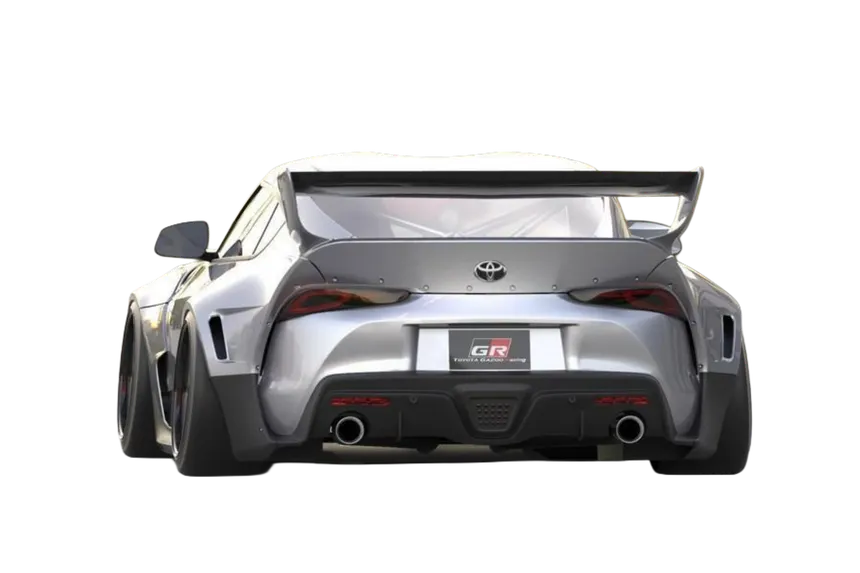
Kei Miura grew up in bosozoku culture and the illegal Osaka Kanjo races — nocturnal street circuits on Osaka’s urban highways that are exactly as insane as they sound. He came out of that world with two things: an obsession with the lines of classic Japanese cars and an absolute contempt for doing things the way they’d always been done.
His company, TRA Kyoto, operates from Kumiyama-cho in Kyoto Prefecture. Under the Rocket Bunny (aggressive wide body kits with exposed bolts) and Pandem (more refined versions) brands, Miura has become globally synonymous with body widening. The name “Rocket Bunny” wasn’t even a brand name originally — it was the internal project name when he developed his first kit for the Toyota GT86. The kit was so explosively popular that the project name consumed the company.
What separates Miura from any other kit manufacturer isn’t the aesthetics — it’s the process. When he started, every body kit maker in Japan hand-sculpted their master molds from clay, a slow artisanal process prone to errors. Miura built his own 3D scanner using parts from an Xbox console and wrote the software with a friend from Kyoto University to make the data compatible with CAD systems. This approach — laser scanning of the actual vehicle, 3D-rendered design, CNC-machined molds — was science fiction in the Japanese tuning world fifteen years ago. Today it’s the industry standard. Miura invented it in his garage.
His design philosophy is clear: amplify what the car already has, never impose something that doesn’t belong to its lines. When designing a kit, he starts with a freehand sketch, then laser-scans the complete vehicle, adjusts the lines in CAD, and machines the molds via CNC. The entire process, from concept to product, is controlled by him alone. The kits are manufactured in FRP (fiber-reinforced plastic) and prices range from around $2,700 for a Golf MK7 to over 8.5 million yen for his most extreme creations.
His catalog includes Japanese cars (86/BRZ, Silvia S13/S14, RX-7, 350Z, Supra, NSX), European (BMW E30, E36, E46 M3, Golf MK2 and MK7), and American (Corvette C8, Ford Raptor, Challenger). But in January 2026, Miura surprised the world at the Tokyo Auto Salon with the “Pocket Bunny” — a body swap that converts a Suzuki Twin (a 660cc kei car) into a mini Nissan R32 GT-R. The madness is deliberate: the man who defined wide body is now obsessed with making tiny cars look like monsters in miniature.
He accepts custom one-off kit commissions for individual clients. The cost of a one-off isn’t published, but available references place it in the high five-figure range. If you have a car with interesting lines and a story worth telling, Miura listens.
Wataru Kato: the provocateur who cut a Ferrari
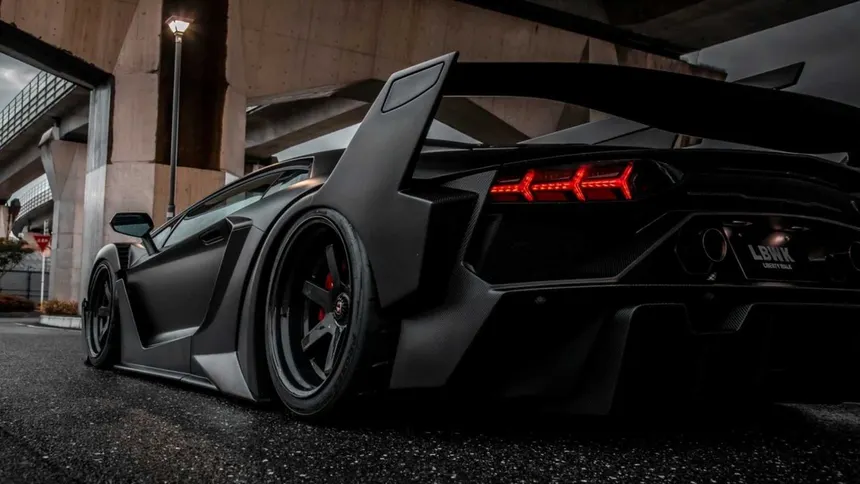
Wataru Kato founded Liberty Walk in 1993, when he was 26 years old. The name — “liberty walk” — is a statement of principle: the freedom to modify whatever you want, including what the rest of the world considers untouchable.
Kato started by importing BMWs and Mercedes into Japan and opening a used car dealership. He then moved to manufacturing body kits for kei cars — tiny, cheap cars that nobody considered worthy of serious modification. That phase was crucial: it taught him to work within extreme constraints and to understand that visual provocation has nothing to do with the price of the base car.
The moment that changed everything was SEMA 2009. Kato brought a Lamborghini Murciélago with a full kit — but it wasn’t wide body yet. Nobody cared. Three years later, at SEMA 2012, he returned with a wide body Murciélago with cut-and-widened fenders, riveted directly onto the original bodywork. The automotive world lost its mind.
The reaction was exactly what Kato wanted: horror from the purists, adoration from the modifiers. He cut a Lamborghini. With an angle grinder. And riveted fiberglass on top. The idea that someone could do that to a half-million-dollar car was as offensive to some as it was liberating to others. Liberty Walk didn’t just change the supercar wide body trend — it created it from scratch.
Since then, Liberty Walk has worked on Ferrari 458, Ferrari F40, Nissan GT-R (with three different kit versions, from $12,500 to over $29,000), Aventador, Huracan, McLaren, BMW, Lexus LC500, and practically anything with four wheels and a price tag that causes physical pain when you see it being cut. He operates under three sub-brands: LB Performance (subtler modifications), LB Works (full widenings with exposed bolts), and LB Silhouette Works GT (radical transformations replacing nearly every panel except roof and doors — a direct homage to the 1980s Super Silhouette cars).
His declared inspiration is the Kaido Racers of the 80s and 90s: square fenders, no bumpers, transplanted headlights, and an attitude of “don’t ignore me.” In January 2026, he unveiled the Final Edition kit for the Nissan GT-R R35 at the Tokyo Auto Salon — the last aero kit for both the R35 as a generation and as a Liberty Walk product. A deliberate, ceremonial end to an era.
Kato is the polar opposite of Miura in philosophy. Where Miura respects a car’s lines and seeks to amplify them with digital precision, Kato destroys them with a cutting disc and builds something new on top. Where Miura is the engineer, Kato is the provocateur. They’re both right.
Akira Nakai: the artisan who only touches Porsche
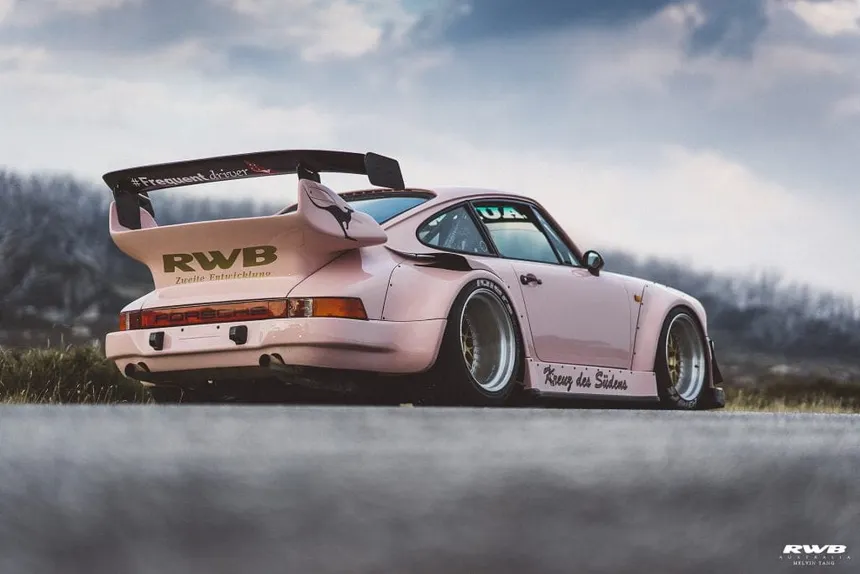
Akira Nakai was born on October 15, 1970, in Chiba, Japan. His career started with the Rough World drift crew, a Toyota AE86 Corolla Trueno group known for their aggressive driving, matte-painted cars, and no-permission-needed attitude. Nakai spent over two decades with the group and is believed to have pioneered a specific suspension setup style for drift cars that later became widespread.
In the late 1990s, while working at a body shop, he came across a damaged Porsche 911 Turbo (930). He bought it. He restored it his way. The result was the first RWB Porsche, christened “Stella Artois” after his favorite beer. With that single creation, Rauh-Welt Begriff — “rough world concept” — was born in 1997 in Chiba-Ken.
What makes Nakai unique isn’t just the design — it’s the ritual. Every RWB Porsche is personally built by him. He travels to the client’s workshop, anywhere in the world, with his tools. He arrives, meets the owner, assesses the car, and starts cutting. No templates. The cut lines are marked with tape and executed by eye, based on decades of experience. Everything is done by hand — the air saw, the fender fitting, the suspension. A complete build takes one to two days of intensive work.
Each RWB receives a unique name at the end of construction, based on the owner’s personality or something Nakai experienced during the process. “Stella Artois” was the first. Then came “Penthouse,” “Natty Dread,” “Pandora One,” “Hibiki,” “Mai”… No name is repeated. No car is the same. And Nakai only builds one RWB per client — his reasoning is that the car he makes for you is so perfect for you that you don’t need another one.
He only works with specific 911 generations: the 930 (1975-1989), the 964 (1989-1994), the 993 (1993-1998), the 996 (1997-2004), and the 997 (2004-2012). Nothing more modern. No other car. Only Porsche 911.
His declared inspiration is the aesthetics of golden-era competition 911s — the 934 and 935 racers, the aerodynamics of the Japanese Super Silhouettes — fused with Japan’s street tuning culture. The results aren’t just show pieces: Nakai insists his cars be driven. Several RWBs have competed and won at the Idlers 12-hour races at Twin Ring Motegi.
Estimates put the total number of RWBs built worldwide at between 300 and 500 units. The kit alone starts at around $24,000-$28,000, plus Nakai’s flight, accommodation, and labor costs. A realistic budget with suspension, wheels, and tires runs around $40,000 on top of the base Porsche cost. The current waiting list is approximately three years.
The first RWB built outside Japan was “Rough Evolution,” in Thailand. The first two in the United States were Mark Arcenal’s “Pandora One” (founder of Fatlace) and Brian Scotto’s “Hoonigan” (co-founder of Hoonigan), both built at the Fatlace shop in San Francisco.
Three philosophies, one shared DNA
What connects Miura, Kato, and Nakai — beyond shared Japanese nationality and a mutual obsession with widening cars — is a direct line to Japan’s 1980s street and competition culture. All three grew up watching the Super Silhouettes at Fuji and the bosozoku on the streets. All three absorbed that same aesthetic of impossible fenders, aggressive spoilers, and exposed rivets. And all three reinterpreted it in completely different ways.
Miura is the technologist who digitized an analog art. Kato is the provocateur who democratized automotive blasphemy. Nakai is the artisan who turned modification into personal ceremony. None of them is exclusively right. All three are.
The debate between purists and modifiers will exist for as long as cars exist. But there’s something the data doesn’t argue with: when Hasemi’s Super Silhouette Skyline was spitting fire at Fuji in 1982, the bosozoku watching from the stands already knew that a car isn’t just transportation. It’s a statement. And if that statement needs fenders wider than hell to be heard, then so be it.
Before you leave, check you’re still alive.