
Karma Automotive: 146 cars a year, a CEO who’s smiling, and the play nobody is watching
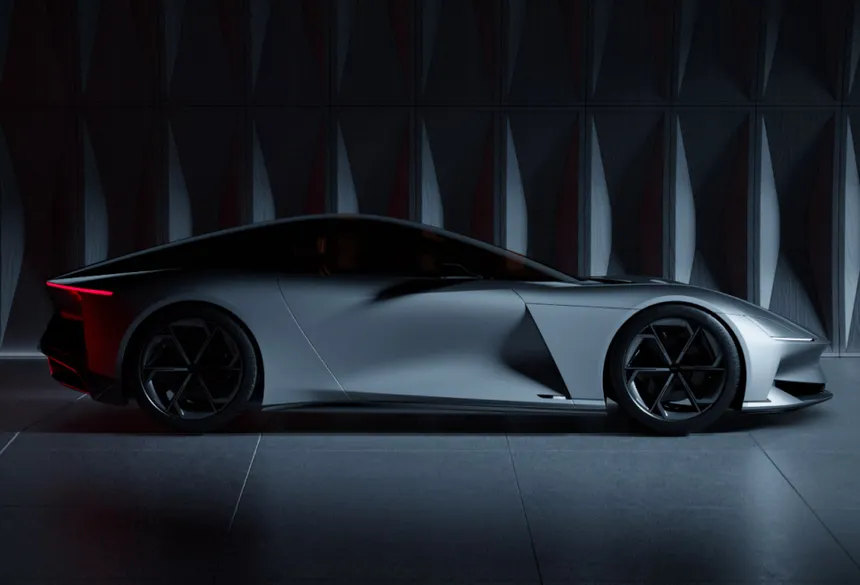
146 cars. All of 2025. Worldwide.
And Marques McCammon, Karma Automotive‘s CEO, goes on the record saying he’s happy with that number.
Happy.
You read that and think it’s a dead company that doesn’t know it yet. Desperate marketing spin. Someone who hasn’t read the results sheet. Because in the car industry success means volume. Always has. More units sold, more profit, more market share, more analysts clapping at your quarterly earnings. That’s the game. That’s always been the game.
Karma doesn’t play that game. And what they’re building below the radar should worry more than a few people.
The trick is in what you don’t see
Pagani builds between 40 and 50 cars a year. Koenigsegg, similar figures. Bugatti does about 80 Chirons annually. Nobody calls them failures. They’re called exclusive, artisanal, ultra-luxury. And nobody asks them to justify their business model in a press conference.
Karma always gets asked. Every article starts with the same veiled question: is this even a real company?
And look, the question has some logic behind it. Because Karma was born from a bankruptcy. From a company — Fisker Automotive — that promised big, delivered short, and collapsed in 2013 with nearly a billion dollars in debt. The car was called the Fisker Karma. A luxury plug-in hybrid. It hit the street before the Tesla Model S. It was more beautiful than any American sedan of its generation. And it generated more headlines for its disasters than for its performance.
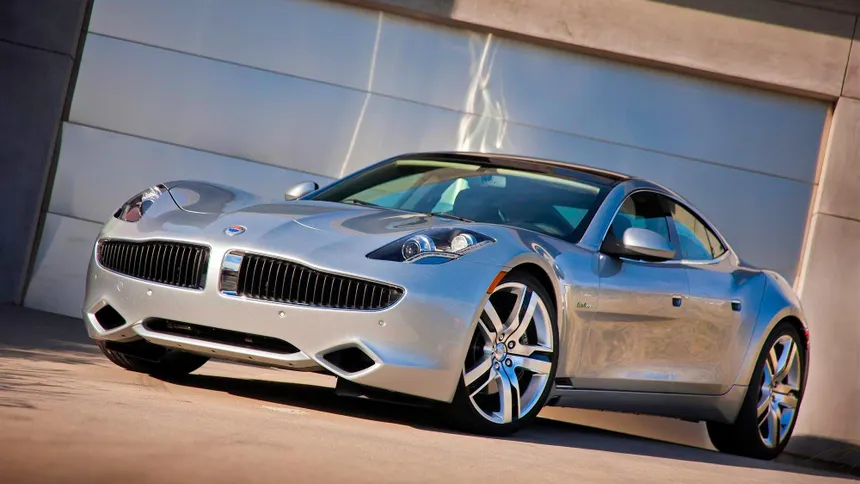
Exactly 2,667 units were built before production stopped in July 2012. Battery supplier A123 Systems went bankrupt that October. And in October 2012, Hurricane Sandy flooded Port Newark, New Jersey, with seawater and destroyed 338 Karmas sitting on the docks. 16 of them caught fire — a short circuit in a salt-corroded low-voltage control unit. The irony nobody told you: many of those cars were being held at the port specifically to carry out a recall for cooling fans that had already caused fires. They were held back to prevent them from catching fire. They caught fire.
Over $33 million in losses. The insurer, XL Insurance America, refused to pay. Fisker sued in New York. Another front in a war they had no resources to fight. Those 338 destroyed Karmas were not stock pulled from a warehouse of thousands. They represented a brutal percentage of the 2,667 total units ever built. The company was bleeding out. Consumer Reports reported their test car broke down after 200 miles. The brand became a punchline. And in November 2013, Fisker Automotive filed for bankruptcy. Nearly a billion dollars in debt. A $168 million Department of Energy loan the government would never see again.
That was the end.
Until it wasn’t.
Two pieces of the puzzle
In February 2014, China’s Wanxiang Group — the country’s largest auto parts manufacturer — bought Fisker’s assets for $149.2 million at a Delaware bankruptcy auction. Two days. 19 rounds of bidding. Six times the opening offer from the other bidder.
But here’s the detail nobody connects: Wanxiang already owned A123 Systems, the company that made the batteries that failed in the original Karma. They bought the broken batteries in January 2013. And the broken car a year later. They had both pieces of the puzzle. And they put them together.
The company was refounded as Karma Automotive. Design and executive headquarters in Irvine, California. Manufacturing at the Karma Innovation and Customization Center (KICC) in Moreno Valley, California. All tooling shipped from the original factory in Finland. Hand-built. Deliberately slow. Deliberately small.
Since its founding, Karma has delivered approximately 1,000 vehicles total. One thousand. In a decade.
And this is where you have to decide whether you think they’re incompetent or doing something entirely different from what you assume.
What’s under the hood
The Karma Revero 3G — the direct evolution of the original Fisker Karma — is an EREV. Extended Range Electric Vehicle. Two electric motors on the rear axle, a 28 kWh lithium-ion battery, and a BMW B38 1.5-litre turbocharged 3-cylinder engine — the same block from the BMW i8 — working exclusively as a generator. No mechanical connection between the combustion engine and the wheels. All thrust is electric. Always.
536 combined horsepower. 550 lb-ft of torque. 0-60 in 3.9 seconds. Top speed 125 mph. Up to 80 miles electric range, up to 360 miles total. Hand-assembled at the KICC. Every single one. The factory has capacity for 3,000 to 5,000 units a year. They could multiply current output by twenty. They choose not to. 160 units worldwide. $123,100 in the U.S., €174,463 in Europe. 4-year unlimited-mileage warranty.
The Karma Invictus is the same car with the calibration turned up. $185,000. 30 global units. If you see one, it’s rarer than a Pagani Utopia.
And you’re probably wondering: why should I care about a car that’s made in batches of 160 and most people have never seen in a photo?
Because the car is not the main product. The car is the showroom window.
The play nobody is watching
In February 2024, Karma acquired the tech assets, intellectual property, and OEM contracts of Airbiquity, a Seattle company with over 20 years developing connected vehicle software deployed in more than 60 countries. The result is Karma Connect: a proprietary Vehicle Data Management and over-the-air update platform that Karma already offers as a B2B service. To whom? To the world’s second-largest automaker.
Read that again. A 146-car-a-year company is selling connectivity tech to a manufacturer that sells millions.
In August 2024, Karma announced a bilateral collaboration with Intel Automotive to co-develop SDVA — Software Defined Vehicle Architecture. The concept: replace the 100+ independent electronic control units in a conventional car — connected by over a mile of copper cabling — with centralized computing systems using software-defined zonal controllers. Faster, lighter, more efficient, software-upgradeable. At CES 2025 they demonstrated it publicly. And Karma has stated it will sell SDVA solutions to other OEMs and Tier 1 suppliers.
McCammon repeats it in every interview: “We are a technology company that manufactures ultra-luxury vehicles.” Most people roll their eyes. But when your OTA platform runs in 60+ countries and your B2B client sells more cars in a week than you’ve sold in your entire history, the line starts sounding less like a slogan and more like a business model hiding in plain sight.
What’s coming: the pipeline
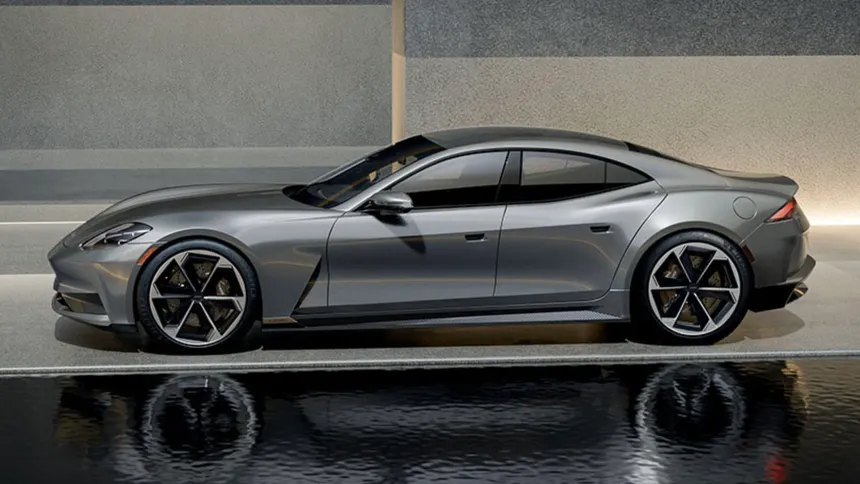
Karma Gyesera — Revero successor. 4-seat grand coupé. Aluminum spaceframe, carbon fibre and composite body. Evolved EREV powertrain with a turbocharged 4-cylinder as generator (stepping up from the Revero’s BMW 3-cylinder). 566 hp, 546 lb-ft, 0-60 in 4.0 seconds. First model with the “Comet Line” design language. Production from late 2025, priced from $165,000.
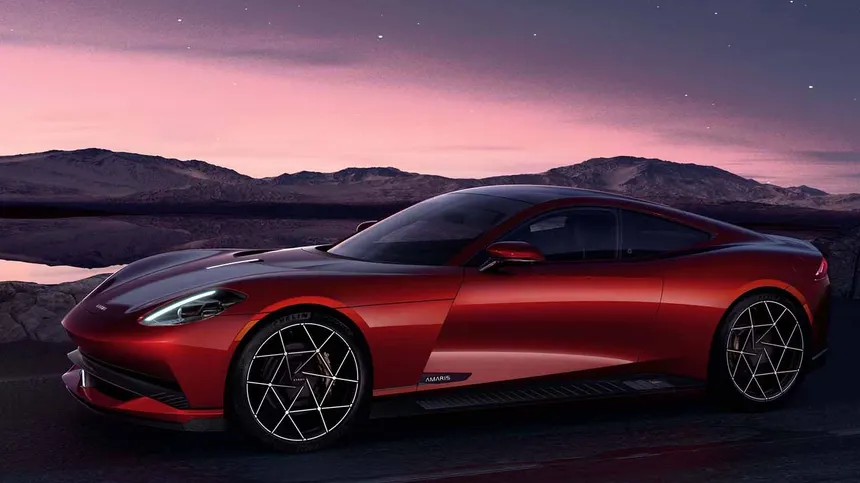
Karma Amaris — 2-seat EREV luxury coupé with swan doors. 708 hp, 676 lb-ft, 0-60 in under 3.5 seconds, top speed electronically limited to 165 mph. 41.5 kWh battery: over 100 miles electric, over 400 miles combined. Carbon fibre and aluminum body, 22-inch forged wheels, three screens, electrochromatic roof. The cupholders hide beneath the wireless charger until you need them. The passenger screen only turns on when someone sits down. Production Q4 2026, from $200,000.
Karma Kaveya — And this is where polite conversation ends.
The Kaveya: it works or it doesn’t exist
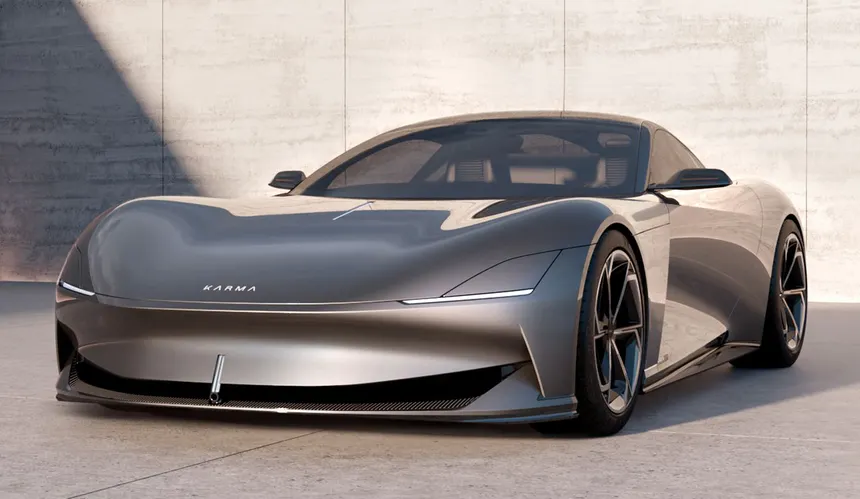
Fully electric super-coupé. Butterfly doors. Aluminum chassis, carbon fibre body. Over 1,000 hp in standard trim — up to 1,180 hp in all-wheel-drive dual-motor configuration. 1,270 lb-ft of torque. 0-62 mph in approximately 2 seconds. Top speed exceeding 200 mph.
But that’s not the important part. The important part is what’s inside the cells.
The Kaveya will be the first passenger vehicle manufactured in the United States with production solid-state batteries. Not a prototype. Not a concept car. Production.
The batteries are FEST® — Factorial Electrolyte System Technology — built by Massachusetts-based Factorial Energy. Factorial already supplied cells for a lightly modified Mercedes EQS that covered 749 miles on a single charge between Stuttgart and Malmö, Sweden. Their partners include Mercedes-Benz, Stellantis, and Hyundai. Solid-state cells replace liquid electrolyte with a solid ceramic or glass material — higher energy density, faster charging, better fire safety than conventional lithium-ion.
Karma deliberately delayed the Kaveya in 2025. High-nickel lithium-ion batteries weren’t cutting it: too much weight, too much cost in thermal management. McCammon was blunt about it. And he waited until Factorial had the cells ready.
The battery layout is not a conventional skateboard. It’s what they call a “dog bone” configuration — which lets the car sit lower and distribute weight more effectively than any flat-floor EV architecture. Estimated price: $400,000. Production planned for late 2027, approximately 300 units in the first year.
The electronic architecture is SDVA co-developed with Intel. Centralized computing. Zonal controllers. The first car on earth designed from the ground up with this technology. And here’s a detail that doesn’t make the press releases but explains a lot: McCammon and Jack Weast — Intel Fellow and VP of Intel Automotive — worked together over a decade ago at Wind River, which was an Intel division. This is not a cold commercial alliance. These are people who know each other, share a vision, and have been waiting years for the right moment to execute it.
Everything converges in this car. Factorial’s battery. Intel’s brain. Airbiquity’s connectivity. Two decades of hand-building in California. The 146 cars a year that kept the lights on while they assembled all of this underneath.
What remains to be proven
The full pipeline — Gyesera, Amaris, Kaveya, and the Ivara GT-UV in 2028 — marks the first time in Karma’s history they’ll have more than one active model simultaneously. The dealer network already spans North America, Europe, South America, and the Middle East, with European presence in Sweden, France, the Netherlands, and Spain. The infrastructure is in place. The models are coming. And the Kaveya is the piece that holds everything together.
Because the car industry does not run on promises. It runs on cars on the road. And the Kaveya has to prove that solid-state batteries work outside the lab. That SDVA isn’t a PowerPoint slide. That a 146-car-a-year company can deliver a 1,000+ hp, $400,000 super-coupé worth every single dollar. Not in a rendering. Not in a press release. On asphalt.
The car Henrik Fisker designed arrived before Tesla. It went bankrupt. It was resurrected. And it has spent a decade in silence — hand-building cars almost nobody sees, selling technology to manufacturers that sell millions, and waiting for the moment to put the only thing that matters on the table: a car that shuts everybody up.
The skeptics have a decade of reasons to doubt. Karma has a decade of quietly building the answer.
That answer has a name. It’s called Kaveya. And it arrives in 2027.
Check you’re still alive.