
Koenigsegg: The Third Swede Nobody Mentions — Who Makes Everyone Else Look Ordinary
By Not Enough Cylinders
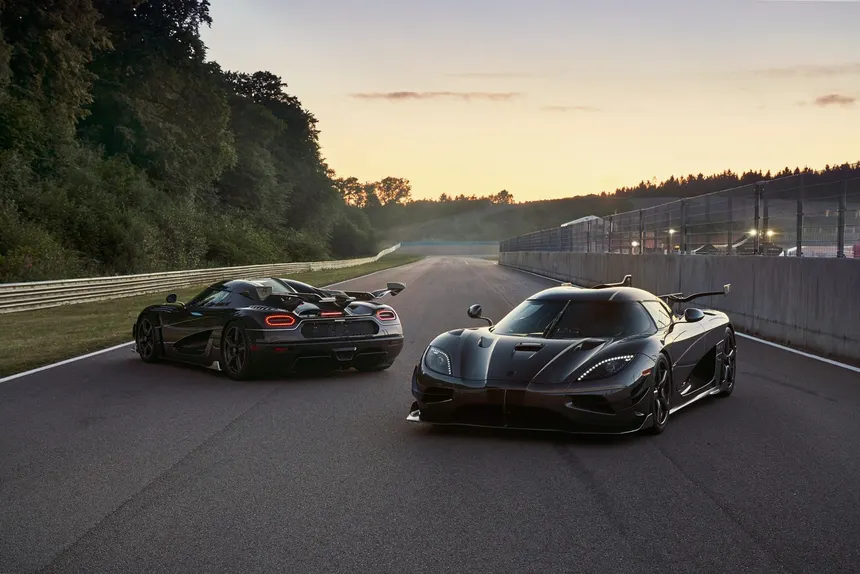
We’ve talked about Volvo. We’ve talked about SAAB. Both brands have been in the collective automotive imagination for decades.
Now let’s talk about the Swede almost nobody mentions when discussing Swedish cars. The one operating in a completely different dimension. The one that doesn’t compete with BMW or Mercedes or Porsche. The one that competes with concepts of what’s possible.
Koenigsegg.
If you don’t know it, we’re going to fix that right now. If you do, we’re going to tell you things about it you probably didn’t know.
Who Koenigsegg Is and Why You Should Care
Christian von Koenigsegg founded the company in 1994. He was 22 years old. He had no experience in the automotive industry. He had no team of veteran engineers. He had the conviction that he could build the fastest road car in the world from a small workshop in Sweden.
That could be the beginning of an exemplary failure story.
It wasn’t.
The first real production unit — the CC8S — was delivered in 2002. Eight years after founding. Eight years of work from a team that at its most numerous didn’t reach fifty people.
The CC8S produced 655hp from a supercharged Ford V8. In 2002, that figure placed Koenigsegg immediately in conversation with Ferrari, Lamborghini, and McLaren. For a company of 50 people in a converted Swedish airport hangar, it was a result improbable to the edge of the impossible.
And after that, everything only went further.
The Numbers That Don’t Make Sense Until You Understand Them
To understand Koenigsegg, you need to understand that it operates on a different scale of greatness from any other road car manufacturer.
Agera RS (2017): Broke the production car top speed record with 457.49 km/h on a closed road in Nevada. Not on a circuit. On a Nevada road. The previous record was held by the Bugatti Chiron at 420 km/h.
Jesko Absolut: Koenigsegg claims a theoretical top speed of 330 mph — over 530 km/h. Theoretical because achieving it would require conditions that don’t exist anywhere. But the aerodynamics and engine power make it mathematically possible. The engine produces 1,600hp on E85. On regular petrol, 1,280hp.
Regera: A 1,500hp combined plug-in hybrid. But the interesting part isn’t the power figure: it’s that the Regera has no conventional gearbox. It has a hydraulic coupling system Koenigsegg calls Koenigsegg Direct Drive. The combustion engine works alongside three electric motors without the steps of a manual or automatic transmission. The result is torque delivery so linear and constant that the acceleration is viscerally different from any other car.
Gemera (2020): The moment Koenigsegg decided it could also make a family car. Four seats. Four doors (opening in opposite directions, no B-pillar). 1,700hp from a 2.0-litre three-cylinder assisted by three electric motors. 0-100 in 1.9 seconds. Space for four people, luggage, and a reference audio system.
The Gemera exists because Christian von Koenigsegg wanted a car in which he could take his children without giving up what Koenigsegg has always been.
If that doesn’t seem like the most absurdly personal engineering project in automotive history, you haven’t fully understood it.
The Technology They Invented Because It Didn’t Exist
What distinguishes Koenigsegg from most supercar manufacturers isn’t just the power. It’s the amount of technology they’ve had to invent because what they needed didn’t exist in the market.
Koenigsegg Direct Drive (KDD): Already mentioned. A transmission that isn’t a transmission. The system eliminates the conventional gearbox by using electric motors to cover the rpm ranges the combustion engine doesn’t cover efficiently. The result is a single gear range from 0 to top speed.
Freevalve: Perhaps the most revolutionary technology to come out of Ängelholm (where Koenigsegg has its facilities, on the same site as the former SAAB plant) in decades. Freevalve is a camless valve actuation system. Each valve is controlled individually and completely variably through a combination of pneumatic, hydraulic, and electrical actuators. This eliminates the limitations of the conventional camshaft and allows the engine to adjust valve timing completely freely according to each cycle’s needs. The engine can run in Miller, Otto, or Atkinson cycle depending on conditions. It can simulate different displacements. It can fire from any cylinder. It’s a revolution the industry is taking decades to adopt due to implementation costs.
Koenigsegg Aircore: Hollow carbon fibre wheels that are structurally stronger and significantly lighter than any market alternative. Koenigsegg builds them because the ones that existed didn’t meet their requirements.
CCAM (Cabrio Coupe Agera Monocoque): The carbon fibre structure they use as the chassis base, developed internally with proprietary manufacturing processes.
The pattern is consistent: Koenigsegg needs something, it doesn’t exist, they invent it. And then the industry, decades later, starts adopting versions of what Koenigsegg already had.
The Airport Hangar and 150 Employees
Here’s the part that’s hardest to believe.
Koenigsegg currently has approximately 600-700 employees at their facility in Ängelholm, Sweden. For many years they operated with significantly fewer. And yet they’ve produced technology that manufacturers with tens of thousands of engineers haven’t managed.
How?
Part of the answer is the Swedish culture we explored in the previous article: the pragmatism, the willingness to ignore conventions when there’s a technical reason, the obsession with doing what you do properly rather than doing a lot of what you do.
But there’s another factor: Christian von Koenigsegg is one of those rare cases of a founder who is simultaneously visionary, detail engineer, and business person astute enough to keep a company alive in an impossible market for thirty years.
He’s not a designer who delegates engineering. He’s not a businessman who hires engineers. He’s someone who understands every level of the product and can make informed decisions at each one.
That’s extraordinarily rare. And it’s part of why Koenigsegg exists when all the probabilities said it shouldn’t.
The Attempt to Buy SAAB: When the Third Swede Tried to Save the Second
Here’s a story that connects perfectly with the earlier article about SAAB’s death.
In 2009, when GM decided to sell SAAB, Koenigsegg Group AB joined an investor consortium to attempt the purchase. Negotiations advanced for months. It was the largest rescue attempt by Swedish capital for the brand.
Ultimately, in November 2009, Koenigsegg withdrew the offer. The official reasons were vague: complexity of negotiation, GM conditions, financing structures.
The unofficial reasons circulating in the sector pointed to SAAB’s debts and obligations being incompatible with maintaining the independence Koenigsegg needed.
It’s a story of what could have been: the third Swede rescuing the second. A 150-person manufacturer trying to save one of 3,400. Swedish engineering protecting Swedish engineering.
It didn’t work. And SAAB died anyway, eighteen months later.
But the attempt says much about Christian von Koenigsegg. He’s not someone who looks away when the industrial fabric of his country is in danger.
Why Koenigsegg Isn’t as Famous as It Should Be
There’s an interesting paradox in the hypercar world: Bugatti has Volkswagen Group budget and French luxury marketing. Ferrari has decades of Formula 1 and an unbeatable brand narrative. McLaren has the heritage of Bruce McLaren and Gordon Murray’s F1.
Koenigsegg has an airport hangar in Sweden and the speed records.
The difference is marketing. Koenigsegg has never had — or sought to have — the communications apparatus of the big brands. Their cars sell for what they are, not for what they represent culturally. And in a world where 80% of a hypercar’s price is brand and narrative, that’s a significant commercial disadvantage.
But it’s also a consequence of being Swedish. The Jantelagen again. You don’t shout. You don’t exhibit. You build the best car you can build and let the car speak.
The Agera RS breaking the speed record in Nevada with the time it achieved is the automotive equivalent of an unknown jazz musician taking the stage at a festival and leaving speechless everyone who thought they’d seen it all.
The Future: Koenigsegg and Electrification
Koenigsegg’s position on electrification is the most coherent in the ultra-performance market.
They don’t reject electrification. They don’t embrace it blindly. They use it where it adds real value.
The Gemera uses electric motors to complement a two-litre three-cylinder combustion engine in a way that the combined unit produces 1,700hp. The electric motors give the instant torque at low revs the combustion engine can’t produce. The combustion engine gives the high-rev power the battery can’t sustain over time. It’s hybridisation as an engineering tool, not as an ESG statement.
The Jesko, by contrast, is pure combustion. Because for top speed records, the energy density of liquid fuels remains unbeatable by any battery that exists or will exist in the short and medium term.
Koenigsegg chooses technology based on the problem it solves. Not based on market consensus or what’s politically correct to announce in a press release.
Again: very Swedish.
Conclusion: The Swede Operating in Another Dimension
Koenigsegg isn’t a car brand. It’s an ongoing experiment into the limits of what can be manufactured in small volumes with proprietary technology and without the constraints that mass production imposes.
It’s the Swedish answer to the question of what happens when you apply the Nordic philosophy of functionality, obsession with real engineering, and rejection of convention to the most extreme problems the automotive industry can pose.
The result is cars that sometimes sound like speculative fiction. And then they go out onto a Nevada road and break all the records.
Volvo invented the seatbelt and gave it away free because human life is worth more than a patent.
SAAB put the engine backwards because it was the correct solution even though nobody else did it.
Koenigsegg invented a gearbox-less transmission, a camless valvetrain, and the world’s fastest production car because what they needed didn’t exist and they decided to create it.
All three are Swedish. The logic is the same.
Only the scale is different.
Did you know about Koenigsegg before this article? Which is your favourite model from the brand? Tell us in the comments.
Full Swedish universe series: Volvo’s Five-Cylinder Engine | SAAB 900 Turbo and Who Killed SAAB | SAAB 9-3 Viggen: The Last Scream | Why Swedes Design Such Strange Cars