
MA-FIA III: The Price of Racing — How the FIA Turned Motorsport into a Billionaire’s Theme Park
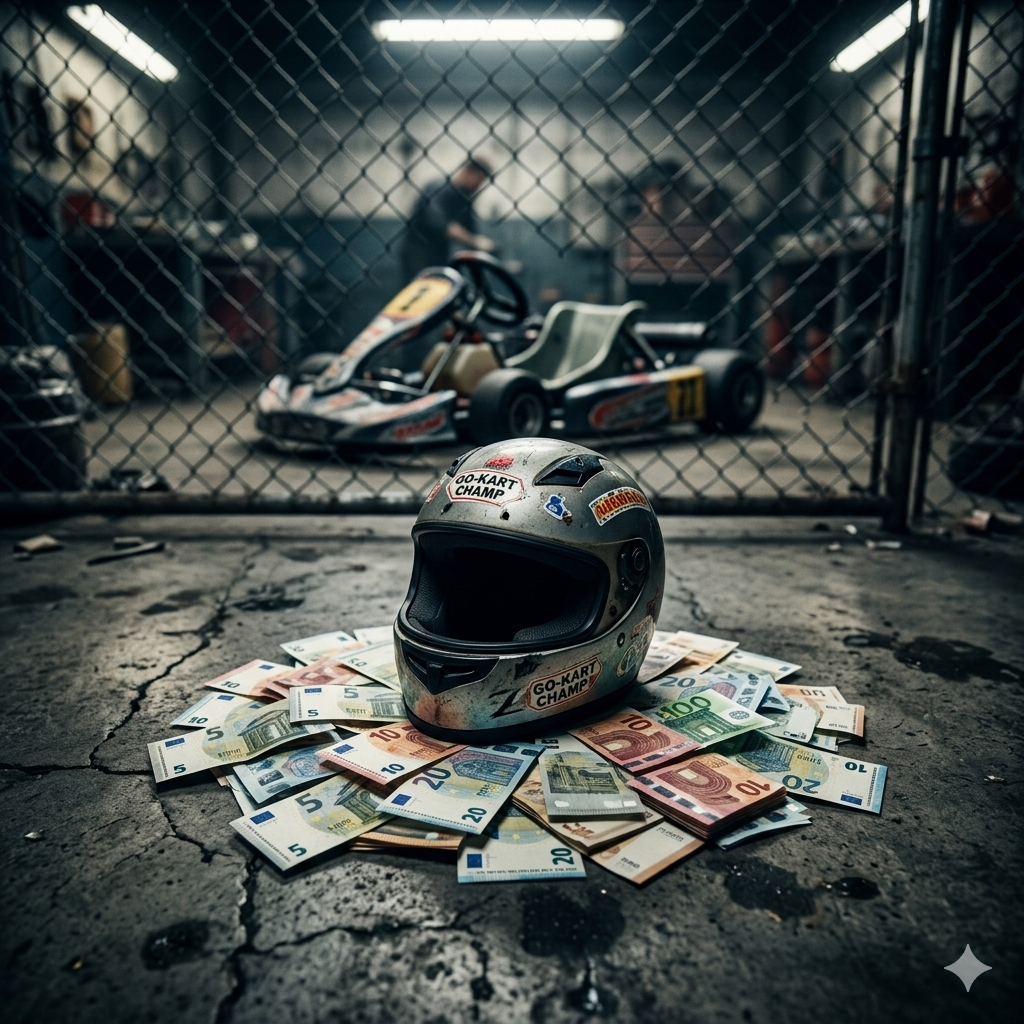
€50,000 a year for your 8-year-old to race karts. €1.3 million per season in F3. Nearly a million for a rally car you can’t buy. And if you make it to F1, over a million euros just for the licence. Welcome to the FIA’s “accessible” motorsport.
This is the third instalment of MA-FIA. The first laid out the full case against the FIA. The second exposed the Aramco lobbying operation in Brussels. Today we go to the bone of what hurts most as fans: the price of racing. What it costs to get in, what it costs to move up, and why motorsport has become a sport where your talent matters less than your father’s bank balance.
This Is Written from the Workshop, Not a Corner Office
Let me be clear from the start: the person writing this has over 30 years in the motor industry. Automotive, industrial mechanics, assembly. Today I work at Stadler Rail, building trains. The motorsport that hooked me was a sport where the bloke from your town with a workshop and enough passion could end up on the starting grid.
That motorsport no longer exists. And the FIA killed it with regulations.
The Price of the Ladder: From Karts to F1
Let’s put the numbers on the table. That’s what we do at NEC.
Karting: Where Everyone Starts
Karting is the gateway. Hamilton started there. Senna started there. Schumacher started there. And if you’ve got a kid with talent, that’s where you’ll start too.
Cost? To compete nationally with any seriousness: €10,000-50,000 per year depending on the country and level. For international competition — where the academy scouts are watching — it climbs to €50,000-100,000 annually. Mercedes F1 boss Toto Wolff puts it at “probably €1 million” to cover junior, senior and international karting stages for a talented kid.
A million euros. In karts.
But karting isn’t what it used to be. A December 2024 Washington Post investigation described the international karting circuit as “a kind of oligarchy” where “the sons and daughters of multimillionaires and actual oligarchs” crisscross Europe every weekend for mini-Grand Prix. Kids from teams like Baby Race arrive with personal mechanics, telemetry rigs, and in some cases bodyguards. Some families arrive by helicopter. One father was recorded screaming at his 8-year-old: “I’m paying 50,000 euros a year for you to race like this?!”
To have any real shot at F1, a kid has to be in Europe. The American circuit doesn’t count. The scouts from Ferrari, Mercedes and Red Bull academies look there. And the races are dominated by elite teams with sensor technology that measures the hundredths you lose in every corner.
Meritocracy? Only if your parents can sign six-figure cheques for a decade.
Formula 4, 3, 2: The Escalator of Cash
F4: €200,000-300,000 per season. Your kid is 15 and you’ve already spent €1-1.5 million on karts. F3: €800,000-1,300,000 per season. Most drivers need two seasons. That’s €1.6-2.6 million just for F3. F2: €2-3 million per season. You need to win it or finish near the top for a real shot at F1.
The Total Bill Nobody Shows You
Wolff puts it at €4.5-5 million “if you’re an extraordinary talent.” Other sources cite €8-10 million when you include training, travel, physical preparation, technical staff and everything around the driver across a decade of development.
For perspective: becoming a professional footballer costs around $30,000-50,000. A professional tennis player, similar. Motorsport is 100 to 200 times more expensive than any other elite sport to reach the professional level.
And when you arrive, the FIA charges you for the privilege.
The Super Licence: The FIA Charges You to Race
To drive an F1 car you need an FIA super licence. In 2025, the base fee is €11,453 plus €2,313 per championship point scored the previous season.
In practice, Max Verstappen paid $1,079,448 for his 2025 super licence. Lando Norris, $925,779. Charles Leclerc, $881,805. Total FIA super licence revenue in 2025: approximately €7.1 million.
Seven million euros. Just for the privilege of racing. For a licence. From a “non-profit” with $205 million in operating income.
And when the drivers asked where that money goes — through the GPDA, in 2024 — Ben Sulayem said it was none of their business. As we covered in MA-FIA I.
Rally: The Privateer Who No Longer Exists
This is where it truly hurts for those of us who come from grassroots motorsport.
The WRC was always the championship where driver talent mattered more than budget. Where a privateer with a well-prepared car could challenge a factory team on the right stages. Where the connection between road car and competition car was real — you’d see an Impreza or a Lancer on the rally and cross the same model on the street the next day.
The FIA has systematically destroyed all of that.
Rally1 cars, the WRC’s top category, cost nearly €1 million per unit. The FIA admitted it publicly. The original target was far lower, but the mandatory hybrid system imposed in 2022, homologation requirements, aerodynamic complexity and specialist materials sent costs spiralling beyond anyone’s reach.
Result? M-Sport, the WRC’s only real privateer outfit, has sold just one Rally1 car to a customer. One. The top category has fewer than 10 cars on the grid. The number of competitive privateer teams in the premier class is exactly zero.
For comparison: the World Superbike Championship has 5 factory teams and 12 privateer teams. The WRC has 3 factory teams and zero privateers. That’s the difference between a sport that keeps the door open and one that’s bolted it shut.
Rally1’s hybrid systems were the FIA’s regulatory crown jewel. Sold as “the future of rallying.” They lasted three years of a five-year homologation cycle. Teams that invested millions in hybrid development were left holding the bill. And now the FIA presents its WRC27 rules — capped at €345,000 per car — as “forward-thinking vision” when it’s actually an admission that their previous regulations destroyed the category.
And Rally2, the second tier? A Rally2 car costs around €245,000. Still a quarter of a million. For a privateer competing on passion without factory backing, that’s still an enormous barrier. But at least there’s still a grid there — precisely because the FIA couldn’t get its regulatory hands into it as deeply as it did with Rally1.
The Licences, the Homologations, and the Bureaucratic Toll
Beyond the cars and the training, the FIA has built an empire of fees, licences, homologations and inspections that weigh down every aspect of competitive motorsport.
Want to homologate a rally car? FIA technical passport, roll cage inspection, chassis unit identification, certificates for every component, each with its own fee. Want to organise a race? FIA calendar registration fee, per-category fee, technical evaluation, circuit inspection, mandatory FIA delegate attendance — every day a technical delegate is present has its own charge. Want to compete as a driver at international level? FIA international licence, routed through your national federation, with its own cost structure stacked on top.
Each of these fees is individually “reasonable” if you look at it in isolation. The problem is that stacked together they create a system where the cost of entry to competitive motorsport has multiplied exponentially over the past two decades. The net effect is an economic filter that has nothing to do with talent and everything to do with financial capacity.
The FIA publishes its schedule of sporting fees every year. Pages and pages of line items for every conceivable licence, homologation, inspection, registration and certification. For a small team or privateer trying to go racing at any level above club, the administrative burden alone — before you’ve bought a tyre or filled the tank — can run into the tens of thousands.
And the Fan? $1,600 for a Ticket
Because it’s not just expensive to race. It’s expensive to watch.
The average ticket to the Las Vegas F1 Grand Prix costs $1,600. Sixteen hundred dollars to sit in a grandstand watching cars that sound like vacuum cleaners circling a car park. Prices at other GPs aren’t much better — Monaco, Abu Dhabi, Singapore, Saudi Arabia… Affordable races are the exception, not the rule.
Meanwhile the calendar swells to 24 races, with events in countries that have zero motorsport tradition but plenty of petrodollars. And the working-class fan — the one who used to fill the grandstands at Silverstone, Spa, Monza and Montjuïc — gets priced out.
F1 generated $3.2 billion in revenue in 2023, up 25% year on year. Netflix’s Drive to Survive brought millions of new fans. Teams sign multi-million deals with luxury brands and champagne houses. But the mechanic who leaves the workshop on Friday afternoon and wants to watch a race on Sunday has to choose between the ticket and the mortgage. The sport that was built by working people watching working machines is now a luxury product marketed at people who wouldn’t know a spark plug from a glow plug.
That’s the FIA’s motorsport in 2026. Accessible for those already inside. Unreachable for everyone else.
The Motorsport We Fell in Love with No Longer Exists
I write this because I care. Not because I enjoy complaining, but because motorsport changed my life and it kills me to watch it being turned into a private club.
The kid who starts karting with talent but without a millionaire father has the road blocked. The privateer who wants to rally with a car he built in his workshop can’t afford the regulatory toll. The fan who wants to see a race in person needs a loan for the ticket. And meanwhile, the FIA collects $205 million a year, charges a million for a licence, and when you ask where it goes, tells you it’s none of your business.
Lewis Hamilton — the sport’s biggest star — came from a working-class background. He’s said publicly that he doesn’t know if his path could be repeated today because of the costs involved. When the most successful driver in history says the system that produced him is now broken, maybe it’s time to listen.
Motorsport was born on dirt roads, with people who risked their lives because they loved speed. Today it’s a theme park where the entry fee costs more than the dream, and the rules are written by people who never got their hands dirty.
That’s the MA-FIA. And we’re not done yet.
Sources: Toto Wolff, statements on development costs (Raconteur / CNN). Washington Post — investigation into karting as oligarchy (December 2024). GrandPrix247 — karting-to-F1 cost breakdown (2025). Autosport Forums — 2025 super licence fees by driver. Kym Illman — FIA financial analysis, $205M operating income 2024. Motorsport.com — Rally1 costs, hybrid failure, WRC27 analysis. Rush Magazine — WRC privateer vs WSBK comparison (December 2024). FIA — 2025 sporting fees schedule. Front Office Sports — road to F1 costs (May 2025).
Check you’re still alive.