Maserati: Seven Brothers, One Trident, and the Greatest Race Ever Run
The family born for speed
To understand Maserati, you need to start with a fact almost nobody knows: there weren’t six brothers. There were seven.
Rodolfo Maserati was a locomotive driver for the Italian railways, based in Voghera, Lombardy. He married Carolina Losi, and between 1881 and 1898 they had seven sons. The third, Alfieri, was born in 1885 and died before his first birthday. When the next son arrived, Rodolfo and Carolina gave him the same name: Alfieri. It was this second Alfieri who would found Maserati. The fate of one of the most important car manufacturers in history was born, quite literally, from a tribute to a lost brother.
The six surviving brothers were Carlo (1881), Bindo (1883), Alfieri II (1887), Mario (1890), Ettore (1894), and Ernesto (1898). Five of them shared the obsession with mechanics and speed they’d inherited from their father. The sixth, Mario, preferred brushes to pistons. And yet it would be Mario who created the brand’s most recognizable symbol.
Carlo: the genius who left too soon
Carlo Maserati designed his first internal combustion engine in 1898. He was 17. That same year he was hired by Fiat as a test driver. He built that engine in his spare time while living in Turin and mounted it on a wooden chassis — what many automotive historians consider the first Maserati prototype, nearly two decades before the company existed.
Carlo went on to become technical director of Isotta Fraschini’s racing team, bringing his brother Alfieri along with him. His talent caught the attention of Marquis Michele Carcano, a local nobleman who offered to finance the manufacture of his motorcycle design. Two years later, Carlo won his first race: a 35-mile scramble from Brescia to Orzinuovi against a field of cars and motorcycles.
In 1910, Carlo died of tuberculosis. He was 29 years old. The trauma tore through the family. Alfieri, the closest to Carlo in intelligence and passion, took on the role of leader. Together with the young Ettore, barely 16, he left for Argentina to work for Isotta Fraschini. Mario, devastated, threw himself into painting.
Carlo’s death became the silent fuel that ignited everything that followed. Alfieri didn’t just want to build cars. He wanted to finish what his older brother had started.
December 1, 1914: a garage in Bologna
On December 1, 1914, Alfieri, Ettore, and Ernesto Maserati opened a small automobile repair workshop at Via de’ Pepoli 1/A, in the historic center of Bologna. They called it Società Anonima Officine Alfieri Maserati. The municipal permit describes, with bureaucratic precision, the equipment inside: a 2 HP electric motor to power a lathe, two drills, and a grinding wheel for sharpening workshop tools.
Five months later, Italy entered World War I. Alfieri and Ettore were called to the front. The workshop was left in the hands of Ernesto, who was 16 years old and still attending evening classes at Bologna’s Technical Institute.
The spark plugs that flew over Vienna
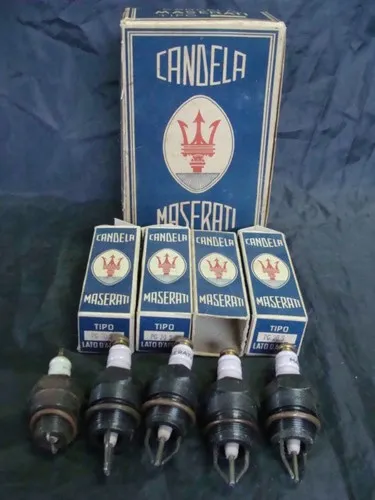
During the war, Alfieri perfected and patented a new type of mica-insulated spark plug that delivered more consistent engine performance. He opened a spark plug factory in Milan under the name Fabbrica Candele Maserati. Those spark plugs were installed in the engines of the Italian army’s Ansaldo SVA biplanes.
And here is where the story intersects with one of the most spectacular missions of World War I. On August 9, 1918, poet and activist Gabriele D’Annunzio led a squadron of 11 Ansaldo SVA aircraft on a round trip of over 1,200 kilometers from the military airfield at Due Carrare, near Padua, to Vienna. They didn’t drop bombs. They dropped over 400,000 propaganda leaflets onto the capital of the Austro-Hungarian Empire. The engines of those aircraft ran on Maserati spark plugs.
Before building a single car, the Maserati name had already flown over an enemy capital.
The trident: when an artist looked at a fountain
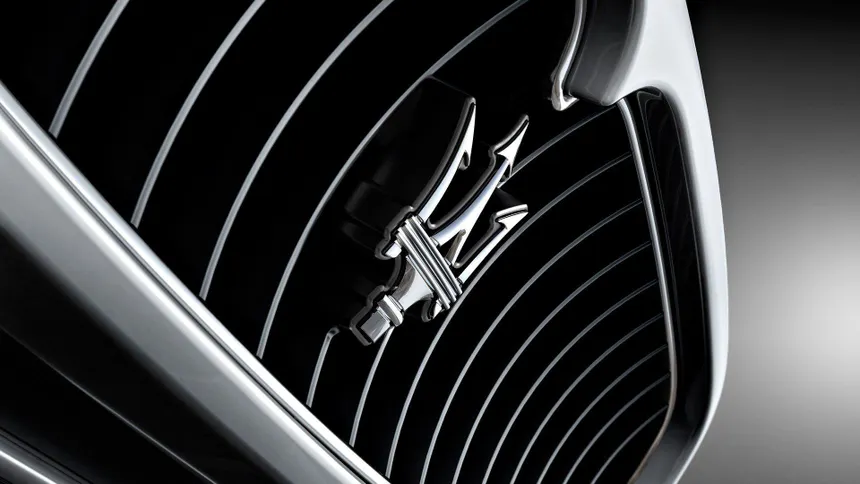
When the brothers needed an emblem for their brand, they turned to the only one who didn’t share their obsession with engines. Mario Maserati, the family’s artist, looked for inspiration in the streets of his city. He found it in Bologna’s Piazza Maggiore, in the Fontana del Nettuno — a late Mannerist masterpiece completed around 1566 by the sculptor Giambologna.
The suggestion came from Marquis Diego de Sterlich, a close family friend. Neptune, the Roman god of the sea, held a trident symbolizing power, vigor, and dominion. But there’s a detail almost nobody mentions: Neptune was also known as Neptunus Equester — patron of horses and racing. There couldn’t have been a more fitting symbol for a racing car manufacturer born in Bologna.
Mario designed the trident in 1920. At the point where the shaft transforms into the three prongs, he deliberately added a triple line — the number three as a symbol of perfection and harmony. The logo colors — red, white, and blue — come directly from Bologna’s official city banner. In over a hundred years, the fundamental design has not changed.
When Maserati unveiled the Nettuno engine powering the MC20 in 2020, the name was no coincidence. It was a thread pulled across a century, connecting the brand’s most advanced supercar to the Renaissance fountain that an artist once studied on a morning in his city’s main square.
The Tipo 26 and the Targa Florio: where it all began
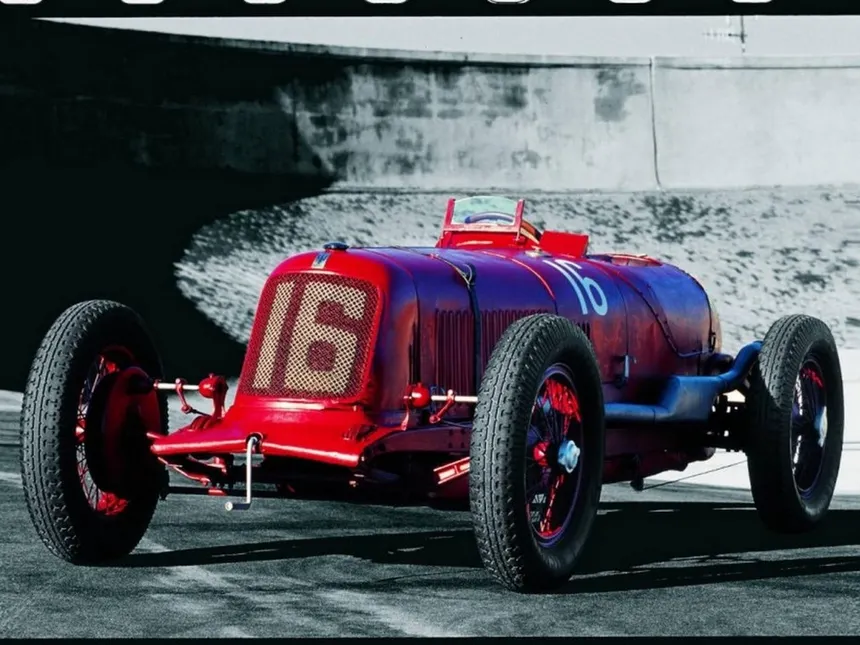
After the war, the brothers moved to a larger facility in the Pontevecchio district. Alfieri and Ernesto worked for Diatto as engineers and racing drivers, but in 1925 Diatto went bankrupt and withdrew from competition. The brothers acquired Diatto’s racing assets — unfinished chassis, gearboxes, key components — and transformed them into the first car to bear the Maserati name.
The Tipo 26 debuted in 1926: a Grand Prix single-seater with a supercharged 1.5-liter inline-eight engine and twin overhead camshafts. Alfieri drove it personally in its first race, the Targa Florio in Sicily. Result: ninth overall and a class victory. The Tipo 26 was the foundation of everything that followed, with 43 units produced in various evolved forms.
In 1929, the Maserati V4 — a monster with two eight-cylinder engines mounted in parallel forming a 4-liter V16 — set a world speed record at Cremona: 247.93 km/h over a 10-kilometer course. The driver was Baconin Borzacchini. Italy had a new name at the top of motorsport.
Alfieri’s death and Nuvolari’s arrival
In 1927, during the Coppa Messina, Alfieri suffered a serious crash that cost him a kidney. He returned to racing but never fully recovered his health. In 1932, after surgery on his remaining kidney, complications arose and Alfieri died. He was 44. Over 15,000 people attended his funeral in Bologna, including drivers, mechanics, factory workers, and Enzo Ferrari himself.
His tomb in Bologna’s Certosa Cemetery is the work of artist Mario Sarto: a memorial of red porphyry with a green diorite base, a bronze bust and eagles, inscribed with “to the pioneer of the engine and speed.”
Ernesto abandoned his racing career to oversee the technical department alongside Ettore. Bindo, the most corporate of the brothers, assumed the presidency. And in 1933 came the most unexpected reinforcement: Tazio Nuvolari, nicknamed “The Flying Mantuan” and described by Ferdinand Porsche as “the greatest driver of the past, the present, and the future,” switched to Maserati after a falling-out with Enzo Ferrari. Nuvolari won the Belgian GP at Spa in the 8CM in legendary fashion: he qualified eleventh, asked for the front chassis to be reinforced overnight, and the next day went from last to first in a single lap.
Adolfo Orsi, Indianapolis, and Mussolini’s car
In 1937, the Maserati brothers sold the company to Modena-based industrialist Adolfo Orsi. The new owner moved the headquarters from Bologna to Modena in 1940 — directly across from Ferrari’s original premises. The brothers stayed on for ten more years as contracted engineers.
Under Orsi’s direction, Maserati achieved something no other Italian manufacturer has ever accomplished: winning the Indianapolis 500. In 1939 and 1940, American driver Wilbur Shaw won the race consecutively at the wheel of the Maserati 8CTF, known as the “Boyle Special.” An Italian single-seater dominating the biggest event in American motorsport. To this day, Maserati remains the only Italian manufacturer to have won the Indy 500.
During World War II, Maserati ceased racing car production and switched to manufacturing spark plugs, batteries, and electric delivery vehicles for the Italian war effort. But there’s an anecdote that borders on the surreal: Maserati was commissioned to build a V16-engined town car for Benito Mussolini’s personal use, to rival the one Ferry Porsche was designing for Adolf Hitler. The project was never completed. The plans were scrapped.
The brothers leave, Fangio arrives
In 1947, with their contract expired, the three surviving brothers — Bindo, Ettore, and Ernesto — made a painful decision: to leave the company that bore their name. They returned to Bologna and founded OSCA (Officine Specializzate Costruzioni Automobili) in San Lazzaro di Savena, where they produced small-scale sports and competition models. In 1954, an OSCA MT4 1450 won the Sebring 12 Hours with Stirling Moss at the wheel, beating Ferrari. Decades later, Moss bought an OSCA as his car of choice for historic motorsport events.
Meanwhile, in Modena, Maserati was living its golden age thanks to one man: Juan Manuel Fangio. And in particular, thanks to one race.
August 4, 1957: the greatest race in history
The 1957 German Grand Prix at the Nürburgring Nordschleife isn’t just Fangio’s best race. For many historians, it’s the greatest Formula 1 race ever run.
Fangio was 46. He drove the Maserati 250F, a single-seater with a 2.5-liter six-cylinder engine that wasn’t the most powerful in the paddock but was beautifully balanced. Against him, the Lancia-Ferraris of Mike Hawthorn and Peter Collins, on harder Englebert tires that could last the full 22 laps — over 480 kilometers — without stopping. The Maserati’s Pirellis were faster but softer, requiring a pit stop.
Maserati’s strategy was brilliant and risky: start on a half tank, build an advantage with a lighter car, pit at mid-race, and chase down the Ferraris. Fangio executed the first phase flawlessly: pole position, the lead from lap three, and a 28-second advantage when he pitted on lap 12.
Then everything fell apart. The mechanics, who had practiced the stop in 30 seconds, took 52. The right-side mechanic dropped the rear wheel nut under the car and spent half a minute finding it. Fangio left the pits 48 seconds behind Collins in second place.
What happened over the next ten laps is motorsport legend. But there’s a tactical detail almost nobody tells: Marcello Giambertone, Fangio’s sporting director, leaned over the car during the stop and whispered that he should take it easy for two laps to deceive Ferrari’s pit wall. Fangio complied. Ferrari signaled “steady” to their drivers. When Bertocchi, Maserati’s legendary chief mechanic, gave the signal to attack, Fangio recovered over 14 seconds in a single lap.
Over the following laps, Fangio broke and re-broke the lap record nine times. His fastest lap was 8 seconds quicker than his own pole position time. He passed Collins on lap 21 and Hawthorn shortly after, his left wheels on the grass, in a move that would be unthinkable today.
He won by 3.6 seconds. It was his 24th victory — and his last. His win percentage of 46.15% remains the highest in Formula 1 history.
After the race, Fangio said: “I have never driven that quickly before in my life, and I don’t think I will ever be able to do it again.” Years later he added: “I couldn’t sleep for two nights afterwards, still making those leaps in the dark on curves where I had never before had the courage to push things so far.”
That victory was also the last for Maserati as a constructor in Formula 1.
From the Birdcage to the Quattroporte: reinvent or die
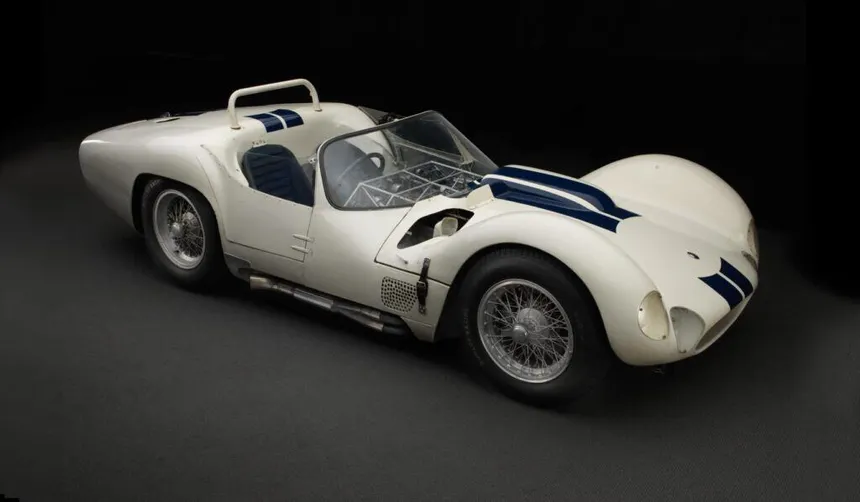
After the 1957 Mille Miglia tragedy, where a Ferrari killed its driver, co-driver, and ten spectators near Guidizzolo, Maserati officially withdrew from competition. But it left one final gift: the Tipo 60, nicknamed “Birdcage” for its tubular chassis made of over 200 welded small-diameter steel tubes. It won the 1000km Nürburgring in 1960 and 1961.
The 3500 GT of 1957, with its aluminum body, marked the shift toward road-going grand tourers. In 1963, the first Quattroporte was unveiled at the Turin Motor Show: a racing engine inside a sedan. It was one of the fastest four-door cars in the world. The 1967 Ghibli, designed in collaboration with Giorgetto Giugiaro, cemented the brand as a synonym for Italian sporting elegance.
Things almost nobody knows
Maserati didn’t just power cars. Its engines were used in racing boats from the 1930s onward. Count Theo Rossi, a world champion powerboat racer, equipped one of his boats with twin Maserati V16 engines. In 1958, a Cantieri Timossi hydroplane powered by a Maserati V8 won the world championship.
When the Orsi family divided the Maserati group among themselves, a notary’s error allowed the spark plug division to continue using both the Maserati name and the trident emblem. That division, Fabbrica Candele e Accumulatori Maserati, went on to produce motorcycles and a 50cc scooter with gender-specific frames: the T2/U (Uomo, for men) and the T2/D (Donna, for women).
Maserati built an exclusive car for the Shah of Persia, Mohammad Reza Pahlavi, based on the 3500 GT prototype with a V8 engine from the 450 S and finishes in gold and rare woods. Among its most celebrated admirers was Luciano Pavarotti.
Citroën buys Maserati: the strangest marriage in motoring
In January 1968, while Paris was gearing up for the May revolts, Citroën bought Maserati. The decision baffled the entire industry. Pierre Bercot, Citroën’s managing director, needed a powerful engine for his upcoming grand tourer, Project S. Rather than develop one in-house, he bought an entire Italian racing car factory.
Giulio Alfieri, Maserati’s brilliant chief engineer — the same man who had designed Fangio’s 250F and the Ghibli — was tasked with creating a V6 for the new French car. There’s a persistent myth that he simply lopped two cylinders off the existing Maserati V8. The reality is that Alfieri designed a completely new engine from scratch, a 90° V6 displacing 2,670 cc with four overhead camshafts. He did it in a matter of weeks, which fed the legend of the “chopped” motor. The result was the Citroën SM, unveiled at the 1970 Geneva Motor Show: a front-wheel-drive coupé with Citroën hydropneumatic suspension and a Maserati engine. An impossible cross that worked sublimely.
But what mattered most for Maserati was what Citroën’s financial backing allowed them to build in Modena. In 1971 came the Bora, the first mid-engined production Maserati, designed by Giorgetto Giugiaro. It was also the first Maserati with independent suspension on all four wheels — something Lamborghini had offered since 1964 with the Miura. The Bora incorporated Citroën’s hydraulic technology for brakes, clutch, seat adjustment, and retractable headlights. A year later came the Merak, with the SM’s V6 enlarged to 3.0 liters, followed by the Khamsin, a front-engined GT with Citroën’s DIRAVI power steering that Marcello Gandini described as one of his most satisfying designs.
Then came the 1973 oil crisis. Demand for sports cars collapsed. Citroën, already drowning in debt from developing the SM, the Wankel rotary engine with NSU, and the absence of a mid-range model for 15 years, went under. Peugeot absorbed Citroën in 1975 and immediately cut Maserati loose. The trident brand was put back on the market. In less than a decade, it had gone from glory to the brink of liquidation.
Alejandro de Tomaso and the Biturbo: the car that saved and almost destroyed Maserati
Alejandro de Tomaso, an Argentine businessman based in Modena with his own supercar brand, acquired Maserati in 1976 with help from the Italian government, which wanted to preserve jobs. De Tomaso had a clear plan: turn Maserati into a high-volume manufacturer. His role model was the BMW 3 Series.
The result was the Biturbo, unveiled on December 14, 1981 — exactly the 67th anniversary of the company’s founding. It was the first production car in history equipped with twin turbochargers. A 2.0-liter V6 with two IHI turbos producing 180 hp — more power than the BMW 323i, more than any competitor in its segment. And at a similar price point. The idea was to create a “people’s Maserati,” a car with exotic sports car performance but the discretion of a sedan.
De Tomaso invested 50 billion lire of Italian taxpayer money to automate production at the Innocenti factory in Lambrate, Milan. The factory was designed to produce 30 cars per day. Initially, sales were spectacular: 40,000 initial orders. In its best year, 1984, 4,200 units were produced. In the United States, 2,023 units sold in its first year.
But de Tomaso made a fatal error. Giorgio Manicardi, Maserati’s international sales manager, wanted to launch the Biturbo at 22 million lire. De Tomaso insisted on pricing it below 20 million. The consequence was no margin left for proper quality control. Early Biturbos suffered from hot-starting problems with the carburetors, chronic electrical faults, corrosion from non-galvanized panels, and non-intercooled turbos that overheated. In the United States, with its consumer protection laws, the car acquired a disastrous reputation. By 1987, Maserati stopped officially exporting the Biturbo coupé to the U.S. to let dealers clear their warehouses.
The irony is that the Biturbo steadily improved over the years — intercooler added in 1985, electronic fuel injection in 1986, and the later derivatives like the Shamal (with a new 3.2-liter twin-turbo V8 styled by Gandini) and the Ghibli II were serious, well-built cars. But the reputational damage was done. However, there’s an uncomfortable truth: without the Biturbo, Maserati would have ceased to exist. It was the car that proved a niche brand could democratize without losing its name — a lesson Porsche would learn later with the Cayenne.
De Tomaso had another peculiarity: he banned Maserati from racing throughout his entire tenure. A manufacturer born on the racetrack, with Targa Florio and Nürburgring DNA in every bolt, was forbidden from competing for nearly two decades.
The Fiat era and the Ferrari renaissance
In 1993, Fiat acquired Maserati. In 1997, shares were transferred to Ferrari, and Maserati became the prancing horse’s luxury division. It was the best corporate decision anyone ever made regarding Maserati.
Ferrari provided Maserati with its engineering resources, distribution network, and above all, its engines. The 3200 GT of 1998, with a 3.2-liter twin-turbo V8 producing 370 hp, was the first Maserati in years that critics considered worthy of the name. Its boomerang-shaped taillights, designed by Giugiaro, became an instant icon.
But the real masterstroke came in 2003 with the Quattroporte V, designed by Pininfarina. A luxury sedan with a Ferrari 4.2-liter V8, a six-speed gearbox developed by Ferrari, and a visual presence that made a Mercedes S-Class look like a taxi. Lorenzo Ramaciotti oversaw the design. It was the car that put Maserati back in the global luxury conversation and definitively cracked the American market.
The MC12: Maserati returns to racing
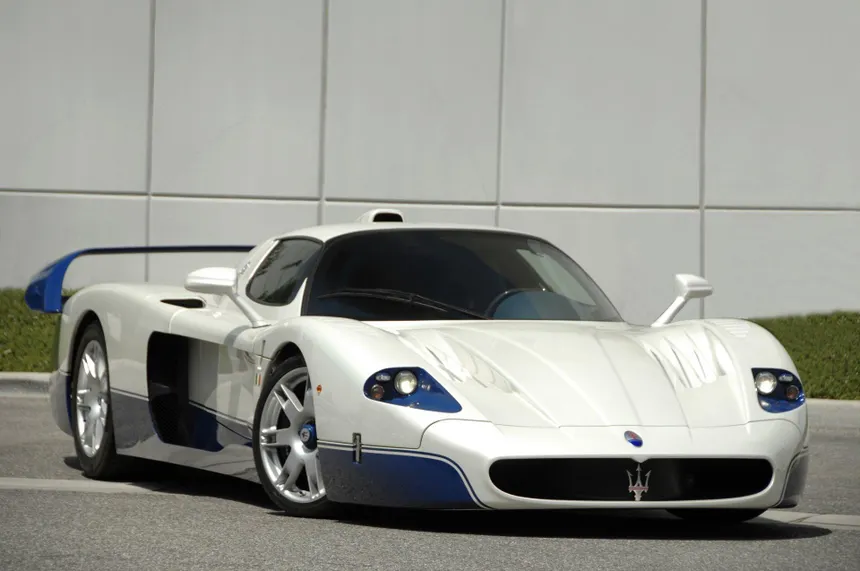
In 2004, after nearly two decades of absence, Maserati returned to competition. And it did so with a car that was, essentially, a Ferrari Enzo dressed in blue and white. The MC12 used the Enzo’s chassis and 6.0-liter V12 engine, rebodied with a carbon fiber shell 290 mm longer and designed specifically for GT homologation. Only 50 road units were built, priced at 600,000 euros each, and all sold before production began.
On track, the MC12 was devastating. It won the FIA GT Championship in 2005, 2006, and 2007, plus the Spa 24 Hours three consecutive times. It was proof that Maserati’s competitive DNA hadn’t died — it had only been sleeping.
GranTurismo, Ghibli, and Levante: the expansion
The 2007 GranTurismo, with a Ferrari V8 displacing 4.2 liters (later 4.7) and Pininfarina design, became one of the most successful GTs in the brand’s history, remaining in production until 2019. It was a car that did something few cars manage: it sounded better than its numbers suggested. The naturally aspirated V8’s exhaust note at full throttle was a sales argument all on its own.
In 2013, under Sergio Marchionne’s direction within the Fiat Chrysler group, Maserati launched the new Ghibli and Quattroporte VI. The strategy was ambitious: triple sales, reach 50,000 annual units, compete directly with the BMW 5 Series, Mercedes E-Class, and Audi A6. In May 2014, Maserati sold over 3,000 cars in a single month — an all-time record. In 2016 came the Levante, the first SUV in the brand’s history.
But expansion came at a cost. Ghiblis with VM Motori diesel engines and finishes below luxury-brand expectations drew criticism. Maserati was dangerously approaching the territory the Biturbo had explored three decades earlier: volume at the expense of exclusivity.
MC20 and the Nettuno engine: returning to the source
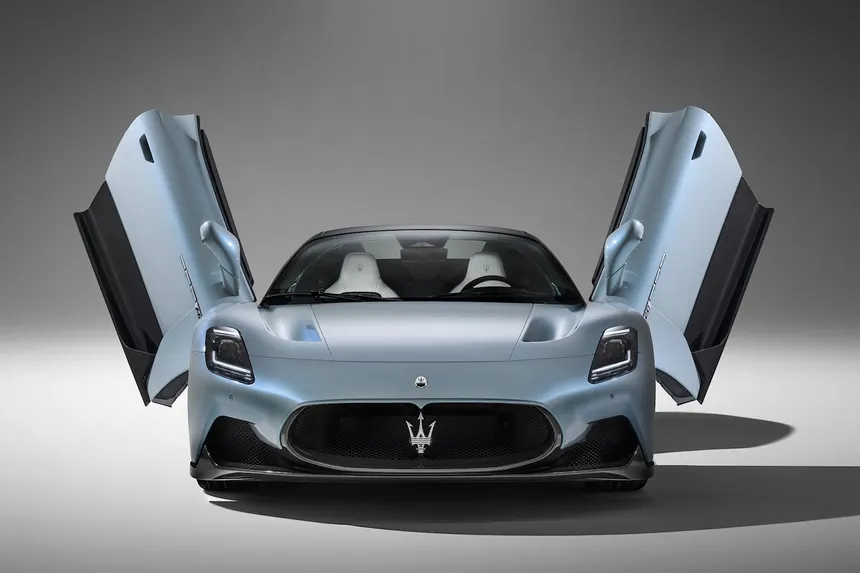
In 2020, Maserati unveiled the MC20. And with it, something it hadn’t done in over two decades: design and build its own engine from scratch, without relying on Ferrari.
The Nettuno is a 3.0-liter twin-turbo V6 producing 630 hp. Its pre-chamber combustion technology, derived from Formula 1, uses a dual-injection, dual-spark-plug system enabling both efficient low-load driving and maximum power on track. The name, Nettuno — Neptune — was a thread pulled across a century, connecting the brand’s most advanced supercar to the Renaissance fountain that Mario Maserati once studied on a morning in his city’s main square.
The MC20 earned critical acclaim. It could sprint from 0 to 100 km/h in 2.9 seconds, reach 325 km/h, and did so with a carbon fiber structure weighing less than 1,500 kg. The convertible variant (MC20 Cielo) and fully electric version (MC20 Folgore) followed. The new GranTurismo and GranCabrio also launched in both combustion and electric forms.
Stellantis and the existential crisis
In 2021, Fiat Chrysler merged with the PSA Group to form Stellantis, placing Maserati under the same corporate umbrella as Citroën — more than forty years after that traumatic 1975 divorce. The irony is hard to miss.
What followed was not a renaissance. In 2024, Maserati’s production and sales collapsed. The Cassino plant, where the Grecale was built alongside the Alfa Romeo Giulia and Stelvio, entered recurring production stoppages. The electric Folgore sold barely 150 units in key European markets. Production of the Ghibli and Quattroporte ceased in 2023, the Levante in 2024. The lineup shrank to the GranTurismo, GranCabrio, Grecale, and MC20.
Carlos Tavares’ departure as Stellantis CEO in late 2024, following massive group losses — Stellantis reported a net loss of €22.3 billion for 2025, including €25.4 billion in extraordinary charges — left Maserati in strategic limbo. Antonio Filosa took over as group CEO. Santo Ficili, heading both Maserati and Alfa Romeo, has publicly reaffirmed that Stellantis will not sell Maserati, that the United States remains a strategic market, and that future plans include production of exclusive one-off and few-off models in Modena.
But reality is harsh. Analysts openly debate whether Stellantis should sell Maserati to a Chinese group like Chery or Geely. U.S. tariffs on luxury imports further complicate the equation. And the brand, which imports 100% of the vehicles it sells in the American market, has no margin for error.
At the 2026 Goodwood Revival, Maserati will be the celebrated marque, commemorating the centenary of its first victory at the Targa Florio. A film about the Maserati brothers is reportedly in development for the silver screen. The history continues to generate interest. The question is whether the company can keep pace with its own legend.
111 years later, the trident still stands
The story of Maserati is the story of a family that bet everything on speed and paid the price with the lives of two brothers. It’s the story of an artist who found a racing brand’s identity in a 16th-century fountain. It’s the story of spark plugs that flew over Vienna before a single Maserati car existed. It’s the story of a 46-year-old Argentine who drove the greatest race ever run. It’s the story of the world’s first twin-turbo production car, of an impossible marriage with Citroën, of an MC12 that dominated the FIA GT, and of an engine named Neptune that closed the circle a century later.
Maserati has survived two world wars, the deaths of its founders, bankruptcy, Citroën, De Tomaso, Fiat, Ferrari, and now it must survive Stellantis. Neptune’s trident is still there, where Mario placed it over a century ago. And as long as that symbol sits on the nose of a car, the story isn’t over.
Now, check you’re still alive.