
Mercedes-Benz 300 CE (C124): The Pillarless Coupé That Defined an Era
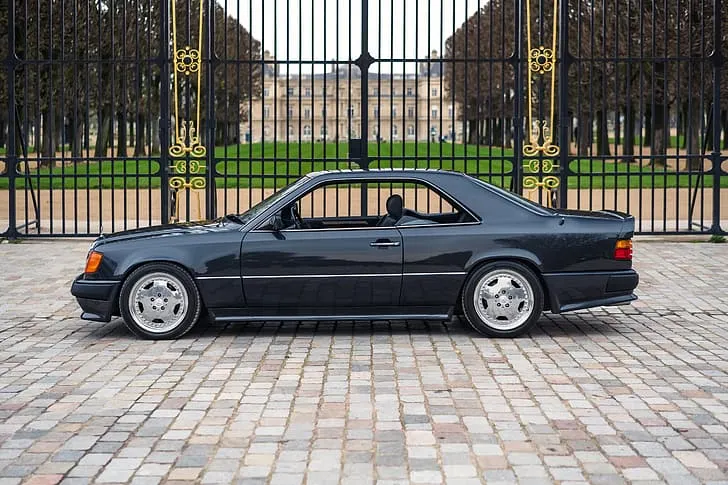
When Mercedes Built a Two-Door Car and Forgot to Include the B-Pillar
Every generation of car enthusiasts has a design element they mourn. For those who grew up in the 1980s and 1990s, it’s the pillarless coupé — a body style where all four windows can be lowered simultaneously, leaving nothing but open air between the A-pillar and the rear quarter. No central post interrupting the glass line. No compromises.
The Mercedes-Benz 300 CE, chassis code C124, is perhaps the most elegant expression of this dying art form. Produced from 1987 to 1993 (later renamed E-Class Coupé until 1997 for the cabriolet), it took the already-legendary W124 platform and distilled it into something more refined, more purposeful, and more beautiful than the sedan it was based on.
It’s the Mercedes coupé that enthusiasts whisper about. And if you’re reading this, you probably already know why.
The W124 Foundation: The Best Car in the World
To understand the C124, you need to understand its foundation.
The Mercedes-Benz W124, launched in 1984, is routinely described as one of the greatest cars ever manufactured. Period. Not one of the greatest Mercedes. Not one of the greatest sedans. One of the greatest cars. The engineering behind it was so thorough that Mercedes spent eight years in development — from 1976 to 1984 — before a single customer car left the factory.
The W124 introduced the multi-link rear suspension (now standard across the industry), advanced crumple zone engineering, widespread use of high-strength steel, and a level of build quality that set the benchmark for every European manufacturer. Taxi drivers across the world still run W124s with 500,000+ km on the odometer as daily workhorses.
It was into this platform that Mercedes chose to build its new coupé.
The C124: More Than a Two-Door W124
When Mercedes-Benz presented the C124 in early 1987 — almost three years after the sedan’s launch — they could have simply removed two doors and called it a coupé. They didn’t.
The C124 was substantially different from the W124 sedan:
Shorter Wheelbase
The coupé sat on a shortened wheelbase, giving it more compact proportions and a sportier visual balance. The shorter platform improved turn-in response and gave the car a slightly more dynamic character than the sedan.
Pillarless Design
The defining feature. With no B-pillar, rolling down all four windows transforms the C124 into something that feels almost like a cabriolet. The uninterrupted glass line creates an elegance that modern coupés — with their thick pillars dictated by crash regulations — simply cannot replicate.
This design choice had structural implications: Mercedes reinforced the A-pillars, the door frames, and the floor pan to maintain rigidity without the B-pillar’s contribution. The doors themselves are longer than the sedan’s, providing easier rear-seat access while maintaining the coupé silhouette.
Lower Roofline
The C124 sits lower than the W124 sedan, with a roofline that slopes more aggressively toward the rear. Combined with unique rear quarter windows and a redesigned greenhouse, it creates proportions that are unmistakably coupé — elegant where the sedan is authoritative.
Individual Rear Seats
Instead of the sedan’s rear bench, the C124 featured two individual rear seats, emphasizing its four-seater grand touring character.
The Engines: Refined Sixes
The C124 was never about brute force. Unlike the 500E sedan, which received a V8, the coupé was exclusively powered by inline engines — four-cylinders and sixes — with naturally aspirated refinement as the priority.
The Range:
| Model | Engine | Power | Torque | 0–100 km/h |
|---|---|---|---|---|
| 230 CE | 2.3L I4 M102 | 132 hp | 205 Nm | ~11 sec |
| 300 CE | 3.0L I6 M103 | 180 hp | 255 Nm | 8.1 sec |
| 300 CE-24 | 3.0L I6 M104 24V | 220 hp | 265 Nm | 7.7 sec |
| E 220 (post-facelift) | 2.2L I4 M111 | 150 hp | 210 Nm | ~10 sec |
| E 320 (post-facelift) | 3.2L I6 M104 | 220 hp | 310 Nm | 7.9 sec |
The sweet spot for enthusiasts is the 300 CE-24 — the 24-valve version of the inline-six, producing 220 hp with a smoothness that only a naturally aspirated straight-six can deliver. Available with a five-speed manual or four-speed automatic, it offered a driving experience that balanced refinement with genuine sporting intent.
The 300 CE-24 was only available in Europe and Japan, making it a particularly desirable variant for collectors. A total of 24,463 units were produced.
For the North American market, the 300 CE carried the M103 engine (12-valve, 180 hp) through most of its run, later transitioning to the M104 3.2-liter unit under the E 320 name.
The AMG Variants: When the Coupé Got Serious
While Mercedes kept the C124’s official engine range restrained, AMG had other ideas:
- 300 CE 3.4 AMG — Bored-out inline-six producing approximately 272 hp. A rare and desirable fast tourer
- E 36 AMG — The 3.6-liter AMG version of the inline-six, available after the facelift. Approximately 268 hp with significantly improved torque
These AMG variants are exceptionally rare and command serious premiums in the collector market. They represent the C124 pushed to the limits of what its inline-six architecture could deliver — and those limits were higher than most people expected.
Design: Bruno Sacco’s Quiet Masterpiece
The C124 was designed under Bruno Sacco, the same man responsible for the R129 SL, the W140 S-Class, and virtually every significant Mercedes design from the 1970s through the 1990s.
Sacco’s approach to the C124 was characteristically restrained. Where BMW’s E24 6 Series was dramatic and Audi’s coupés were futuristic, the C124 was correct. Every line served a purpose. Every proportion was balanced. There was no single element that screamed for attention — instead, the entire car communicated quality through coherence.
The front end shared the sedan’s face (subtly modified for the coupé’s lower hood line), but the side profile was unique: the longer doors, the absent B-pillar, and the lower roof created a silhouette that was distinctly more athletic. From the rear three-quarter angle — the money shot for any coupé — the C124 is simply beautiful.
It’s a design that grows on you. Not love at first sight, but the kind of understated elegance that, once you see it, you can’t unsee.
The Cabriolet: A124
The C124’s story extends beyond the coupé itself. In 1992, Mercedes used the C124 as the basis for the A124 Cabriolet — the first four-seat Mercedes convertible since the W111 ended production in 1971.
Creating the cabriolet required reinforcing nearly 1,000 individual components to maintain structural rigidity without a fixed roof. The A124 featured gas-fired emergency roll bars (inherited from R129 technology) and proved so successful that it outlived the coupé, remaining in production until 1997.
The A124 cabriolet has become increasingly collectible, particularly in E 320 form with the 3.2-liter inline-six and a manual transmission — a combination that offers open-air motoring with mechanical purity.
Production Numbers and the Market
The C124 was never a volume seller — it was a niche model within an already-premium lineup. Total production across all C124 coupé variants was approximately 141,498 units from 1987 to 1996.
Current market values reflect the C124’s status as a “hidden gem” rather than a blue-chip collectible:
- 230 CE / E 220: €5,000–€15,000 for decent examples
- 300 CE (M103): €8,000–€20,000
- 300 CE-24 (M104): €12,000–€35,000 — the enthusiast’s choice
- E 320 (post-facelift): €10,000–€25,000
- AMG variants: €30,000–€80,000+ depending on documentation and condition
The manual transmission cars command premiums of 20–40% over automatics, and the 300 CE-24 with a five-speed Getrag is widely considered the most desirable non-AMG specification.
Why the C124 Matters
The Mercedes-Benz C124 represents the last era when a major manufacturer could build a pillarless coupé for volume production. Modern crash safety regulations have made the B-pillar mandatory for structural integrity, meaning the C124’s signature design feature is physically impossible to replicate in a new car.
This isn’t nostalgia talking — it’s physics. The pillarless coupé is extinct, and the C124 is one of its finest final specimens.
But beyond the B-pillar question, the C124 matters because it represents Mercedes-Benz at its most confident. It’s not a flashy car. It’s not a loud car. It’s not even a particularly fast car. It is, however, a perfect car for its intended purpose: covering long distances in absolute comfort, with two or four occupants, looking effortlessly elegant while doing so.
In an age of SUVs, crossovers, and turbocharged everything, the C124 300 CE is a reminder that some of the best cars ever made were the ones that didn’t try to be anything other than excellent at being themselves.
Pillarless. Purposeful. Perfect.
Would you choose the C124 coupé or the A124 cabriolet? Hardtop elegance or open-air freedom?