
Mercedes-Benz 300 SL Gullwing: Aviation on Wheels
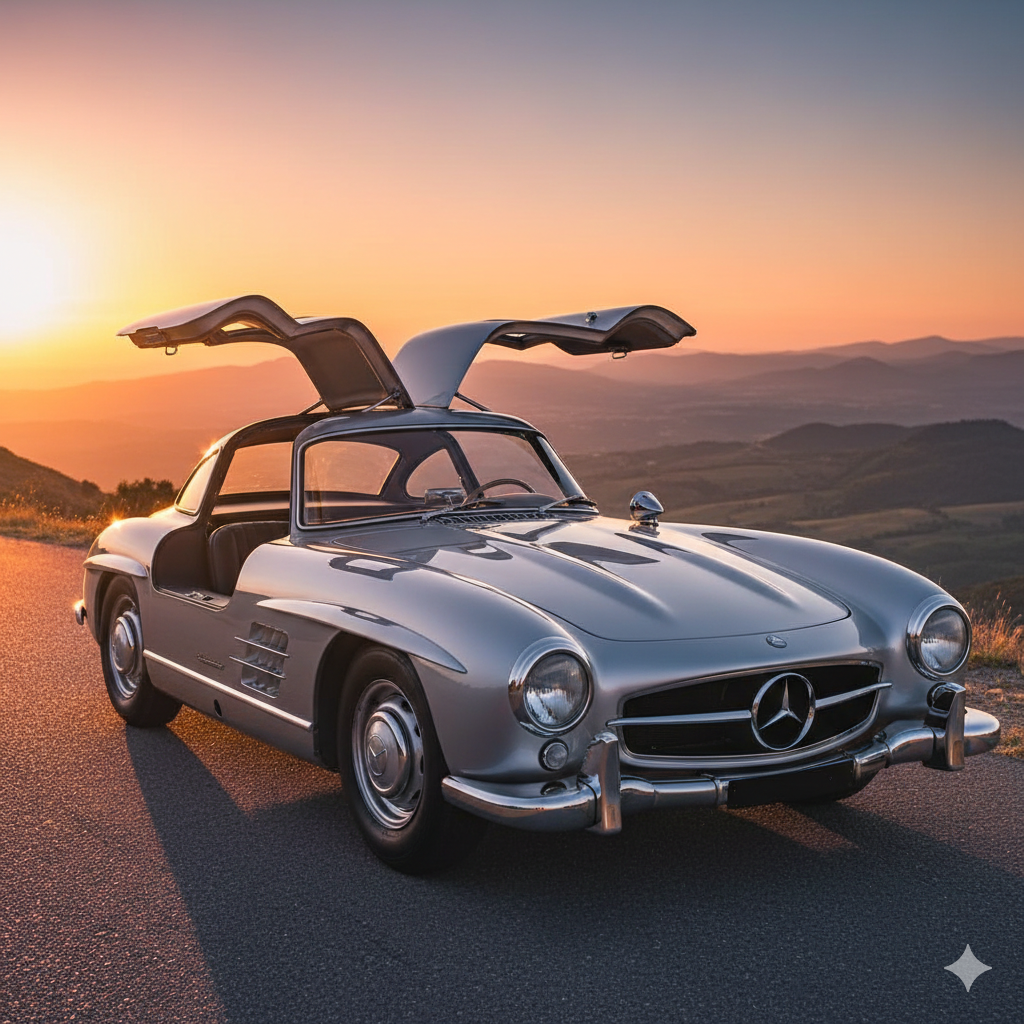
There is a photograph from 1954 that says it all. A Mercedes-Benz 300 SL with its doors open to the sky, parked in front of a DC-3 on an airstrip. The message was clear: this is not a conventional automobile. This is aviation on wheels. Seventy years later, the 300 SL Gullwing remains the gold standard against which everything claiming to be a “luxury sports car” is measured. And for good reason.
The Origins: From the Ashes of War to Le Mans Glory
To understand the 300 SL, you have to understand post-war Germany. Mercedes-Benz had been one of the world’s most prestigious manufacturers before 1939, but the war left its factories in ruins and its reputation stained by association with the Nazi regime. The company desperately needed something to restore its international image.
The solution came from Alfred Neubauer, Mercedes’ legendary racing team manager, and Rudolf Uhlenhaut, chief engineer and one of the most talented test pilots of his generation. Their idea was bold: create a racing car that would dominate international competition and reclaim Mercedes’ place in the elite of world motorsport.
The result was the W194, developed in secret during 1951 and presented at the 1952 Mille Miglia. The car was revolutionary: a tubular space frame made of steel—inspired by aircraft construction—that weighed barely 110 lbs but offered unprecedented structural rigidity. The engine, derived from the robust M186 straight-six found in the 300 sedans, was tilted 50 degrees to the left to lower the hood line and improve aerodynamics.
The results on the track were devastating. In 1952, the W194 won the 24 Hours of Le Mans (with a 1-2 finish), the Carrera Panamericana, and the Bern Grand Prix. Mercedes was back, and the racing world was on notice.+1
Doors Born Out of Necessity
The 300 SL’s most iconic feature—the gullwing doors—was not a stylistic choice. It was pure engineering solving an impossible problem.
The W194’s tubular space frame had exceptionally high side sills, necessary for the structural rigidity that made the car so competitive. These tubes ran along the sides of the cockpit at a height that would have cut any conventional door in half. There simply was no room for a traditional side-opening door.
Rudolf Uhlenhaut and his team explored several solutions. Sliding doors? Too complex. Entry through the roof like a fighter jet? Impractical. The final solution was elegantly simple: doors hinged on the roof that opened upward, clearing the cabin access without interfering with the structural sills.
The mechanism used roof-mounted hinges and gas springs to assist the opening. The result was not just functional but spectacularly dramatic. When both doors opened simultaneously, the car looked like a bird about to take flight. The nickname “Gullwing” was inevitable.
Interestingly, the doors created another challenge: the windows couldn’t roll down because they would hit the sills. The solution? Removable windows. For summer driving or track use, you simply popped them out and stored them behind the seats. It was a pragmatic solution typical of a car designed first and foremost to win races.
Max Hoffman: The Man Who Convinced Stuttgart
The production 300 SL almost didn’t exist. Mercedes considered the W194 an “image” project, not a commercial product. The race car had served its purpose: restoring the brand’s prestige. There were no plans for mass production.
Then came Max Hoffman.
Hoffman was the Mercedes-Benz importer for the U.S. East Coast, a Viennese entrepreneur with an infallible eye for the American luxury market. From his Park Avenue showroom, he had turned unknown European brands into status symbols for the New York elite. He knew his clientele better than anyone: industrialists, Hollywood stars, old-money heirs—all looking for something to set them apart from the herd of Cadillacs and Lincolns.
Hoffman flew to Stuttgart with a proposal: he would personally guarantee the sale of 1,000 units of a street version of the W194 if Mercedes built it. It was a massive gamble—each car would cost more than a house—but Hoffman was convinced the market was there.
The Mercedes board was skeptical. A thousand luxury sports cars? In a war-torn market? But Hoffman was persuasive, and his track record was flawless. Finally, Mercedes agreed. Project W198—the production version of the race car—received the green light. Hoffman had changed automotive history with a sales promise.
The M198 Engine: Direct Injection and 215 Horses of Fury
The heart of the production 300 SL was the M198 engine, a significant evolution of the racing powerplant. It kept the basic 3.0L SOHC straight-six architecture but incorporated an innovation no other street car had ever used: direct mechanical fuel injection.
The system, developed by Bosch, was derived directly from German aviation engine technology used during the war. Instead of carburetors mixing air and fuel before the intake, the system injected fuel directly into each cylinder with exact timing. The benefits were massive: better throttle response, higher efficiency, linear power, and crucially, the ability to function at any angle without the fuel-delivery issues that plagued carburetors.
This last bit was vital. The engine was mounted at a 50-degree tilt, a position that would have caused havoc with conventional carburetors. Direct injection made it possible.
The result: 215 hp at 5,800 rpm, with 203 lb-ft of torque available in the mid-range. For 1954, these numbers were alien. The Jaguar XK120, considered one of the fastest cars in the world, made 160 hp. The Aston Martin DB2/4 made 140. The 300 SL blew past them by an embarrassing margin.
However, direct injection had its quirks. It required a specific startup ritual: ignition on, wait a few seconds for the fuel pump to pressurize the system, then crank. Ignoring this could flood the cylinders or foul the plugs. Modern mechanics know that this system, while revolutionary, demands respect.
Top Speed: The Fastest Production Car in the World
Mercedes didn’t pull any punches during speed testing. On the Autobahn between Munich and Ingolstadt, a pre-production 300 SL equipped with the longest available gear ratio hit 162 mph (260 km/h). It was officially the fastest production car in the world, a title it would hold for years.
To put this in context: in 1954, the speed limit on American highways was often 70 mph. The 300 SL could double that with ease. When the automotive press tested the car, the results were consistent: 0-60 mph in under 9 seconds and a top speed that no other street car could touch. Road & Track called it “the ultimate sports car.” Motor Trend stated that “driving the 300 SL is like piloting a fighter plane on wheels.”
The Bodywork: Art in Steel (and Aluminum)
The design of the production 300 SL was the work of Friedrich Geiger, head of Mercedes’ body department, working under Karl Wilfert. The basic silhouette followed the race car but was refined for daily use.
The elongated hood, required to house the tilted engine, created dramatic proportions that would define Mercedes’ design language for decades. The side air vents, pronounced wheel arches, and bobtail rear—everything flowed with a coherence that made the car look in motion even when parked.
Production used steel panels, but Mercedes offered an optional full aluminum alloy body for customers who prioritized performance. These cars—only 29 units—weighed 176 lbs less than the steel versions. Today, these “Alloy Gullwings” are the most valuable 300 SLs in existence, reaching stratospheric prices at auction.
The Interior: Purposeful Luxury
Climbing into a 300 SL is an experience. The high sill of the tubular chassis requires a specific move: sit on the sill first, then rotate your legs inside. It’s not graceful, but once inside, the cockpit is surprisingly cozy.
The dashboard was dominated by a large speedometer and tachometer, with secondary gauges for oil temp, oil pressure, and fuel. The two-spoke steering wheel, which could tilt down to make entry easier, became an icon in its own right.
The seats, upholstered in leather or plaid fabric, offered surprisingly good lateral support. The space behind the seats served for modest luggage—the 300 SL was, after all, a Grand Tourer. While many colors were offered, the most iconic are the light blue plaid and the red leather over beige.
The Owners: A Who’s Who List
The price of the 300 SL—nearly $7,000 in the U.S. ($80k+ adjusted for inflation, but much more in terms of relative buying power)—placed it firmly in collector territory from day one. For context: a 1954 Cadillac Eldorado cost around $4,700. A Mercedes 300 SL was 50% more expensive than the most luxurious Cadillac available.
The clientele was appropriately exclusive:
- Clark Gable ordered his in silver over red and was frequently seen driving it through Hollywood.
- Sophia Loren had a white one for cruising the Italian Riviera.
- The Shah of Iran bought multiple units for his collection and as diplomatic gifts.
- Juan Manuel Fangio, five-time F1 World Champion, received one as a gift from Mercedes. He used it as a daily driver between races.
- Pablo Picasso, Herbert von Karajan, and Porfirio Rubirosa were also notable owners.
Competition: The Gullwing on Track
While intended for the road, many owners couldn’t resist racing them. In the 1955 Carrera Panamericana—one of the world’s most dangerous races—a team of production 300 SLs finished first and second in their class against dedicated race cars.
In the U.S., the 300 SL dominated. Paul O’Shea won the SCCA production car championship in 1955 and 1956 with a 300 SL, proving the fastest street car in the world could also win on Sunday.
The 1957 Roadster: Evolution and Controversy
In 1957, Mercedes introduced the 300 SL Roadster (W198 II) to replace the Gullwing coupe. The Roadster solved several practical issues: it had conventional doors (thanks to a modified chassis with lower sills), easier entry/exit, and a soft top.
Mechanically, the Roadster was superior. The rear suspension moved from a swing axle to a low-pivot system that dramatically improved high-speed stability, fixing the Gullwing’s only real handling weakness. But among collectors, the original Gullwing remains king. The doors, born out of engineering necessity, had become the defining element.
Total Production and Value
Between 1954 and 1957, Mercedes built exactly 1,400 units of the Gullwing coupe.
- 29 units were Alloy-bodied.
- Most were exported to the U.S., fulfilling Hoffman’s prophecy.
- Each car was hand-built in Sindelfingen, requiring about 2,000 man-hours per unit.
Current Valuations (2026):
- Excellent restored steel examples: $1.3M – $1.6M
- Alloy-bodied examples: $5M – $10M+ (with some reaching record highs in private sales).
The Legacy: The First Supercar
The term “supercar” didn’t exist in 1954. But the 300 SL defined it. Before the Gullwing, the fastest cars were uncomfortable race adaptations. The 300 SL proved you could have both: a car that could win a race on Sunday and take you to the opera on Monday.
That blueprint—extreme performance mixed with luxury—set the stage for the Lamborghini Miura, the McLaren F1, and the Bugatti Veyron.
Conclusion: Why the Gullwing Matters
Seventy years later, the Mercedes-Benz 300 SL Gullwing remains relevant as a demonstration of what is possible when engineering meets limitless ambition.
It wasn’t designed to be an icon. It was designed to win races and sell cars. The fact that it became the gold standard of automotive beauty was almost accidental—the result of solving engineering problems with solutions that happened to be aesthetically perfect.
That is the lasting lesson of the Gullwing: Best form follows best function. The doors aren’t beautiful because someone decided they would be; they are beautiful because they are the perfect solution to a specific problem.
The most beautiful car ever made. The first true supercar. The car that defined Mercedes-Benz for the world.
Pingback: Mercedes-AMG Black Series: Complete History of All 6 Models