
OPEL LOTUS OMEGA / VAUXHALL LOTUS CARLTON (1990–1992)
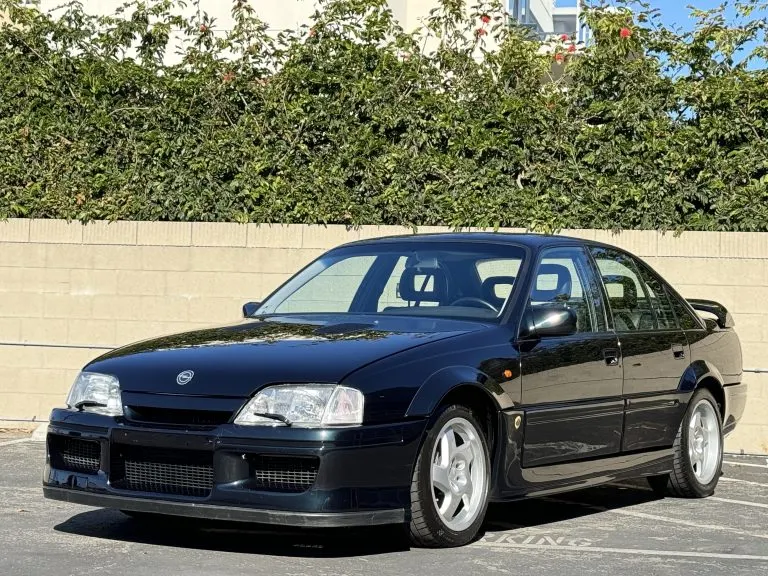
Opel Lotus Omega: The Four-Door Family Saloon That Was Faster Than a Ferrari Testarossa (And Scandalised the British Press)
In 1990, the British press was furious. The reason: General Motors, in partnership with Lotus, had just launched a four-door saloon onto the market — perfectly capable of transporting a family with all their luggage — that reached a top speed of 283 km/h (176 mph). Faster than a Ferrari Testarossa of the same era. Faster than a Porsche 911 Carrera of the time. The second-fastest production four-door saloon in the world at the moment of its launch, behind only the BMW M5.
The tabloids — The Sun leading the charge — called for it to be banned. They argued it was socially irresponsible to place that level of performance within reach of any citizen with sufficient funds. No special licence requirements, no experience prerequisites, nothing preventing a person without any credentials beyond a credit card from taking home a vehicle capable of these figures.
The Opel Lotus Omega — sold in the UK as the Vauxhall Lotus Carlton — was the last truly antisocial saloon built before political correctness and emissions regulations permanently changed the game. And that is exactly why we need to talk about it.
The Project That Started in a Norfolk Workshop
The Lotus Omega story does not begin in Opel’s offices — it begins at Lotus’s facility in Hethel, Norfolk, England. General Motors had acquired a majority stake in Lotus in 1986, and in 1987 the idea emerged of creating a high-performance version of the Opel Omega A executive saloon, using the high-performance engineering expertise that Lotus had accumulated over decades of Formula 1 involvement and its own road-going sports cars.
The project was internally designated as Type 104 in Lotus nomenclature, and the final result was presented to the public at the 1990 Geneva Motor Show.
The Surgery Lotus Performed on the Opel Engine
The base engine Lotus started with was the Opel Omega A GSi’s 3.0-litre, 24-valve straight-six — a respectable unit in its own right, but completely insufficient for the project’s objectives. Lotus intervened radically.
First, displacement was increased to 3,615 cc through the use of a forged crankshaft, Mahle slipper-type forged pistons, purpose-designed Lotus connecting rods, and an externally reinforced engine block with additional ribbing to withstand the elevated cylinder pressures — approximately 95 bar — generated by the new forced induction system.
Because yes: Lotus added two Garrett T25 turbochargers operating sequentially, with a water-to-air intercooler manufactured by Behr that was capable of reducing charge air temperature from 120°C down to 60°C. The ignition system was replaced with a wasted spark arrangement using three coils, and lubrication was comprehensively revised to ensure reliable performance under sustained high-power use.
The result was an engine producing 377 bhp at 5,200 rpm and peak torque of 557 Nm at 4,200 rpm. Power that reached the rear wheels — rear-wheel drive only, no AWD — through the same ZF six-speed manual gearbox simultaneously used in the Chevrolet Corvette ZR-1. With a limited-slip differential.
The Numbers That Justified Everything
With 377 bhp and a kerb weight of approximately 1,690 kg, the Lotus Omega had a power-to-weight ratio of roughly 4.7 kg per bhp. The 0 to 100 km/h sprint took 5.1 seconds. The quarter mile approximately 13.5 seconds. And the electronically limited top speed was set at 283 km/h (176 mph).
To contextualise these figures: in 1990, a Ferrari Testarossa produced 390 bhp and reached approximately 290 km/h in a specifically aerodynamic two-seater body. The Lotus Omega reached 283 km/h as a four-door five-seat saloon with a functional boot, no active aerodynamics, no carbon fibre, none of the engineering exonerations that justified the astronomical pricing of the exotic sports cars of the era.
Lotus also reinforced the rear suspension with an additional control arm and revised damping and geometry for improved high-speed stability, fitting the Opel Senator’s self-levelling suspension to compensate for dynamic load changes. The Senator’s Servotronic power steering — which reduced assistance as road speed increased — was also adopted. Brakes used ventilated 330 mm discs at both axles, with four-piston callipers at the front.
Only 950 Units: The Recession That Cut the Dream Short
General Motors hoped to produce 1,100 Lotus Omega/Carlton units. The economic recession of the early 1990s — combined with the £48,000 UK launch price, an absolutely stratospheric figure for a Vauxhall saloon in 1990 — meant sales fell short of expectations. Production was halted in December 1992 with only 950 completed units: 320 Lotus Carltons (Vauxhall, UK market) and 630 Lotus Omegas (Opel, continental European market). 150 units short of the original target.
The irony: many of those 950 units were stolen in the months following launch. One British newspaper headline was unambiguous: “Six Lotus Carltons stolen in a week.” The car they had called for a ban on was now the most wanted vehicle among the country’s car thieves.
The Exterior: The Saloon That Didn’t Want to Draw Attention
One of the most curious aspects of the Lotus Omega is its relative exterior discretion. Without the large rear spoiler and side skirts, the car could be mistaken for a top-specification standard Opel Omega A. The distinguishing elements were: the integrated rear spoiler, side skirts and front splitter, 17-inch alloy wheels in a specific design with 235/45 ZR 17 tyres on the front axle and 265/40 ZR 17 on the rear, and four exhaust pipes. Nothing else.
It was the classic “sleeper” concept elevated to epic proportions. A saloon that in the rearview mirror looked like a standard Omega. Until you pressed the accelerator.
Legacy and Current Values
The Lotus Omega is today one of the most highly valued performance saloons in the classic car market. With only 950 units in worldwide circulation — many of them crashed, stolen, or in poor states of preservation — well-documented, low-mileage examples are extraordinarily rare.
On the current market, the finest examples command prices between 80,000 and 150,000 euros, with isolated cases above that figure for exceptional cars. For a vehicle that many considered a sociological absurdity when it was built, the appreciation has been phenomenal.
The 1991 Pininfarina Chronos deserves a final mention: the Italian design house developed a concept coupé based on the shortened Lotus Omega floorpan, presented at the 1991 Detroit Motor Show. A single example was built, without an engine, as a purely aesthetic exercise. The Lotus Omega’s twin-turbocharged straight-six was never installed in it. But the image of what might have been remains a captivating “what if” for enthusiasts.
Conclusion (Completely Unfiltered)
The Opel Lotus Omega was the last car in automotive history that triggered a genuine moral scandal simply for being too fast. Not for its emissions, not for its fuel consumption, not for its manufacturing process. For being too fast for a family saloon.
And that tells you a great deal about the era we live in today. We now have four-door saloons with 600 or 700 bhp that nobody calls for banning. Because we have become accustomed. Society has normalised speed to the point where the Lotus Omega scandal of 1990 looks like an amusing anecdote today.
But I miss that era when a car could make headlines simply for being, unapologetically, too fast. Today everything is measured in CO2 grams per kilometre. In 1990, it was measured in the expression on the passenger’s face when they glanced at the speedometer.