
Spain’s DGT Environmental Label: The Biggest Bureaucratic Scam of the Century (and the Working Class Always Pays)
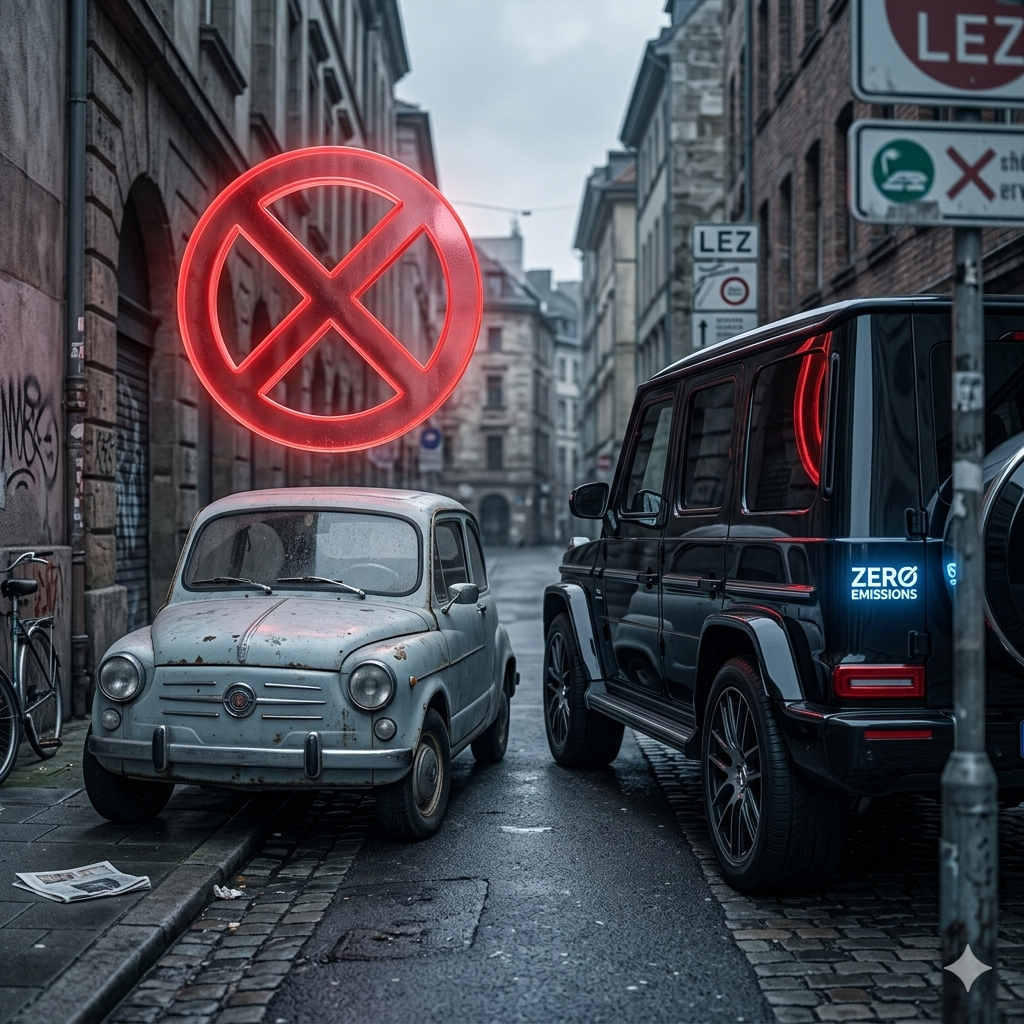
Let me tell you a story you probably already know if you live in Spain—but nobody has laid out the data quite like this, unfiltered and raw. The story of how Spain’s environmental vehicle labeling system was designed in a way that benefits the wealthy and punishes those who can least afford it. The story of a bureaucratic disaster that has been screwing over ordinary workers since 2016, while a Porsche Cayenne weighing 2,600 kilograms with 739 horsepower and a price tag north of €200,000 cruises through downtown Madrid with its blue “zero emissions” sticker and nobody bats an eye.
Welcome to the Spain of two speeds. Once again.
A System Born Broken
In 2016, Spain’s Directorate-General for Traffic (DGT) implemented the environmental label system. Four stickers—Zero (blue), ECO (blue and green), C (green), and B (yellow)—plus a group with no label at all: the outcasts. On paper, the idea was brilliant: classify vehicles by their environmental impact to favor cleaner ones and restrict the dirtiest.
Here is the catch. The criteria were not based on actual emissions from each vehicle. They were based on the registration date and engine technology type. Let that sink in: it does not matter how much your car actually pollutes. What matters is when you registered it and what technology sits under the hood.
This means a Porsche Cayenne Turbo E-Hybrid with 739 horsepower, weighing 2,600 kg, which consumes over 12 liters of gasoline per 100 km once its electric battery runs out after roughly 40–70 kilometers, carries the same Zero label as a pure electric Renault Zoe that emits literally zero grams of CO₂ from its tailpipe.
Meanwhile, a 2004 Peugeot 206 HDi diesel—a car that consumes just 4.5 liters per 100 km and that many families keep running as a daily workhorse—gets no label at all. Zero. Nothing. It cannot enter Low Emission Zones. It cannot park for free. It cannot use the HOV lane. And if the owner lives in Barcelona, soon they will not even be allowed to drive into the city where they work.
Fair? I did not think so either.
The Numbers Do Not Lie: Spain in Hard Data
Let us get into the hard data, where reality strips naked.
According to figures from ANFAC and IDEAUTO based on DGT data, Spain’s vehicle fleet had approximately 7.75 million vehicles with no environmental label at the end of 2025—roughly one quarter of the entire national fleet. Add the 8.93 million vehicles with label B (yellow), and we are talking about more than 16 million vehicles in Spain that are either penalized or completely excluded from the system.
On the other side of the scale, vehicles with the Zero label—electric, plug-in hybrid, and similar—totaled 742,315 units. That is 2.3% of the total fleet.
But here is the most devastating figure: the average age of passenger cars in Spain is 14.6 years. More than 8.5 million vehicles on Spanish roads are over 20 years old. Spain has one of the oldest vehicle fleets in the European Union, well above the European average of 12.3 years.
And why don’t people replace their cars? That is the crux of the entire issue.
The Price the Average Worker Cannot Afford
The average price of a new car at an official dealership in Spain reached €40,582 in the first four months of 2025, according to the Coches.com/Ganvam Barometer. That represents a 38.1% increase compared to 2019, before the pandemic. According to Spain’s Tax Agency, the actual average price paid by buyers (including discounts and promotions) was €23,774.
Now put that in context. The average gross salary in Spain according to the INE (National Statistics Institute) is approximately €28,050 per year. But the median salary—the one that actually reflects what most people earn—is considerably lower. The average salary offered on platforms like InfoJobs in 2024 was €27,060 gross per year, growing 3.1% from the previous year. Meanwhile, vehicle prices increased by 5.6% during the same period.
Financial experts recommend spending no more than 30–35% of annual gross salary on a car purchase. On an average salary, that allows for a car costing between €8,400 and €9,800. With that budget, the cheapest new car you will find in 2026 is a base-model Dacia Sandero hovering around €11,000. An electric car with a Zero label? Completely out of the equation for the vast majority of Spanish workers.
The result is predictable: in 2020, 7.5 new cars were bought for every used one; by 2025, the ratio had dropped to 4.3. People buy old cars because they cannot afford new ones. And old cars have no label. And without a label, you cannot move.
The Plug-in Hybrid “Zero Emissions” Fraud
This is where the system goes from being a bureaucratic mess to an outright fraud.
Spain’s Consumer Organization (OCU), a participant in the Green NCAP consortium, analyzed 147 vehicles on the market and found that 38% of plug-in hybrids carrying the Zero label produce excessive pollutant emissions. Thirty-eight percent. More than one in three.
Which ones are the worst offenders? Large SUVs with powerful engines. Vehicles like the Porsche Cayenne e-Hybrid, the Mercedes-Benz GLE, and the Ford Explorer. Heavy cars with engines ranging from 300 to 500 horsepower that, once their minimal electric range is depleted, become gasoline-guzzling machines at rates exceeding many combustion cars with the C label.
But wait, there is more. The study also revealed that 25% of mild hybrid vehicles with the ECO label have excessive emissions. These cars carry a 12 or 48-volt battery whose real impact on fuel consumption and emissions is, by the data itself, merely token. Yet they proudly display the ECO label with all its privileges.
And the most infuriating finding: 9% of gasoline and diesel cars with the C label—the green one, the one for the so-called polluters—received good environmental ratings thanks to their genuinely low real-world emissions. Small, efficient models like the Toyota Aygo X 1.0, the Kia Picanto 1.2, or the Skoda Octavia TDI, which pollute less in the real world than many hybrids carrying the Zero label.
The OCU said it plainly: the label system is unfair and lacks objective criteria.
The Law That Was Supposed to Fix Everything (and Fixed Nothing)
In November 2025, Spain’s Congress gave final approval to the Sustainable Mobility Law (Law 9/2025, published in the Official Gazette on December 4). It was supposed to reform the label system to base it on actual CO₂ emissions rather than registration date. In fact, the original text included an obligation for the Government to conduct a study on updating the labeling system within 12 months.
What happened? An amendment introduced by the PP (People’s Party) in the Senate eliminated that obligation. And the Congress ratified the Senate’s amendments with 179 votes in favor against 171 opposed. Just like that. And the system stays as it is, with no reform date in sight.
Environmental organizations had been demanding reform for more than five years. After the vote, they publicly reminded everyone that the Zero label certifies vehicles that still pollute and that the ECO label is a misleading catch-all for consumers.
But nobody cared. The automotive lobby pushed back, manufacturers argued about “legal and technical uncertainty,” and the result is that everything stays the same. The usual winners win. The usual losers lose.
Low Emission Zones: The Working Class Invisible Wall
Since Spain’s Climate Change Law came into effect in 2021, more than 140 municipalities with over 50,000 inhabitants are required to create Low Emission Zones (LEZ). Madrid 360, Barcelona’s LEZ, and an increasing number of cities restrict access for vehicles without labels and, progressively, for those with the B label.
In Barcelona, starting in 2028, vehicles with the B label will be banned from entering the LEZ except in specific circumstances. That affects millions of drivers who will not be able to reach their workplace in the city center.
And who are these drivers? Not Porsche Cayenne owners. They are workers who need their car to get to work, who live on the outskirts because they cannot afford to live downtown, and who drive an old car because they cannot afford a new one.
It is a double penalty: first you are punished for not being able to buy a new car, and then you are prevented from reaching your job with the car you can actually afford.
The Historic Vehicle Paradox: The Older It Is, the Freer It Gets
And now comes what I consider the definitive proof that this system is an absolute joke.
If you take a car that is more than 30 years old and register it as a historic vehicle under Royal Decree 1247/1995, that car becomes exempt from LEZ restrictions. In Madrid, the Municipal Sustainable Mobility Ordinance explicitly states that vehicles registered as historic may circulate within the LEZ, with a limit of 96 days per year. Málaga has similar provisions. Barcelona handles it through special permits, but access exists.
Think about what that means. A 1975 SEAT 127 with a carburetor, no catalytic converter, belching black smoke every time it starts, built in an era when the word “emissions” did not exist in any engineer’s vocabulary, can legally drive through downtown Madrid.
But a 2004 Peugeot 206 HDi with direct injection, a catalytic converter, a particulate filter, meeting Euro 3 standards and consuming just 4.5 liters per 100 km, cannot.
The first one is exempt because it is considered “cultural heritage.” The second is banned because it was registered on the “wrong” date.
Someone please explain in which parallel universe a 1975 car pollutes less than a 2004 one. Because in this one, it certainly does not.
And let me be clear—I am not against historic vehicles. I am the first to defend automotive heritage preservation. But the contradiction is so blatant, so grotesque, that it proves beyond any doubt that the label system has nothing to do with actual emissions. It is pure administrative theater.
What Other Countries Do (and Spain Does Not)
In Norway, pioneers in electrification, they have started taxing vehicles by weight. The logic is simple: a 2.5-ton electric SUV causes more road wear, occupies more space, and—in full lifecycle terms—has a larger environmental footprint than a small car.
In Paris, they are exploring formulas to penalize larger vehicles that park on the street, regardless of their label.
In Germany, the environmental labeling system (Umweltplakette) is far from perfect, but at least it is based on the vehicle’s actual Euro standard and particulate emissions, not on a generic registration date.
Spain, meanwhile, continues with a system that even the DGT itself acknowledges needs reform—but nobody dares touch it because economic interests outweigh both social justice and genuine environmental progress.
The Real Cost: Not Just Money, but Rights
What is at stake is not just money. It is the right to mobility. When you ban someone from driving their car into the area where they work, you are limiting their ability to earn a living. When you tell them they need to buy a €25,000 car on a salary of €1,400 per month, you are telling them to deal with it.
The average annual cost of car ownership in Spain is approximately €3,850. That represents 9% of the average household income. For many families, a car is not a luxury—it is the tool that allows them to get to work, take the children to school, and do the grocery shopping.
Telling them their car “pollutes too much” based on registration date rather than actual emissions is, at best, dishonest. At worst, classist.
My Take (and I Am Not Keeping Quiet)
I have spent more than 30 years in industry. I have worked on cars, machines, robots, and trains. I know mechanics from the inside—not from a corner office overlooking a fancy boulevard.
And what I see is a system designed by people who have never had to choose between filling the tank and making it to the end of the month. A system that rewards those who can afford a €200,000 Porsche Cayenne with a Zero label—a car that pollutes more than many economy cars when running on gasoline—and punishes the worker who keeps a 2004 Peugeot 206 HDi alive with 200,000 kilometers on the clock that consumes half of what the executive’s SUV does once the battery runs out.
The solution is not complicated. You measure what comes out of the tailpipe. You certify with real-world data, not manipulated laboratory cycles. You eliminate registration date as a criterion and replace it with what actually matters: how much each individual vehicle pollutes.
Does a 2024 plug-in hybrid pollute more than a 2010 diesel when running on gasoline? Then its label should reflect that.
Does a 1998 car running on LPG emit less than a 2023 mild hybrid with an ECO label? Then give it the label it deserves based on its emissions, not its age.
But of course, that does not serve certain interests. Because if you measure real emissions, premium SUV manufacturers lose their selling point. If you measure real emissions, 500-horsepower plug-in hybrids lose their blue sticker. If you measure real emissions, the greenwashing-on-wheels business is over.
And until things change, the ones footing the bill are always the same: the working class.
Those of us who do not have €40,000 for a new car. Those of us without a garage with a charging point. Those of us who need our old car to get to work every morning at six.
Spain’s DGT environmental label does not measure emissions. It measures your bank account.
And that, my friends, is the biggest scam of the century.
What do you think? Has the label system affected you? Do you drive a car with no label and have to figure out how to get to work every day? Tell me in the comments. And if you think this article deserves to be read, share it. Because those of us who always pay the price are tired of staying quiet.