
Suzuki Escudo Pikes Peak: Nearly 1,000 CV, Two Engines and the Most Famous Car That Never Won
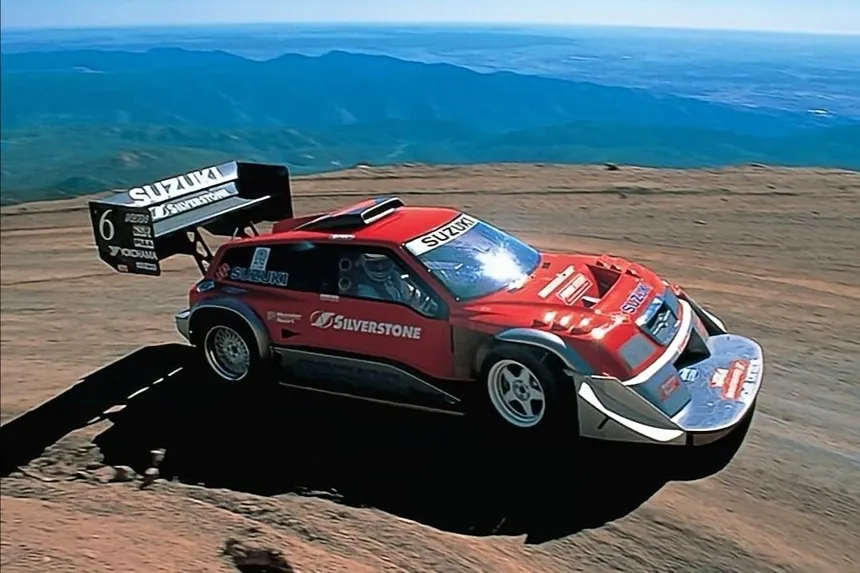
The Fastest Car in Gran Turismo 2. The Most Intimidating Nickname in Motorsport. And a Victory That Hides a Twist.
If you ask any gamer born between 1985 and 1995 what’s the most brutal car they’ve ever driven in a simulator, there’s a very high chance the answer is: the Suzuki Escudo Pikes Peak.
That white monster with its aircraft-wing rear spoiler that in Gran Turismo 2 left every other car looking at its taillights. The nearly 1,000 CV machine that most players unlocked late in the game and which made everything else feel like a toy. The car people used to win races in obscenely dominant fashion and which friends would ban in multiplayer sessions.
That’s the Suzuki Escudo. And the real story is even stranger than the myth.
Because it turns out that the most famous Escudo — the twin-turbo V6 that everyone knows from Gran Turismo — never won Pikes Peak. It took three consecutive second places. And the driver piloting it, Nobuhiro “Monster” Tajima, won the race with other cars both before and after.
That, friends, is a story worth telling.
The Man: Nobuhiro “Monster” Tajima
Before talking about the car, you have to talk about the man. Because without Tajima, the Escudo doesn’t exist. Without Tajima, Suzuki probably never arrives at Pikes Peak with that kind of determination — the determination of a Japanese man who builds things in his garage and then turns out to be unbeatable.
Nobuhiro Tajima was born on June 28, 1950, in Suginami, Tokyo. He started competing in 1968 in the All Japan Dirt Trial Championship — Japan’s rallycross series — and won his first race on debut. Nine national championships later, he was king of Japanese rallycross. The nickname “Monster” didn’t come from his win record but from his physical size — he’s unusually tall and muscular by Japanese standards — and his driving style, savage and at the absolute limit at every corner.
In 1983 he founded Monster Sport International, a competition car preparation shop. In 1986 he sealed his association with Suzuki by founding Suzuki Sport, the brand’s in-house motorsport division. Tajima wasn’t just a driver. He was builder, tuner, team manager, and businessman. When he arrived at Pikes Peak, he came with his own car, built in his own workshops, with his own money.
That already tells you a lot about what you’re about to read.
His first Pikes Peak appearance was in 1988, with a Mazda in the Rally-Production GT category. He finished third in 14:11.97. Not the result he wanted. What he wanted was to win. And to win, he needed something different.
The First Escudo: Two Engines Because One Wasn’t Enough
The Suzuki story at Pikes Peak starts before the famous Escudo. It starts with a solution so absurd it could only have come from someone who doesn’t accept conventional limitations.
In 1992, Tajima arrived at Pikes Peak with a Suzuki Cultus — the Swift in Western markets — powered by two engines. Not double supercharging on a single engine. Two complete engines. One at the front driving the front axle. One at the rear driving the rear axle. Each one a four-cylinder G16A 1,590 cc unit with a turbo, producing around 450 CV each. Total: roughly 900 CV in a car weighing 900 kilograms.
The logic was simple and brilliant at the same time: if combustion engines lose up to 30% of their power due to altitude by the time they reach Pikes Peak’s summit, the solution is to start with so much power that even with that percentage loss you still have more than everyone else. And if one engine doesn’t give you enough, fit two.
The twin-engine Cultus won the Unlimited class in 1993. In 1994 it won again, and Tajima became the first Japanese driver to win Pikes Peak overall. In 1995, with a version rebodied in Escudo bodywork — same twin-engine concept, new clothes — he won again on a weather-shortened course.
Up to here, a clean record of victories. But then the real Escudo arrived.
The V6 Escudo: The Monster That Gran Turismo Made into a God
For 1996, Tajima ditched the two-small-engines configuration and built something new: a car with a single centrally-mounted twin-turbo 2.5-liter V6, producing around 970-981 CV, in an aluminum chassis weighing approximately 800-850 kilograms.
The power-to-weight ratio was roughly 1 CV per kilogram. The same as the Koenigsegg One:1, the Swedish hypercar that in 2014 shook the world using that figure as its headline marketing claim. Tajima had achieved it twenty years earlier on a mountain in Colorado.
The aerodynamics were flat-out deranged. The front splitter was as wide as the car’s hood. The rear wing looked like it belonged on a fighter jet. At a time when most competition cars ran modest wings, the Escudo carried what literally appeared to be an aircraft’s wing. The car’s lift coefficient — CL — was estimated at 4.2. For context, a current Formula 1 car sits around 3.0-3.5. The Escudo generated more aerodynamic downforce than a Formula 1 car.
The gearbox was a six-speed sequential. Four-wheel drive throughout. That gearbox had to manage nearly 1,000 CV and send it to four tires on a gravel road with no guardrails.
What Gran Turismo 2 Didn’t Tell You:
The Escudo’s engine had a characteristic that gave real drivers cold sweats: it was extremely peaky, with virtually all the power available between 6,000 and 8,000 rpm. Below 6,000, the car was almost normal. Above it, it was a missile. The problem was that on Pikes Peak’s slower corners, where drivers had to drop below 70 km/h, the engine dangerously approached the dead zone. A poorly executed gear change, a tenth of a second’s hesitation, and turbo pressure was gone at the worst possible moment.
In the video game, that detail was smoothed over. On the real mountain, it was the difference between winning and crashing.
The Paradox: The Most Famous Car That Never Won
Here’s the plot twist that throws most enthusiasts off when they discover it.
The Suzuki Escudo V6 — the car Gran Turismo immortalized, that late-1990s car magazines put on their covers, that became synonymous with Pikes Peak for an entire generation — never won the race.
In 1996, the year of its debut, Tajima finished second. The winner was Rod Millen in his Toyota Celica, with which he had been dominating the race since 1994 and whose record would stand for thirteen years.
In 1998 and 1999: second again.
Three years with the most powerful car in the race. Three years as the favorite. Three years finishing second.
Why? The answer is a mix of factors. Millen’s Celica was an extraordinarily balanced and proven car, with years of development specifically for Pikes Peak. The Escudo was more powerful on paper but harder to manage, with that peaky engine demanding extreme driving precision on every gear change. And Pikes Peak, as always, had the final word.
Tajima won Pikes Peak a total of seven times: 1993 and 1994 with the Cultus, 1995 with the twin-engine Escudo, and then 2006, 2007, 2008, 2009, 2010, and 2011 with other cars. But the V6 Escudo, the most famous of all, doesn’t account for a single victory in Colorado. Its three wins came in New Zealand’s Race to the Sky.
That’s real motorsport. The car that looks fastest on paper doesn’t always win the world’s most demanding race.
2011: The 10-Minute Barrier and Tajima’s Definitive Legacy
If the V6 Escudo is the famous but frustrated chapter, 2011 is the chapter that defines Tajima’s legacy forever.
At 61 years of age, at the wheel of a Suzuki SX4 Hill Climb Special with a 940 CV twin-turbo V6, Nobuhiro Tajima crossed the Pikes Peak finish line in 9:51.278.
For the first time in the race’s history — since 1916 — someone had broken the 10-minute barrier. And that someone was a 61-year-old Japanese man, on a partially gravel course, in a car he had built himself.
Additional context: the car’s radiator was smoking during the final section. Tajima completed the climb with the engine overheating. If he’d stopped, he’d have lost the record. He kept going. And he crossed the line.
With that time, Tajima also broke Rod Millen’s record of 10:04.060 set in 1994 — a record that had stood for thirteen years.
Colorado Springs dedicated a plaque to him reading “King of the Mountain.” In 2018 he was inducted into the Colorado Springs Sports Hall of Fame. The mountain in New Zealand where he won the Race to the Sky eight times is officially called “Tajima’s Mountain.”
The Debate: Was the Escudo Really the Fastest Car, or Just the Most Theatrical?
Here comes the question that divides enthusiasts.
The V6 Escudo had nearly 1,000 CV and sci-fi aerodynamics. On paper, it should have destroyed Pikes Peak. It didn’t. Does that mean it was an overrated car? That its Gran Turismo fame inflated a more modest reality? Or simply that the peaky engine and management difficulty meant its theoretical power never translated into real-world time?
There’s another possible reading: maybe the Escudo was exactly what it appeared — a machine at the absolute limit of what a human being can control — and the fact that Tajima put it on the podium three consecutive years with something that extreme says more about his talent than about any supposed weakness of the vehicle.
And then there’s the most provocative question of all: if Gran Turismo 2 hadn’t existed, would the Escudo today be known only to Pikes Peak enthusiasts, or would it still be the global legend it is? Does a Japanese games console deserve credit for putting Pikes Peak on the map for an entire generation of motorsport fans?
The Gran Turismo Connection: When a Video Game Became the Best Marketing in Motorsport History
Gran Turismo 2 launched in 1999. The Escudo was there from the start, and it was obscenely fast. There was no other car in the game that came close once it was unlocked. Players who discovered it felt like they’d found a cheat code, a game error, something that shouldn’t be possible.
But it was real. A real car that genuinely existed, built by a Japanese man in his Tokyo workshop who called himself Monster. And when those players grew up and started looking for more information about real motorsport, the first thing many of them searched for was: what is that Suzuki Escudo from the game?
That search led them to Pikes Peak. And Pikes Peak opened an entire world.
Polyphony Digital, the Japanese studio behind Gran Turismo, did more for Pikes Peak’s visibility outside the United States than probably any marketing campaign the race itself ever ran. And they did it by accident, simply by including the fastest car they knew about in their simulator.
Verified Technical Sheet: Suzuki Escudo Pikes Peak V6 (1998)
| Data | Value |
|---|---|
| Engine | Twin-turbo V6, 2,500 cc |
| Power | ~981 CV |
| Maximum torque | ~688 lb-ft / ~933 Nm |
| Weight | ~800-850 kg |
| Transmission | 6-speed sequential |
| Drivetrain | 4WD |
| Chassis | Tubular aluminum |
| Best Pikes Peak results | 2nd in 1996, 1998 and 1999 |
| Race to the Sky wins (NZ) | 1998, 1999, 2000 |
| Driver | Nobuhiro “Monster” Tajima |
Tajima at Pikes Peak (verified):
- First appearance: 1988 (3rd in Mazda)
- First King of the Mountain: 1995
- Total overall victories: 7
- First sub-10 minutes: 9:51.278 (2011, Suzuki SX4)
- Colorado Springs Sports Hall of Fame: 2018
Next episode: Rod Millen’s Toyota Celica/Tacoma — The New Zealander who dominated the mountain before Monster arrived, and whose record survived 13 years.