The Phantasm ‘Cuda Wore 440+6 Badges and Hid a 340 Underneath. Nobody Called It for 46 Years.
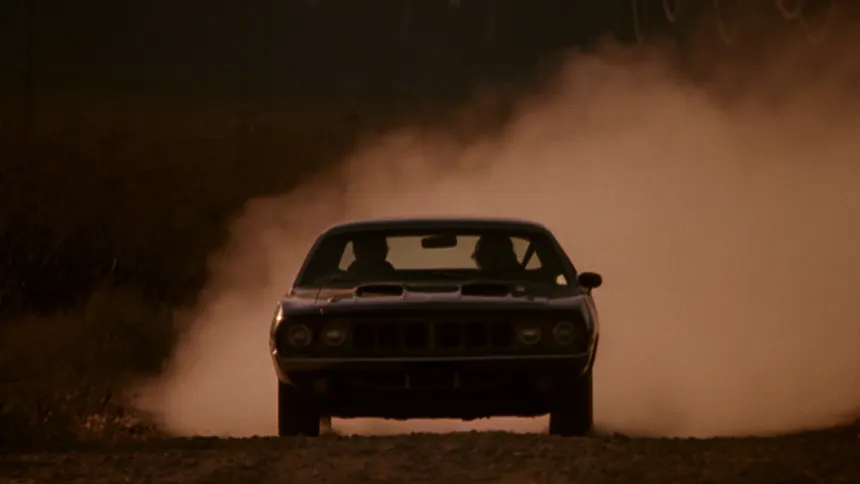
Five films, three different displacements, a cloned Hemi and a vanished original. Don Coscarelli couldn’t afford the car his screen promised. So he lied. And the lie worked.
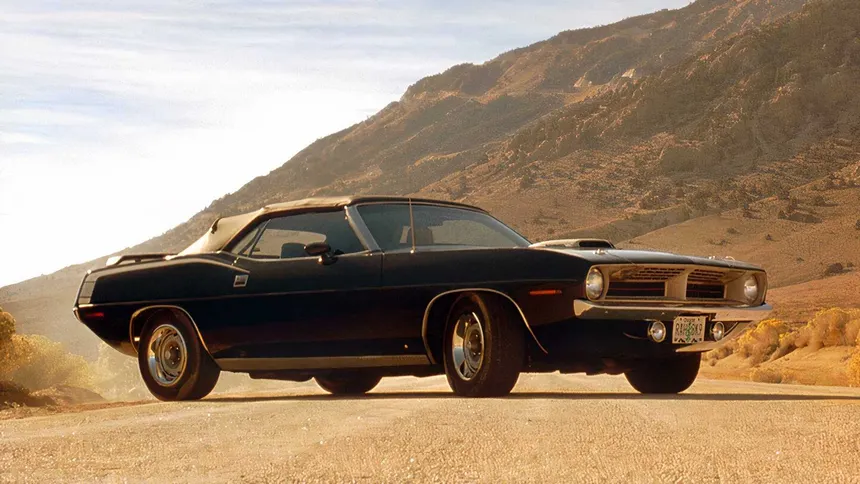
Pause the VHS, the DVD or the 2016 J.J. Abrams-produced Blu-ray remaster of Phantasm (1979) on any shot of the black ‘Cuda’s hood, and you can read the badges plainly: 440+6. Four-forty plus six. The second-fiercest engine in Plymouth’s 1971 E-body catalogue. A 7.2-litre V8 with three Holley two-barrel carburettors running in line, factory-rated at 390 gross horsepower. The motor that ran a ‘Cuda 440 Six-Pack down a quarter-mile in the mid-14-second range and made a noise like a foundry collapsing.
Under the hood of the car you actually see on screen, none of that was there.
There was a 340. The bottom of the ‘Cuda V8 range. 275 gross horsepower. A four-barrel carburettor. Quarter-mile at 15.2 seconds. A perfectly good motor, but not the motor the badges advertised. The gap between what the bodywork promised and what the engine bay was hiding came to 115 horsepower and 100 cubic inches.
Don Coscarelli, a 24-year-old director working out of a rented mountain cabin in California, couldn’t afford a 440+6 ‘Cuda in 1978. He couldn’t afford a Hemicuda either, and that one wasn’t even in the conversation. He bought what he could (a tired 1971 ‘Cuda 340), slapped two lying decals on the hood, painted it black, and shot the film. The movie pulled in $22 million off a budget of $300,000. Seventy-three-to-one return. And the lie worked so well that nobody called it across five films, forty-six years and a complete cult franchise. Go on any Mopar forum today and ask what engine the Phantasm ‘Cuda ran. Half the answers will tell you it was the Hemi. The other half will tell you it was the 440+6. Neither is correct.
That’s what we’re peeling apart here. Layer by layer. Because the lie escalated across five films, kept growing with each sequel, and built one of the dirtiest and most beautiful stories in American independent cinema.
What the Badges Sold, What Was Actually In There
The 1971 Plymouth ‘Cuda was offered with six engines. Bottom to top: the base slant-six (which no actual ‘Cuda buyer ordered, since that engine was reserved for the cheaper Barracuda), the 318 V8 at 230 hp, the 340 V8 at 275 hp, the 383 Magnum at 300 hp, the 440 Six-Pack at 390 hp, and at the top of the heap the 426 Hemi at 425 gross horsepower at 5,000 rpm with 490 lb-ft (664 Nm) of torque at 4,000 rpm. The Hemi was the ceiling. 1971 was also the final production year of the street 426 Hemi. After that it was gone. Emissions law, insurance premium spikes, the OPEC shock, the first death rattle of the muscle era.
Coscarelli bought rung two, not the ceiling. The car he found was a 1971 ‘Cuda hardtop, factory-painted FC7 In-Violet (a deep purple from the Plymouth catalogue), with white interior. Mechanically: a 340 cubic-inch V8 (5,572 cc), an A-833 four-speed manual gearbox topped with a Hurst Pistol-Grip lever, an 8¾-inch Sure-Grip rear differential at 3.55 ratio. The carburettor was a Carter Thermoquad 1,000 cfm, fitted by a previous owner replacing the original. Quarter-mile times in the 15.2-second bracket per period Plymouth build sheets.
For Coscarelli, the car was financially right and cinematically wrong. A funeral home, a graveyard at night, and a bright violet paint job didn’t rhyme. The bodywork was tired. The wheels were thin steel. The visual promise wasn’t landing.
The bodyshop pass paid for what was, on paper, a straightforward cosmetic rebuild: respray in X9 Formal Black (Plymouth’s catalogue black), black vinyl reupholstery, a fine blue-and-grey pinstripe down the flanks, lead-filled rear fender flares to clear new chrome Cragar SS wheels with oversized rubber, and a tinted sunroof. All of that was legitimate restoration work.
Then came the move that changed everything: two large “440+6” decals applied to the sides of the twin-scoop hood. Upbadging, in the Mopar collector vocabulary. The single dirtiest move in the second-hand muscle-car market: stick the badges of a higher engine on a car carrying a lower one. In the used-car economy of the late seventies, it was the favourite trick of dealers and private sellers trying to inflate the asking price of an ordinary ‘Cuda. In Coscarelli’s hands, it was cheap propmaking that worked as visual menace.
The audience saw the black car roaring through the frame, read “440+6” on the hood, and bought the entire promise. Coscarelli knew exactly what he was doing. He also knew almost nobody in a 1979 cinema, with a monaural Dolby mix on an indie horror feature, was going to distinguish a 340 with a Thermoquad from a 440 Six-Pack by sound alone.
That’s the first layer of the lie.
The Detail That Any Mopar Nerd Would Catch in the First Shot
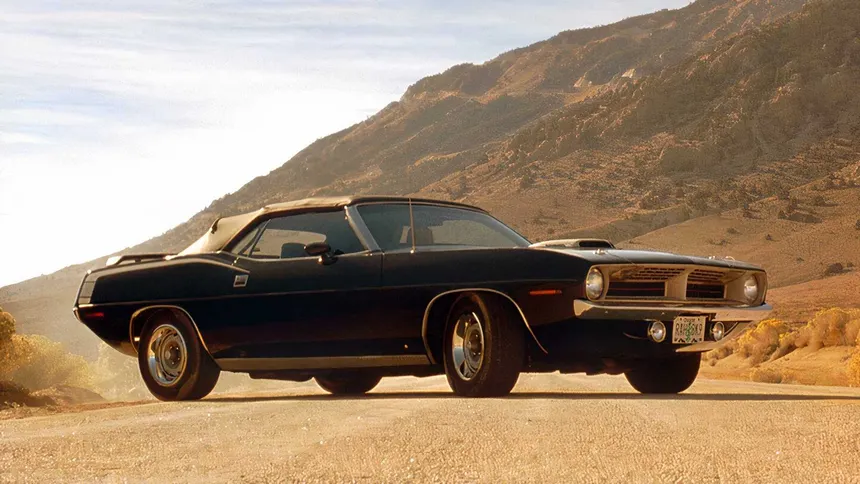
There’s a visual giveaway in Phantasm that exposes the deception before anyone even opens the hood. It isn’t just the badges. It’s the hood itself.
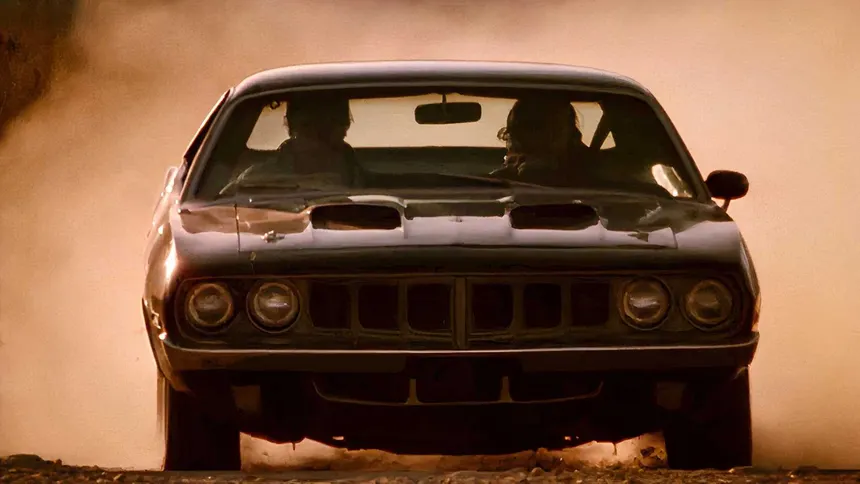
The 1971 ‘Cuda came with a choice of two performance hoods: the Rallye (with two small, non-functional symmetrical scoops) and the Shaker (a hood with a rectangular cutout housing an air box bolted directly to the engine, sticking up through the bodywork and vibrating with the idle, painted Argent Silver or matte black). The Shaker was mandatory on the catalogue Hemicuda and optional on the ‘Cuda 340, 383 and 440. It was the visual icon of Mopar muscle in this era.
The Phantasm ‘Cuda wears the Rallye hood with the two small scoops, not the Shaker. That’s logical, because the car left the factory as a 340 ‘Cuda whose original owner hadn’t ticked the Shaker option box. The problem is that if you then paste “440+6” badges onto a Rallye hood, you’re claiming a configuration that barely existed in the real world. A 1971 440 Six-Pack ‘Cuda was almost always ordered with the Shaker, and the rare combination of Rallye hood + 440+6 was extremely uncommon at the dealer level. Any serious Mopar enthusiast in 1979 who looked at the car with any attention would spot the trick.
Nobody in the mainstream audience did. The film is shot at night, the camera holds tight, the cuts are quick, and the 1979 horror-movie crowd was not, broadly speaking, the same crowd that gathered at the Mopar Nationals at Englishtown.
The lie survived the first film. Then Coscarelli decided to take it up a level.
Phantasm II: Universal Pays $3M and Four Disguised 318s Show Up
Universal Pictures put $3 million on the table in 1988 for Phantasm II. Ten times the original budget. Major studio distribution. A chance to do the thing properly. Coscarelli, instead of buying a 440 Six-Pack ‘Cuda (already collectible by then), raised the lie: this time the brothers’ car would not be a 440+6 in disguise. It would be a Hemicuda. The 426. The Elephant Motor. The peak of the American muscle car.
Except, again, no.
The Phantasm II production sourced four 1971 ‘Cudas, all hardtops, all painted glossy black, all wearing chrome Cragar SS and Hemicuda badging on their flanks. Three cars were assigned to action work, continuity and day-to-day shooting. The fourth, in production-team jargon the glamour car, was the clean one for close-ups, publicity stills and promo. The difference between the glamour car and the other three was not under the hood. It was in handling: the glamour car never took a hit, the other three did.
None of the four ran a 426 Hemi. None ran a 440 either. All four were powered by the 318 cubic-inch V8 (5,211 cc), 230 gross horsepower. The smallest V8 in the 1971 ‘Cuda lineup. Below even the 340 of the original film. The franchise had just gone up in budget, in marketing, in distribution, and at the same time it had gone down in actual displacement on the cars being filmed. Only Coscarelli and his production team knew.
Why not a real Hemicuda? Because by 1988 the 1971 Hemicuda hardtop had begun its serious collector appreciation curve. Of the 108 Hemicuda hardtops built in 1971 (plus 11 convertibles, in single digits with a one in front), few survived in decent shape. Buying one to wreck on screen had become financially indefensible. Coscarelli and his executive producer Roberto Quezada did the maths any sensible director of the moment would have done: four 318s dressed up as Hemis came out an order of magnitude cheaper than one numbers-matching Hemicuda.
The visual giveaway was the same as in the first film: Rallye hood instead of the Hemicuda’s mandatory Shaker. Any Mopar enthusiast spotted it on the second shot. The mainstream audience, again, didn’t.
Coscarelli told Mopar Action in the early nineties that his private plan, after Phantasm II wrapped, was to convert one of the four cars to a genuine 426 Hemi setup: engine, suspension, rear axle, brakes, complete package. Whether the conversion was ever completed isn’t clearly documented in publicly available primary sources. What is documented is that the glamour car remains in his personal collection and turns up occasionally at horror conventions and Southern California car shows. It is the most authentic surviving Phantasm car.
Phantasm III: The Only Real Hemi in the Whole Franchise (and It’s a Clone)
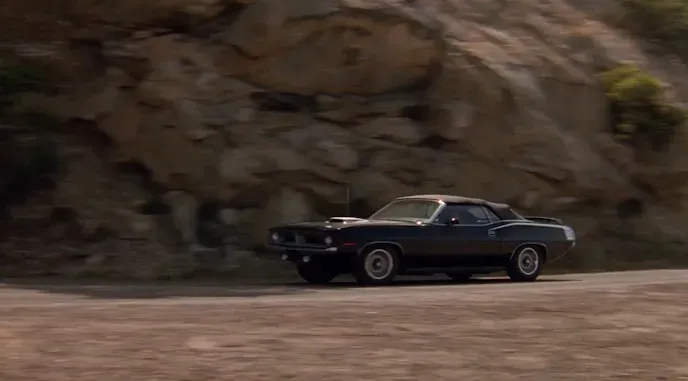
Cut to 1994. Phantasm III: Lord of the Dead. Budget $2.5 million, this time without Universal in the room. Coscarelli decided to do what the two previous films had skirted around: put a real 426 Hemi on screen. And not in a hardtop. In a convertible. Triple black: black paint, black top, black interior. The most photogenic car in the entire franchise.
To find one he hired Greg Buhlinger, a West Coast Mopar restoration specialist with a reputation for knowing where the rare E-body cars were buried. Buhlinger located what Mopar people call a clone project: a 1970 Hemicuda convertible that was not numbers-matching (the original 426 had vanished from the car decades earlier), but into which an enthusiast had installed a period-correct, fully restored 426 Hemi. A technical deception at a new level: the car had the right engine, the right chassis, the right body, but without numbers-matching it was not a real Hemicuda for collector purposes. A clone built out of real parts.
For a film, none of that mattered. What mattered was that the car sounded like a Hemi, accelerated like a Hemi and filmed like a Hemi. It did all three.
This is the point where Phantasm’s lie collides with the actual economics of the American muscle car. Of the 14 Hemicuda convertibles Plymouth built in 1970, the small number that have surfaced at public auction since the 2000s have crossed the $3 million-per-car mark several times at Mecum and Barrett-Jackson. The current public sale record for the model is north of $3.5 million. For fourteen cars that left the Hamtramck plant in 1970 at under $6,000 each with the Hemi option included ($871 extra over the base price).
If Coscarelli had bought a numbers-matching Hemicuda convertible in 1994, when these cars were still trading at $200,000-$300,000 in collector circles, he would today be sitting on a piece worth ten times what he paid. Instead, he bought a clone. And yet the Phantasm III car remains the best-sounding, best-accelerating, best-photographed ‘Cuda in the entire saga.
Buhlinger stayed with the car as on-set mechanic for the whole shoot. Without him, the production didn’t finish. There were no spare parts, in his own words: if the car broke, the shoot stopped. The 426 Hemi is a powerful motor but it is not an easy motor. Dual quad carburettors, dual-point ignition, narrow operating temperatures, California desert heat. Buhlinger kept it alive on craft alone.
The Jump That Almost Killed the Stunt Driver
The maddest single sequence in the entire Phantasm franchise is in the third film. Shot for real. No CGI, no blue screen, no compositing. It nearly cost a life.
The setup: the triple-black ‘Cuda is flat-out down a desert road, chased by one of the Tall Man’s hearses. Coscarelli’s idea was for the hearse to hit a steel ramp at speed, sail clean over the ‘Cuda, and crash to the road in front to block the muscle car’s escape.
Hearse stunt driver: Bob Ivy, a working professional and, by his own later admission, a Phantasm fan since he saw the first film as a teenager. ‘Cuda stunt driver: uncredited. On-set mechanic for the ‘Cuda: Greg Buhlinger.
The plan was for Ivy to launch half a mile back, build to about 50 mph (80 km/h) at the ramp (three inches of steel with a kicker at its peak), and clear the ‘Cuda cleanly. The hearse weighed roughly 6,000 pounds: 2,720 kilos of steel, engine and chassis.
What happened: Ivy hit the ramp with the throttle pinned, doing well over 70 mph (more than 110 km/h). Coscarelli, from the camera position, heard the engine note and realised the speed was wrong, but couldn’t stop it. On impact, the hearse’s solid steel frame torqued in a shower of sparks. The vehicle was launched skyward. It flew 186 feet through the air: roughly 57 metres of distance, passing 9 metres above the ‘Cuda. The ‘Cuda’s stunt driver, seeing the shadow overtake him from above, floored the accelerator. The hearse crashed down inches from the ‘Cuda’s rear bumper. A second later, it would have crushed it.
Bob Ivy came out of the wreckage unconscious. The standby safety crew pulled him from the cab. He survived. He recovered. He returned to the franchise for Phantasm IV: Oblivion and Phantasm: Ravager. But at the moment of impact, per Coscarelli’s own later interviews, the director believed he had a dead stunt driver on his set.
It would have been the second on-set death in low-budget American independent cinema in under a decade. The first was assistant cameraman Bruce Ingram on The Wraith (1986), also killed by a filming vehicle that overturned chasing a prototype car. Through luck and through the ‘Cuda driver’s reflex, Phantasm only ended up with one unconscious stunt driver and a totalled hearse.
The Founding Father Vanished
Back to the first film. Because the lie has a melancholy epilogue.
The original 1971 ‘Cuda from Phantasm I (the 340 car, the one with the fake 440+6 badges, the one that launched the whole saga) vanished. After the 1978-79 shoot wrapped, the car changed hands through several California used-car dealers, lost its documentation trail, and disappeared. Phantasm.com, the official site run by Coscarelli’s company, puts it bluntly: “the car vanished into legend.” No one knows whether it’s still being driven, sitting rusted in some anonymous collector’s yard, scrapped, or restored without anyone documenting its provenance.
The car that launched one of the most persistent horror franchises in American independent cinema is, today, literally a ghost.
In 2013, Welby’s Car Care in Springfield, Oregon — the workshop behind the Velocity Channel show Graveyard Carz, fronted by Mark Worman — restored a 1971 ‘Cuda 340 hardtop as the official tribute build to the Phantasm I car. Don Coscarelli and A. Michael Baldwin travelled to the shop to inspect and drive the finished restoration. The build was broadcast across two season-two episodes (Phantasm ‘Cuda and Back in Triple Black). It’s the closest the public will get to the original.
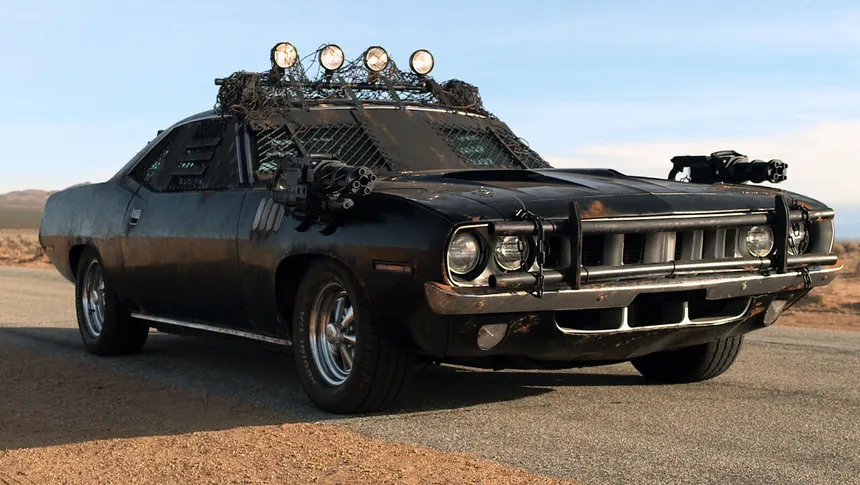
The final accounting of the saga: the Phantasm II glamour car remains in Coscarelli’s personal collection and shows up at conventions. The Phantasm III Hemicuda convertible clone appears occasionally at Los Angeles car events, also reportedly in his custody. The first film’s car, the founding father, remains lost. The other three Phantasm II cars — the non-glamour ones — were either lost or destroyed along the way. The Phantasm II glamour car reappeared in Phantasm: Ravager (2016) reskinned as the “Battle Cuda”, fitted with armour plating and machine guns for the post-apocalyptic finale of the franchise.
Why the Lie Worked (and Why It Matters)
A legitimate question at the end of this: why did nobody raise their hand? Upbadging is a recognised fraud in the Mopar collector market; specialist publications (Mopar Action, High Performance Mopar, Mopar Muscle) had spent decades exposing cars wearing badges from engines they didn’t carry. How did the Phantasm ‘Cuda lie survive forty-six years without becoming a collector’s scandal?
The short answer: because nobody cared in a cinema context. The Phantasm ‘Cuda never claimed to be a numbers-matching Hemicuda or a build-sheet 440+6. It was a prop. It was a working film car with the dramatic job of broadcasting menace and speed. It did that job. The technical deception was irrelevant to the film’s target audience, who were buying tickets to see supernatural horror, not to check whether the hood callouts matched the carburettor.
The long answer is more interesting. The lie held because Coscarelli turned it into an implicit pact with the viewer. The Phantasm ‘Cuda was never the car its badges claimed. It was the car the director could afford, dressed to serve the picture. And by making it work on screen, by giving it weight and presence, by carrying it across five films and finally losing the original, the car earned a kind of cultural status that no numbers-matching Hemicuda will ever have in horror cinema.
A real 1970 Hemicuda convertible today is a Mecum auction lot. The 340 ‘Cuda dressed as a 440+6 that filmed Phantasm is lost legend. Different categories. Different kinds of patrimony. The first is measured in millions of dollars. The second is measured in the memory of the fans who saw the film at fourteen on rental VHS and never forgot the shot of that black car rolling out of the funeral home.
That’s the actual economics of a film car. And that’s why the Phantasm ‘Cuda is worth, in real cultural terms, more than the fourteen surviving Hemicuda convertibles sitting in Texas billionaires’ garages.
Check you’re still alive.