
The Popemobile: The Most Impossible Design Brief in Automotive History
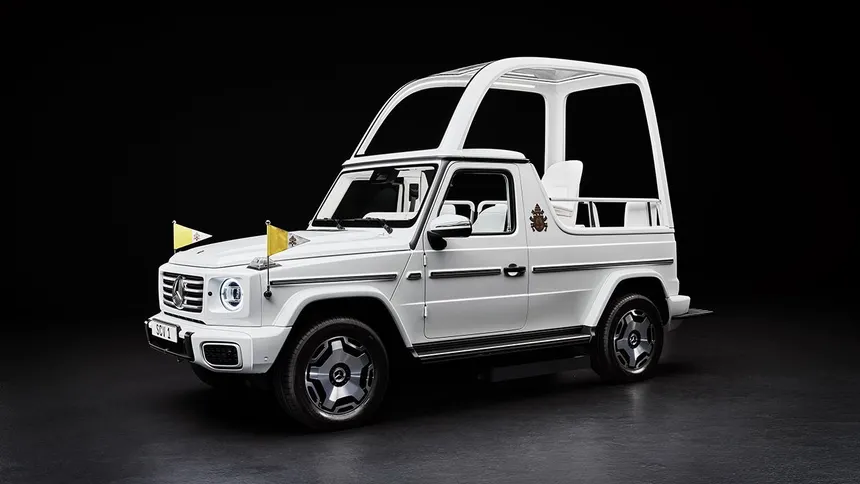
A car manufacturer gets a call. The client needs a vehicle that does all of this simultaneously: millions of people must see the occupant from every angle. It must withstand rifle fire at point-blank range. It must cruise at five kilometers per hour for hours without the engine, transmission, or climate systems failing. It must fit through medieval streets three meters wide. It must carry its own oxygen supply. Its 8-millimeter bulletproof glass dome must not fog up at 40 degrees with an 80-year-old man standing inside. And all of it must convey closeness, humility, and spiritual authority.
No supercar, no expedition off-roader, no presidential limousine has ever had to solve that equation. Because that equation has no clean solution. It has compromises. It has contradictions. It has engineering pushed to the limit of what a vehicle can do.
The Popemobile has been solving it for nearly a century. And nobody has ever told the story from an engineering perspective.
The Problem of Seeing Without Being Hit
The Popemobile’s first contradiction is also its most brutal: the occupant must be completely visible and completely protected at the same time. One negates the other. Visibility means maximum glass surface. Protection means maximum armor. And armor, by definition, is opaque.
The solution was bulletproof glass. But that phrase hides an engineering problem nobody talks about. The glass on the 1983 Mercedes-Benz 230 GE — the model that established the modern Popemobile standard — is 8 millimeters thick. It is not standard glass with a film stuck on top. It is a sandwich of glass and polycarbonate layers engineered to absorb the kinetic energy of a projectile without fragmenting inward. Each panel weighs three to four times more than standard glass of the same dimensions.
Now multiply that weight across the entire surface of a dome that wraps around the occupant on all four sides and overhead. The result: a modern Popemobile weighs five tons. The Leyland T45 built for John Paul II’s 1982 UK visit weighed twenty-four — two-inch armor plating on the platform, blast-resistant floor, a six-cylinder diesel producing 154 horsepower, crawling through London streets at processional speed.
Before the 1981 assassination attempt, visibility wasn’t an engineering problem. It was a carpentry problem. Popes traveled on human shoulders — the sedia gestatoria, a portable throne carried by twelve bearers — or in open convertibles where anyone could reach them. Paul VI rode through New York in 1965 in a Lehmann-Peterson Lincoln Continental with an open rear section. John Paul II crossed St. Peter’s Square on May 13, 1981 in a white Fiat 1107 Nuova Campagnola, completely open. Mehmet Ali Agca fired four times from less than five meters. Two bullets hit the abdomen and left hand. Five hours of surgery. He survived.
That shot forced the contradiction into a single problem: seeing and protecting became the same engineering challenge. And the car industry answered with glass, not steel. Mercedes-Benz, which had been supplying vehicles to the Vatican since 1930, took the lead with the 230 GE. But they weren’t alone. Toyota supplied Land Cruisers for challenging terrain. Fiat provided vehicles for internal Vatican use. Land Rover and Leyland built the first post-assassination armored vehicles for the UK. In the Philippines in 1995, Francisco Motors built a handmade Popemobile on an Anfra AUV chassis with a Mazda engine for the largest papal crowd in history — four to five million people in Manila’s Luneta Park — funded entirely by private donations and approved by the Swiss Guard. Every host country became a temporary Popemobile manufacturer, each one facing the same impossible equation with whatever resources they had at hand.
The Problem of Cooling an Engine That Isn’t Moving
Any mechanic knows that a stationary car with its engine running heats up faster than one cruising at 120 km/h. At highway speed, air enters through the grille and flows through the radiator by natural convection. The electric fan only supplements that flow. At five kilometers per hour — the Popemobile’s ceremonial speed — that airflow vanishes. The fan must handle all the heat dissipation that vehicle movement normally provides.
In a 1,500-kilogram production car, that already stresses the cooling system. In a five-ton vehicle whose engine fights against the rolling resistance of armor that triples the original weight, running for hours under direct sun, the cooling system must be over-engineered to levels you wouldn’t find even in a competition car. Larger-capacity radiator, high-flow electric fans, redesigned cooling circuit. All to maintain operating temperature while the vehicle does something no production engine is designed for: running indefinitely at minimum revs under maximum load.
The answer is over-engineering the entire circuit: larger-capacity radiator, high-flow electric fans capable of pushing enough air through the radiator cells without any help from vehicle movement, and redesigned cooling circuits with electric water pumps independent of engine speed — because in a conventional engine, the water pump is driven off the crankshaft, and at minimum revs it pumps less coolant precisely when you need cooling most. Mercedes, one of the few manufacturers in the world equipped to armor vehicles at the factory level, solves this in-house — it’s not an aftermarket shop adapting the car, it’s the manufacturer’s own engineering redesigning the complete system.
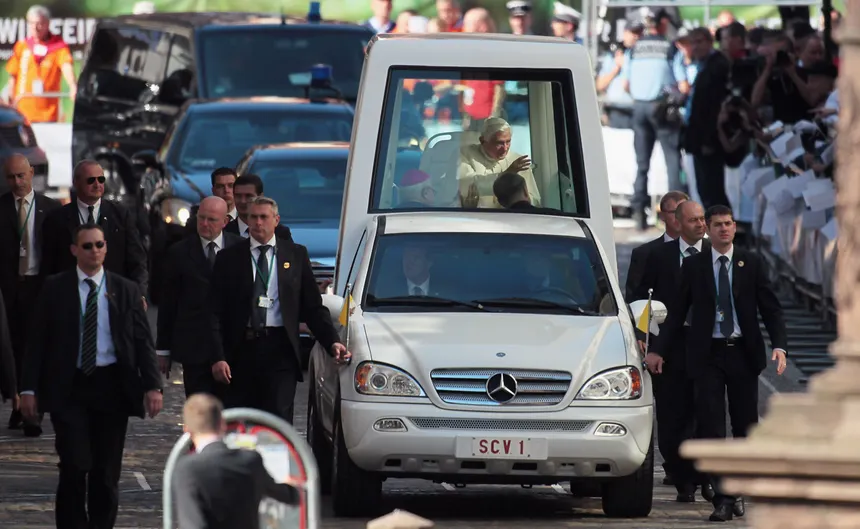
But the engine isn’t the only thing cooking. The glass dome is a greenhouse. A sealed polycarbonate capsule under tropical sun reaches 60 degrees Celsius within minutes. The original 230 GE included a dedicated air control system to prevent the dome walls from fogging — because if the glass fogs, the Pope disappears and the vehicle loses its primary function. Later models added high-capacity climate control dedicated exclusively to the occupant zone. Benedict XVI’s Mercedes M-Class went further: an independent oxygen supply inside the cabin, in case a chemical or biological attack compromised outside air.
The Problem of a Transmission That Doesn’t Exist
First gear in any gearbox is designed for one thing: launching from a standstill. Acceleration from rest, transition to second, and gone. It is not designed to hold constant speed indefinitely. But that is exactly what the Popemobile requires: sustained speeds between three and fifteen kilometers per hour, for hours.
With an engine designed to operate between 2,000 and 6,000 rpm forced to run at its lowest possible range, moving a mass three times greater than the manufacturer intended, a stock transmission becomes a guaranteed failure point. The torque converter overheats. Internal components suffer accelerated wear. Gearbox lubrication isn’t calibrated for those sustained conditions.
Popemobiles use transmissions that are redesigned or reprogrammed specifically for this operating regime. This isn’t a minor adjustment. It means rethinking the relationship between engine and wheels for a scenario no manufacturer accounts for in production engineering. The electric Mercedes Popemobile delivered in December 2024 — a G-Class G580 with four near-wheel motors — solves this problem at its root: an electric motor delivers maximum torque from zero rpm and needs no conventional gearbox. Ninety-four years of the Mercedes-Vatican relationship culminated in the most elegant possible solution to the Popemobile’s ugliest problem.
The Problem of Standing a Man on Top of an Armored Vehicle
When you triple a vehicle’s weight without changing its wheelbase or exterior dimensions, the center of gravity shifts, suspension geometry changes, and dynamic behavior becomes unpredictable. Now add a hydraulic throne that raises the occupant based on crowd density. Every centimeter it rises, the center of gravity rises with it.
A turn on a cobblestone plaza with a Pope standing on a throne two meters above the ground inside a five-ton vehicle is a stability calculation no suspension engineer would sign off on lightly. The suspension must absorb irregular cobblestones without transmitting jolts to a standing occupant — who wears no seatbelt, who is holding a grab bar, who is 80 years old. And it must do this without the vehicle swaying enough to risk rollover.
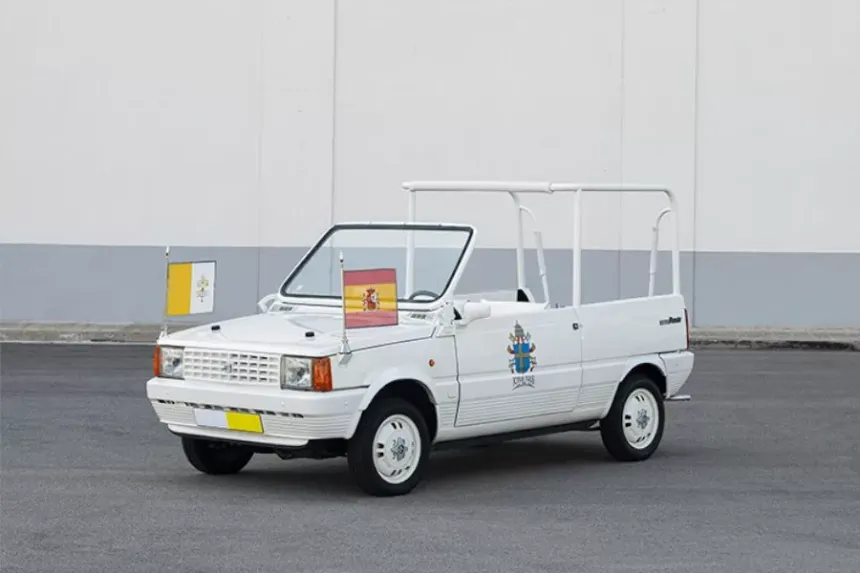
In Spain in 1982, the solution to this problem was eliminating it entirely: John Paul II needed to enter Barcelona’s Camp Nou for Mass before 121,000 people, the armored Popemobile didn’t fit through the stadium gates, and the alternative was an open SEAT Panda with a grab bar. No armor. No dome. No stability calculations. Probably the smallest — and the most honest — Popemobile ever built.
The Unsolvable Contradiction: Francis Breaks the Mold
In 2013, Jorge Mario Bergoglio was elected Pope and decided the Popemobile’s contradiction couldn’t be solved with more engineering — only by eliminating the question. He compared the armored dome to “a sardine can” and got rid of it.
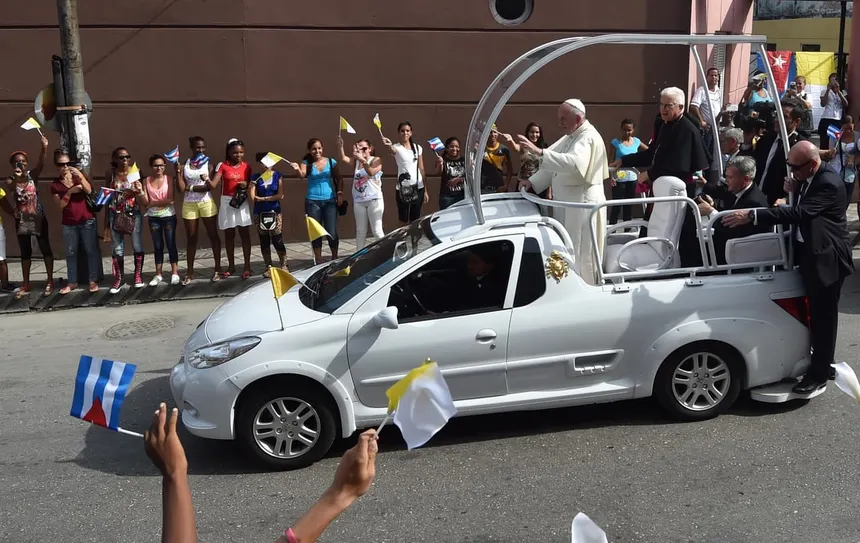
In August 2014, he asked South Korea’s organizing committee for the smallest car in the country. They offered a Kia Morning; he chose a Kia Soul for rear-seat space. A $14,100 car. No armor. In 2015, he arrived in the United States in a borrowed Fiat 500L and rode through streets in an open Jeep Wrangler. At the Vatican, he drove a Ford Focus. Before that, a Renault 4L. In an interview with Barcelona’s La Vanguardia, he was blunt: “It’s true that anything could happen, but let’s face it, at my age I don’t have much to lose.”
Headlines worldwide didn’t discuss his homilies. They discussed the cars. Every Kia Soul, every Fiat 500L, every open Wrangler was a communication act more powerful than any marketing campaign ever paid for by a car manufacturer. Francis chose risk because the risk was the message: I am here. No wall between you and me. The man leading 1.4 billion Catholics drove cars any worker could afford.
Before him, a Ferrari Enzo gifted to John Paul II — declined by the Pope, who suggested auctioning it for victims of the 2004 Indonesian tsunami — sold for six million dollars. A white-and-gold Lamborghini Huracán, blessed and sent to auction — proceeds went to trafficking victims in Africa. After him, luxury brands stopped trying to impress the Vatican with horsepower and started listening to what the Popemobile had always demanded: mechanical humility in service of a function.
Was it irresponsible? Was it the most powerful gesture a Pope could make? Engineering has no answer to that question. Because that question isn’t about engineering. It’s the one variable in the Popemobile’s design brief that no manufacturer can solve: how much glass the man inside wants between himself and the world.
Epilogue: From the Nürburg to Electric
In December 2024, Mercedes-Benz delivered to Francis a handmade, fully electric G-Class G580. Four near-wheel motors adapted for ceremonial speeds. Central rotating seat adjustable for height. Left door welded into the bodyshell in traditional coachbuilding fashion. Retractable roof. Pearl white. The first electric Popemobile in history.
Francis died on April 21, 2025. His successor — Leo XIV, Robert Francis Prevost, born in Chicago, first American-born Pope — inherited the electric Mercedes. And in February 2026, Ford delivered a custom Explorer Hybrid built at the Chicago Assembly Plant, in the same neighborhood where the Pope grew up. Inside: empty boxes from Aurelio’s, his favorite pizza, and two reserved Illinois plates: “DA POPE” and “LEO XIV.”
Nearly a century. More than twelve manufacturers. From thrones on human shoulders to electric motors with four independent drive units. A first vehicle conceived by Ferdinand Porsche in 1930 and a last one delivered by the Mercedes CEO personally in 2024. And through all of it, one constant: the Popemobile remains the only vehicle in the world that must be simultaneously the most exposed and the most protected. No contract. No logo on the bodywork. Just the privilege of building the car that carries the most watched man on the planet.
Check you’re still alive.