
Porsche 356: The Car That Started a Religion
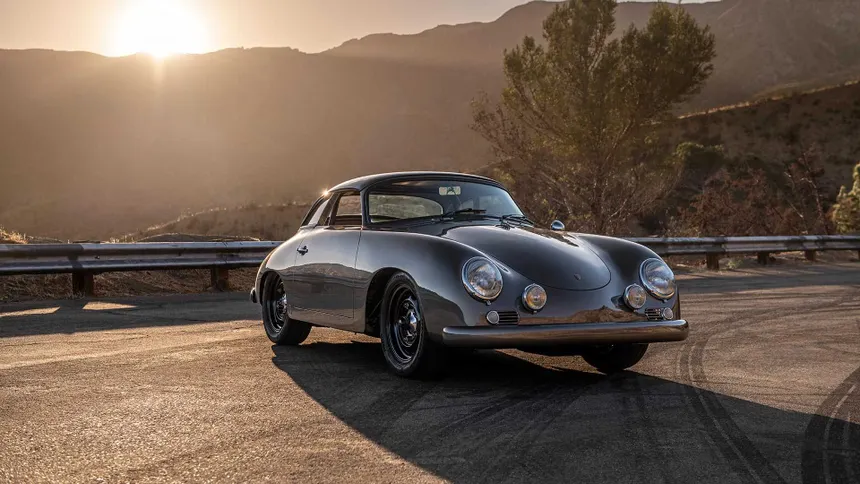
Before the 911 became the centre of the Porsche universe, before the Turbo became a status symbol and the GT3 became a track day weapon, there was a small, rounded, Beetle-derived sports car that looked like it had been sculpted by the wind itself.
The Porsche 356 is where everything started. And I mean everything.
Every obsession with flat-six engines. Every argument about air-cooled versus water-cooled. Every middle-aged man who spends Saturday mornings polishing a car worth more than his house. It all traces back to this humble little machine that Ferdinand “Ferry” Porsche built in a wooden shed in Gmünd, Austria, in 1948.
And the story of how it happened is one of the most unlikely origin stories in automotive history.
Born From Ruins
The story of the 356 is inseparable from post-war Europe. The Porsche family had been building engineering consultancy work for decades — Ferdinand Porsche Sr. designed the Volkswagen Beetle for Hitler’s Germany, a fact the company has spent the better part of 80 years trying to contextualise rather than celebrate. The elder Porsche was imprisoned by the French after the war for his involvement with the Nazi regime, leaving Ferry to pick up the pieces of a family business that had been reduced to almost nothing.
After the war, Ferry Porsche found himself in Austria with a dream, limited resources, and access to Volkswagen parts. The logical thing to do? Build a sports car. Because apparently, when your country is in ruins and your father is in prison, the rational response is to design a two-seat roadster.
The first prototype, the 356/1, was a mid-engined roadster completed in June 1948. It used a modified 1,131cc Volkswagen flat-four producing around 35 horsepower. That’s not a typo. Thirty-five. And yet, because the car weighed barely 585 kilograms, it moved with a purpose that belied its humble specifications. It was entered in a race at Innsbruck in July 1948 and won its class — Porsche’s first competition victory, achieved before the company had even properly established itself as a manufacturer.
Ferry quickly switched to a rear-engine layout for the production version — it was cheaper to manufacture and made more sense using VW components. That decision, made purely for pragmatic reasons, would define Porsche’s DNA for the next eight decades and counting. Every 911 that has ever been built carries the echo of that original compromise: the engine goes in the back because it was easier to build it that way with Volkswagen parts in 1948.
The earliest production cars were hand-built in Gmünd using aluminium bodywork, and only about 52 were made before production moved to Stuttgart in 1950. These Gmünd cars are now among the rarest and most valuable Porsches in existence, commanding prices that would make even the most hardened collector wince.
The Evolution Nobody Expected
The 356 went through several iterations, each one refining what came before, and the progression tells the story of a company finding its feet with remarkable speed.
The Pre-A (1948–1955) established the template. Split windshield models from the earliest production years are now among the most valuable Porsches in existence. These were coach-built cars with an artisan quality that mass production would inevitably dilute. The early cars used Volkswagen engines with minimal modification, but Porsche’s engineers were already pushing for more — boring out cylinders, improving cooling, refining the suspension geometry to extract every last drop of performance from the platform.
The 356 A (1955–1959) brought the first serious engineering upgrades. The engine options expanded significantly, with displacements ranging from 1.3 to 1.6 litres and power outputs climbing toward 100 horsepower in the hottest variants. The Carrera variant arrived with its exotic four-cam engine derived from racing, and the iconic Speedster became the car that defined an entire generation of California cool. The 356 A was also the car that established Porsche’s reputation for quality and reliability — these were sports cars you could drive to work every day, not fragile exotics that spent more time in the workshop than on the road.
The 356 B (1959–1963) raised the headlights, enlarged the rear window, and generally made the car more civilised without losing the essential character. By this point, Porsche was no longer a curiosity — it was a legitimate sports car manufacturer winning races across Europe. The T5 and T6 body variants within the B series showed Porsche’s obsessive approach to incremental improvement, with subtle changes to bumpers, engine lids, and interior appointments that only true enthusiasts can distinguish at a glance.
The 356 C (1963–1965) was the final evolution, featuring disc brakes on all four wheels — a significant upgrade over the drum brakes that had been a persistent criticism of earlier models — and the most refined versions of the air-cooled flat-four. The SC variant with its 95 horsepower engine represented the peak of naturally aspirated 356 performance, offering a genuinely quick car that could hold its own against much more powerful machinery thanks to its light weight and superb balance. By the time the last one rolled off the line in 1965, over 76,000 units had been produced. Not bad for a car born in a shed.
The Speedster: Where Legend Met Reality
If the 356 created the Porsche religion, the Speedster was its scripture.
The story goes that Max Hoffman, Porsche’s American importer and one of the most influential automotive figures of the 1950s, demanded a stripped-down, affordable sports car for the US market. Hoffman had an uncanny ability to read the American automotive appetite, and he recognised that there was a market for a lightweight, open-top European sports car that didn’t cost as much as a small house.
Ferry Porsche obliged with the Speedster — a low-windshield, spartan roadster that cost $2,995 in 1955. The windshield was so low that taller drivers had to look over it rather than through it. The side curtains were flimsy. The folding top was rudimentary at best. Comfort was an afterthought. It was perfect.
James Dean drove one. Steve McQueen owned one. Every wannabe rebel in Southern California wanted one. The Speedster became the car that married European engineering elegance with American open-road freedom, and it did so at a price that actual human beings could theoretically afford. It was the original “affordable Porsche” — a concept that Porsche would revisit decades later with the 924, 944, and Boxster, always with the same tension between accessibility and exclusivity.
Today, a good 356 Speedster will cost you somewhere between €400,000 and over a million euros depending on condition and provenance. So much for affordable. The most exceptional examples — matching numbers, documented history, original colours — have crossed the €2 million mark at auction, making the Speedster one of the most valuable non-racing Porsches ever produced.
The Carrera: A Name Earned, Not Invented
Modern Porsche slaps “Carrera” on everything from base 911s to SUV trim levels, which has diluted the name into meaninglessness. But the original Carrera designation on the 356 meant something extraordinary.
The 356 Carrera used the Type 547 engine — a 1.5-litre four-cam flat-four designed by Ernst Fuhrmann that was essentially a racing engine detuned for road use. The word “detuned” is generous. This engine was complex, temperamental, and glorious. It featured dual ignition, dry-sump lubrication, and roller-bearing crankshaft — technology that was cutting-edge for a road car in the 1950s and utterly impractical for daily driving. Mechanics who could properly service a Carrera engine were rare then and rarer now.
It was named after the Carrera Panamericana, the legendary Mexican road race where Porsche made its international reputation in the early 1950s. A 356 entered by Porsche finished first in the 1,500cc class in 1953, beating far more established competitors and proving that this small German manufacturer could compete on the world stage.
A 356 Carrera today is one of the most sought-after Porsches ever built. Only around 700 were made across all variants — the Carrera Deluxe, Carrera GT, and Carrera 2 spanning the A, B, and C series. Finding one in good condition requires either deep connections or deeper pockets, and prices have long since left the realm of rational automotive purchases and entered the world of art collecting.
What the 356 Actually Taught Porsche
Beyond the romance and the auction prices, the 356 established principles that still define Porsche today, and understanding these principles is essential to understanding why the company has endured while so many competitors have disappeared.
Lightness over power. The 356 never had massive horsepower. Its fastest variants barely cracked 130 hp in Carrera form, and the standard cars were well under 100. But because the car was light and balanced, it felt faster than its numbers suggested. This philosophy — that the driving experience matters more than the spec sheet — is something Porsche understood before Lotus made it a marketing slogan. Colin Chapman gets the credit for “simplify, then add lightness,” but Ferry Porsche was living that principle a decade earlier.
Evolution, not revolution. The 356 was continuously improved rather than redesigned. Each version was better than the last, but recognisably the same car. Porsche would apply this same philosophy to the 911 for the next sixty years, and it’s become the company’s defining characteristic — the idea that you don’t throw away what works, you make it better. Every competitor who has tried to redesign their sports car from scratch every decade has eventually stumbled. Porsche just kept refining.
Racing improves the breed. Porsche raced the 356 from the start, and lessons from competition directly influenced road car development. The Carrera engine was a direct technology transfer from the track. The suspension improvements came from racing experience. The braking upgrades were driven by competition demands. This wasn’t marketing — it was engineering philosophy, and it established a pipeline from track to road that Porsche maintains to this day with cars like the GT3 and GT2 RS.
Charge more, deliver more. The 356 was always more expensive than its competitors. An MG, a Triumph, or an Austin-Healey could be had for significantly less money. Porsche justified the premium by offering superior build quality and engineering, and crucially, by delivering a product that backed up the price tag with tangible substance. Whether they’ve maintained that standard in the SUV era is a debate for another article, but the principle was established here.
Build a community, not just a customer base. The 356 fostered a sense of ownership loyalty that bordered on fanaticism. Porsche Club of America was founded in 1955, and 356 owners were its backbone. This wasn’t accidental — Porsche actively cultivated relationships with owners, invited them to the factory, and treated them as part of the family. That community-building approach has paid dividends for seven decades.
The 356 Today
The collector market has pushed 356 values into territory that would make Ferry Porsche’s head spin. A basket-case project car starts around €50,000-€70,000, and even that seems remarkable for a pile of parts that will cost you another €100,000+ to properly restore. A decent driver-quality Coupé runs €100,000-€200,000. Speedsters and Carreras are in a different stratosphere entirely.
But here’s what’s interesting about the 356 community: it’s arguably the most genuine subset of Porsche ownership. These aren’t people buying a car to post on Instagram. 356 owners tend to actually drive their cars, attend rallies, and get their hands dirty. There’s a purity to the 356 ownership experience that gets progressively diluted as you move up the Porsche timeline. The 911 community has been infected by speculation and investment thinking. The 356 community, while not immune to market forces, retains a hobbyist spirit that feels authentic.
The mechanical simplicity of the 356 is part of this appeal. Unlike a modern Porsche that requires specialist diagnostic equipment and factory-trained technicians, a 356 can be maintained and even restored by a competent home mechanic with good tools and patience. The engines are small, relatively simple, and well-documented. Parts are available through a robust aftermarket ecosystem. You can understand how this car works by looking at it, which is something you absolutely cannot say about a 992 with its layers of electronic management systems.
Is the 356 overvalued? Probably. Is it overrated? That’s harder to argue. This is a car that created an empire from nothing, that proved a small company in post-war Austria could compete with established manufacturers, and that established a design language and engineering philosophy that endures to this day.
You don’t have to be a Porsche fanatic to respect what the 356 achieved. You just have to appreciate what it means when someone builds something extraordinary from almost nothing.
That’s the 356 story. Not bad for a car that was basically a Beetle with ambitions.
Pingback: Porsche 911: Overrated Legend or Deserved Icon? The Full History