
Porsche 928 — The Car That Tried to Kill the 911
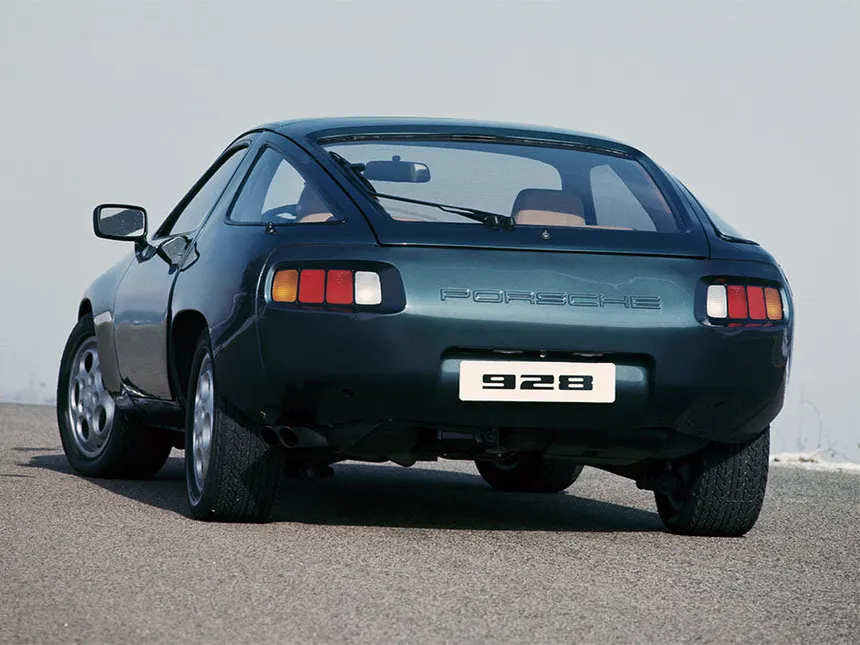
Porsche 928: Porsche’s Greatest Failure
In the mid-1970s, Porsche made a rational, engineering-driven decision: the 911’s rear-engine, air-cooled layout was a dead end, and the future required a front-engine, water-cooled grand tourer.
They were right about the engineering. They were catastrophically wrong about their customers.
The Porsche 928 is one of the most fascinating cars in automotive history — not because of what it achieved, but because of what it represents: the moment Porsche learned that their customers don’t buy engineering. They buy mythology.
The Rational Porsche
By the early 1970s, Porsche’s leadership was genuinely concerned about the 911‘s future. Emission regulations were tightening across all major markets, noise standards were becoming stricter, and the fundamental physics of a rear-engine, air-cooled car presented increasing challenges that couldn’t be solved without radical — and expensive — engineering interventions.
The air-cooled flat-six had been pushed about as far as it could go within the constraints of the existing architecture. Cooling was becoming a serious issue as power outputs climbed. Noise regulations threatened to make the distinctive air-cooled clatter illegal in key markets. And the rear-engine weight distribution, while manageable in a lightweight car, was becoming increasingly problematic as crash safety requirements added weight and complexity.
Ernst Fuhrmann, who became Porsche’s CEO in 1972, commissioned the development of a completely new car that would eventually replace the 911. Fuhrmann was an engineer’s engineer — the same man who had designed the legendary four-cam engine for the 356 Carrera. He approached the problem with pure engineering logic: identify the 911’s fundamental limitations, then design a car that eliminated all of them.
The result, launched in 1977, was the 928 — and it was everything the 911 wasn’t.
Front-mounted, water-cooled V8 engine. Rear transaxle for perfect 50/50 weight distribution. Independent rear suspension with the Weissach axle — a clever passive rear-steer system that improved stability during deceleration. A body designed by Wolfgang Möbius that looked like it came from the future, with smooth curves and an aerodynamic profile that was decades ahead of its time. Pop-up headlights that gave the front end a predatory look when open and a clean, undisturbed surface when closed. Aluminium construction throughout the front end and doors, reducing weight in the areas that mattered most for handling balance.
The 928 won the European Car of the Year in 1978 — the first and only sports car to receive the award, before or since. Critics raved about its combination of performance, comfort, and technological sophistication. Road testers from every major publication praised the 928 as a quantum leap forward from the 911 in terms of refinement, ride quality, and high-speed stability.
And 911 owners absolutely despised it.
The V8 That Porsche Doesn’t Talk About
The 928’s engine was remarkable, and it deserves more attention than Porsche’s official history typically gives it.
The original powerplant was a 4.5-litre all-aluminium V8 with single overhead cams that produced 240 horsepower. It was smooth, refined, and completely unlike anything Porsche had built before. The engine note was a cultured, distant rumble rather than the mechanical clatter of an air-cooled flat-six — more like a luxury car than a sports car, which was precisely the point and precisely the problem.
Over its 18-year production run, the engine evolved through several significant variants. The 928 S (1980) enlarged the engine to 4.7 litres and 300 horsepower. The 928 S4 (1987) brought a complete engine redesign with dual overhead cams, 32 valves, and 320 horsepower from 5.0 litres — a genuinely modern engine that was competitive with anything in the GT class. The 928 GT (1989) pushed output to 330 horsepower with revised engine management. And the final 928 GTS (1992–1995) enlarged the engine to 5.4 litres and 350 horsepower, making it one of the fastest grand tourers available anywhere.
The 928 GTS could hit 275 km/h and accelerate from 0 to 100 km/h in about 5.2 seconds. In the early 1990s, that was legitimate supercar territory — faster than a Ferrari 348, faster than a Lotus Esprit Turbo, faster than anything from Aston Martin. And it did all of this while carrying two adults in genuine comfort across continental distances at sustained high speeds.
But here’s the thing about the 928’s V8: it didn’t sound like a Porsche. It didn’t feel like a Porsche. The car drove beautifully — reviewers consistently praised its balance, its ride quality, and its ability to cover vast distances at absurd speeds in complete comfort. But it lacked the mechanical rawness, the air-cooled clatter, the sense of danger that 911 buyers craved.
The 928 was better as transportation. The 911 was better as an experience. And Porsche’s customers had made it abundantly clear which one they valued more.
Why the Market Rejected Perfection
The 928’s failure is a masterclass in understanding that products don’t sell on objective superiority alone. It should be required reading in every business school, because the lessons it teaches about customer psychology, brand identity, and the limits of rational product development are as relevant today as they were in 1977.
The 911 faithful viewed the 928 as heresy — a betrayal of everything Porsche stood for. Front engine? V8? Automatic gearbox option? This wasn’t a Porsche. This was a German Corvette with a crest on the bonnet. The emotional rejection was immediate, visceral, and impervious to any logical argument about the 928’s engineering superiority.
Porsche’s dealer network struggled with the 928 from the start. Salespeople who’d built their careers selling the 911 mystique — the rear-engine challenge, the air-cooled sound, the racing heritage — couldn’t pivot to a rational argument about weight distribution and ride comfort. The 928 required a completely different sales conversation, one that focused on objective quality rather than emotional engagement, and most dealers simply didn’t know how to have it.
The competitive positioning was also awkward. Buyers who wanted a GT cruiser could get a Mercedes SL for less money and with better brand recognition in the luxury segment. Buyers who wanted a sports car bought 911s. The 928 sat in a no-man’s land between luxury GT and sports car that neither customer segment fully embraced.
By the early 1980s, the writing was on the wall. Peter Schutz replaced Fuhrmann as CEO in 1981, and one of his first acts was to guarantee the 911’s future. The famous story goes that Schutz walked into his office, saw a product planning chart that showed the 911’s production line ending in the mid-1980s, and drew a line extending it indefinitely into the future. Whether this story is literally true or a corporate legend, the effect was real: the 911 would live, and the 928 would never replace it.
The 928 would continue in production — it was too good a car to kill immediately, and it had its own loyal following among buyers who appreciated what it offered on its own merits. But it would never be the flagship. It would never be the “real” Porsche. It would remain the rational alternative that the market chose to reject in favour of the irrational original.
The last 928 GTS rolled off the line in 1995, after 18 years of production. Total production across all variants: approximately 61,056 units. By comparison, Porsche now sells that many Cayennes in about four months. The 928 was never a commercial failure in absolute terms — it sold steadily throughout its life — but it was a strategic failure in the sense that it failed completely in its original mission of replacing the 911.
The 928 Today: Revenge of the Underdog
Here’s where the story gets interesting, and where the 928 starts to have the last laugh.
For years, the 928 was the bargain of the Porsche world. While air-cooled 911s were climbing into six-figure territory on waves of nostalgia and speculation, you could buy a decent 928 S4 for €15,000-€25,000. A GTS — objectively one of the finest grand tourers of the 1990s, a car that could embarrass modern machinery on a cross-continental run — could be had for €40,000-€60,000. The 928 was the thinking person’s Porsche, bought by people who drove their cars rather than displayed them.
Values have started climbing in recent years as a new generation of enthusiasts discovers the 928 on its own merits rather than measuring it against the 911. The GTS in particular has seen significant appreciation, driven by the recognition that it represents one of the last great naturally aspirated V8 grand tourers — a type of car that emission regulations and electrification are rapidly making extinct. The best GTS examples now comfortably exceed €100,000, and exceptional cars have broken the €150,000 barrier.
But the 928 remains one of the most undervalued cars in the Porsche lineup relative to its objective quality. You’re getting a V8 grand tourer with genuine Porsche engineering, a driving experience that holds up remarkably well by modern standards, and a design that somehow looks more futuristic now than it did in 1977. The 928’s styling has aged better than almost any car from its era — the smooth curves, the integrated bumpers, the cab-forward proportions all look contemporary in a way that few 1970s designs manage.
The catch? Maintenance. The 928 is complex, parts are increasingly scarce and expensive, and a neglected example can present bills that make its purchase price look like a deposit. The timing belt service on a 928 is a notorious wallet-emptier — it’s a major job that requires significant disassembly, and if it’s not done on schedule, the consequences are catastrophic engine damage. The automatic gearbox, found on the majority of 928s, requires specialist knowledge and expensive parts when it needs attention. Electrical systems can be temperamental, particularly on earlier cars.
This is not a car for someone who wants weekend fun without mechanical commitment. This is a car for someone who is willing to invest time, money, and emotional energy into a relationship with a machine that rewards commitment with an experience that few modern cars can match.
What the 928 Teaches Us
The Porsche 928 is proof that being the better product doesn’t guarantee market success. It was more comfortable than the 911, better balanced, more technologically advanced, and more practical. On paper, it was the superior car in almost every measurable dimension.
But cars aren’t spreadsheets. People don’t buy sports cars with their rational brains. They buy them with the same part of their brain that fell in love for the first time — irrational, emotional, and completely impervious to logical argument.
The 911’s flaws — the rear-engine weight distribution, the cramped interior, the mechanical demands — weren’t weaknesses. They were character. And character, as the 928 proved, is something you can’t engineer into existence no matter how much money you spend. You can build a better car, but you can’t build a more compelling one through engineering alone.
Porsche learned the lesson well. They’ve never again tried to replace the 911. Every other model in their range — the Boxster, Cayman, Cayenne, Panamera, Taycan, Macan — exists to fund the 911’s continued evolution. The 911 is the soul. Everything else is the business that pays for the soul to exist.
The 928 was the better car that lost. And in losing, it taught Porsche the most valuable lesson in its history: never bet against mythology.