
Porsche 944 Turbo: Four Cylinders of Pure Heresy
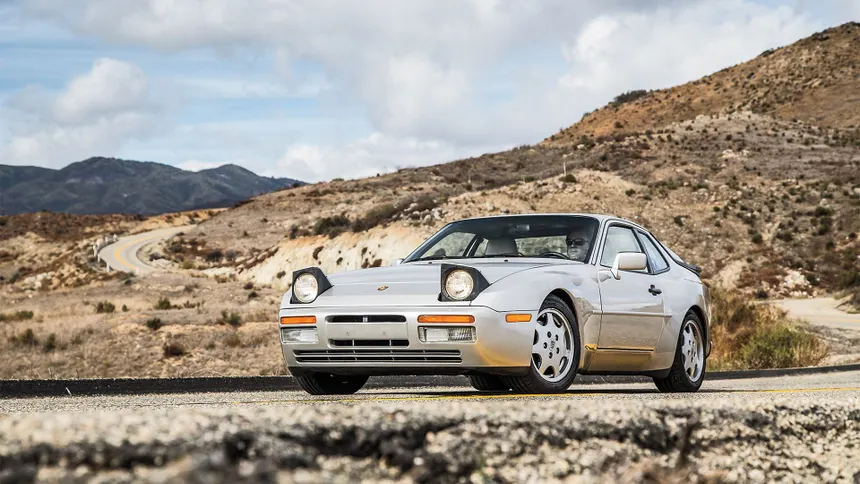
Let me describe a car to you: front-mounted four-cylinder engine, rear transaxle, pop-up headlights, and a price tag significantly below the flagship model. If I told a modern Porsche enthusiast this was a “real” Porsche, they’d spit out their flat white.
But the Porsche 944 Turbo wasn’t just a real Porsche — it was, per several period road tests, a better-handling car than the contemporary 911. And that inconvenient truth is exactly why the Porsche faithful have spent four decades trying to pretend it doesn’t exist.
The Transaxle Era Nobody Celebrates
The 944 belongs to what Porsche historians call the “transaxle era” — a family of front-engine, rear-transaxle cars that includes the 924, 944, 968, and the grand touring 928. These cars were Porsche’s attempt at diversifying beyond the 911, offering more accessible sports cars that could reach a wider market without the compromises inherent in the 911’s rear-engine layout.
The strategy made perfect business sense. The 911 was expensive to produce and limited in its appeal by the demands it placed on drivers. A front-engine car with conventional weight distribution would be easier to drive, cheaper to manufacture, and accessible to buyers who wanted the Porsche badge without the rear-engine learning curve. The fact that this strategy was also sound engineering — front-engine/rear-transaxle is an objectively excellent sports car layout — was almost beside the point. This was about survival and growth.
The 924 came first in 1976 and earned instant scorn for its Audi-sourced engine and Van der Meulen design that many considered too soft for a Porsche badge. The criticism was partially justified — the 924’s 2.0-litre Audi engine was agricultural by Porsche standards, and the car felt like what it partially was: a project that had been started at Volkswagen and finished at Porsche. It was quick enough and handled beautifully, but the powertrain undermined any claims to sporting credibility.
The 944, launched in 1982, was the response to every criticism levelled at the 924, and it was comprehensive.
The 944 used an all-new 2.5-litre inline four-cylinder engine that was essentially half of the 928’s V8 — literally derived from the same engine block, split down the middle. It produced 163 horsepower in naturally aspirated form — decent but unremarkable on paper. The real story was in the engineering details: balance shafts to eliminate the vibration that plagues large four-cylinder engines, a toothed-belt-driven camshaft, and a level of refinement that was genuinely impressive for a 2.5-litre four.
The body was wider, more aggressive, and far better proportioned than the 924. Where the 924 had looked slightly apologetic, as if embarrassed to be wearing a Porsche badge, the 944 looked purposeful and muscular. The wheel arches were flared, the stance was wider, and the overall impression was of a car that had earned its crest rather than borrowed it.
But the chassis was where the 944 truly distinguished itself. The front-engine/rear-transaxle layout gave it textbook 50/50 weight distribution — better than the 911 had ever achieved, and better than most purpose-built sports cars managed. The suspension was fully independent, with MacPherson struts at the front and semi-trailing arms at the rear, tuned by engineers who clearly prioritised driver engagement over comfort.
Car magazines loved it. Customers bought it. But the real magic came in 1985 when Porsche strapped a KKK turbocharger to that four-cylinder and created something genuinely special.
The 944 Turbo: Where Numbers Tell the Story
The 944 Turbo (internally designated 951) produced 220 horsepower from its turbocharged 2.5-litre four. That number doesn’t sound impressive by modern standards, but context is everything. In 1985, 220 horsepower was enough to match the contemporary 911 Carrera 3.2 in a straight line — a car with two more cylinders, a more prestigious name, and a significantly higher price tag.
And in corners, the 944 Turbo was flatly superior to the 911 of its era.
The weight distribution was better — genuinely 50/50, with none of the rear-heavy bias that made the 911 entertaining but treacherous. The steering was more communicative, with a directness and precision that the 911’s geometry couldn’t match because of the weight of the engine hanging behind the rear axle. The brakes — massive ventilated discs borrowed from the 911 Turbo — were sensational, with none of the weight transfer drama that rear-engined cars inflict on their front brakes under hard stopping. The chassis balance was so neutral that instructors at Porsche’s own driving school reportedly preferred the 944 Turbo to the 911 for teaching proper technique, because it rewarded good driving without punishing small mistakes.
The turbocharger itself was well-matched to the engine’s character. Boost came on progressively — there was lag, this being 1985, but it was manageable and predictable rather than the binary on/off boost delivery that made the 930 famous as a widowmaker. Power built smoothly from around 3,000 rpm and pulled strongly to the 6,500 rpm redline, giving the driver a broad, usable powerband that made the car fast on real roads rather than just impressive on a spec sheet.
Then, in 1988, Porsche released the 944 Turbo S — a 250-horsepower variant that elevated the car from very good to genuinely exceptional. The Turbo S received a larger turbocharger, revised engine management with higher boost pressure, stiffer suspension, larger brakes from the 928 S4, wider rear tyres, and a limited-slip differential. The result was one of the fastest cars you could buy in 1988: 0-100 km/h in about 5.5 seconds and a top speed of 262 km/h.
The 944 Turbo S is, in my opinion, one of the most underappreciated performance cars ever made. It offered 90% of the 911 Turbo experience for 60% of the price, with significantly more predictable handling and none of the snap oversteer that made the 930 famous for removing hedges and frightening passengers. If Porsche had put a flat-six in it and called it a 911, it would be worth six figures today. Instead, it had four cylinders and pop-up headlights, so it’s worth a fraction of comparable 911s despite being, by many objective measures, the better car.
Why the Purists Refused to Accept It
The problem with the 944 was never the car itself. The problem was tribalism — pure, irrational, impervious-to-evidence tribalism.
The 911 community viewed the transaxle cars as dilutions of the brand — cheaper alternatives designed to bring Porsche to the masses. The four-cylinder engine was seen as fundamentally unworthy of the crest, as if the number of cylinders in an engine was a measure of moral character rather than engineering specification. The front-engine layout was heresy. Pop-up headlights were for Mazdas and Toyotas, not for Porsches. The fact that you could buy one without remortgaging your house was, paradoxically, the most damning criticism of all.
Never mind that the 944 Turbo could lap most tracks faster than a 911 Carrera of the same era. Never mind that it was genuinely one of the best-balanced chassis Porsche has ever built, before or since. Never mind that Ferry Porsche himself reportedly considered the 944 the best car Porsche was making at the time — a statement that, if true, must have been received about as well as a papal endorsement of atheism.
The 944 committed the unforgivable sin of being accessible. A Porsche you could actually afford was, to the faithful, not really a Porsche at all. This is a community that derives its identity partly from exclusivity, and a car that democratised access to the badge was threatening in a way that went far beyond automotive preferences.
This snobbery persists today, decades after the car went out of production. Mention a 944 in most Porsche forums and watch the responses range from polite dismissal to open contempt. The transaxle cars are tolerated in the Porsche community the way a distant relative is tolerated at family gatherings — technically part of the family, but not really invited to the important conversations. Meanwhile, the same people who sneer at 944s are paying €300,000 for air-cooled 911s that the 944 could out-handle in period.
The 968: The Forgotten Finale
The 944’s story doesn’t end with the Turbo S. In 1992, Porsche launched the 968 — essentially a heavily revised 944 with a 3.0-litre engine, VarioCam variable valve timing, and updated styling. The 968 was the most refined transaxle car Porsche ever built, and the 968 Club Sport was a stripped-out driver’s special that many consider one of the best-handling Porsches of any era.
The 968 died in 1995 along with the 928, ending the transaxle era entirely. Porsche replaced both with the Boxster — a mid-engined roadster that was cheaper, simpler, and strategically positioned to avoid threatening the 911’s primacy. The lesson of the 928 had been learned, and it was applied ruthlessly: nothing in the Porsche range would ever again be allowed to challenge the 911’s position as the brand’s core identity.
The 944 Turbo Today
For years, the 944 Turbo was one of the great sports car bargains — a genuine Porsche with brilliant dynamics for €15,000-€25,000. Values have risen recently as the market discovers what driving enthusiasts have known for decades, but you can still find good Turbo examples for €30,000-€50,000. The Turbo S commands more, typically €50,000-€80,000 for clean examples, and the rarest variants can push into six figures.
The ownership experience has its challenges. The engine is robust if maintained but can be expensive when things go wrong — the balance shaft belt failure is the 944’s equivalent of the IMS bearing in early 996s, a known weakness that can cause catastrophic engine damage if ignored. The dashboard develops cracks that range from cosmetic to horrifying. The electrics can be temperamental, particularly on cars that have lived in hot climates. The pop-up headlight mechanisms wear and can become reluctant to operate. Finding a specialist who takes transaxle cars as seriously as air-cooled 911s can be difficult, though the community has grown significantly in recent years.
But when everything works, the 944 Turbo delivers a driving experience that still holds up remarkably well against modern machinery. The steering weight, the chassis balance, the progressive power delivery — these are qualities that age better than raw horsepower. A well-maintained 944 Turbo feels like a car designed by engineers who cared about dynamics first and marketing second. That’s increasingly rare, and increasingly valuable.
The Real Legacy
The 944 Turbo proved that Porsche could build a world-class sports car without relying on the 911 formula. It demonstrated that four cylinders, properly implemented, could deliver genuine performance. And it offered an entire generation of enthusiasts their first taste of Porsche ownership — many of whom eventually graduated to 911s and became the loyal customers who fund Porsche’s business today.
The irony is thick: a car that the 911 community dismissed as “not a real Porsche” served as the gateway drug that created thousands of future 911 customers. Porsche owes the 944 more than it will ever publicly acknowledge.
In a just world, the 944 Turbo would be celebrated alongside the best 911s. In our world, it remains the Porsche that Porsche fans love to hate. It’s a car that selects its owner based on driving priorities rather than social aspirations, and that selectivity is increasingly rare and increasingly valuable in a market dominated by badge-buying and social media posturing.
Their loss.
Pingback: Porsche 356: History, Evolution & Why It Still Matters