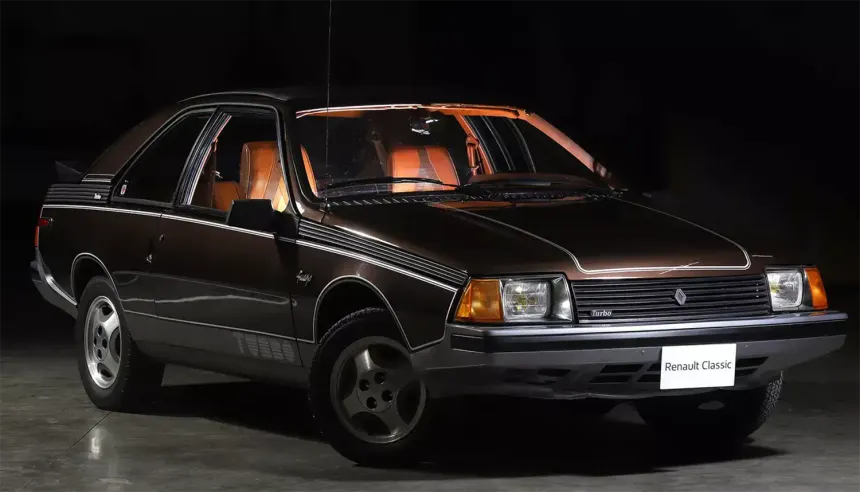
Renault Fuego Turbo: The Coupe That Invented the Key Fob in Your Pocket
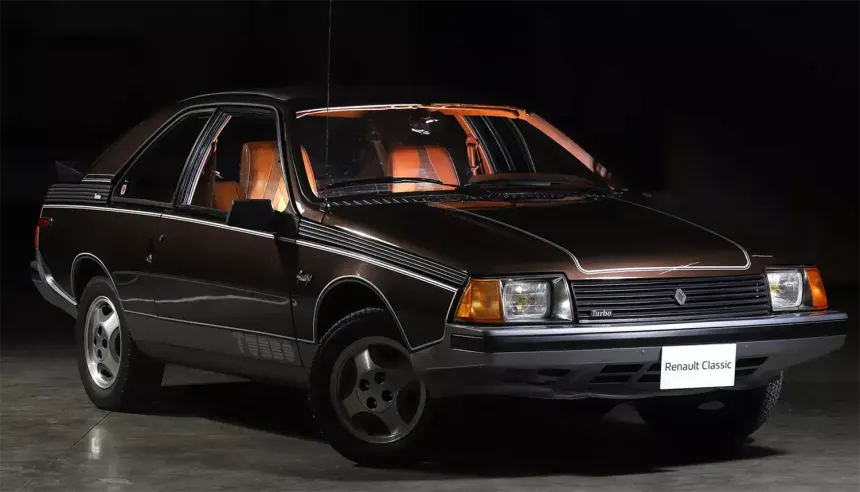
You do it every day without thinking. Pull the fob from your pocket, thumb a button, and from across the parking lot your car goes “thunk” and flashes its lights. That whole ritual, that little jolt of satisfaction, traces back to one car. A French coupe from the 1980s, plastered with TURBO stickers, judged by its looks far more often than by what sat underneath them.
And here’s the kicker for American readers: you could buy this thing at an AMC dealership. The Renault Fuego landed in the States in 1982, badged and sold through American Motors, a year before it even went on sale in France. Most people who saw one had no idea they were looking at a car that pioneered two features now bolted to every vehicle on Earth.
Let’s set the record straight, because the Fuego deserves better than the punchline it became.
A Coupe Shaped by the Wind Tunnel
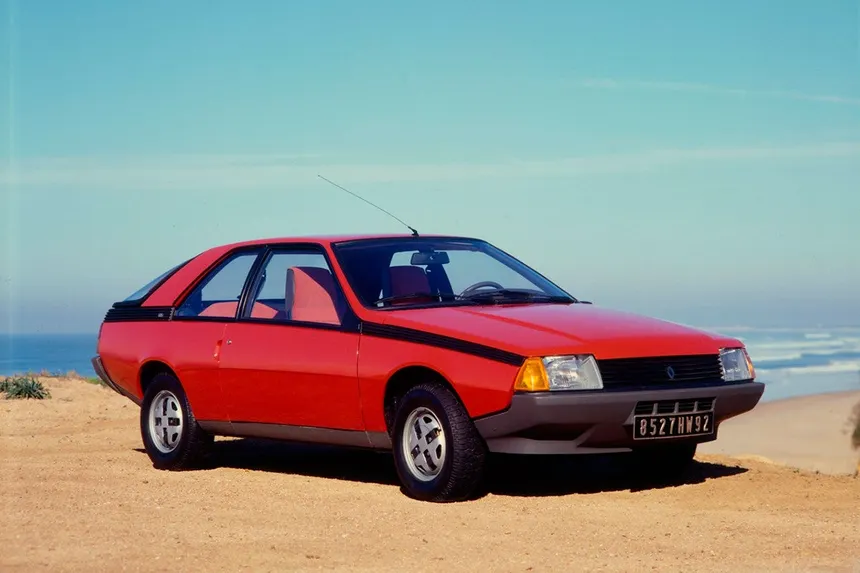
Renault unveiled the Fuego at the 1980 Geneva Show to replace the R15 and R17 coupes of the previous decade, a pair that had sold more than 300,000 units combined between 1971 and 1979 and left a hole to fill in the brand’s sporting range. Those two had been built by Chausson in Maubeuge, the same coachbuilder that would go on to assemble the Fuego, so the new coupe wasn’t just a spiritual successor but a literal one, rolling down the lines of the same northern French town. The replacement had to be more modern, more slippery, and above all cheaper to build. The first big decision was equal parts styling and aerodynamics: it was among the first mass-produced four-seat sports models designed in a wind tunnel.
The payoff was a drag coefficient between 0.32 and 0.35 depending on version and year. To put that in 1980 terms, most cars of the era sat around 0.40-plus. The Fuego slipped through the air better than nearly anything on the road. That bubble-glass hatchback, often compared to the Porsche 924’s, wasn’t just fashion. It was part of a shape built to cheat the wind, penned under the direction of Robert Opron, the same man behind the Citroën SM and CX.
Underneath, things were more down to earth. The Fuego shared its platform, floorpan, and much of its hardware with the Renault 18, an utterly ordinary family sedan. This was the depths of the early-’80s recession, and Renault did what nearly everyone did back then: build the new thing on top of what already existed. Rather than a clean-sheet design, the Fuego was a sharp suit tailored over a known, well-proven skeleton, which takes nothing away from it given how well the suit turned out.
The PLIP: Infrared, Not Radio
In 1982, the Fuego became the first car in the world with remote central locking, a fact as true as it is underappreciated. But mind the technical detail, because almost everyone gets it wrong: that first system didn’t use radio frequency like today’s fobs, but infrared. The commercial name was “Infrawave,” and its range was a laughable five feet or so, meaning you practically had to aim it at the car the way you aim a TV remote.
The invention belonged to a Frenchman, Paul Lipschutz, who worked at the lock company Neiman. From his name came the label that entered automotive history: “le PLIP.” In France, people still say they’re going to “plip” the car when they unlock it. That verb was born right here.
Radio frequency, with its longer range and better security, came later, once the rest of the industry, BMW, Honda, Toyota, took Lipschutz’s idea and refined it. But the door, in the most literal sense, was opened by the Fuego.
The Second First Nobody Remembers
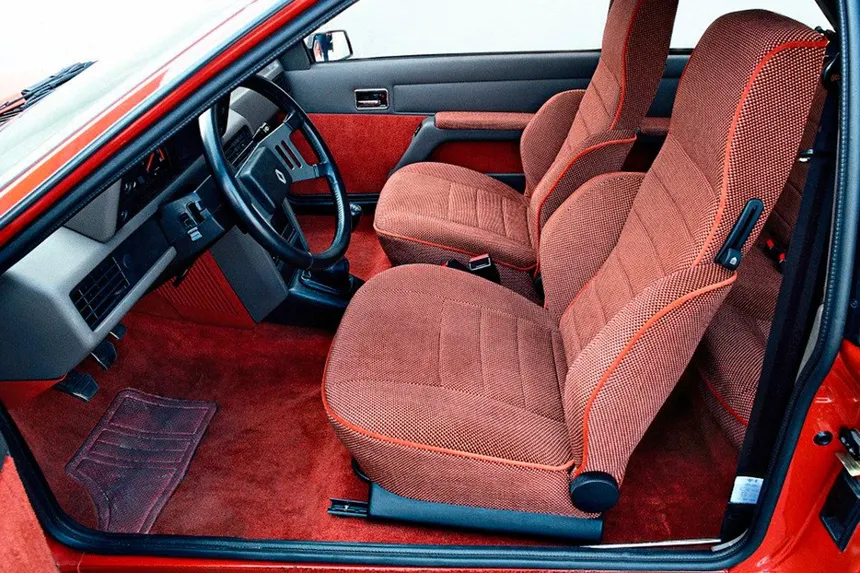
And it wasn’t alone. The Fuego was also the first car with audio controls mounted on a stalk beside the steering wheel, on the European left-hand-drive GTX and Turbo from 1983.
Think about that. Today you’ve got buttons on the wheel to bump the volume, skip a track, answer a call, and you take it completely for granted. That started here too. Renault popularized it the following year on the R25, and from there it spread across the entire industry. Two features now fitted to every car on the planet, both debuted by the same coupe that so many people look down on. And this wasn’t some obscure oddity nobody bought: the Fuego was the best-selling two-door coupe in Europe from 1980 to 1982, which makes it all the stranger that its pioneering role got quietly written out of the story.
Now, the Turbo
Here’s the version that matters. In 1983, alongside a light facelift, new grille, new bumpers, freshened interior, Renault launched the Fuego Turbo. And Renault knew exactly who it was hunting: it wanted to peel buyers away from the VW Golf GTI and the hot hatches devouring the affordable performance segment.
But the numbers that mattered most to an American buyer were the ones against home-market coupes, and here the federalized Fuego was on the back foot. The U.S. Fuego Turbo’s 1.6, choked to around 107 hp SAE net, faced the second-generation Toyota Celica Supra, whose 2.8-liter inline-six made roughly 145-150 hp and hit 60 mph in about 9.8 seconds. On paper the Supra simply had more of everything: more cylinders, more torque, more badge credibility. Even measured against the European-spec Fuego Turbo’s full 132 hp, the comparison flattered the Toyota, because the Supra wrapped its power in rear-wheel drive and a Lotus-tuned suspension, exactly the sporting hardware the front-drive Fuego couldn’t answer. The Renault’s case was never raw pace; it was aerodynamics, comfort, and equipment. Against a Supra on a dealer lot, that was a hard pitch to win.
The engine was a 1,565 cc gasoline block, oddly smaller than the naturally aspirated 2.0 already in the range, but force-fed by a turbo that lifted output to 132 hp in European trim. More than the power, what mattered was the torque: 200 Nm on tap from just 3,000 rpm. In a car that dipped near 1,050 kg in its lightest form, that torque meant a mid-range shove the naturally aspirated cars of the day couldn’t match. It was turbocharging as the ’80s told it: below a certain rpm not much happened, then boost came in and the car lunged forward.
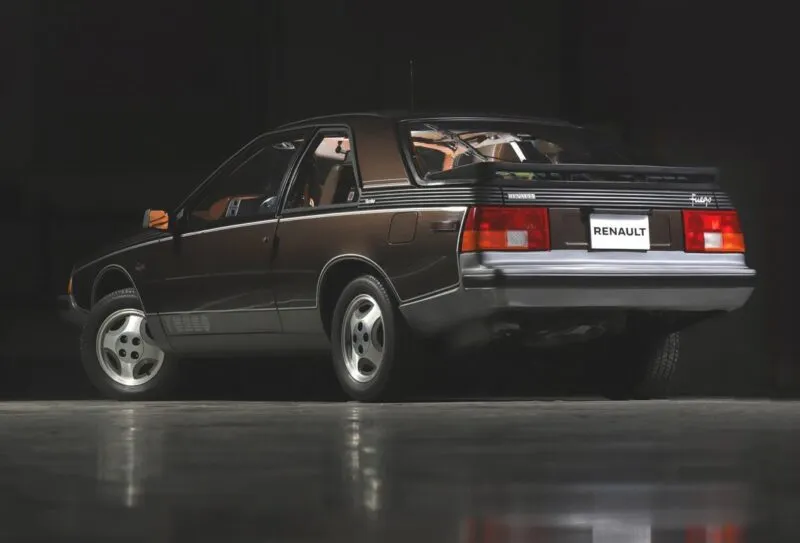
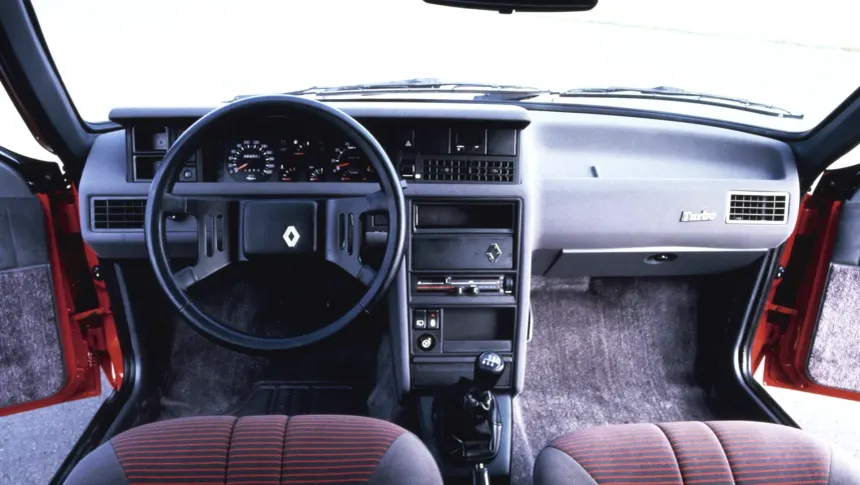
It came exclusively with a five-speed manual, no automatic on the European Turbo, and drove the front wheels through a longitudinally mounted engine. As the range flagship, it debuted kit unthinkable on lesser trims: four-wheel disc brakes, two electric door mirrors, and an on-board computer, all standard. Outside, specific alloy wheels and “Turbo” decals down the flanks gave it away. In that era, those stickers were a statement as much as a decoration. The ’80s sold turbocharging like it was witchcraft.
The American Chapter
The U.S. Fuego Turbo was a different animal. Emissions rules and “federalization,” bigger bumpers, sealed-beam headlamps, Americanized colors and trim, choked the engine down to around 107 hp SAE net. The original design team reportedly hated what the States did to their car. Priced at $8,495 at launch and rated at 39 mpg on the highway, it earned decent reviews, MotorWeek liked the styling and standard electric sunroof, but flagged weak brakes and noticeable understeer. Sales never took off. The Fuego was meant to be Renault’s American “halo” car, and it didn’t save the brand’s fortunes in the States. By 1984, AMC dealers were handing out rebates just to move them, and later that year the range finally got the fuel-injected 2.2-liter engine it should have had from the start, long after the train to success had left the station.
There’s a line from the enthusiast world that captures the American problem better than any spec sheet: the Fuego, people said, screamed “my owner can’t afford a 924” a little too loudly. In a country where the Porsche 924 set the template for the affordable sporty coupe, looking like a cut-price imitation was fatal, however many world firsts sat under the skin. Europe read the same shape as smart and modern; America read it as trying too hard.
In Argentina, by contrast, the Fuego became a genuine icon, built at the Santa Isabel plant in Córdoba and staying in production long after Europe had moved on, going head to head with the Ford Taunus. Down there, they loved it for real.
The production spread is worth a line. Of the 265,367 Fuegos built, roughly 85% came out of the Maubeuge plant in France, but a share was assembled in Palencia, Spain, at the RESA factory, supplying European markets into 1986. A French silhouette, an Italian’s hatchback design, and a good chunk of them bolted together on the Castilian plains.
The Image That Hurt It
Let’s be straight: Renault earned part of the Fuego’s bad rap itself. Putting a Turbo Diesel in the same lineup, however quick it was for an oil-burner (and it was quick, briefly the fastest diesel in the world in 1982) muddied the message. A sporty coupe with a diesel sibling doesn’t sell dreams cleanly. And pop culture filed it under one heading: ’80s fashion accessory, right down to appearing in the summer hits of the day.
But close your eyes and strip away the stickers and the prejudice. What’s left is an aerodynamic coupe, comfortable for four, carrying two inventions that changed cars forever, and a turbo motor that genuinely troubled the benchmarks of its time. Not bad at all for a car so many never bothered to look at.
Rust, Its Real Enemy
If the Fuego is a rare sight today, it isn’t only because sales were soft: it’s because so many of them rotted. The sheet metal was its weak point, and anyone hunting one now knows it. The door bottoms rust from the inside out when the drain holes clog, the leading edge of the hood and the front wings chip easily, and it didn’t help that the factory paint wasn’t the toughest. The high-lipped tailgate takes knocks to its plastic trim, and its release, worked by a lever in the driver’s door jamb, is one to check still functions.
The mechanicals, on the other hand, held up. Because every engine was shared with high-volume Renault models, parts were never hard to find, and the blocks were reasonably durable, needing only the usual checks such as blue exhaust smoke betraying tired rings and bores. In American hands the story was harsher: up against Japanese coupes like the Celica, built to shrug off abuse, the Fuego simply wilted under the punishment a typical US buyer dished out. The engine rarely killed it. The bodywork, and the climate, did.
When Image Eats Engineering
With the Fuego, something happened that the car world sees more often than it admits: image ate engineering alive. A car that debuted two technologies you use every single day ended up remembered as a poser’s coupe, elbowed aside by rivals with fancier badges, while brands with a sharper marketing department pinned on medals that largely belonged to this misunderstood Frenchman.
It’s worth remembering for what it was, not for the label stitched onto it, because brave cars and ideas ahead of their time have been buried by the truckload under an unfair reputation while the applause went to someone else. The Fuego opened a door we all open now, absent-mindedly, every time we thumb a button and watch the lights blink back from across the parking lot without a thought for who we owe the gesture to.
Check you’re still alive.