
Scuderia Cameron Glickenhaus: Le Mans’ Last Privateer

From Hollywood to Sleepy Hollow: Who Is Jim Glickenhaus
Before he ever put a car on the Le Mans grid, Jim Glickenhaus had put Jackie Chan in front of a camera. Born in New York City on July 24, 1950, raised in New Rochelle, Glickenhaus directed, wrote, and produced action films throughout the 1980s and ’90s. The Exterminator (1980) was his commercial hit. The Protector (1985) was his clash with Jackie Chan — Glickenhaus cut his version, Chan cut another for Asia, and neither would give an inch. When the Hollywood majors swallowed the independent market whole, he walked away from filmmaking and toward what had always kept him up at night: cars.
He was no newcomer. At 12 years old, Jim was already spending afternoons at Luigi Chinetti Motors, the legendary Ferrari dealership in New York. Chinetti handed him a racing jacket on a rainy day. That jacket still hangs in Jim’s office today — inside a converted beverage warehouse on a residential street in Sleepy Hollow, New York. The same warehouse that holds one of the most important private collections of competition cars in the world — 1960s racing Ferraris, a Ford GT Mark IV from Le Mans, machines that won Daytona and Spa.
Glickenhaus doesn’t collect cars to look at them. He drives them. And when he stopped finding cars that satisfied him, he decided to build his own.
The P4/5: Where It All Began
In 2005, Pininfarina proposed building a one-off on a Ferrari Enzo platform. The result was the Ferrari P4/5 by Pininfarina. It cost $4 million. Luca di Montezemolo, Ferrari’s president, showed up in a helicopter when he found out. He was not pleased. But Andrea Pininfarina reminded him that coachbuilding was tradition, and Glickenhaus made clear he didn’t care whether it wore the Cavallino badge or not.
Jim wanted to race the P4/5 at Le Mans. The ACO said no — it was a one-off, it didn’t fit any class. So he called the Nürburgring. Peter Geisheker, promoter of the Nürburgring 24 Hours, said yes. He later admitted he thought the chances of Glickenhaus actually showing up were zero.
He showed up. And with him, Scuderia Cameron Glickenhaus was born — the name combining his wife Meg Cameron’s maiden name with his own. In 2011, the P4/5 Competizione debuted at the 24 Hours of Nürburgring. When Ferrari complained about him using their components, Jim ripped the Cavallino badges off the car, drew an SCG shield with a felt-tip pen on Scotch tape, and went back to the track.
SCG 003: The First Clean-Sheet Car
In 2013, the SCG 003 project kicked off: designed by Granstudio with Lowie Vermeersch leading exterior design, engineered by Paolo Garella (ex-Pininfarina), chassis manufactured by Manifattura Automobili Torino in Rivalta di Torino. Unveiled at Geneva in 2015. The competition version ran a Honda 3.5-liter twin-turbo V6 tuned to 500 hp under FIA regulations. The road car used a BMW 4.4-liter twin-turbo V8. Prices from €2.1 million. In 2017, the NHTSA approved SCG as a Low Volume Manufacturer — up to 325 cars per year without meeting federal crash test standards.
That same year, Jeff Westphal set a 6:33.20 on the full 20.8 km Nordschleife layout with the 003C. During qualifying for the 24 Hours of Nürburgring, not in a private session on a prepared track.
The Le Mans Dream: SCG 007 LMH

When the FIA and ACO announced the new Le Mans Hypercar regulations in 2018 — designed to replace the eye-watering LMP1 hybrid era and lower the barriers to entry — Glickenhaus was the first to commit. Before Toyota, before Peugeot, before anyone.
The establishment’s initial response was telling. Jim called the FIA to attend the first rules-definition meeting. The answer: “You will not be allowed in the building. We have McLaren and Aston Martin. We’ll let you know if we need you.” Glickenhaus wrote a letter from the Nürburgring: “I’m not messing around. I’m building a car. Either treat me with respect or I’m gone.” The FIA reversed course.
The SCG 007 LMH was developed by Podium Advanced Technologies in Italy, with aerodynamics from Sauber Motorsport and logistical support from Joest Racing — the same Joest that won Le Mans in 1984, 1985, and 1997, the last genuine privateer to win the race. The engine was a 3.5-liter twin-turbo V8 by Pipo Moteurs, built on the foundation of their WRC powerplants.
But the road to the debut was mined with regulatory shifts. Specification changes forced SCG to abandon their agreement with Alfa Romeo (whose engine couldn’t reach 870 hp in endurance trim), find an alternative in Pipo Moteurs, and then adapt again when the power target was cut to 670 hp. Every regulation change cost millions to a team funded by one man’s personal wealth.
WEC by the Numbers (2021-2023)
| Data Point | Figure |
|---|---|
| Debut | 8 Hours of Portimão, 2021 |
| Seasons | 3 (2021, 2022, 2023) |
| Races entered | 12 |
| Pole positions | 2 (Spa 2022, Monza 2022) |
| Podiums | 4 |
| Best Le Mans result | 3rd (2022) — first American podium in 53 years |
| Le Mans 2023 | 6th and 7th — ahead of Porsche and Peugeot |
| Le Mans starts | 6 (3 editions × 2 cars) |
| Le Mans retirements | 0 |
Six starts, six finishes. No car finished lower than seventh overall. The 2022 podium with Westbrook, Briscoe, and Mailleux was the first for an American team in the overall classification since the Ford GT40 won in 1969. At Monza 2022, Glickenhaus started from pole and was fighting for the win when a turbo failure ended their race. Paddock bets before the 2021 debut gave SCG two hours before breaking down.
The Withdrawal: When the System Expels What It Can’t Control
In October 2023, Jim Glickenhaus confirmed that SCG would not enter the 2024 WEC season. “When we started, we were told we had to build a car to certain rules and certain performance figures, and that’s what we did. The idea was that we would have a fair and equal chance to compete during the entire period the Hypercar rules were in effect. But there was no fair and equal way forward.”
The problem was structural. When SCG entered, the estimated LMH budget was around €20 million. As Porsche, Ferrari, BMW, Cadillac, Peugeot, and Lamborghini joined, costs exploded. The big manufacturers were outspending SCG by a factor of 10 to 15. They accumulated 100,000 kilometers of testing. Glickenhaus hadn’t tested his car since Monza 2022. “If you don’t have the money to test, you can’t get your car where it should be. There’s nothing BoP can magically fix.”
Without sponsors — and without the ability to race in IMSA to generate revenue on American soil — the operation was unsustainable. “I race because I love to race. I can afford to race. I do it personally. It’s not a business thing. But at some point, my shareholders are going to say ‘Jim, enough’.”
He said he didn’t want to be “cannon fodder” for Toyota and Ferrari.
After WEC: The Road Cars
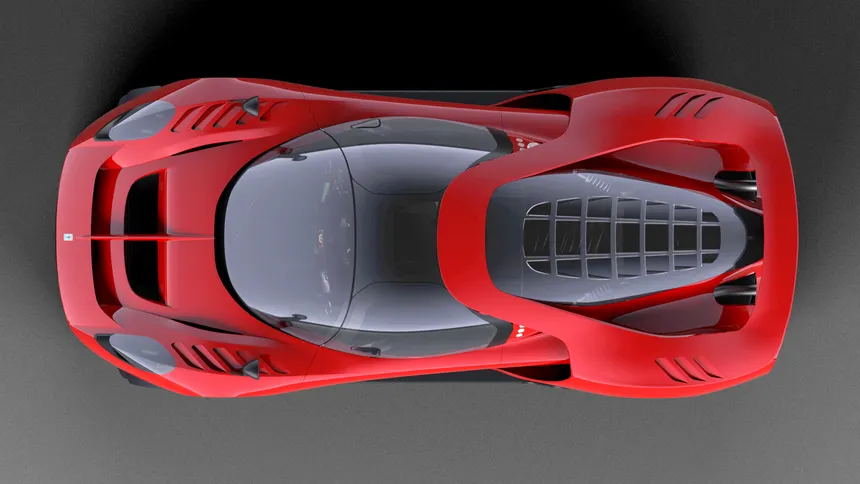
SCG was never just a racing team. The goal was always to race first and then sell road versions.
The SCG 004S runs a supercharged 6.2-liter V8 producing 650 hp with a six-speed manual and a central driving position — three-seat layout, like the McLaren F1. Carbon fiber monocoque, built by Roush Performance in Detroit. Deliveries from early 2025 through HK Motorcars, their only worldwide dealer. The 004CS adds a blown rear diffuser, larger brakes, and built-in air jacks for track days.
The SCG 007s is the street-legal version of the Le Mans hypercar. Unveiled at Concorso d’Eleganza Villa d’Este in May 2025. Katech-built twin-turbo 6.2-liter V8 producing 1,000 hp, seven-speed automated manual gearbox, rear-wheel drive, 1,550 kg. Three-seat layout with central driver’s position. Aerodynamics virtually identical to the race car. Limited to 24 units at $2.3-2.5 million. Glickenhaus has claimed it would break the 6-minute barrier at the Nürburgring Nordschleife on street tires.
And there’s the SCG Boot — a high-performance off-roader inspired by Steve McQueen’s 1967 Baja Boot, designed for the Baja 1000.
A Necessary Character
Jim Glickenhaus is a Wall Street multimillionaire who ripped Ferrari badges off with his own hands. A B-movie director who built a hypercar that stood on the Le Mans podium. A man who calls IMSA’s rules “illegal” and “idiotic” in official WEC press conferences. A collector who says that not driving your Ferrari is like not sleeping with your girlfriend so she’ll be more desirable for the next guy.
He doesn’t filter what he thinks. He doesn’t play the corporate game. And that has cost him dearly — but it has also given him something no WEC manufacturer can buy: the genuine loyalty of motorsport fans worldwide.
SCG didn’t win Le Mans. But it proved you can get to Le Mans, finish every single race, stand on the podium, and beat Porsche and Peugeot — on one man’s budget with a team that fit in a van. That doesn’t get erased from the record. That doesn’t get matched by a press release.
🔴 MA-FIA VI: The IMSA Case — When Being American Isn’t Enough
What follows is a companion analysis to the main article. It is part of the investigative series “La Mafia de la FIA” by Not Enough Cylinders, documenting the structural failures of international motorsport governance.

The 2,500-Car Wall
To compete in IMSA’s GTP class, a manufacturer must produce more than 2,500 vehicles per year for worldwide sale. Acura, BMW, Porsche, Cadillac — all qualify. Scuderia Cameron Glickenhaus, obviously, does not.
Jim Glickenhaus stated that he received assurances in the summer of 2020 that his 007 LMH would be eligible to race in IMSA. It was, he said, a condition of entering the LMH program. “Frankly, if we knew we could not race in IMSA, we would not have gone forward.”
The irony is threefold:
SCG is an American company, headquartered in Sleepy Hollow, New York, with production in Danbury, Connecticut. IMSA, the organization that promotes sportscar racing in North America, blocked an American manufacturer from racing on American soil.
LMH/LMDh “convergence” was sold as the unification of the sport. An LMH could race in WEC. An LMDh could race in WEC. But an LMH could not race in IMSA if its manufacturer didn’t produce 2,500 cars per year. Convergence existed on paper, not on the track.
The financial damage was direct. Without access to IMSA, SCG couldn’t attract American sponsors. Without American sponsors, it couldn’t fund its WEC program. The IMSA block didn’t just close the door to Daytona — it shortened SCG’s life at Le Mans.
Glickenhaus put it with surgical precision: “The fans will believe there is convergence when an LMDh wins Le Mans and an LMH wins the 24 Hours of Daytona. Until that happens, convergence doesn’t exist.” IMSA president John Doonan agreed with the analysis. And then told him he couldn’t race in IMSA.
The Question Nobody Answers
Is the 2,500-car rule a legitimate technical barrier or market protection for manufacturers that can meet it? Glickenhaus called the situation potentially “illegal” under US anti-trust laws and threatened legal action. The legal action never came. The WEC program ran out first.
What remains is an uncomfortable precedent: the LMH ruleset was designed to open the door to boutique constructors. IMSA closed it with a requirement only industry giants can meet. Rules are not neutral. They are written by those with the power to enforce them, and enforced based on who benefits.
Check you’re still alive.
Pingback: MA-FIA VI: When Being American Isn't Enough — IMSA vs Glickenhaus