SUBARU IMPREZA 22B STi
Subaru Impreza 22B STi: The Rally Samurai That Conquered the World
There are cars built to sell. And then there are cars built to prove something. The Subaru Impreza 22B STi belongs firmly in the second category. Born in 1998 as a limited edition celebrating two simultaneous milestones — Subaru’s 40th anniversary as an automobile manufacturer and the brand’s third consecutive World Rally Championship constructors’ title — it has never stopped growing in legend, price, and almost religious devotion among Japanese car enthusiasts worldwide.
The Context: Subaru Against the World
To understand the 22B, you first need to understand what Subaru meant in the 1990s. While Toyota and Nissan dominated global sales with their executive sedans and high-performance sports cars, Subaru was the small manufacturer, the outsider from Fuji Heavy Industries that had committed to a technical combination no one else offered as standard in mass-production vehicles: symmetrical permanent all-wheel drive paired with a horizontally-opposed boxer engine. An engineering philosophy that felt completely different from everything else on the road.
But it was in rallying where Subaru found its true purpose. When the Subaru World Rally Team, managed by the British firm Prodrive under David Richards’ direction, began competing with the Impreza in 1993 after retiring the Legacy RS, the motorsport world experienced a seismic shift. Colin McRae, a Scottish driver with a suicidal and spectacular style who seemed physically incapable of lifting off the throttle, took that blue car wearing 555 sponsor livery to places nobody thought possible.
In 1995, McRae became the youngest and first British driver to win the WRC drivers’ title, while Subaru claimed its first constructors’ championship. In 1996, with McRae defending the number 1 and Kenneth Eriksson as second driver, Subaru won the constructors’ title for the second consecutive time, though McRae narrowly lost the drivers’ crown to Tommi Mäkinen. In 1997, with the debut of the new Subaru Impreza WRC replacing the Group A Impreza 555, the team won the constructors’ title once more with eight victories from fourteen rallies, though McRae again lost the drivers’ championship to Mäkinen by a single point.
The Impreza 22B was born from that accumulated euphoria. Three consecutive constructors’ championships. The small Japanese manufacturer had repeatedly defeated giants like Mitsubishi, Ford, and Toyota. And Subaru was celebrating its 40th birthday. Something special was needed — something fans could touch, drive, and own.
The Name: A Mystery That Lives On
The name “22B” is one of the most fascinating enigmas in Japanese car culture. The most widely accepted explanation holds that “22” refers to the 2.2-liter engine displacement, a significant increase from the standard STi’s 2.0 liters. As for the “B,” opinions divide and the debate has raged for nearly three decades without resolution.
According to some sources close to Subaru of Japan, the “B” is an internal company code designating turbocharged engines. Others argue the “B” references the Bilstein suspension the car was factory-equipped with, as all other Subarus used KYB dampers. There’s also an extraordinarily popular fan theory: 22B in hexadecimal notation equals the number 555 in decimal, and 555 was precisely the State Express cigarette brand that sponsored the Subaru World Rally Team from 1993 onward.
Coincidence or deliberate nod? Subaru has never officially confirmed any of the three explanations. It’s entirely possible the name works on multiple levels simultaneously, something very characteristic of Japanese corporate culture where layers of meaning are part of the design itself. What’s beyond dispute is that the name has become as iconic as the car.
The Numbers: What They Claimed and What It Really Made
The 22B’s official specifications declared 280 PS (276 bhp) at 6,000 rpm and 363 Nm of torque at 3,200 rpm. But here’s where it gets interesting. In Japan, there existed a gentleman’s agreement among manufacturers known as the 280 PS pact, whereby no Japanese production car would declare more than that figure, ostensibly to reduce traffic accidents.
Everyone knew that cars like the Nissan Skyline GT-R, Toyota Supra, Mitsubishi Lancer Evolution, and of course the 22B comfortably exceeded that figure. Independent testing placed the 22B’s real power output well above 300 bhp, with some examples reaching even higher depending on turbo condition and boost pressure. As one specialist auction house noted, “whilst officially listed as having an output of 276 bhp, real world figures suggest the actual number comfortably starts with a three.”
The engine was the EJ22G, a turbocharged flat-four boxer with a closed-deck block. Actual displacement was 2,212 cc, achieved by maintaining the engine’s stroke at 75mm while enlarging the bore to 96.9mm. It used an IHI VF22 turbocharger with a top-mounted intercooler, 565cc injectors, and a compression ratio of 8.0:1. Mounted longitudinally and sitting extremely low thanks to the horizontally-opposed boxer configuration, it provided a center of gravity that no conventional inline engine could match.
The transmission was a five-speed manual with ratios identical to the WRX Type R, but with gears that had been shot-peened for additional strength and reliability. The center differential was viscous-type and the rear was a limited-slip unit. Torque distribution was 50:50 between front and rear axles. The clutch was upgraded to a sintered twin-disc system with a ceramic disc, a component directly inherited from competition use.
Brakes featured four-piston calipers at the front and two-piston at the rear, painted red with the Subaru name in white. Ventilated discs measured 326mm at the front and 316mm at the rear.
The Body: Rally Car DNA on the Street
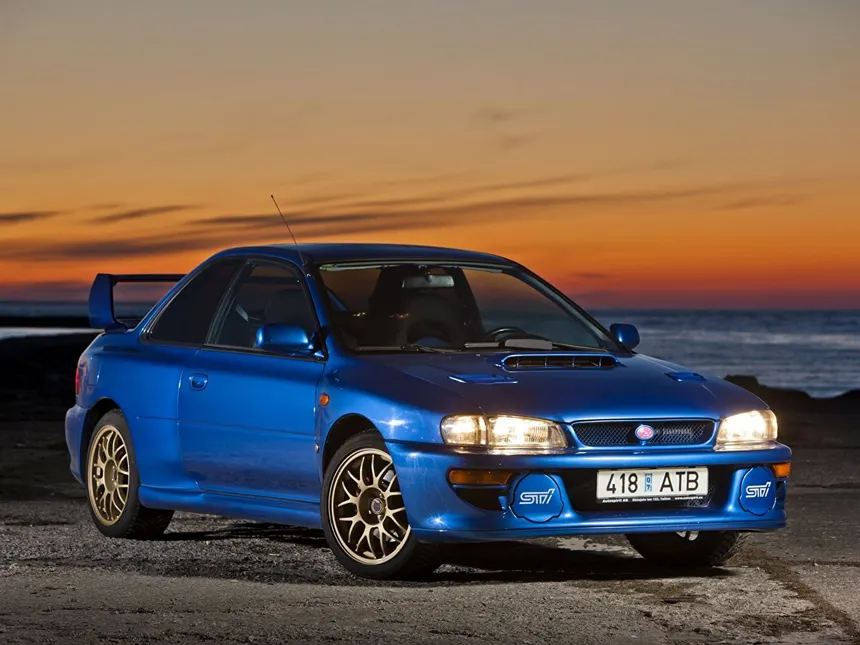
Visually, the 22B is unmistakable. The two-door coupe bodyshell received the fender flares designed by Peter Stevens for the WRC rally car, widening the overall track by 80mm per side to a total width of 1,770mm. These extensions weren’t decorative. They housed BBS Elektra alloy wheels measuring 17×8.5 inches, significantly larger than the standard WRX Type R’s 16×7-inch items, wearing Pirelli P Zero 235/40 ZR17 tires.
The hood featured a functional NACA duct for the intercooler, and the adjustable rear spoiler was directly inherited from the rally car’s aesthetic language. The color was exclusive and non-negotiable: Sonic Blue Mica, a deep blue with metallic flecks that has become the single most iconic color in all of Subaru’s history. There was no color option. Every example left the factory in Sonic Blue, full stop.
The interior was deliberately austere for what was supposed to be a celebration car. Recaro semi-bucket seats with manual adjustment, a flat-bottomed Momo steering wheel, STi instrumentation with center-mounted tachometer, and an overall finish that fiercely prioritized function over any pretension of luxury. No navigation, no screen, nothing that wasn’t strictly necessary for driving fast and feeling the car communicate through every surface. Curb weight was 1,270 kg, a figure that seems almost inconceivable today for a permanently all-wheel-drive production car.
The Sale: Between 30 Minutes and 48 Hours
Subaru announced production of 400 numbered units exclusively for the Japanese market, priced at 5,000,000 yen. Sources differ on the exact speed of sale: some cite under 30 minutes, others 48 hours. What’s indisputable is that demand brutally exceeded supply and Subaru had to employ a selection system among buyers who had placed deposits.
A curious detail: unit number 13 never received its numbered plaque. Subaru of America imported it as a press car, and the #13 plate was never assigned. Three additional units received the special #000/400 plaque: two went to the WRC team drivers, Colin McRae and Nicky Grist, and the third to David Lapworth of Prodrive, the man responsible for the championship-winning rally cars.
Subsequently, 24 additional examples were produced for export markets: 16 for the United Kingdom (modified by Prodrive with longer gear ratios and UK-specification lights), 5 for Australia, and the 3 prototypes, bringing total production to approximately 424 units.
Driving: The Experience That Changed Everything
Those who have driven a 22B describe the experience as visceral in a way modern cars simply cannot replicate. The hydraulic power steering transmits every road surface imperfection directly to your palms. The turbo has a perceptible lag that creates an explosive and addictive power delivery once it reaches boost. The exhaust sounds like no other four-cylinder on the planet, with that characteristic uneven boxer burble that has become Subaru’s unmistakable sonic signature.
The permanent all-wheel drive provides security and traction capability that the contemporary Mitsubishi Lancer Evolution matched mechanically but not emotionally. The 22B is rawer, more direct, more analog in its communication. There’s no electronic traction control, no stability control, no sophisticated ABS. It’s the driver and the mechanics in direct conversation, with no digital translators between them.
On mountain roads with fast linked corners, the 22B finds its natural element — the terrain it was conceived for. Understeer is minimal thanks to the boxer engine’s inherent balance and symmetrical torque distribution. The suspension, featuring inverted Bilstein dampers and specific-rate springs, keeps the car flat and controlled through bends without sacrificing comfort on straight sections. It’s a car that demands respect but rewards you with pure, unfiltered information about what’s happening between rubber and tarmac.
The Rivalry: 22B vs. Evo
You cannot discuss the 22B without mentioning the Mitsubishi Lancer Evolution. The rivalry between the Impreza and the Evo defined an entire era of Japanese motoring and remains one of the most passionate debates in the automotive world. Both cars competed in rally, both featured turbocharged all-wheel drive, both cost similar money, and both generated a tribal loyalty among their followers that resembles religion more than consumerism.
While Mitsubishi adopted a progressively more technological approach with its active Super AYC all-wheel-drive system and electronically controlled differentials, Subaru stayed true to a more mechanical, analog philosophy. The result was a completely different character behind the wheel. The Evo was more precise, more surgical, more predictable. The 22B was more organic, more connected, more emotional, more capable of surprising you.
In period comparative tests, lap times were practically identical. But the driving experience was completely different — like hearing the same musical piece performed by two orchestras of opposing temperaments. Subaru fans argued the boxer’s feel was irreplaceable. Mitsubishi fans pointed out the Evo’s traction technology was objectively superior. Nearly thirty years on, the debate remains as alive as the first day.
Legacy and Current Values
The 22B is today one of the most valuable Japanese cars in the global collector market. Prices have experienced a vertiginous climb over the past decade, driven by the convergence of several factors: the model’s extreme rarity, generational nostalgia from those who grew up playing Gran Turismo on PlayStation and watching WRC on television, and the car’s progressive eligibility for import into markets like the United States under the 25-year rule.
In 2015, a 22B in good condition could be found for around $60,000-$80,000. By 2020, prices already exceeded $150,000 with ease. At recent auctions, low-mileage examples with complete documentation have reached and exceeded $400,000. The #000 prototype that belonged to Colin McRae has become one of the most coveted pieces in automotive collecting, with an estimated value that transcends the merely financial.
Subaru has never made anything like it again. There have been special STi models and limited editions with alphanumeric designations, but none has captured the 22B’s unrepeatable magic. It was a unique moment in history: the exact intersection of sustained sporting success, honest engineering from an analog era, and the absolute peak of the golden age of Japanese performance cars.
The 22B isn’t just a car. It’s proof that a small manufacturer, with the right ideas and the courage to execute them, can create something that transcends mechanics and becomes culture. Every time a blue Subaru with gold wheels passes on the street, it’s the echo of the 22B. Every time someone hears that unmistakable uneven boxer rumble, it’s the legacy of the rally samurai that conquered the world.
Pingback: Mitsubishi Lancer Evolution: Historia Completa y Legado
Pingback: Cosworth: History of the Company That Powered Half the World in Competition