Toyota Celica GT-Four: The Japanese Icon that Conquered Rallying… Until They Got Caught Cheating.
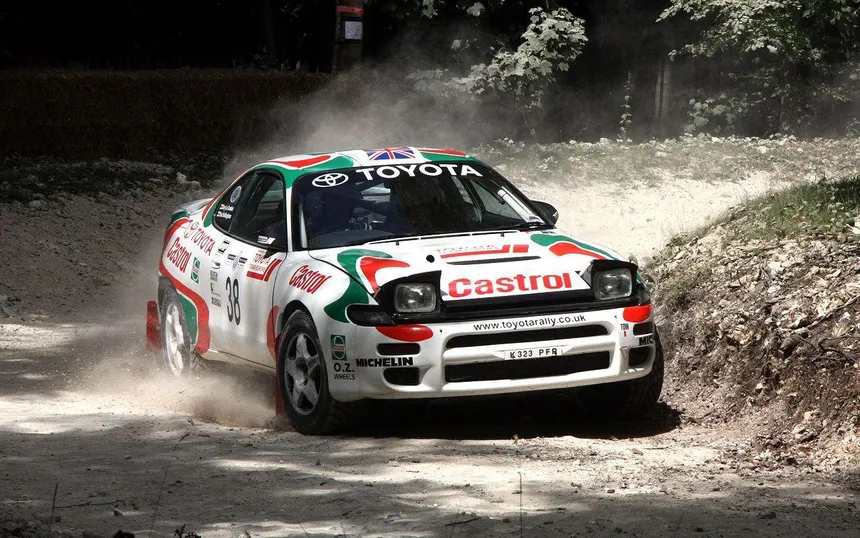
Toyota Celica GT-Four: The Rally Car the World Should Never Have Known — Until They Got Caught
Some cars win races. Some cars dominate. And some cars dominate so completely that the rest of the paddock starts wondering whether the regulations apply equally to everyone.
The Toyota Celica GT-Four ST185 was the third kind.
This is the car that won the Monte Carlo Rally three consecutive times. The car that led Didier Auriol to the world drivers’ championship in 1994. The car that starred in one of the most embarrassing and fascinating episodes in WRC history when Toyota was disqualified from the 1995 Rally of Catalonia for manipulating the turbo restriction system.
A story of championships, brutal speed, and large-scale cheating. Exactly the kind of story that deserves to be told properly.
Toyota in Rally: The Japanese Bet on Europe
Toyota didn’t arrive in the WRC by accident. By the late 1980s, the Japanese brand had spent years building a reputation for almost boring reliability in the European market. Cars that worked, didn’t cause problems, did exactly what was asked of them without drama. Wonderful for the average buyer. Deadly for brand image among enthusiasts.
Rally was the perfect answer. High-profile sport in Europe. Victories that translate directly into sales. And crucially, a sport where reliability isn’t a handicap but a fundamental asset: being fastest is worthless if your car breaks before the finish.
Toyota’s rally program began with the Celica GT-Four ST165 in the late 80s. Promising but not definitive. The qualitative leap came with the ST185 in 1992.
The ST185: The Machine
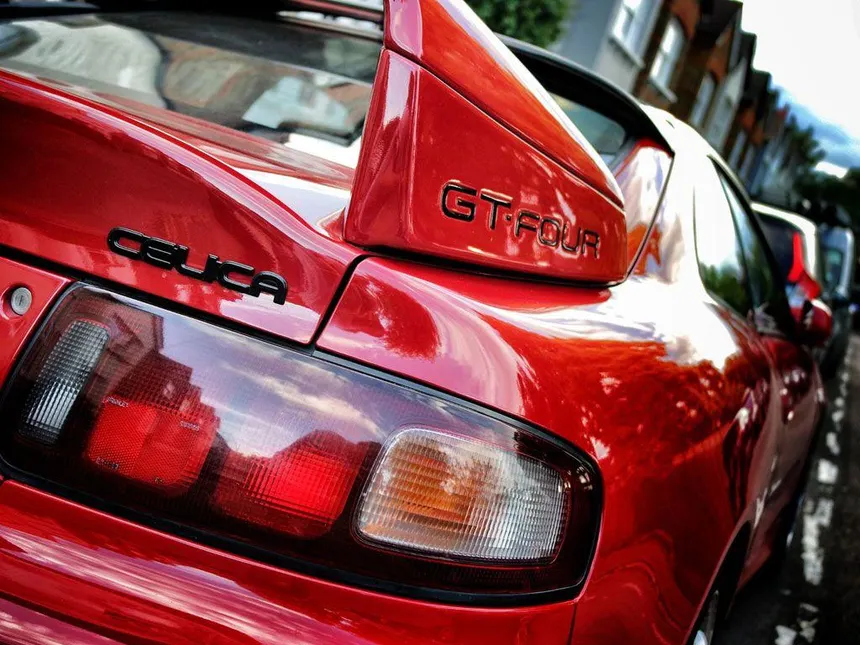
The road-going GT-Four was a moderately styled car hiding mechanics that were advanced for its era. The 3S-GTE engine: four-cylinder inline, two liters, variable geometry turbo, 204 hp in road trim. Four-wheel drive with active torque distribution. A car that sold reasonably well in Europe, especially among those who knew what lay beneath the conservative bodywork.
The rally version was another dimension entirely. Same base engine, but with preparation extracting 300 to 370 hp depending on specification. The four-wheel drive system was optimized for each rally’s conditions — different torque split on tarmac, gravel, snow. The chassis was rebuilt with lighter materials. The result was a car with an enormous operating window: fast in all conditions, reliable with Japanese discipline, and with a technical team that understood the details.
The Toyota World Rally Team, based in Cologne, was one of the best-organized operations in the WRC. It didn’t have Lancia‘s romantic history or the budgets of larger brands, but it had what often proves more decisive: methodical working processes and technical refinement that few operations could match.
1992-1994: The Golden Era
The three years of ST185 dominance are an extraordinary WRC chapter. The car won the Monte Carlo Rally in 1993, 1994, and 1995 — three consecutive times at the most iconic and prestigious event on the calendar. At Monte Carlo, where tarmac can go from dry to icy within meters and tire choice management is almost a mental discipline, the ST185 was simply the best.
The 1993 constructors’ championship went to Toyota. The 1994 drivers’ title went to Auriol. In two years, the Japanese team had gone from serious contender to the paddock’s benchmark.
Then came the 1995 Rally of Catalonia.
The Scandal: The Illegal Valve
This is where the story turns dark, and I think it’s important to tell it without euphemisms because it’s an integral part of what the ST185 represents.
The WRC of that era used a homologation system that included a turbo restrictor valve, designed to limit boost pressure and therefore maximum power. It was a technical equalization mechanism — all cars had to operate within the same limitation.
At the 1995 Rally of Catalonia, technical commissioners discovered that Toyota World Rally Team cars had a device installed that allowed them to bypass this restriction under certain conditions. In simple terms: when commissioners measured turbo pressure, the system showed normal readings. In competition, the valve permitted higher boost and therefore more power.
Toyota was excluded from the Rally of Catalonia and, more devastatingly, from the 1995 constructors’ championship. The penalty was one of the most severe the WRC had applied to that point. The scandal had consequences far beyond lost points: the team’s reputation was damaged, the credibility of their previous results called into question, and the relationship between Toyota and the FIA significantly deteriorated.
The Ambiguous Legacy
The Toyota Celica GT-Four ST185 occupies an ambiguous place in WRC and motorsport history. It’s a car of extraordinary speed, with brilliant victories and first-rate drivers. And it’s also a car associated with the biggest technical scandal in the championship’s history to that point.
How do you reconcile the two?
I think you don’t. The history of motorsport, like the history of sport in general, isn’t a story of heroes without shadows. It’s a mixture of technical genius, ambition, competitive pressures, and sometimes the temptation to go beyond what’s permitted when the pressure to win is high enough.
The ST185 was the best car of its era for three years. It was also the car that symbolized that in motorsport, as in any human competition, rules are sometimes a suggestion that the most audacious — or the most dishonest — decide to interpret in their own way.
The history wouldn’t be complete without both parts. And that’s exactly why it deserves to be told.