
Naturally aspirated engine: how an engine breathes without a turbo
Gasoline is the cheap part of horsepower. Any idiot can squirt more fuel into an engine; the injector doesn’t care, the pump doesn’t care, and the tank holds plenty. What nobody can do for free is get more air into a cylinder, and that’s the whole game. Every horsepower figure you have ever argued about at a bar is really a statement about air: how much an engine manages to swallow on each stroke, and how fast it can keep doing it. Fuel just follows along, in a ratio the chemistry sets for you.
So before this series gets to turbochargers, superchargers, twin-charging and the weird stuff engineers tried and buried, we start with the engine that gets no help at all. The naturally aspirated engine. The one that has to take whatever air the sky decides to give it. If you understand how that engine breathes, every piece of forced induction that comes later stops looking like magic and starts looking like what it is: a way of cheating at a game whose rules were already written.
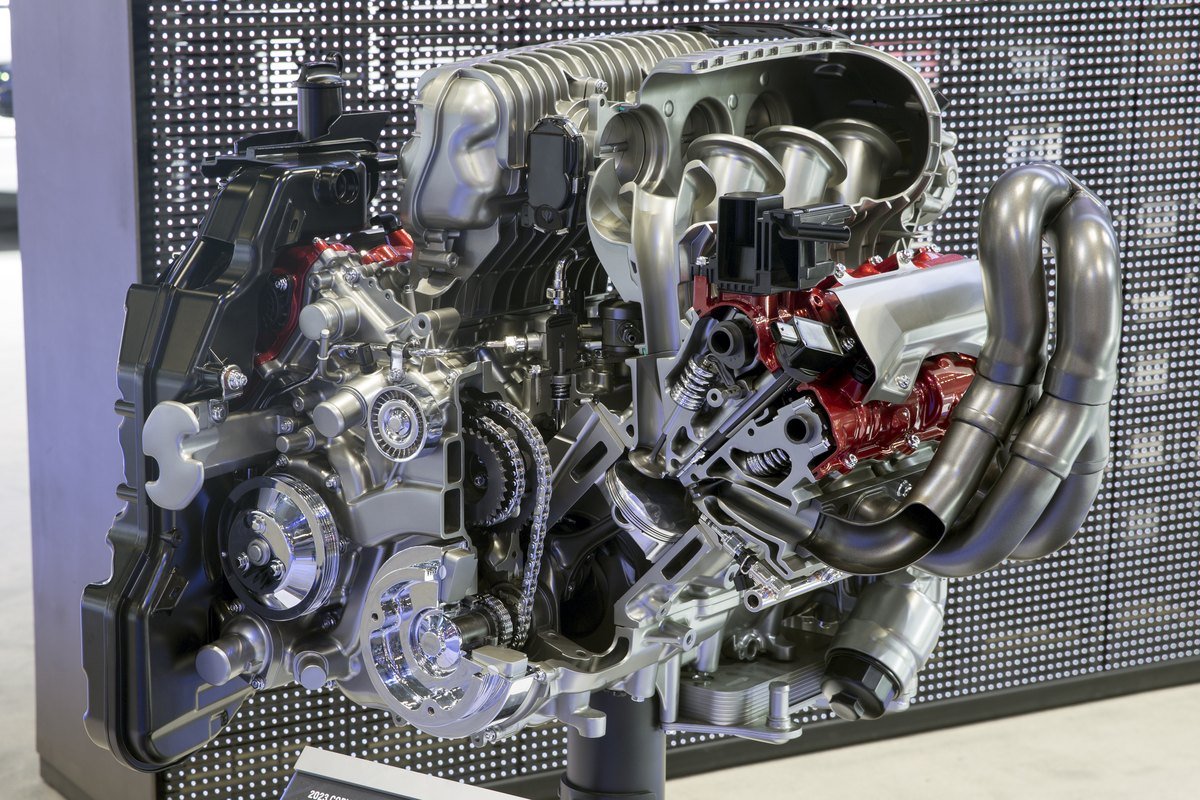
And there’s a modern American engine that proves the clean game still has tricks left in it. The Chevrolet LT6, the 5.5-liter flat-plane V8 in the C8 Corvette Z06, makes 670 horsepower with no turbo and no blower, and the engineers who built it say that across a big chunk of its rev range it packs more air into each cylinder than the cylinder’s own volume should hold. That sounds impossible. By the end of this chapter it won’t.
Your engine doesn’t suck
Start with the word everybody gets wrong. An engine doesn’t suck air in. Air can’t be pulled; it can only be pushed. What the engine does is make room.
On the intake stroke the piston drops, the intake valve is open, and the volume above the piston grows. The pressure in there falls below the pressure in the intake tract, and the air outside, which is sitting under the weight of the entire atmosphere above it, gets shoved in to fill the gap. At sea level that push is about 14.7 psi, one bar. It’s the same thing that happens when you pull back the plunger on a syringe: you didn’t drag the liquid in, you took pressure away on one side and let the other side do the work.
So the real engine behind a naturally aspirated engine is the atmosphere, and the atmosphere isn’t the same everywhere. Drive to Denver and the air pressure is down to roughly 12 psi, about 17 percent less push. Every naturally aspirated engine in the Mile High City carries a handicap no tuner can program away, and at the summit of Pikes Peak, above 14,000 feet, the push is down by more than 40 percent.
Hold onto that idea, because it’s the spine of this whole series. If the atmosphere is doing the pushing, then there’s a natural reference for how full a cylinder can get: the amount of air its displacement would hold at the pressure and temperature the air arrived at. Engineers gave that reference a name.
Volumetric efficiency, and why the number lies to you
Volumetric efficiency is the ratio between the air an engine actually traps in a cylinder and the air that would fill the cylinder’s swept volume under reference conditions. A one-liter cylinder that traps exactly one liter’s worth of air per intake stroke is at 100 percent. Simple.
Real engines rarely get there, because air on its way to the cylinder runs an obstacle course. Air filter. Intake tube. Throttle body. Plenum. Runner. A bend or two. Then the gap around the valve head, which is open only for a few thousandths of a second. Every one of those costs a little pressure, and less pressure at the valve means fewer air molecules end up inside. A typical street engine at wide-open throttle lands somewhere around 80 to 90 percent, depending on rpm and how much effort went into the design.
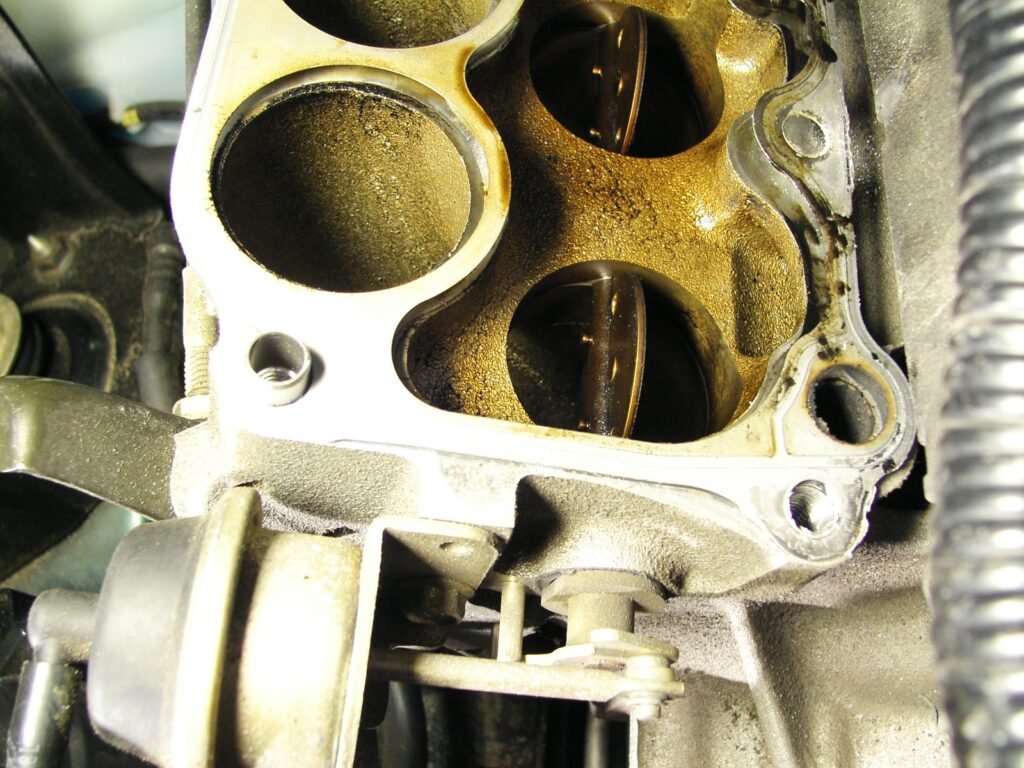
The phrase that matters there is wide-open throttle. A gas engine controls its power by strangling its own intake: the throttle plate is literally a choke point you open with your right foot. Cruising on the interstate at part throttle, the cylinders are filling to a fraction of what they could, on purpose. Quote a VE number without saying the throttle position and you’ve said nothing.
There’s a second trap, and it’s the one spec-sheet warriors fall into constantly. VE has to be measured against something, and the something isn’t standardized. Some engineers reference ambient air outside the car. Some reference conditions in the intake manifold. Some use a corrected lab standard. The same engine can post noticeably different percentages depending on the yardstick. So the next time somebody on a forum brags about a VE figure, the only correct response is “relative to what?”
Now the good part. That 100 percent is a reference, not a ceiling. A naturally aspirated engine can beat it, with no pump of any kind, using nothing but the shape of its plumbing.
The air in your intake has momentum
Air is light, but it isn’t weightless. A column of air rushing down an intake runner at well over a hundred miles an hour carries real momentum, and momentum doesn’t like being stopped.
Picture what happens when the intake valve snaps shut on that moving column. The air at the front piles up against the closed valve and forms a zone of high pressure, the way a line of people bunches up when the front of the line stops dead. That high-pressure zone doesn’t stay put. It races back up the runner at the speed of sound.
Here’s the piece most explanations skip. When that pressure pulse reaches the open end of the runner, where it meets the plenum or the open air, it doesn’t come back as a pressure pulse. It reflects inverted, as a low-pressure pulse, a rarefaction. Bounce it again off the closed valve and it flips back. So the runner is never quiet. It’s full of pulses of high and low pressure sloshing back and forth at roughly 1,100 feet per second, a bit faster when the air is hot.
Now make that useful. If you choose the runner length so that a high-pressure pulse arrives at the intake valve while it’s open, and especially in the last moments before it closes, you get extra air for free. The valve closing point is where the engine decides how much mass it keeps. Arrive there with a little extra pressure behind the valve and the cylinder traps more than the atmosphere alone could have pushed in. That’s how an engine with no compressor gets past 100 percent.
The catch is time. The pulse takes about the same time to run the length of the runner whatever the engine is doing, but the time the valve stays open shrinks as revs climb. A runner tuned so the pulses line up at 3,000 rpm will be badly out of step at 6,000, and at the wrong rpm the pulse arrives as a low-pressure dip that actively robs the cylinder. A fixed runner is a bet on one slice of the rev range.
There’s a second, separate effect hiding in the same hardware, and it’s worth keeping apart: Helmholtz resonance. Blow across the neck of a bottle and you get a note, because the slug of air in the neck bounces like a mass on a spring against the cushion of air trapped inside. An intake runner feeding a plenum can behave the same way. Wave tuning and Helmholtz tuning are different physics, and real intake manifolds use both.
Detroit figured this out with 30-inch tubes
Americans have been playing this game for a long time, and the most glorious example is still the 1960 Chrysler 300F.
Chrysler’s engineers wanted torque from the 413-cubic-inch wedge V8, and they knew the physics: long runners resonate at low frequencies, which means low and middle rpm. So they built the Ram Induction manifold, with two four-barrel carburetors mounted on the outside of the engine and runners about 30 inches long crossing over the top of the V to feed the opposite bank. It looked like somebody had tied a pretzel out of cast iron. According to the Chrysler 300 Club’s records, it gave up a few horsepower at the top end compared to the previous year’s setup but delivered more torque and moved peak torque about 800 rpm lower: 375 hp at 5,000 rpm and 495 lb-ft at just 2,800.
The fun detail is the 400-horsepower option. To get the power up top, engineers took the same manifold and cut away part of the internal walls so the air only traveled roughly half the distance. From outside it looked identical. Inside, the runners were effectively around 15 inches long, which shifted the tuning higher up the rev range. Only a tiny number of cars got it. Same engine, same castings outside, a different personality decided entirely by the length of the air’s path.
That’s the whole principle of the variable intake manifold, built decades before anybody had a computer to switch between the two modes.
Two lengths in one manifold
Once electronics and vacuum actuators got cheap, carmakers stopped choosing. A variable-length intake manifold gives the air two routes: a long path for torque down low and a short path for power up high. The patents read almost like a physics textbook. Long runner, lower resonant frequency, fatter low-end torque. Short runner, higher frequency, peak cylinder filling moved toward redline.
Mercedes-Benz’s M272 V6, the engine in a huge number of 2000s C-Class, E-Class and ML models sold in the U.S., is a good one to study, partly because so many people have had to fix it. Its manifold coils the runners into spirals to fit a long path in a small package, with flaps partway along that open a shortcut. Under load in the middle of the range, roughly 1,700 to 3,900 rpm according to most service descriptions, the flaps close and the air takes the full long route. Above that, they open and the air cuts through on the short path. Closed means long, open means short; plenty of explanations online get that backwards. A vacuum actuator moves the flaps. A separate set of swirl, or tumble, flaps near the ports does a different job, stirring the incoming charge to help combustion, and has nothing to do with runner length.
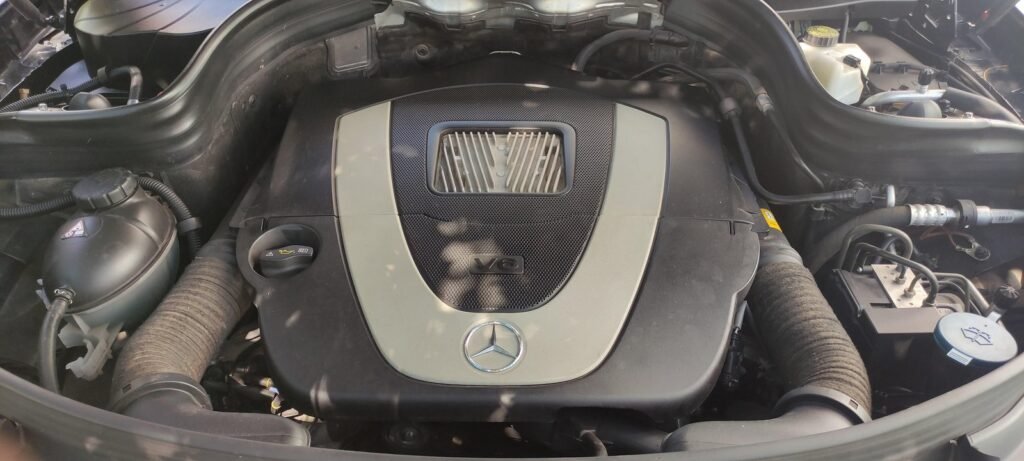
It’s beautiful engineering with a well-known weakness. The plastic levers that move the flaps get stiff with carbon, crack, and leave the system stuck in one position, usually with a check engine light and a code for the runner flap. Ask any independent Mercedes shop in America about M272 intake manifolds and watch their face.
The same family of engines had a quieter career in Spain: the Mercedes Viano van, built at the Vitoria plant in the Basque Country, offered the 3.5-liter M272 V6 with 258 horsepower. Spiral runners and fragile flaps, doing their resonance trick inside a people mover.
How the LT6 cheats without a turbo
Now back to that Corvette, because the LT6 is where all of this stops being theory.

Chevrolet didn’t use moving flaps inside the runners. The LT6 has an intake with two plenums, one feeding each bank, joined by three electronically controlled valves that GM calls communicator valves. Opening and closing them changes how the two plenums interact and moves the resonant behavior of the whole system up and down the rev range. Hagerty reported that at wide-open throttle the paired valves stay closed until about 2,000 rpm and the third until about 5,800, and that in Tour mode they follow a milder schedule to keep the noise down.
The result, per the GM engineers Hagerty interviewed, is volumetric efficiency above 100 percent across a wide window, around 110 percent at the 6,300 rpm torque peak and still about 106 percent at the 8,400 rpm power peak. An earlier outside estimate published before the engine came out was lower, so treat the exact decimal with some caution. The concept, though, is solid: pressure pulses timed to arrive at the valves in the engine’s favor over as much of the rev band as possible. It isn’t boost in the turbocharger sense. It doesn’t hold pressure steady at every rpm. It’s a series of well-timed shoves, and on an engine that spins past 8,000 rpm, a lot of shoves.
It’s worth putting the LT6 next to the American V8 most people know. A traditional pushrod small-block Chevy and the LS family that followed it were built around low-end torque, compact size and cheap production, and their intakes were tuned accordingly. The LT6 is a dual-overhead-cam, four-valve, flat-plane engine designed for the racetrack first. Same brand, entirely different idea of what breathing means.
Bigger doors, better timing
All the tuning upstream ends at the same bottleneck, the intake valve. What matters there is effective flow area: how big the valve is, how far it lifts, how cleanly the air turns around the seat, and how long it stays open. Get the runner perfect and choke it at the valve, and you’ve wasted your time.
That’s why serious engines use four valves per cylinder. Two smaller intake valves give more seat circumference and more flow area than one big one in the same bore, and they leave room for the spark plug right in the middle of the chamber. GM Europe’s Cosworth-developed 16-valve engine in cars like the Vauxhall Astra GTE 16V made that case in the 1980s, long before it was normal in a family car.
It’s also why variable valve timing exists. Shifting when the valves open and close moves the engine’s best breathing up and down the rpm range, the same job the variable manifold does with runner length. Take the idea all the way and you get rid of the camshaft entirely, which is what Koenigsegg’s camless Freevalve system does, and before that there were the rotary valves that tried to replace poppet valves altogether.
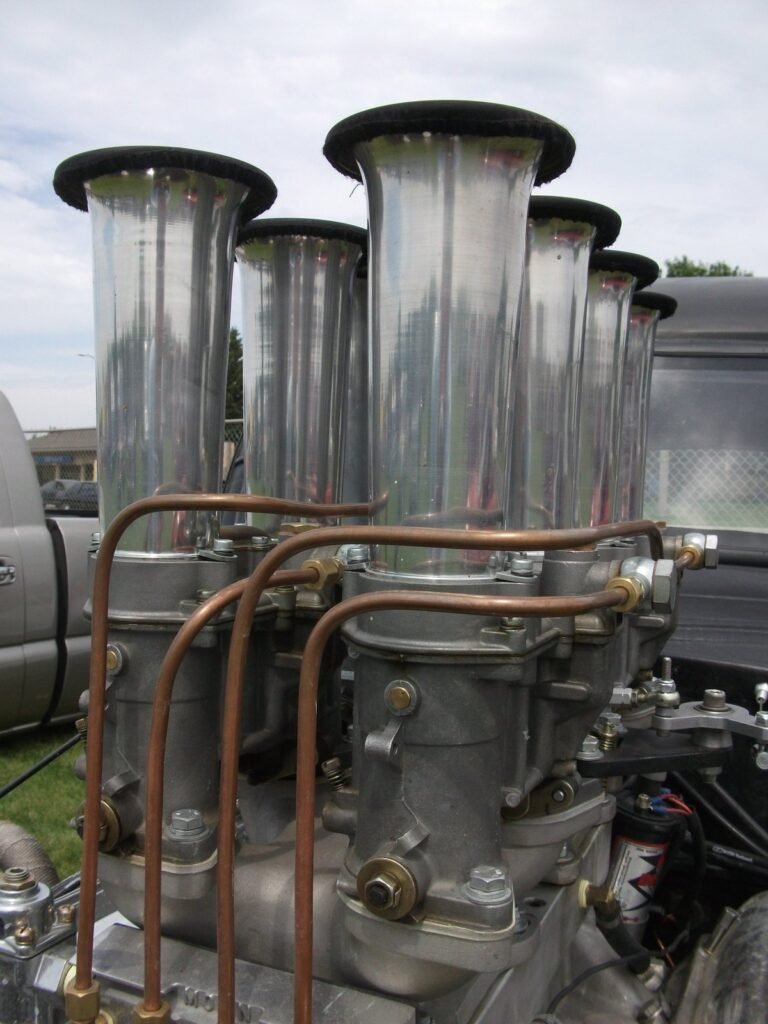
And it’s why the most breathing-obsessed engines fit one throttle per cylinder. Individual throttle bodies put a separate throttle right at each intake port, so the air doesn’t have to pass through one shared choke point and refill a big plenum before the engine responds. The throttle reacts instantly, and the short distance from throttle to valve keeps the intake’s behavior crisp.
The S65 and the sound of a clean game
The best example most Americans have actually driven is the BMW S65, the 4.0-liter V8 in the E90, E92 and E93 BMW M3 sold from the 2008 model year. Eight cylinders, eight individual throttle bodies. A 92 mm bore over a 75.2 mm stroke, so oversquare that the pistons travel a short distance on every revolution, which keeps mean piston speed manageable and lets the engine make its 414 horsepower at 8,300 rpm and rev to 8,400. A 12:1 compression ratio, high for a street engine of its time.
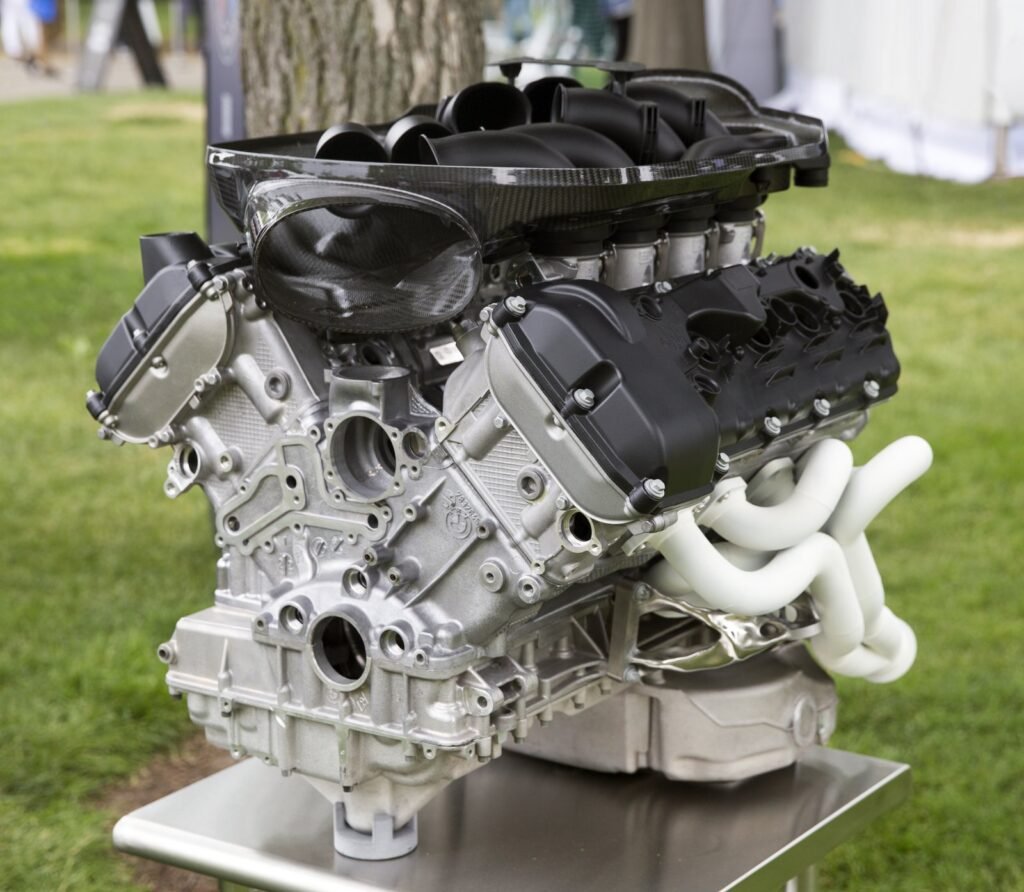
When it came out, its rivals were heading the other way. Mercedes-AMG answered with the big 6.2-liter M156 V8 in the C63, more displacement and less rpm. A few years later, the M3 that replaced the S65 car switched to a twin-turbo inline six. For a lot of enthusiasts, the E9x M3 was the last time BMW’s M division bet everything on breathing well instead of breathing under pressure. Above 6,000 rpm, with eight throttles open and no turbo hiss covering the induction roar, it remains one of the best arguments for the naturally aspirated engine ever made.
Where the clean game runs out
So here are the rules as they stand. A naturally aspirated engine fills itself by making room and letting the atmosphere push. One hundred percent volumetric efficiency is a reference point, not a wall. Momentum, wave timing, Helmholtz resonance, valve area and valve timing can push a well-designed engine past it, but only in the rev bands where everything lines up.
And no amount of clever plumbing changes the fundamental limit. The push comes from the atmosphere: about 14.7 psi at sea level, less in Denver, a lot less on top of Pikes Peak. You can be extraordinarily smart about how you use it. You can’t make it bigger.
More than a century ago, engineers asked the obvious question. Why wait for the atmosphere to push the air in when a machine could do the pushing? That’s where forced induction begins, and where today’s obsession with small turbocharged engines and downsizing ultimately comes from. A turbo, a supercharger, any of them does exactly what a naturally aspirated engine does, fills a cylinder with air, except it brings its own pressure to the fight.
Next chapter, we start pushing. The positive-displacement supercharger, the first machine anybody bolted to an engine to force-feed it air, and why the most famous of them all, the Roots blower, doesn’t actually compress anything inside itself. Almost everything you’ve read about it online gets that wrong.
Chapter two is up: how a supercharger works, from the GMC 6-71 to the twin-screw, and why the Roots blower doesn’t compress anything inside itself.
Chapter three explains how a turbocharger works, and why turbo lag and boost threshold are two different problems.
Check you’re still alive.
Photos: Mr.choppers (CC BY-SA 3.0), epinkert (CC BY 3.0), Steliosk0 (CC0), OWS Photography (CC BY 4.0), dave_7 (CC BY 2.0).