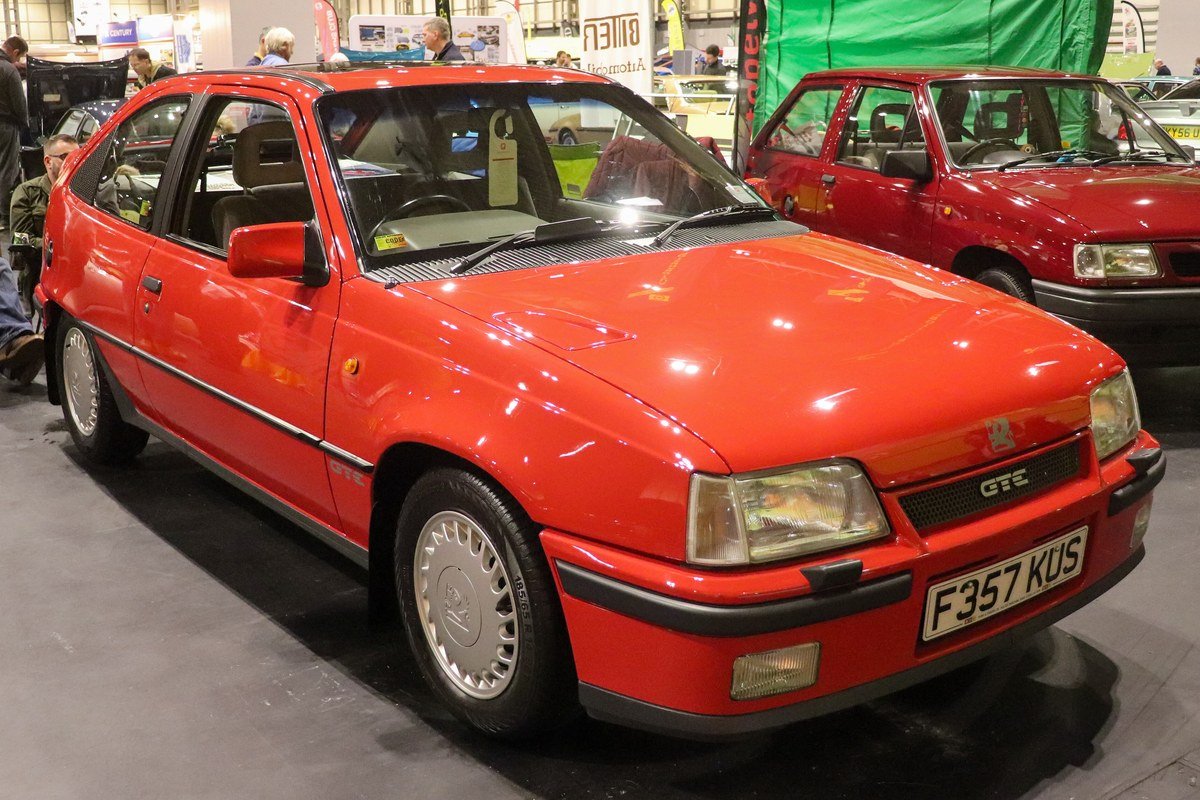
Vauxhall Astra GTE 16V: the Cosworth Red Top hatch America never got
In 1988 you could walk into a Pontiac dealer in Ohio and drive home in an Opel Kadett. Nobody told you that, of course. It said LeMans on the back, it was built by Daewoo in South Korea, and it had a 1.6-liter four making 74 horsepower. That same spring, in Britain and Germany, the very same body shell was leaving the factory with a Cosworth-developed sixteen-valve engine, 156 horsepower and a top speed of 135 mph. America got the rental-lot version of one of the great hot hatches of the decade and never knew what it was missing.
This is the story of the other one. In Britain it wore a Vauxhall badge and was called the Astra GTE 16V. Everywhere else in Europe it was the Opel Kadett GSi 16V. Under the hood of both sat an engine so far ahead of the car around it that people still argue about which one deserved the other.
One body, three badges
General Motors launched the fifth-generation Kadett in the fall of 1984. It was a sensible front-wheel-drive compact with a slippery wedge shape, and Europe liked it enough to vote it 1985 Car of the Year. The sporty GSi version, with a drag coefficient of 0.30, was, according to Opel, the most aerodynamic sedan in the world when it came out.
GM then did what GM always did with a good platform: it spread it around. Vauxhall sold it in the UK as the Astra. Daewoo built it in Korea, and from the 1988 model year it crossed the Pacific as the Pontiac LeMans. Pontiac sold the LeMans through the 1993 model year. The fast version never made the trip.
The fast version started with a phone call to England. Rather than tweak the old eight-valve GSi again, GM asked Cosworth to design a four-valve head for its two-liter Family II block. Cosworth, the outfit behind the DFV V8 that won Formula 1 races for more than fifteen seasons, ran the job as project KB. Opel showed the result at the Frankfurt show in September 1987, and the car went on sale in early 1988. It was the first Opel road engine with four valves per cylinder.
Why it’s called the Red Top
Pop the hood and you can’t miss it: a red cover runs along the top of the engine, over the spark plugs. Enthusiasts in Britain started calling it the Red Top, and the name stuck harder than any of GM’s official codes.
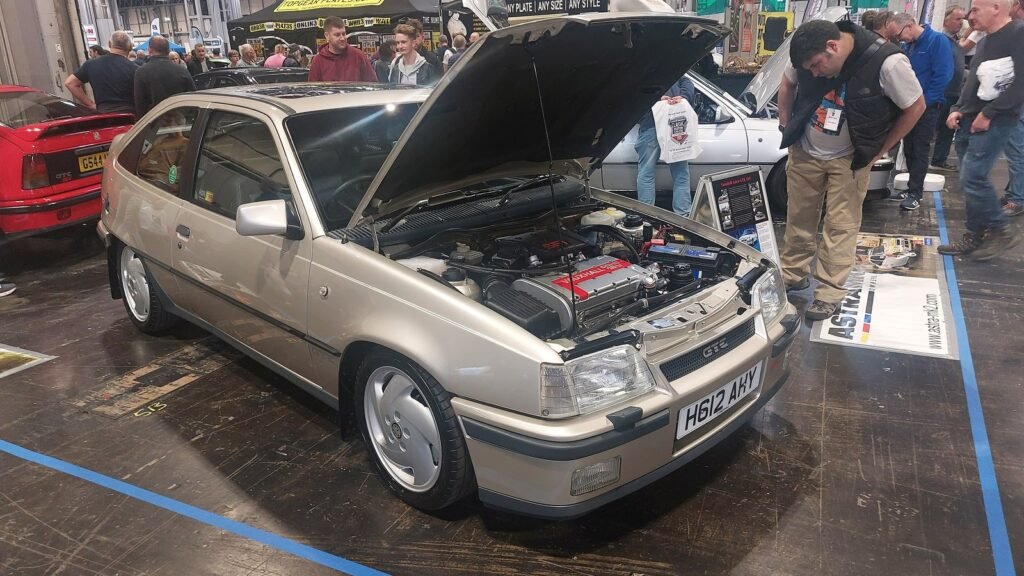
Those codes matter, though, because they explain the oldest argument about this engine. There were two versions built side by side. The 20XE had no catalytic converter and made 156 hp and 150 lb-ft. That’s the one British Astra GTE buyers got, and it’s the number British magazines printed. The C20XE added a three-way catalyst and an oxygen sensor, the same hardware every American car had carried since the mid-seventies, and dropped to 150 hp at 6,000 rpm and 145 lb-ft at 4,800. West Germany was pushing catalysts hard by then, so the German Kadett GSi 16V came with the C20XE from day one. The C stands for catalyst. When you read 150 in one place and 156 in another, nobody is lying. They’re just looking at different tailpipes.
The block was cast iron and almost comically overbuilt. The head was aluminum. The first ones were cast by Cosworth itself using its Coscast process, which pumps molten aluminum into the mold under pressure instead of letting gravity pour it in. That detail sounds like trivia. It turned out to be the difference between an engine that lasts forever and one that slowly fills its cooling system with gunk, and we’ll get there.
What 156 horsepower meant in 1988
To put those numbers in an American frame: in 1988 the US-market Volkswagen GTI 16V made 123 hp. The Honda CRX Si, the car every American enthusiast of that era still gets misty about, made 105. The Vauxhall had thirty-plus horsepower on the best German hatch you could buy in the States and fifty on the best Japanese one.
British magazine Autocar ran a three-way test in May 1988, Astra GTE 16V against the Golf GTI 16V and the Peugeot 309 GTI, and called the Vauxhall “the king of the hot hatches.” Its math was hard to argue with. With roughly a ton of car to push, the GTE 16V worked out at 155 hp per metric ton. A Porsche 944 S, the car a successful dentist bought that same year, had a worse power-to-weight ratio. The official top speed for the catalyzed Kadett was 135 mph, and Auto Bild has since timed one from 0 to 62 mph in 7.6 seconds.
The Germans were just as impressed. Auto motor und sport, the country’s car-buyer bible, called it the hammer of the four-valve engines.
A great engine in an ordinary car
Here’s where owners start hedging. The engine was magnificent. The rest of the car was a Kadett.
The suspension had been set up for a family compact that spent its life on commutes and vacation runs. Put 156 hp through the front wheels of that chassis and the two halves of the car start disagreeing with each other. The engine came alive above 4,000 rpm and pulled hard to the redline; the front tires, meanwhile, wanted to know what all the fuss was about. Opel quietly stiffened the dampers in late 1988, only months after launch, which tells you somebody in Rüsselsheim had noticed too.
None of that made it a bad car. It made it a demanding one. Drive it with some respect for what the chassis could handle and it rewarded you with one of the best engines of the decade. Drive it like a race car and you’d find out where the limits were faster than you wanted.
The rivals came at the problem from other directions. Volkswagen went for low-rpm shove with a supercharger, the G-Lader scroll unit that powered the Golf G60 in Europe and the Corrado G60 that Americans could actually buy, and then shrank the engine to 1,763 cc for the all-wheel-drive Golf Rallye G60. Ford stuck a turbo on the Escort RS Turbo. Peugeot’s 309 GTI 16 of 1989 matched the Red Top’s output with its own 1.9-liter twin-cam and wrapped it in a much sharper chassis, which is why people who drove both still pick the Peugeot on a back road. And by 1990 Nissan was selling the Sunny GTI-R, a turbocharged all-wheel-drive rally special that made every naturally aspirated hatch look quaint. The Vauxhall never won on balance. It won on the engine.
The head that went bad
Back to that casting process. As demand grew, GM brought in Kolbenschmidt, a German supplier, to cast heads alongside Cosworth. In 1991 the Coscast head was dropped altogether and replaced by a gravity-poured GM head.
Some of those later heads were porous. Microscopic voids in the aluminum let oil, which runs at higher pressure than coolant, seep into the water jacket. The symptom is the one every mechanic dreads: a beige, mayonnaise-like sludge under the coolant cap. Not every late head failed, and the GM-era casting has its defenders, but enough went bad that tuners still hunt for the Coscast logo before they buy. A specialist can fix a leaky head today by sleeving the galleries or injecting polymer into them. In 1991 most owners just got a bill.
Superboss
If you want the best chapter of this story, you have to go to South Africa, where nobody in Europe was paying attention.
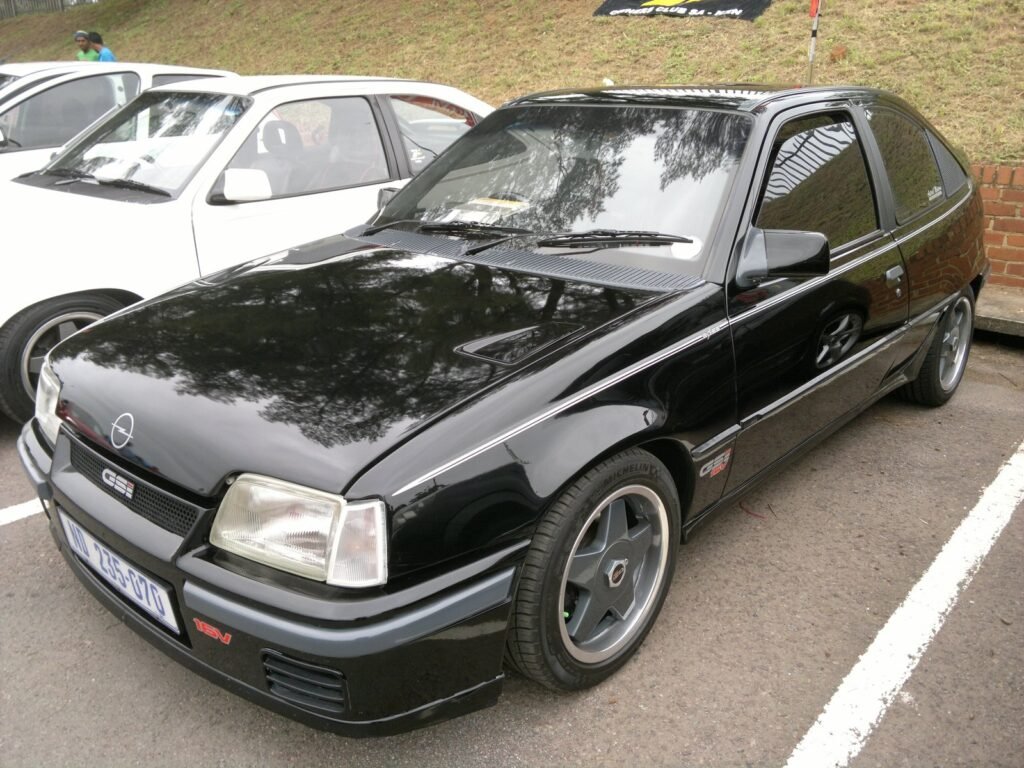
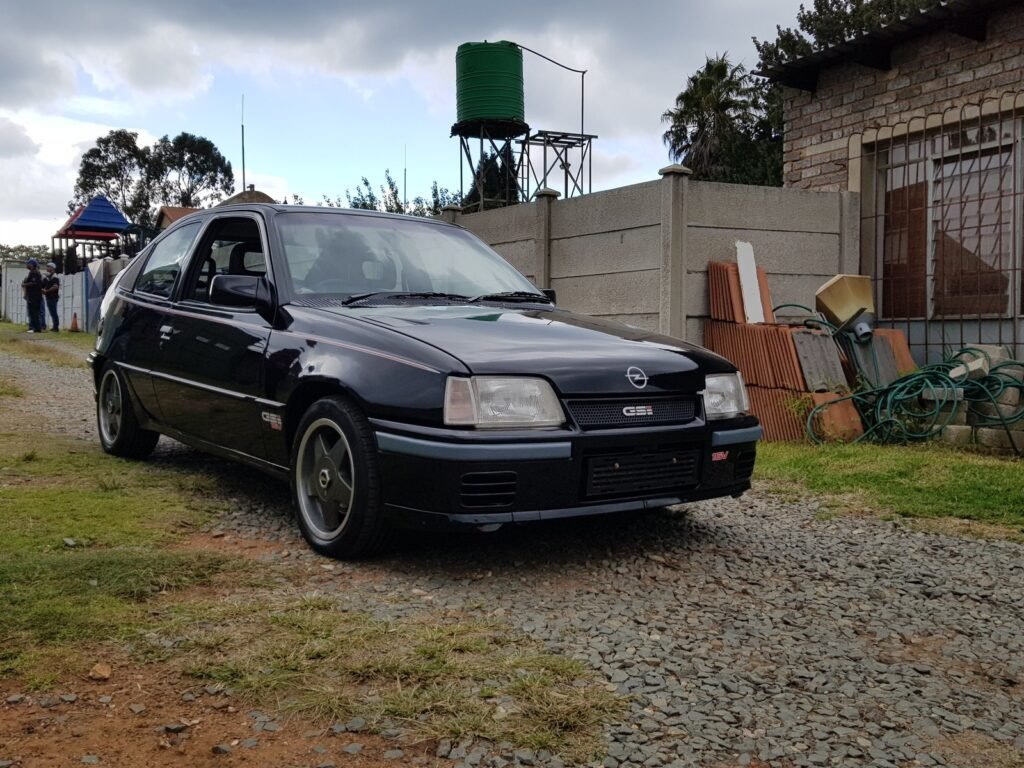
GM’s South African arm, Delta Motor Corporation, built Kadetts in Port Elizabeth for a market that was hungry for anything quick. The eight-valve GSi was nicknamed the Boss. The 16-valve car that arrived in 1989 with 115 kW became the Big Boss. And then, to go racing, Delta built the Superboss.
The reason was South Africa’s Group N production-car championship, where the opposition was BMW’s 325iS. BMW never sold the E30 M3 in South Africa, so its local division built its own substitute: a two-door with a 2.7-liter six and a cylinder head worked over by Alpina. To beat that with two liters, Delta’s engineers took the Red Top apart. They fitted 276-degree Schrick cams with separate street and track settings, forged pistons, higher compression, sodium-filled valves, a four-into-one header and a Promotec engine computer with the limiter at 6,800 rpm. Irmscher supplied a suspension lowered by 20 mm, and local motorsport specialist André Verwey designed the limited-slip differential. Then they threw out the air conditioning, the power steering, the power windows and even the sound deadening.
The result made 125 kW, about 170 hp, and 228 Nm of torque. CAR magazine measured 7.6 seconds to 100 km/h and a true 139 mph flat out, past the end of the 137 mph speedometer. Five hundred were built between 1990 and 1992 to satisfy the homologation rules, and here’s a detail even fans tend to miss: according to Classic Car Africa, only somewhere between 20 and 50 percent of them actually got the hand-ported Cosworth head. The rest ran Kolbenschmidt castings.
On track, Mike Briggs won Class A of the Group N championship in a Superboss in 1991 and 1992, after a feud with BMW driver Tony Viana that included at least one pit-lane shouting match caught on amateur video. Opel’s own heritage advertising claims three titles in a row; the two we can document are those. In 2013, South Africa’s CAR magazine put Chris Harris in a Superboss against a 325iS, and the car caught him by surprise.
The record that isn’t quite a record
Ask a South African about the Superboss and you will hear about the torque record. The story goes like this: 228 Nm from two liters is 114 Nm per liter, and that was the highest specific torque of any naturally aspirated production car in the world until the Ferrari 458 Italia beat it in 2009.
We ran the numbers, and the legend has a hole in it. The BMW E46 M3 CSL of 2003 made 370 Nm from 3,246 cc. That’s 114.0 Nm per liter, a dead heat with the Opel, six years before the Ferrari showed up. And when the 458 did arrive, it didn’t edge past: 540 Nm from 4,497 cc is 120 Nm per liter. So here is the accurate version. A Kadett from Port Elizabeth matched the best normally aspirated engine BMW’s M division could build thirteen years later. That’s a better story than the myth anyway.
The win that never happened
Opel itself is responsible for the other piece of folklore. In its 2024 press release celebrating forty years of the Kadett E, the company says the 250-hp racing Kadett GSi 16V “celebrated its winning premiere” at the opening round of the 1988 German touring car championship, the DTM.
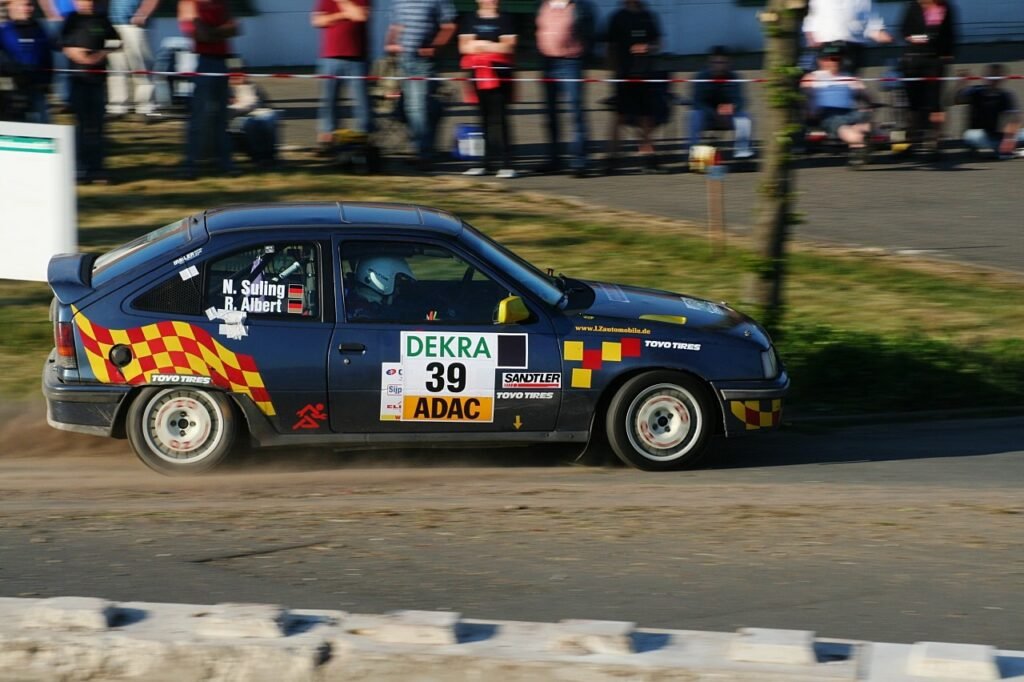
It didn’t. The opening round at Zolder on April 3, 1988, was won by Armin Hahne and Klaus Ludwig, both in Ford Sierra RS500 Cosworths. The Kadett, driven by Heinz-Friedrich Peil with a Kissling-built engine, managed a best finish of 14th all season. It never stood on a DTM podium.
Where the Kadett genuinely won was in the dirt. In July 1988 the Austrian Sepp Haider and co-driver Ferdi Hinterleitner took Rally New Zealand, a round of the World Rally Championship, in a Group A Kadett GSi run by GM Euro Sport. It remains the only world championship win for a Kadett GSi. Some results tables list it as a 16V, but the 16V’s Group A homologation is dated October 1988, three months later, so which engine that car carried isn’t settled. What is settled: in 1989, with the 16V for certain, Haider and Hinterleitner became German rally champions.
The turbo afterlife
GM wasn’t done with the block. In 1992 it dropped compression to 9:1, bolted on a KKK turbocharger and new engine management, and created the C20LET: 204 hp and 207 lb-ft from 2,400 rpm. In Europe it went only into all-wheel-drive cars, among them the Opel Calibra Turbo, the Vectra Turbo and the Vauxhall Cavalier Turbo. South Africa, naturally, did something nobody else dared: it put the turbo engine in the front-wheel-drive Kadett 200 ts with 151 kW and a six-speed Getrag gearbox. CAR saw 146 mph from it.
The naturally aspirated Red Top had its own second career. Spiess-built versions ran in Formula 3 with around 250 hp. Hillclimbers, Caterham and Westfield builders and rally-car restorers all reached for the same engine because it was cheap, strong and nearly impossible to kill. Thirty years of amateur racers are the best review it ever got.
A Spanish footnote
One more twist for the record. In Spain the Kadett E wasn’t a hot-hatch curiosity at all. It was the best-selling car in the country in 1988, the year the Red Top arrived, ahead of the homegrown Seat Ibiza. It even had a Spanish passport of sorts: from March 1986, the four-door Kadett sedan was built at GM’s plant in Figueruelas, near Zaragoza. The GSi went rallying there too, in the hands of drivers like Borja Moratal on the Spanish asphalt championship, wrestling understeer through every hairpin.
Rust and survivors
The Kadett E had one weakness no engine could cover. Its rust protection was poor, the wheel arches went first, and a lot of cars were gone within a decade. Plenty of others were wrecked in amateur racing or “improved” with suspension so stiff they hopped down the road. Auto motor und sport, citing German registration data, counts only 410 Kadett GSi models still on the road in Germany.
That scarcity is why clean cars now sell for real money, and why the Superboss has become a collector car in South Africa. It’s also a reminder of how odd the whole thing was. The same platform that gave America a 74-hp commuter gave Europe one of the strongest normally aspirated engines of its era, and the one country that pushed it hardest was at the southern tip of Africa. If you want to know why people still fight over cars from this period, we wrote about that too, in cars with soul.
Check you’re still alive.
Photos: Vauxford (CC BY-SA 4.0), Kieran White (CC BY 2.0), Lowrsi88 (CC BY-SA 4.0), Sherwin (CC BY-SA 4.0), Bernd Sieker (CC BY-SA 2.0) via Wikimedia Commons.