DeLorean DMC-12: The Most Famous Car That Should Never Have Worked
Every car guy in America has a DeLorean story. Maybe it’s the first time you saw one in a parking lot and did a double-take. Maybe it’s a childhood memory of Back to the Future that permanently lodged those gullwing doors somewhere in your brain. Maybe you’ve actually driven one and you know the dirty secret — those 130 horsepower don’t get the job done.
The DeLorean DMC-12 is the automotive world’s most successful failure. It didn’t work as a sports car. It didn’t save its company. It got its founder arrested. And it became one of the most recognizable vehicles in American culture. That’s a story worth telling properly.
The Man Who Bet Everything on His Name
John Zachary DeLorean was not a dreamer playing at being a car guy. He was a legitimate automotive genius who developed the Pontiac GTO — the car that effectively created the American muscle car category — and the Pontiac Firebird before age 40. He was the youngest division head in GM history. He was charismatic, media-savvy, and genuinely brilliant at product development.
In 1973, he walked away from General Motors. His goal: build his own car, his own way, without corporate compromise.
DeLorean Motor Company was incorporated in 1975. The car he envisioned was radical: a mid-engine sports car with a Wankel rotary engine, a revolutionary composite body built with Elastic Reservoir Moulding technology that would dramatically reduce weight and production costs, a stainless-steel outer skin that would never rust, and a target price of $12,000 — the “12” in DMC-12.
None of that survived contact with reality.
The Wankel engine program collapsed when its supplier shut down. The ERM technology proved completely unworkable at industrial scale — DeLorean had purchased patent rights to a process that had never actually been validated in production. The $12,000 price point became $25,000 by the time the car launched, reflecting cost overruns that consumed funding faster than DeLorean could raise it.
For manufacturing, DeLorean struck a deal with the British government to build a factory in Dunmurry, a Belfast neighborhood, in exchange for government financial backing designed to create jobs in Northern Ireland during the height of the Troubles. It was politically logical for both parties. It was logistically complex in ways nobody fully anticipated.
Lotus was contracted to develop the chassis and engineering under Colin Chapman. The production car used a backbone frame with fiberglass reinforcement under the stainless steel panels. For the engine, DeLorean selected the PRV V6 — a 2.849-liter unit jointly developed by Peugeot, Renault, and Volvo in the 1970s. It was reliable, well-understood, available, and completely uninspiring. Detuned to meet US emissions standards, it produced 130 bhp at 5,500 rpm and 166 lb-ft of torque at 3,000 rpm.
The Car Itself: Brilliant in Theory, Honest in Practice
The first production DeLorean rolled off the Dunmurry line on January 21, 1981. And here’s what you need to understand: the car had genuinely great ideas in it.
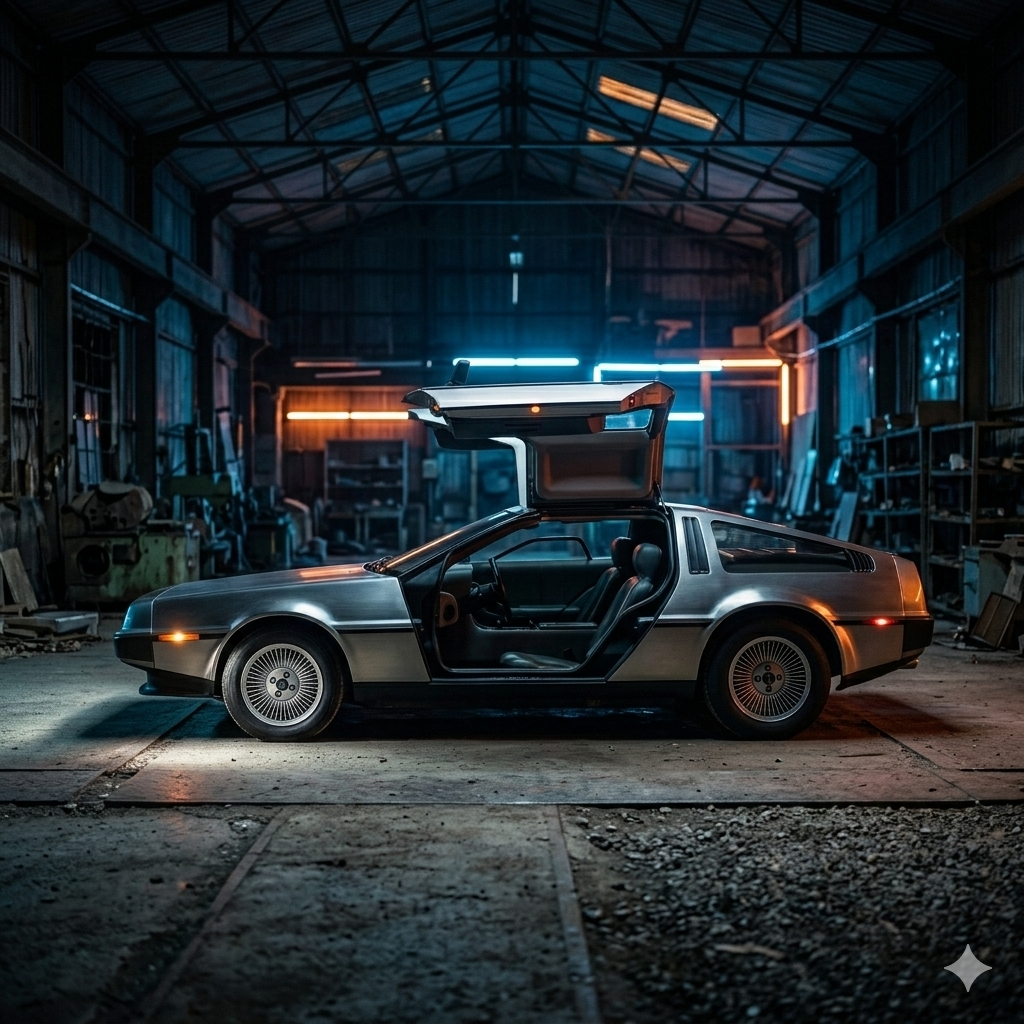
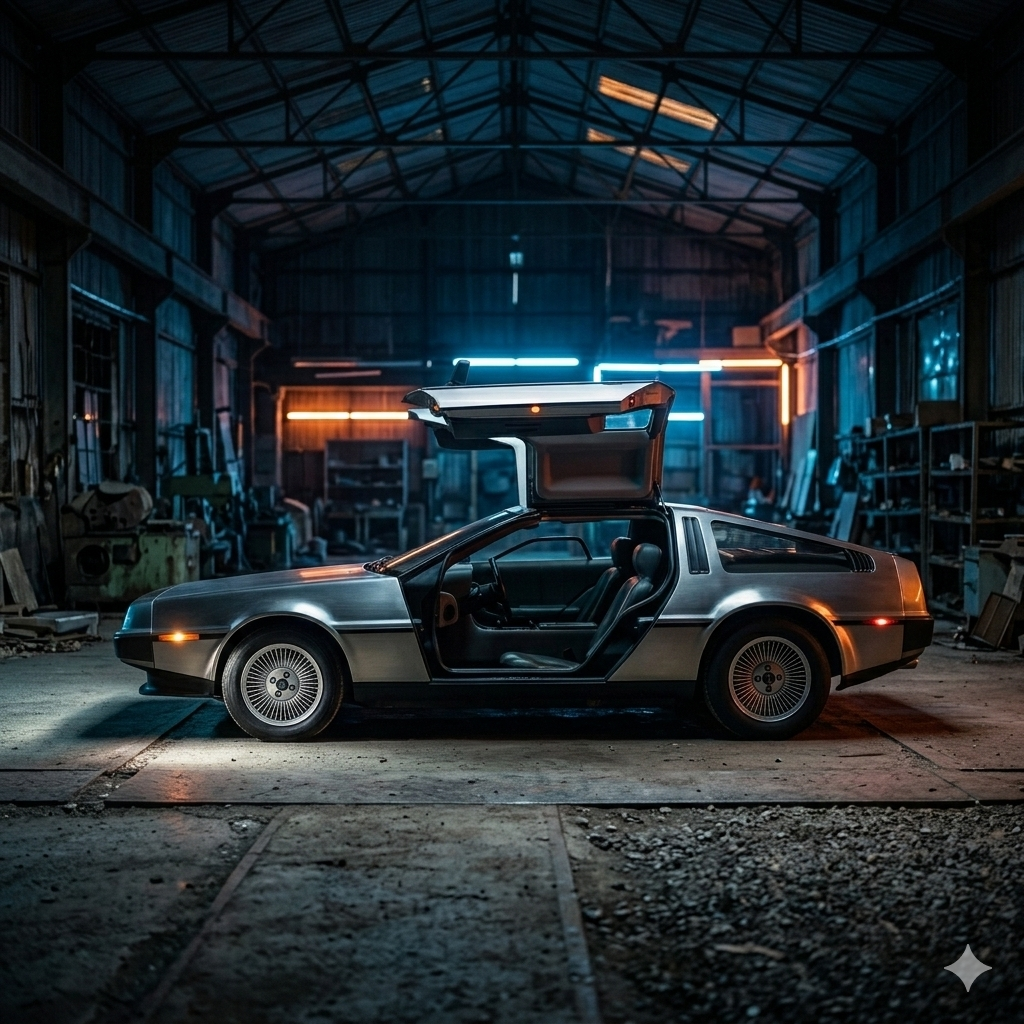
The gullwing doors were functional genius. They needed only 11 inches of lateral clearance to open fully — less than a conventional door. In tight parking lots, they were actually more practical than a regular door. The visual drama of those doors opening upward was, and remains, unlike anything else in production automotive history.
The stainless steel body used AISI 304 alloy — the same grade used in surgical equipment and industrial instrumentation. It genuinely does not rust. It genuinely does not need paint. In theory, a DeLorean body should outlast any conventionally painted car by decades. The engineering logic was sound.
Giorgetto Giugiaro designed the exterior — the same man who had designed the De Tomaso Mangusta a decade earlier — and created a clean, wedge-shaped coupe that looked genuinely futuristic in 1981. The Lotus-derived chassis gave it composed handling with fully independent suspension at both ends and ventilated disc brakes up front.
The problem was simple and brutal: 130 horsepower moving 2,743 pounds. Zero to 60 took 9.6 seconds. Top speed was 130 mph. A 1981 Porsche 911SC made 188 hp, went 0-60 in around 6 seconds, and cost less. A Corvette made 190 hp. Even a base Camaro Z28 was quicker. For $25,000 in 1981 money — roughly $85,000 today — the performance was genuinely indefensible.
The interior was a mixed bag. The leather bucket seats were well-shaped, the tall center console housed the shifter and gave the cockpit a purposeful feel. But finish quality varied, the steering wheel was slightly off-center from the driver’s axis, and rear visibility through the small backlight was compromised. These were the kind of quality issues that Lotus’s involvement should have solved — and didn’t, because budget and timeline were always the limiting factors.
The Collapse: Bankruptcy, Cocaine, and a Movie
DMC hit the market during a US recession. Interest rates were punishing. The car press was lukewarm. Sales were never close to DeLorean’s projections.
In March 1982, DMC management sent telegrams to all 343 US dealerships asking each one to purchase six cars to keep the company alive. Not a single dealer placed an order. Production halted in May 1982. DMC filed for bankruptcy in October of that year.
The same month as the bankruptcy filing, on October 19, 1982, John DeLorean was arrested in Los Angeles. The FBI had set up a sting operation — DeLorean, desperate for money to save his company, had been manipulated into a meeting with undercover agents who were posing as drug traffickers. He was charged with conspiracy to distribute 59 kilograms of cocaine.
He was acquitted in 1984 on the grounds of government entrapment. But the damage — to his reputation, to the brand, to any lingering chance of revival — was complete.
8,583 DeLoreans were built total. A one-model company that lasted barely two years.
And then Robert Zemeckis chose it for Back to the Future.
The 1985 film needed a time machine that looked genuinely otherworldly — not a modified station wagon but something that communicated alien technology without a special effects budget to explain it. The DMC-12 was perfect. No other production car in history looked as consistently futuristic from every angle. The gullwing doors, the brushed steel skin, the wedge profile — it was exactly what the story needed.
The Back to the Future trilogy turned a business catastrophe into a permanent cultural icon. Today, well-maintained DMC-12s sell for $40,000–$70,000 at auction. Specialized restoration shops operate nationwide. Companies offer full electric drivetrain conversions. The car that nobody wanted to buy in 1982 has a waiting list for restoration appointments in 2025.
Final Take: DeLorean Deserved a Better Engine, Not Better Marketing
I’ll say what needs to be said: the DeLorean failed as a sports car because it wasn’t one. There is no version of events where 130 horsepower justifies a $25,000 price tag in 1981. DeLorean tried to substitute design and innovation for performance, and the American market — which had a Corvette — wasn’t buying it.
But there’s a legitimate argument that what DeLorean was trying to build was ahead of its time in ways the automotive press never acknowledged. A stainless-steel body that doesn’t rust, doesn’t need paint, and can be repaired without specialized body shop equipment? In a world where rust was destroying cars in five to seven years? That was a genuinely valuable idea. The durability engineering was real and it worked — surviving DMC-12s are proof of it.
The tragedy isn’t that the DeLorean failed. It’s that the right engine was entirely achievable with the technology of 1981. A turbocharged version of the PRV V6 making 200+ horsepower existed. A small-displacement American V8 would have fit. The Lotus chassis could have handled significantly more power. The decision to use the naturally aspirated PRV in emissions-compliant form was a cost and timeline decision, not an engineering limitation.
Give the DMC-12 200 horsepower and a 0-60 time under 7 seconds, and the entire history of the car changes. The cultural icon we have today is built on a movie’s choice of prop vehicle. The sports car we could have had was one better decision away from being real.
That’s the most American story in automotive history: a great idea, the wrong execution, and a pop culture rescue that nobody planned for. John DeLorean deserved a second chance his car never got.
5 thoughts on “DELOREAN”