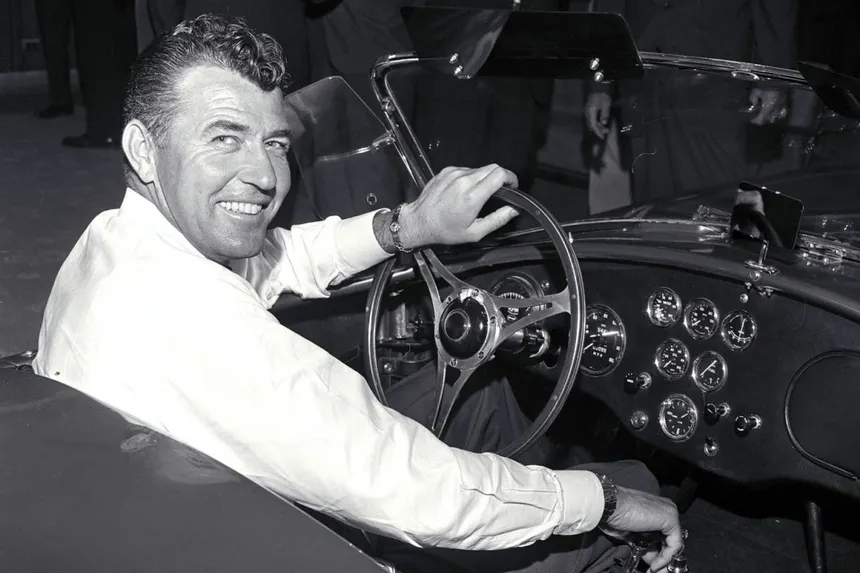
Carroll Shelby: The Chicken Farmer with a Borrowed Heart Who Humiliated Ferrari
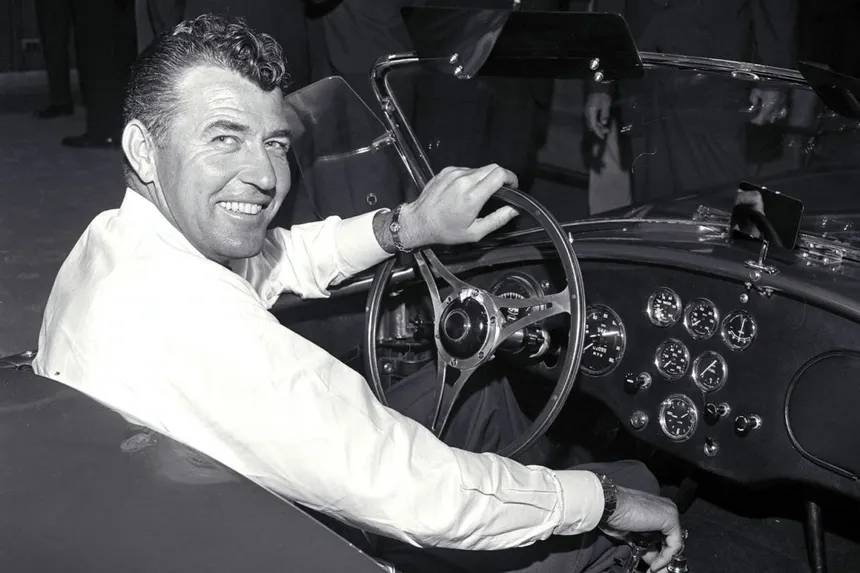
His Los Angeles Times obituary summed him up in a single sentence: “He raced cars. He had a heart transplant from a Las Vegas gambler in 1990 and a kidney transplant from a son in 1996. He was married seven times.”
That sentence is perfect. Because Carroll Shelby was not a normal person. He was a bankrupt chicken farmer, a race driver who competed with nitroglycerin pills under his tongue, a designer who tricked the FIA with inflated chassis numbers, the man who gave Ford the weapons to humiliate Ferrari at Le Mans, the co-founder of the Chili’s restaurant chain, and the longest-surviving heart transplant recipient in the United States. All within the same life. A life that started with a heart defect that should have killed him before twenty.
This is his story. With the data you won’t find on any other car blog.
A Sick Child in a Texas Town
Carroll Hall Shelby was born on January 11, 1923, in Leesburg, Texas, a tiny hamlet in the eastern part of the state. His father Warren was a rural mail carrier and car enthusiast. At age 7, Carroll was diagnosed with a heart valve defect — a congenital condition that kept him bedridden for much of his childhood. Doctors prohibited any physical activity. A child condemned to watch from the window while the world moved without him.
After high school in Dallas, Shelby enrolled at the Georgia Institute of Technology for aeronautical engineering but never finished. In 1941, he enlisted in the Army Air Corps, becoming a flight instructor and test pilot. During the war, he courted his fiancée Jeanne Fields by dropping love letters hidden inside his flying boots from his cockpit onto her family’s farm.
They married in December 1943. Three children followed. It was the first of seven marriages.
The Chicken Farmer Who Lost Everything
After discharge in 1945, Shelby tried dump truck driving, oil field work, and finally chicken farming. The poultry business started well — $5,000 profit on his first batch of broilers. Then Newcastle disease killed every bird. Bankruptcy followed.
Broke and heartbroken (literally), Shelby made the choice that changed history: racing. The detail that created his iconic image: one day in 1952, he had to race but hadn’t had time to change from farm work. He showed up wearing his striped farmer’s overalls. The press went wild. Shelby, shrewd as ever, made the overalls his trademark — wearing them throughout his career, including the Le Mans podium.
The Driver: Nitroglycerin Under the Tongue at 150 mph
Shelby’s racing career was short but blazing. His first known race was a quarter-mile drag in a home-grown hot rod with a Ford flathead V8 in January 1952. He was 29 — late for a racing career. Within years he was piloting for Aston Martin, Maserati, andFerrari across Europe. Sports Illustrated Driver of the Year in 1956 and 1957.
Few know Shelby also raced in Formula 1 — eight Grands Prix in 1958-1959, with a best finish of fourth. He debuted at the 1958 French Grand Prix at Reims.
In 1959, co-driving with Roy Salvadori in an Aston Martin DBR1, he won the 24 Hours of Le Mans — only the second American to do so after Phil Hill.
But the heart that had haunted him since childhood was reaching its limit. In February 1960: angina pectoris diagnosis. Doctors gave him less than five years to live.
In his final major race, a 200-mile event at Riverside in 1960, Shelby drove with nitroglycerin pills under his tongue to stave off a heart attack. He finished third. Afterward, he said: “If I hadn’t slowed down each time I popped one of those pills, I might have won.”
He was 37. Doctors had given him five years. He lived fifty-two more.
The Cobra: Chevrolet Said No, Ford Said Yes
Unable to race, Shelby pivoted. His idea: take a lightweight European chassis and drop in a big American V8. British finesse meets American muscle.
He chose the AC Ace — orphaned after Bristol stopped making its engine. Shelby first asked Chevrolet for V8 engines. They refused flat: they wouldn’t arm a potential Corvette competitor. That “no” from Chevrolet changed automotive history.

Ford said yes. They had a new lightweight 260 cubic inch Windsor V8 and wanted a Corvette killer. In February 1962, an engineless AC Ace chassis arrived at Dean Moon’s shop in Santa Fe Springs, California. In under eight hours, Shelby and Moon had the Ford V8 installed and running. The CSX2000 — the first Cobra — was born.
The Paint Trick
Shelby only had one Cobra but needed the press to believe he had a fleet. So every time a magazine wanted to test the car, he repainted it a different color. Yellow for one magazine. Red for the next. Blue for another. Journalists thought they were testing different cars. Nobody suspected it was the same machine in a new disguise.
The name “Cobra” came to Shelby in a dream. He woke up and said: “It’s going to be called the Cobra.”
The CSX2000 was kept by the Shelby family until 2016, when it sold at RM Sotheby’s for $13.75 million — then the record for an American car at auction.
The Homologation Fraud
Shelby didn’t just trick magazines. He tricked the FIA. To race in GT production categories, the FIA required at least 100 units built. Shelby didn’t have anywhere near that number. So he assigned a massive block of chassis numbers to create the illusion of high production volume. The FIA never verified in person. Shelby competed — and won.
Decades later, in the 1990s, Shelby claimed to have found “leftover chassis” and began selling cars that were actually built from scratch by McCluskey, Ltd. He called them “continuation Cobras.” Purists were furious. Shelby didn’t care.
Ford vs. Ferrari: Le Mans 1966-1967
When Henry Ford II tried to buy Ferrari and Enzo rejected him with an insult, Ford swore to humiliate him at Le Mans. For that, they needed Shelby.
Shelby American prepared the Ford GT40 race cars and managed the team. In 1966, three GT40 Mk IIs crossed the Le Mans finish line 1-2-3 — the most devastating image in endurance racing history. In 1967, Shelby repeated the victory with the GT40 Mk IV, driven by Dan Gurney and A.J. Foyt.
The Shelby Mustangs: GT350, GT500, GT500KR
The Shelby GT350 (1965): rear seats removed for SCCA homologation, 306 hp from the 289 V8. The first 37 “R-model” examples were pure race cars disguised as street machines.
The GT500 (1967): 428 Police Interceptor engine, 355 hp declared. In 1968, with the 428 Cobra Jet, it became the GT500KR — “King of the Road.” Ford claimed 335 hp. We already know how much it really made.
Shelby stopped building his Mustangs after 1970. The relationship with Ford cooled. He wouldn’t work with them again until 2003 — thirty-three years later — when they called him as technical advisor for the Ford GT project.
Life After Ford: Chili’s, Chrysler, and the Dodge Viper
The Chili King
While working for Ford in the ’60s, Shelby bought 200,000 acres near the ghost town of Terlingua, Texas, and in 1967 organized the world’s first chili cook-off — an event that still runs annually.
The cook-off inspired his son-in-law Larry Lavine, who proposed opening a restaurant with the same vibe. Shelby provided the seed money, helped design the menu and interior. The first Chili’s opened on March 13, 1975, in Dallas. It became one of America’s largest casual dining chains.
Shelby also created “Carroll Shelby’s Original Texas Chili Kit” (still sold today) and founded the International Chili Society in 1970. A chicken farmer who founded the international chili society. You can’t make this up.
Chrysler and the Dodge Viper
When Lee Iacocca — the same man behind the Mustang — became Chrysler chairman, he called Shelby again. First for performance Dodge Chargers, then for the Dodge Viper: a V10, no traction control, no ABS — the Cobra’s spirit reborn thirty years later.
The Borrowed Heart: Two Transplants and Fifty Years of Overtime
On June 7, 1990, at 67, Shelby received a heart transplant. The donor: a 34-year-old Las Vegas gambler who had died of an aneurysm. Shelby became one of America’s longest-surviving heart transplant recipients.
Less than a year later, he drove the Dodge Viper pace car at the 1991 Indianapolis 500. With a gambler’s heart in his chest, at 125 mph down Indianapolis’s front straight. He was 68.
In 1996, at 73, his body failed again: he needed a kidney. His son Michael donated one. Shelby became one of the oldest people to survive two vital organ transplants.
When asked how he felt: “I’ll be fine as long as I don’t run out of spare parts.”
Seven Marriages and Miniature Horses
Carroll Shelby married seven times. His sixth wife, Helena Dahl — a Swedish woman he’d met in 1968 — died in a car accident in 1997. It was his only marriage that didn’t end in divorce.
In his final years, Shelby had homes in Bel Air, Las Vegas, and Pittsburg, Texas, where he raised miniature horses and African cattle. From chicken farmer to exotic livestock breeder. The circle closes, but bigger.
May 10, 2012
Carroll Shelby died at Baylor Hospital in Dallas. He was 89. He had survived 52 years beyond what doctors promised. He had built the Cobra, the Shelby Mustangs, helped win Le Mans, co-founded Chili’s, created a chili brand, founded an international chili society, consulted on the Dodge Viper, lived with a Las Vegas gambler’s heart and his son’s kidney, and married seven times.
Shortly before his death, he was working on the new 2013 Shelby GT500. He never stopped building.
Final Statement: Why Carroll Shelby is Immortal
Carroll Shelby wasn’t just a car man. He was living proof that life isn’t meant to be lived at half throttle. Born with a broken heart — literally — he shattered every limit the world placed on him like they were cones on a race course.
He was a chicken farmer who went bankrupt. A race driver who was told he would die. A car designer who cheated the FIA to compete. A restaurant entrepreneur who co-founded one of America’s biggest chains. A terminal patient who lived half a century on borrowed organs. A husband — seven times over — because apparently not even marriage could contain his restless spirit.
Every car bearing his name carries that same energy: the energy of a man who showed up to a race wearing farmer’s overalls because he didn’t have time to change, and turned those overalls into his flag.
Because Carroll Shelby didn’t ask permission. He didn’t wait for perfect conditions. He didn’t give up when told he couldn’t. He just slipped a nitroglycerin pill under his tongue, hit the throttle, and kept going.
And in a world full of people looking for excuses, that’s worth more than any trophy.
Think that was enough? This is Not Enough Cylinders. We don’t come here to repeat what you already know — we come to tell you what nobody bothers to research.
6 thoughts on “CARROLL SHELBY”