MG Metro 6R4: When Williams F1 Stuffed a Purpose-Built Racing V6 Inside Your Grandmother’s Shopping Car
Builds & Swaps | Not Enough Cylinders

A Metro. The most ordinary car in Britain. Until it wasn’t.
In 1980, British Leyland launched the Austin Metro. It was the car that was supposed to save the entire British car industry from total collapse. A three-door, front-wheel-drive supermini powered by a 1.0 or 1.3-liter engine derived from the original Mini’s A-Series — a design that had already been in production for over two decades. The Metro was cheap, it was practical, and it was exactly as exciting as it sounds. It sold to housewives, to retirees, and to civil servants who needed to get from A to B without incident. For years, it was the best-selling car in Britain.
And then, someone at Austin Rover Motorsport decided that this car — this exact car — would compete against the Lancia Delta S4, the Peugeot 205 T16, and the Audi Quattro S1 in Group B of the World Rally Championship.
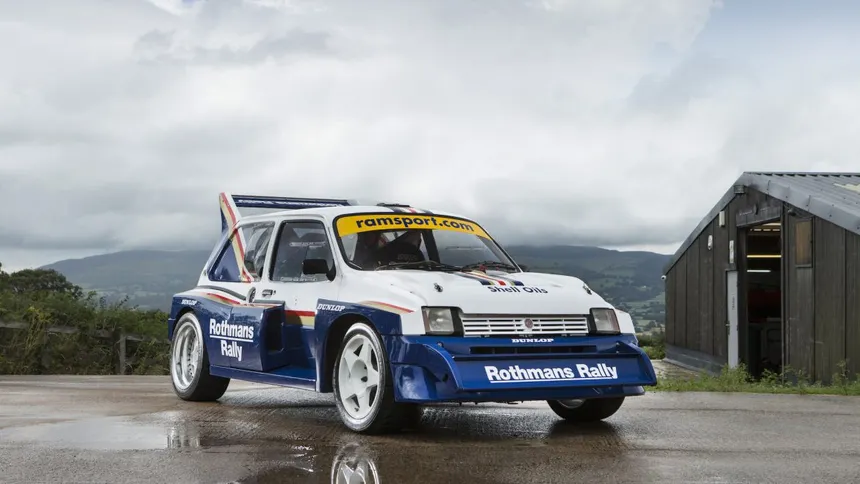
Not with a bigger engine. Not with a turbo bolted onto the stock 1.3. With a 3.0-liter V6 designed entirely from scratch for competition, mounted behind the driver, with permanent four-wheel drive, and a chassis designed by the same people who built Williams’ Formula 1 cars. Inside a body that still looked like a Metro.
The name said it all: 6R4. Six cylinders. Rally. Four-wheel drive. No poetry. No marketing spin. Just engineering.
The team that had no business being there
The project was born in the mind of John Davenport, Director of Austin Rover Motorsport. Davenport had watched what Audi was doing with the Quattro and understood that all-wheel drive was the future of rallying. But Austin Rover had neither a suitable engine, nor a competitive chassis, nor any recent experience in top-level competition. What they did have was political will from the Metro marketing department, who wanted to attach the brand to something more exciting than grocery runs. And that meant budget.
Davenport’s first idea was brutally simple: drop a 3.5-liter Rover V8 into the front of a Metro and send power to the rear wheels. Patrick Head — yes, the Patrick Head who co-founded Williams Grand Prix Engineering, who designed Keke Rosberg’s championship-winning cars and would later lead Nigel Mansell to the title — looked at it and told him that with a V8 up front, the driver would have to sit so far back he wouldn’t be able to see the bonnet. His counter-proposal was far more radical: mid-engine, four-wheel drive. And if it was going to be a V6, it would have to be purpose-built.
In December 1982, Williams delivered the first prototype to Cowley. The team that worked on the 6R4 was small but lethal: John Piper (transmission and suspension layout), Brian O’Rourke (structure and bodywork), and two former F1 mechanics, Ian Anderson (fabrication) and Derek Jones (machining). People who were tuning 300 km/h Formula 1 cars on Friday and welding Metro subframes on Monday.
The engine that didn’t exist: cutting a V8 in half to invent a V6
This is where the story goes completely insane.
While David Wood — Austin Rover Motorsport’s Chief Engineer and former Cosworth employee — was designing the definitive engine, the team needed something to test the prototype with. They didn’t have a V6. There wasn’t a suitable V6 anywhere in the Austin Rover group. Honda, who were partners at the time, had an F2 V6, but its valvetrain was too complex for rally adaptation, and their road-going V6 was unsuitable for competition tuning.
The solution was mechanically savage: Wood took a 3.5-liter Rover V8 block, literally cut two cylinders off, and welded the remains back together to create a 2.5-liter V6. He fitted a purpose-made crankshaft, Rover Vitesse racing internals, and Weber carburetors. The target was 200 bhp. It made 250. That improvised engine, dubbed the V62V, was good enough for the prototype to win a rally before the definitive unit was even ready.
The real engine — the V64V (V6 with 4 Valves per cylinder) — was something else entirely. David Wood designed a 90-degree, 3.0-liter aluminum-alloy V6 with belt-driven twin overhead cams and four valves per cylinder. The cylinder heads shared their architecture with the legendary Cosworth DFV, the engine that dominated Formula 1 for fifteen years. It is believed to be the only engine in history designed specifically for rallying — every other manufacturer relied on modified production blocks.
And in the most counterintuitive decision in all of Group B, Austin Rover decided it would be naturally aspirated. No turbo. While Lancia, Peugeot, Audi, and Ford forced induction into everything they could, the 6R4 relied on displacement, cylinder head design, and pure revs. The reasoning was technical: in a car this small, they eliminated turbo lag, reduced heat management problems, and gained instant throttle response. The V64V produced 250 bhp in Clubman (road) spec and 380–410 bhp in International (competition) spec, with a redline above 8,000 rpm. In full competition trim, the rev limiter kicked in at 10,000 rpm.
137 feet of welding: what it takes to turn a grocery-getter into a weapon
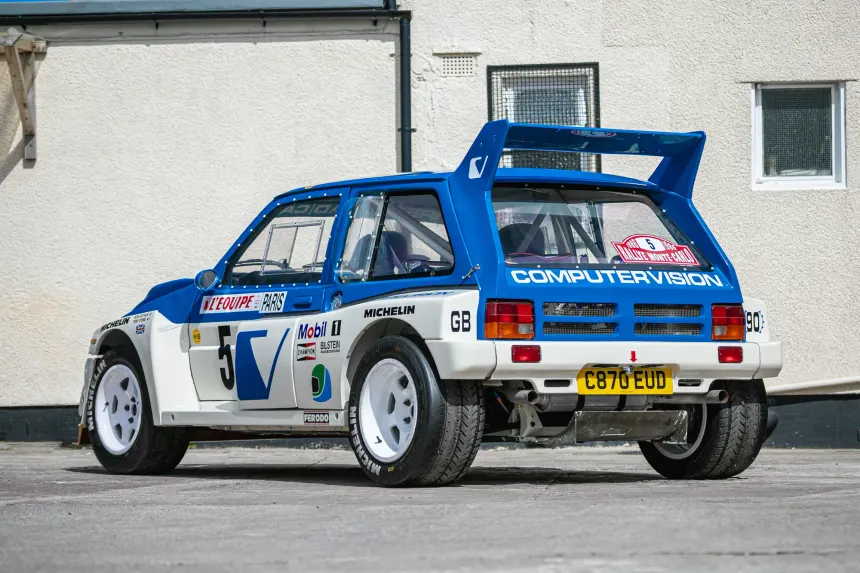
The final 6R4 bodyshell contained 137 feet (41.8 meters) of welding, compared to just 4 feet (1.2 meters) in a standard production Metro, plus 25% more spot welds. The chassis was a semi-monocoque, seam-welded tubular structure designed by Williams, sharing virtually nothing with the road car except the general silhouette and the name.
The exterior bodywork was mostly GRP (glass-reinforced polyester), except for the roof panels (aluminum) and the steel doors — though even these were hidden beneath massive plastic airboxes. In fact, show cars carry stickers indicating where it’s safe to push the vehicle, because press on the wrong spot and you’ll crack a body panel.
The engine was mounted backwards — with the front face of the block pointing toward the tailgate and the gearbox conventionally attached behind it, sitting in the middle of the car. Permanent four-wheel drive used separate propshafts to front and rear differentials. The rear diff was mounted on the side of the engine sump, with one driveshaft running directly through the sump to reach the nearside rear wheel.
Even apparently standard components taken straight off the Metro production line needed modification: the MG Metro dashboard required reshaping to fit the 6R4 body, and the standard headlamp units had to be cut away at the back to make room for the massive front inner wheelarches.
The launch that smashed through a cinema screen
In February 1984, Austin Rover summoned the motorsport press to the Excelsior Hotel at London Heathrow. Journalists sat down to watch a film of the prototype being tested. As the footage reached its climax, the car on screen drove directly toward the camera, growing larger and larger. Just as the image reached life-size, Tony Pond burst through the actual cinema screen in a real 6R4, stopping inches from the front row of journalists.
The car was painted red with a white roof — the livery of the works Mini Coopers from the 1960s. Austin Rover wasn’t just introducing a rally car. They were sending a message: the same brand that had won Monte Carlo with a Mini was coming back to the top.
Seven units, six days, and a rally won before the car officially existed
Production of the 200 homologation units was completed between August and October 1985 at Austin Rover’s Longbridge factory, on a special production line adapted from one previously used for pre-production prototypes. Group B homologation was granted on November 1, 1985 — homologation number B-277.
But there’s a detail almost nobody mentions: Ken Wood (no relation to David Wood the engine designer) took delivery of his Clubman 6R4 on a Thursday. Fitted harnesses and a fire extinguisher on Friday. And on Saturday — six days before the car was officially homologated — he went out and won the Sprint Tyres Trossachs Rally. It was the first-ever victory for a Clubman 6R4, and it happened before the car officially existed as a homologated competition vehicle.
At its international debut, the RAC Rally of November 1985, Tony Pond brought the 6R4 home in third place behind two Lancia Delta S4s — those of Markku Alén and Henri Toivonen. It was the car’s best international result, and the moment it became a genuine threat.
The cursed season: 1986
What followed was one of the most frustrating stories in motorsport. In 1986, the 6R4 entered the rallies of Monte Carlo, Sweden, Portugal, and Corsica. It finished none of them. The problems came almost exclusively from the V64V engine, still suffering the teething issues typical of a new powerplant that hadn’t had enough development time.
The team was beginning to solve the problems when, halfway through the season, the FIA banned Group B following a series of fatal crashes — most devastatingly at the 1986 Tour de Corse, where Henri Toivonen and co-driver Sergio Cresto died when their Lancia Delta S4 plunged off a cliff and burst into flames.
The 6R4 never reached its potential on the world stage. But the story didn’t end there.
After death: rallycross, Ecosse, and the engine that came back inside a Jaguar
When Austin Rover pulled out of motorsport in 1987, they cleared their remaining 6R4 stock by slashing the price from £45,000 to £16,000 — less than half. And they sold the V64V engine design rights to Tom Walkinshaw Racing (TWR).
What TWR did with that engine is arguably more significant than what Austin Rover ever achieved with it.
Under engineer Allan Scott, with Swiss engine builder Max Heidegger, TWR completely redesigned the V64V for forced induction. They increased displacement to 3.5 liters, strengthened the internals, and fitted twin Garrett T03 turbochargers. The resulting engine, codenamed JV6, was a completely different beast.
That engine first appeared in the Jaguar XJR-10 and XJR-11 endurance racers. But its most famous home was the Jaguar XJ220: in production form, the twin-turbo JV6 produced 542 bhp and 644 Nm of torque, making the XJ220 the fastest production car in the world in 1992 at 341 km/h (212 mph). In TWR’s XJ220 S variant, output rose to 680 bhp.
The engine from a British rally car that never finished a single WRC stage ended up powering the fastest production car on the planet. The irony is flawless.
Meanwhile, the V64V also powered the Ecurie Ecosse team to victory in the 1986 Group C2 World Sports Car Championship, with Ray Mallock and Marc Duez driving. And in rallycross, the 6R4 found its true calling: Will Gollop won the 1992 European Rallycross Championship with a 6R4 running a 2.3-liter twin-turbo V64V. Didier Auriol — who would later become World Rally Champion with Lancia — won the 1986 French Rally Championship in a RED-prepared 6R4.
The numbers
| Spec | Clubman (Road) | International (Competition) |
|---|---|---|
| Engine | V64V V6 3.0L DOHC 24V | V64V V6 3.0L DOHC 24V |
| Head architecture | Based on Cosworth DFV F1 | Based on Cosworth DFV F1 |
| Power | 250 bhp | 380 – 410 bhp |
| Max RPM | ~8,000 rpm | ~10,000 rpm |
| Aspiration | Naturally aspirated | Naturally aspirated |
| Gearbox | 5-speed manual, synchromesh | 5-speed dog box |
| Drivetrain | Permanent 4WD | Permanent 4WD |
| Weight | ~1,040 kg (2,293 lb) | ~1,000 kg (2,205 lb) |
| 0–60 mph | 4.5 s | 3.2 s / 2.8 s (full comp) |
| 0–100 mph | — | 8.2 s |
| Bodywork | GRP + aluminum + steel | GRP + aluminum + steel |
| Welding | 41.8 m (137 ft) | 41.8 m (137 ft) |
| Chassis | Semi-monocoque (Williams F1) | Semi-monocoque (Williams F1) |
| Units built | ~200 (homologation) | ~20 |
| Original price | £40,000 – £45,000 | Works teams only |
| Clearance price (1987) | £16,000 | — |
| Auction value (2024–25) | £200,000 – £425,500 | £229,000 – £393,750 |
£16,000 to £425,000: the forty-year revenge
In 1987, you could buy a Clubman 6R4 for £16,000 — the price of a decent family car. Austin Rover practically gave them away to clear stock, warning buyers that the vehicle was “not intended for domestic, casual, business or other motoring on the public highway.”
In May 2024, an ex-Works 6R4 sold for £425,500 at Iconic Auctioneers. In August 2024, a competition-history ex-Works car fetched £393,750. A road-spec Clubman with 3,423 miles made £200,500 in February 2025. The average market value of a Metro 6R4 now exceeds £200,000.
The car that Austin Rover couldn’t give away is now worth as much as a London flat. The car that never finished a WRC rally is one of the most sought-after competition machines of its generation.
Why the 6R4 is the ultimate build
The MG Metro 6R4 is proof that engineering doesn’t need an unlimited budget to be brilliant. It needs the right people at the right moment under the right pressure.
Patrick Head, who designed Formula 1 cars, accepted the challenge of fitting a competition powertrain inside a city car. David Wood designed the only purpose-built rally engine in history — and when it wasn’t ready, he cut a V8 in half so he could keep testing. Tony Pond drove through a cinema screen to present it. Ken Wood won a rally before the car officially existed. And when it all fell apart — when Group B died and Austin Rover retreated — the engine went on to power the fastest car in the world.
A Metro. Your grandmother’s car. With Formula 1 DNA in its cylinder heads, a purpose-built racing V6 behind the driver’s seat, and 41 meters of welding where the road car had 1.2.
Only 200 road cars were ever made. And none of them had any right to exist.
Check that you’re still alive.
Words: Not Enough Cylinders Section: Builds & Swaps