BMW M3 GTR Road Car: The V8 M3 BMW Still Can’t Agree On

For about an hour in October 2001, the rarest M3 ever built sat in the paddock at Road Atlanta. That was the whole American launch of the M3 GTR Strassenversion: one silver car, a price tag of €250,000, and a crowd that had come to watch the race version win. The same weekend, a BMW of North America race car in blue with white stars won the GT class at the Petit Le Mans, a few weeks after 9/11.
The road car existed because of an American championship, it was shown to an American crowd, and the best account of how BMW beat Porsche with it comes from BMW of North America itself. The problem is that BMW, on both sides of the Atlantic, has never settled on the basic facts of the car.
Three stories from one company
Start with how many were built. BMW M’s official website says ten road-legal cars were produced, its summary adds that fewer than ten were sold, and the article admits it isn’t entirely clear where they are or whether their owners ever registered them. BMW Group Classic’s own spec page calls it a small series of just ten vehicles. In August 2015, BMW of North America published a different account: six cars were completed before the program was terminated, three were engineering development cars that were later recycled, and the three production-level survivors belong to the BMW Group Classic collection. Then, in July 2025, BMW of North America went back to talking about ten prototypes.
Power doesn’t line up either. BMW M lists 258 kW, which is 350 PS, with 365 Nm, about 269 lb-ft, at 5,000 rpm. BMW Group Classic and BMW of North America both say 380 hp at 7,000 rpm, and the Classic page pairs that 380 hp with the same 258 kW, a conversion that doesn’t work. Top speed? BMW M says 295 km/h, about 183 mph. Classic says 250 km/h limited and 280 km/h, about 174 mph, unrestricted.
For a company that obsesses over grams and tenths, that’s a remarkable amount of disagreement about its most extreme M3.
Porsche kept winning
The GTR was born out of frustration on American tracks. BMW of North America’s Prototype Technology Group, Tom Milner’s team from Virginia, ran the E36 M3 in the IMSA GT class from 1995. After a learning season, it won fully half of all the races from 1996 to 1998, with drivers’ titles for Pete Halsmer and Bill Auberlen. Then Porsche’s water-cooled 996 GT3 and GT3R arrived. In 1999 PTG won two early races, Porsche won six and took the championships. In 2000, the first full year under the American Le Mans Series name, PTG’s E46 M3 won once, at Sears Point, a traditional BMW stronghold. Porsche won the other eleven.
The E46 race car carried a 3.2-liter inline-six making about 338 hp, and under intake restrictor rules, displacement was everything. A restrictor is a calibrated ring in the intake that caps how much air the engine can swallow. Rev it as high as you like; it can’t breathe more than that hole allows. We break the physics down in the first chapter of our induction series. With airflow capped, the way to make more torque is more displacement to make better use of every gulp. BMW North America’s Rich Brekus put it in five words: “Restrictor racing is a displacement game.” The bigger the engine, he explained, the earlier you develop torque.
Mario Theissen, whose influence at BMW Motorsport was growing, agreed to build a V8 M3. He didn’t think PTG was capable of developing it, so he wanted Team Schnitzer to run it. Brekus insisted PTG get exactly the same cars. So BMW went into 2001 with two works-backed teams fighting each other almost as hard as they fought Porsche. Bill Auberlen, PTG’s driver, summed it up: “You can’t put two roosters in the henhouse.”
A race V8 drawn by an ex-Porsche engineer
The engine was the P60B40, and BMW of North America describes it as a pure racing engine with no production-car ancestry. It was drawn by Reinhard Könneker, an engineer who had come to BMW from Porsche, which means the weapon built to beat Porsche had Zuffenhausen DNA. Aluminum block and heads cast at BMW’s Landshut foundry, dry-sump lubrication and a flat-plane crankshaft. That last detail is race-car stuff: instead of the burble of a Detroit cross-plane V8, a flat-plane crank makes the engine behave like two four-cylinders sharing one crank, revving harder and sounding like a screaming saw. It was also more compact than the S54 inline-six it replaced, despite two extra cylinders.
Race output depends on who’s telling it and which restrictor was fitted. BMW quoted 450 bhp in October 2001, 444 hp at 7,500 rpm in 2015, and roughly 493 hp at 8,000 rpm in 2025. Both the race car and the road car were engineered under Albert Biermann, the man Hyundai would later hire to create its N performance brand.

The P60 wasn’t FIA-homologated for production-based racing, so BMW petitioned the ACO, the Le Mans organizer that wrote the GT rules, pointing out that Porsche already raced a full competition engine in the GT3R. The ACO agreed, on conditions: a parts catalog with every part available, a printed sales brochure, and the car offered for sale on three continents. In other words, road cars.
Building a road car against the clock
BMW M says the rules allowed twelve months to produce at least ten homologation cars and that BMW furnished proof of production “just in time.” The road car was built alongside the racing program in the special vehicles department of BMW’s Regensburg plant in Bavaria. Homologation specials were nothing new. Ford built 500 Sierra RS500 Cosworths and Mazda built its 323 GT-R in the thousands for rallying. BMW was talking about ten at most.
It used a slightly detuned P60 with dry-sump lubrication and a sharply canted radiator venting through the hood. A racing twin-disc clutch fed a six-speed manual, replacing the race car’s sequential gearbox, and a variable locking M differential. The body got extra bracing between the firewall and the strut towers and between the rear shock towers. The roof, rear wing, hood vents and front and rear fascias were carbon-fiber-reinforced plastic. Inside: leather-covered Recaro racing seats, no rear seat, no air conditioning, no radio. Nineteen-inch wheels on 225/40 front and 255/35 rear tires. BMW M puts curb weight at 1,350 kg, roughly 2,976 lb, and 185 kg less than a manual M3. It came only in Titan Silver metallic with an all-black interior, and BMW M quotes the sales leaflet: those who want to win have to be able to do without.
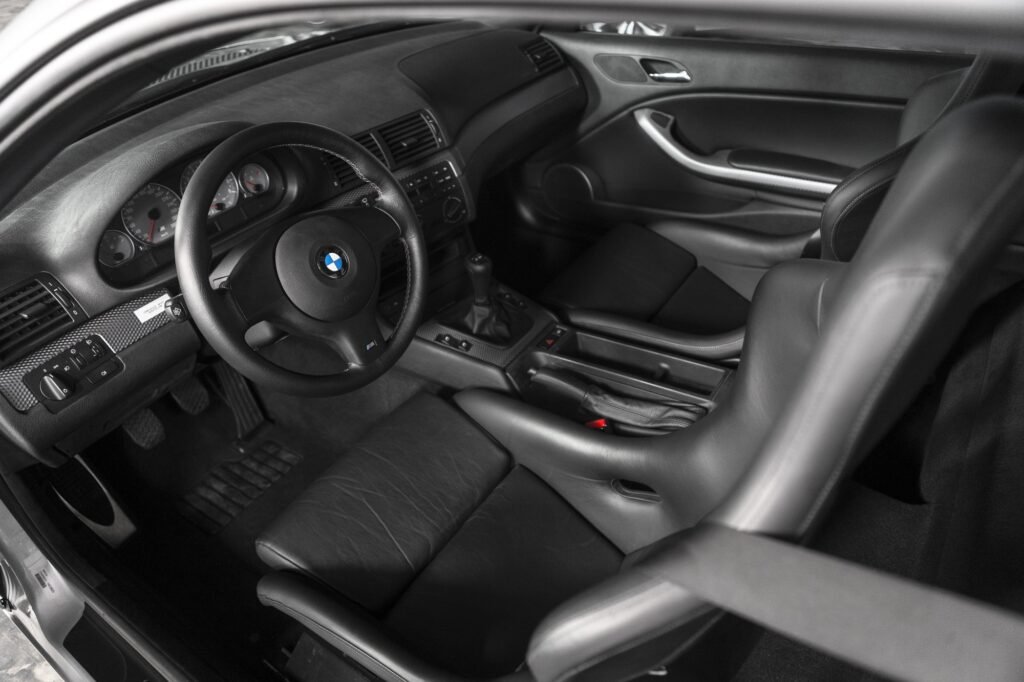
For context, the regular E46 M3 made 333 hp in US trim. The M3 CSL that arrived in 2003, which BMW sold as the most hardcore E46 and never brought to America, made 360 PS and weighed 1,385 kg. The GTR road car was lighter than the CSL, had two more cylinders and a genuine race engine, and depending on which BMW number you believe, made the same power or twenty more.
The announced price was €250,000. BMW showed it simultaneously at the importer in Dubai and in that Road Atlanta paddock, where it stayed on display for approximately an hour.
How the season actually went
BMW of North America’s own 2025 retelling is the best race-by-race account. At Texas on March 4, the P60 wasn’t ready and every BMW ran the six-cylinder. At the Sebring 12 Hours on March 17, Schnitzer tested the V8 in anger: JJ Lehto and Jörg Müller controlled the race from lap four until a late stop to change brakes dropped them to third in GT. The series then crossed the Atlantic for two rounds shared with the new European Le Mans Series. At Donington in April, both Schnitzer cars retired. On May 20 at Jarama, just outside Madrid, Schnitzer finished one-two in GT, Fredrik Ekblom and Dirk Müller ahead of Lehto and Jörg Müller. Until then, Alex Job Racing’s Porsche had won GT at every round. Jarama was the V8 M3’s first win.
Back in the US at Sears Point on July 22, with all four M3s on P60 power, BMWs filled the top four in class. Lehto and Jörg Müller won. On the last lap, Ekblom passed Stuck at the final corner with contact, and officials disallowed the move: Stuck second, Ekblom third. Stuck and Boris Said won for PTG at Portland on August 5. Schnitzer went one-two at Mosport after collisions with both PTG cars, then again at Mid-Ohio and Laguna Seca.
The Petit Le Mans finale on October 6 was the one that mattered to an American crowd. Milner swapped his cars’ Yokohama livery for blue with white stars on the hood, roof and deck lid, which BMW calls the Stars and Stripes livery, and every car in the field carried an American flag decal. Auberlen, Said and Stuck won by a lap. Jörg Müller, sharing with Dirk Müller, earned a one-minute stop-and-go penalty for helping the mechanics clean the windshield during a driver change. The rules allowed the crew only to help the driver into the car and buckle up. They finished second, a lap down.

BMW won seven of the ten races, every round from Jarama onward. It took the manufacturers’ title, Schnitzer took the team title and Jörg Müller the drivers’ crown with 191 points to Lehto’s 186. BMW split the two teammates for the finale to maximize its chances, and Müller said he was deeply disappointed he couldn’t celebrate the title together with JJ. Even the pole count moves: BMW’s October 2001 release says six poles, and its January 2002 withdrawal statement says five, along with “six of eight” races won. Auberlen’s verdict needs no adjustment: “The M3 GTR was the best-handling GT car ever.”
The ruling, and BMW’s competing numbers again
After Sears Point, BMW of North America says, Porsche “called in the generals,” its top engineers. There were even suspicions inside BMW that Schnitzer’s engineers were tampering with the engine management software PTG used. Brekus rejected that and blamed much of the gap on tires: Michelin for Schnitzer, Yokohama for PTG. Outside BMW, the complaint was simpler: the GTR was a prototype dressed as a production car.
What the new rules actually demanded is another number BMW can’t agree with itself on. In 2015, BMW of North America wrote that the production requirement for 2002 was expanded 100-fold, making a similar effort economically impossible. In 2025, it dated the ACO ruling to November 25, 2001, and said it made the P60 illegal unless BMW built 1,000 examples. BMW M’s website says the definition of a series model went from ten to a minimum of 100 homologation models. A hundred or a thousand, depending on which part of the company is talking. BMW of North America adds the comparison that stings: Porsche had built 1,868 911 GT3s from 1999 to 2001, plus 163 full-race GT3Rs.
BMW canceled the road car and, on January 22, 2002, pulled the M3 GTR out of the ALMS. Tom Purves, chairman and CEO of BMW of North America, said the car “was constructed at great expense to meet the 2001 homologation requirements and was granted its homologation accordingly.” With BMW gone, Porsche went undefeated in ALMS GT until 2006, when Risi Competizione’s Ferrari won four races and the GT2 title.
It didn’t stay dead
The race cars went to Europe and ran the Nürburgring 24 Hours from 2003. In 2004 they finished one-two overall, with Dirk Müller, Jörg Müller, Hans-Joachim Stuck and Pedro Lamy in the winning car. In 2005 they did it again with the order swapped: Boris Said, Duncan Huisman, Andy Priaulx and Lamy won, and Stuck finished second.
In America, the E46 GTRs came back in 2004 to Grand-Am, this time with the original 3.2-liter sixes, and promptly won the GT championship. Then Grand-Am banned them, because, as BMW of North America’s Larry Koch put it, the chassis was too trick. In 2006 they returned to the ALMS with 3.4-liter engines and less weight and finished on the podium at Lime Rock. “They were five years old, but they were fairly competitive,” Koch said.
The Petit Le Mans winner, chassis M3-GTR-006, later went through an 18-month ground-up restoration at Rahal Letterman Lanigan, with help from former PTG crew members and BMW Motorsport. BMW of North America unveiled it alongside a road car at the Legends of the Autobahn concours in Monterey in August 2015. According to BMW, it was only the second time a road car had been shown in North America. In 2025, Thomas Plucinsky, head of BMW Group Classic USA, said only three of the race cars remain.
The most famous M3 almost nobody has touched
Most people who know the GTR know it from Need for Speed: Most Wanted. In the 2005 game, the silver-and-blue GTR is the player’s car until Clarence “Razor” Callahan takes it in a pink-slip race the player loses when the engine fails near the finish. Later you learn Razor sabotaged it. Winning it back is the whole point of the campaign, and a generation of gamers drove it for hours without knowing the real one existed.
BMW M finally leaned into that. It took one of its genuine GTR race cars, wrapped it in the game’s silver-and-blue livery over the original paint, announced it on November 26, 2024, and put it on display at BMW Welt in Munich from the next day until January 6, 2025. According to the official Need for Speed blog, it’s the No. 42 car Lehto and Müller raced to the 2001 ALMS title. John Stanley, senior creative director for Need for Speed Unbound, called it “one of the most recognisable and beloved cars in Need for Speed history.” And in May 2026, for the M3’s 40th birthday, BMW took one of its road cars to an exhibition at the Grand Palais in Paris.

BMW had done this kind of thing before. In 1993 it homologated an E36 M3 GTR for the German ADAC GT Cup with a single road car, because that’s all the rules required, and Johnny Cecotto won six of eight races and the title. But that car still used a straight-six. The E46 GTR put a pure race engine on the road, the first V8 in M3 history, six years before the S65 in the E92 M3, which BMW launched in 2007 as the first eight-cylinder M3 as if the GTR had never happened. And according to BMW M, the P60 never went into any other series model.
The NEC verdict
The M3 GTR Strassenversion is the only M3 born from a loophole in the rules and killed by a ruling. It won seven straight in 2001, from Jarama to the Stars and Stripes victory at Road Atlanta, and it was thrown out of America for doing its job too well.
BMW, meanwhile, holds incompatible accounts of its most radical M3 at the same time. Ten, six or three cars. 350 or 380 horsepower. 174 or 183 mph. Six wins or seven, five poles or six. A hundred or a thousand units to keep racing. The company keeps the survivors in its collection, rolls one out now and then for a concours or an exhibition, and lets a video game do the marketing. A road-homologated car whose own maker won’t say if it ever reached a customer is, in practice, a race car with a decorative license plate. We think that’s the best compliment there is. If BMW really wants to honor the first V8 M3, why not publish, once and for all, how many it built and how fast they actually went?
The next time BMW tore up its own rulebook that hard, there was no gasoline involved: we told that story at Not Enough Battery with the BMW i3.
Keep reading: Ferrari 456: The Station Wagon Maranello Erased
Check you’re still alive.
Photos: BMW Group (prensa BMW), BMW Group (prensa BMW), BMW Group (prensa BMW), BMW Group (prensa BMW), BMW Group (prensa BMW).