Fiat Croma Diesel, the Pioneer Germany Buried

Three letters mean money, prestige and supposed German superiority in the car world: TDI. Volkswagen and Audi built an empire on them, and for a while they even sold Americans the idea of “clean diesel” with it, until that story ended in a courtroom. The fast, efficient, refined diesel that filled Europe’s roads for twenty years carries a German stamp burned into everyone’s memory.
Here’s the twist most people never hear, least of all in America, where this car was never sold: the first to put a direct-injection turbodiesel into a production passenger car wasn’t Audi. It was Fiat. With this sedan, the Croma, a year before the first TDI. And through sheer commercial timidity, it handed the Germans all the glory.
This is the story of a forgotten Italian car that changed diesel for good. The story of how Italy invented and Germany cashed in.
Four cars from one mold
To understand the Croma you have to start with one of the most interesting industrial experiments of its day. In October 1978, Fiat and Saab signed a memorandum of understanding to develop a shared front-wheel-drive platform for their large sedans: the Type Four project. Lancia, already inside the Fiat empire, came along by default. Alfa Romeo, still state-owned at the time, signed on in 1982. Four siblings came out of it: the Lancia Thema and the Saab 9000 first, the Fiat Croma at the end of 1985, and the Alfa Romeo 164, unveiled at Frankfurt in 1987.
If two of those names ring a bell, they should. The Saab 9000 and the Alfa 164 were both sold in the United States, the 164 as the last Alfa sedan sold new there until the Giulia arrived in 2017. Their Fiat brother never crossed the Atlantic. Fiat had pulled out of the US market in the early 1980s, so the most important car of the four, technically speaking, is the one Americans never saw.
It’s worth pausing here, because a widespread myth says sharing a platform between brands is a modern sin, a product of the cost-cutting era. False. Type Four proves these alliances go back decades, and that cars with genuinely distinct personalities came out of them. The Alfa was the sporty one, the Saab the clever one, the Lancia the elegant one. And the Fiat? The Fiat was the rational one, the one that had to sell in volume and stay affordable. Alfa Romeo took the platform and its engineering but drew its own body, so the family resemblance ran deeper under the skin than on it.
The Croma, by contrast, shared sheetmetal with the Lancia Thema, and the first three cars were structurally close enough that the doors were interchangeable between Croma, Thema and 9000, even though the real count of shared parts was far smaller than people assume. The body, penned by Fiat’s Centro Stile with Giorgetto Giugiaro, was a clean two-and-a-half-box shape with a practical hatchback that fooled you: head-on, it looked like a classic three-box sedan. Giugiaro liked the trick enough to repeat it in 1991 on the first Seat Toledo, the Spanish sedan that was secretly a hatchback too.
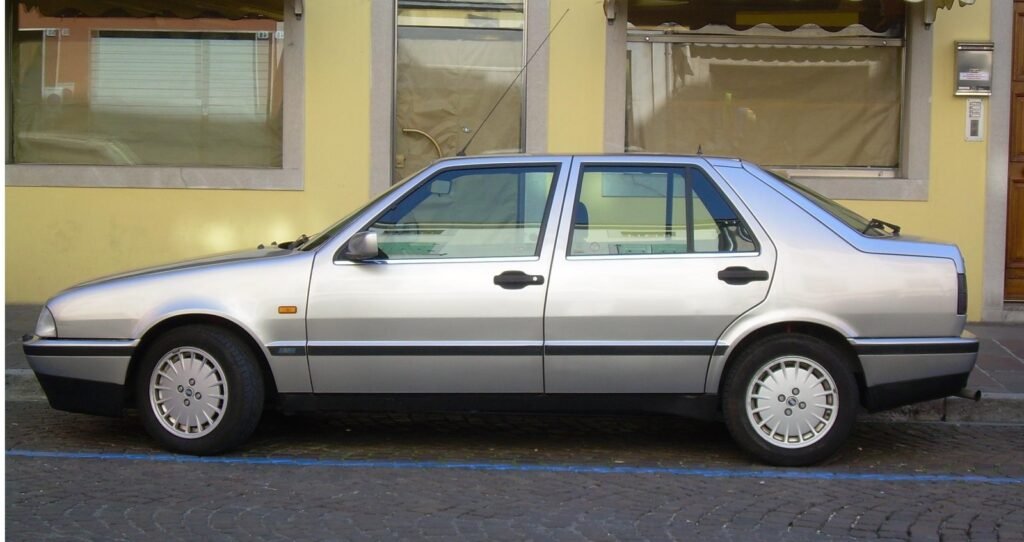
The drag coefficient, the number that tells you how hard a car has to work to push through the air, was around 0.33, though sources wander between 0.32 and 0.34. For a big mid-eighties sedan, that was a very good score. It was also the first large Fiat with a transverse engine and front-wheel drive, a radical break from the rear-drive layout of its dated predecessor, the Argenta.
Five hundred liters of common sense
The Croma sold, and sold well. Motor1 puts production at more than 450,000 over eleven years; Curbside Classic says 438,000 left Fiat’s Turin plants between 1985 and 1996. Either way, most stayed in Italy. Plenty of buyers chose it over a German sedan, and not only on price. It appealed for its sober, functional design, its huge cabin and a 500-liter trunk, around 17.7 cubic feet, reached through that big hatch. It was the rational car par excellence, Fiat’s ammiraglia, the flagship.
It was no stand-up-and-applaud machine, and Fiat never sold it as one. This was a car for the head, not the heart. Room for five, trunk to spare, familiar mechanicals and a price that bit less than the premium rivals. Common sense on wheels. And beneath that layer of good sense it hid the part that makes it historically important.
The diesel that came from the future
Here’s the heart of the story. In June 1988, Fiat presented the version that would set the industry’s course for decades: the Croma Turbo D i.d., with a 1,929cc four-cylinder direct-injection turbodiesel. A warning: the dates wobble here too. Honest John and the French press put the launch in 1986, English Wikipedia in 1987. Motor1, which has told the Croma’s story twice, says June 1988, and that’s the date we go with.
So what does direct injection actually mean? In a diesel, fuel has to be injected into the cylinder to burn. For decades, car diesels used indirect injection: the fuel went first into a small side chamber, the pre-chamber, where it began to burn before spilling into the cylinder. It was a trick to soften combustion so the engine clattered and shook less, but you paid for it in fuel economy and performance. Direct injection scraps the pre-chamber and sprays diesel straight into the cylinder. The result: less fuel burned for the same work. Fiat claimed the Croma used 20% less fuel than a comparable indirect-injection diesel.
Let’s be precise, because it’s easy to oversell this. Fiat did not invent diesel direct injection. Trucks, tractors, ships and industrial engines had used it for decades. By the mid-eighties it had even reached vans: Iveco showed a direct-injection diesel at Geneva in 1984, and Ford put one in its Transit soon after. The principle was old news. The unsolved problem was getting it into a production passenger car without it being unbearable. Direct injection in a tractor, where noise and vibration are part of the scenery, is one thing. In a family sedan, those flaws won’t fly. Taming that combustion for a passenger car was the real wall. And the Croma was the first production passenger car in the world to clear it with a turbodiesel, using a Bosch pump to fire the fuel straight into the cylinders.
There’s more. With the 1991 facelift, Fiat gave that diesel a variable-geometry turbocharger. A normal turbo is a permanent compromise: make it small and it spools early but runs out of breath up top, make it big and it pulls hard high in the rev range but takes forever to wake up. A variable-geometry turbo moves internal vanes that change how the exhaust gas hits the turbine, so it acts like a small turbo at low rpm and a big one at high rpm.
Now a myth worth killing, because it shows up in forums and more than one article: the Croma was not the first production car with a variable-geometry turbo. Nissan had announced a variable-nozzle turbo in 1985 on its Japanese Cedric and Gloria, Honda had the Legend Wing Turbo in 1988, and in 1989 Shelby sold 500 CSX-VNTs, Dodge Shadow-based hot hatches with a Garrett variable-nozzle turbo on a 2.2-liter Chrysler K engine. Yes, an American got there first. All of those were gasoline engines, though. What the Croma did was put the idea on a passenger-car turbodiesel in 1991, years before it became normal. That’s exactly where it would end up ruling: today almost every car diesel has one.
The Achilles heel that cost it the glory
But the Croma never fully tamed that diesel, and that’s why history forgot it. Its big problem was noise. It sounded harsh and metallic, especially cold. That efficient combustion made a racket that nobody would notice in a tractor but that grated in a sedan. Fiat had taken the engineering step without polishing the experience.
Then came the selling part. Diesel Cromas were never marketed in Britain, one of the markets where passenger diesels were growing fastest. And who filled the gap? Austin Rover, which in October 1988 at the Birmingham motor show launched the Montego with the Perkins Prima, a two-liter direct-injection turbodiesel making 81 hp. The British bought their first direct-injection diesel sedan with an Austin badge, while the Italian that had beaten it to market never showed up in the showrooms. The kicker: Commercial Motor magazine had already called the Prima “the first direct injection engine suitable for cars” back in 1986. Suitable, sure. Actually on sale in one, it came after the Croma.
And the rest of Europe? In 1989, barely a year after the Croma, Audi showed its first TDI in the Audi 100, a five-cylinder direct-injection turbodiesel that was far more refined, quieter and electronically managed. Above all, it came with a ferocious marketing push and global ambition. TDI became shorthand for the modern diesel across Europe, and later it was the badge Volkswagen used to sell diesel to Americans. Audi took the credit, the fame and the business of an idea Fiat had put on the road first.
Italy invented the application. Germany refined it and cashed in. The Croma took the brave, rough step; the Audi took the polished, triumphant one. And collective memory, which rewards whoever arrives best rather than whoever arrives first, erased the Italian and crowned the German. Fiat held the future in its hand and let it slip through commercial timidity.
Gasoline, from the turbo to the Alfa V6
The Croma wasn’t only that pioneering diesel. The gasoline lineup leaned on Fiat’s classic twin-cam engine family. The top model at launch was the Croma Turbo i.e., a two-liter turbocharged and intercooled engine with 155 hp, from the same school as the Uno Turbo at the other end of Fiat’s range. One detail explains half of Italian car history in the eighties: in Italy, gasoline cars over two liters paid 38% sales tax. If you wanted a fast car without handing the government a fortune, you bolted a turbo onto a two-liter.
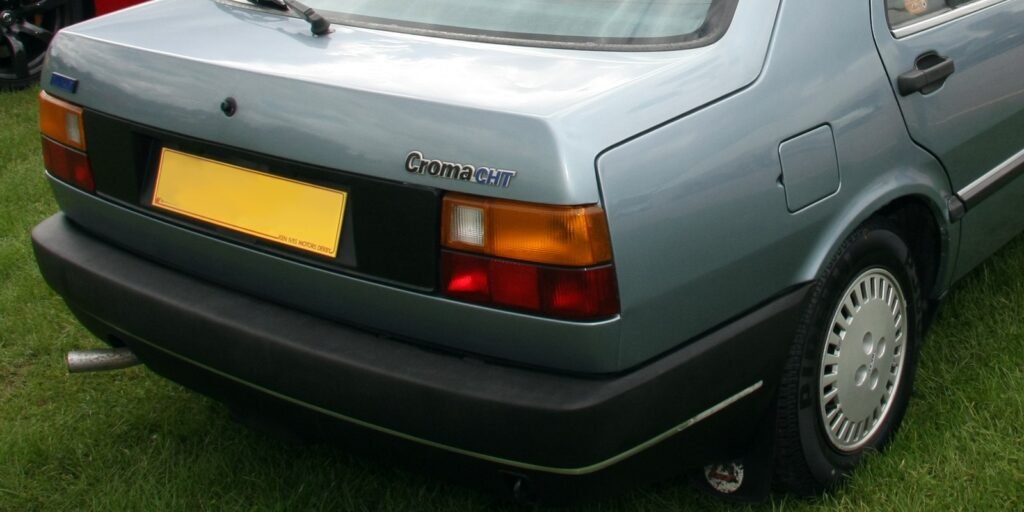
There was also a CHT version, for “controlled high turbulence,” a 90 hp two-liter with a Yamaha-developed system: two separate intake manifolds of different diameters to save fuel at light loads. Motor1 counts it among the first variable-geometry intake systems in series production. And in 1993 came the range-topper, a 2.5-liter Alfa Romeo V6 with 160 hp, cashing in on the Type Four family ties. That Croma topped out at 215 km/h, about 134 mph, ran 0–100 km/h (0–62 mph) in 8.3 seconds and finally got a driver’s airbag, still a rarity in the class in Europe at the time. The Croma was never a sports car, but it wasn’t short on choices.
An ending with no heir
The Croma got a light facelift for 1988, a serious one in January 1991 and another in June 1993. At the end of 1996 the line stopped. Fiat gave it no direct successor: it walked out of the large-sedan segment and left the ground to Lancia, Alfa and, above all, to the Germans who were by then selling TDIs by the truckload.
The name came back in 2005 on a completely different car, a tall, almost minivan-like wagon built in Cassino that lasted until 2010. Its replacement was the Fiat Freemont, which Americans would recognize instantly: it was a Dodge Journey wearing a Fiat badge. The big Fiat sedan died with the original Croma. The pioneer wasn’t only forgotten; it was quietly abandoned by its own maker, which decided the fight wasn’t worth it.
Why the Croma deserves its place
The Fiat Croma proves that car history isn’t always written by those who invent, but by those who know how to tell the story of what they invented. It was a rational, practical, glamour-free sedan, the dull sibling of far more charismatic Alfas, Lancias and Saabs. It passed through half of Europe without fanfare, just another car in its class.
Yet beneath that apparent ordinariness, the Croma took one of the most important engineering steps of its era: it brought the direct-injection turbodiesel to the passenger car and opened the door to the revolution that would define European roads for twenty years. It did it imperfectly, noisily and timidly, true. But it did it first. Then it stood and watched as Audi and Volkswagen reaped the harvest, while in Britain the honor went to an Austin.
Having the genius to invent the future and letting someone else walk off with it is a story the Italian car industry has lived more than once. The Croma wasn’t a failure. It was a pioneer buried for arriving early and not knowing how to shout about it.
Keep reading: Ferrari 456: The Station Wagon Maranello Erased
Check you’re still alive.
Photos: Charles01 (CC BY-SA 4.0), Powering (public domain), Tony Harrison (CC BY-SA 2.0).