
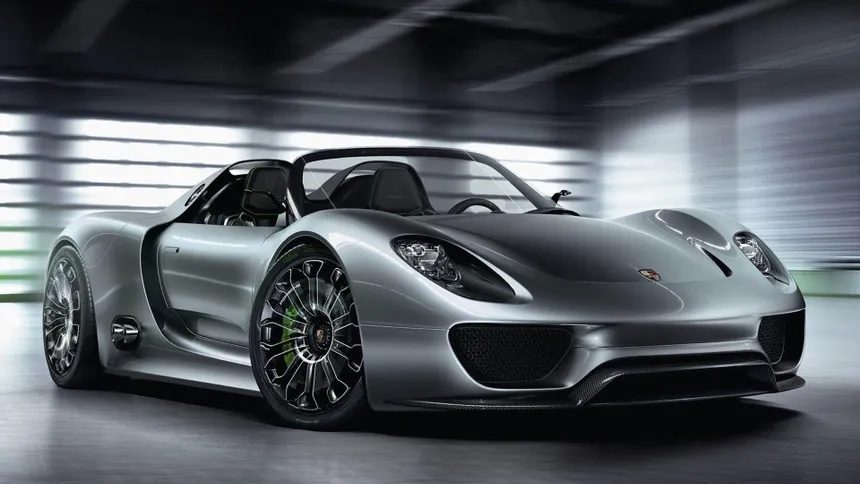
Porsche 918 Spyder: When Porsche Proved Hybrids Could Be Savage
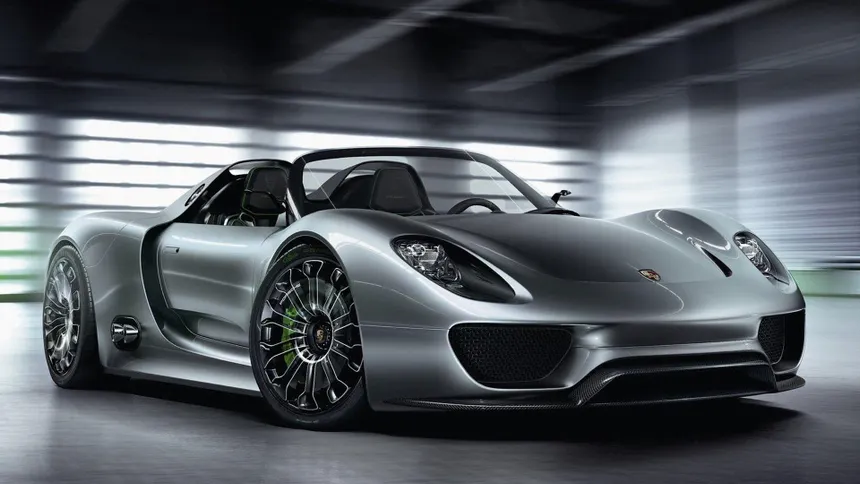
In 2013, the automotive world drew battle lines over the most absurd question in motoring: which hypercar was best — the LaFerrari, the McLaren P1, or the Porsche 918 Spyder?
They called it “The Holy Trinity.” Three hybrid hypercars, launched simultaneously, each taking a different philosophical approach to the same question: how do you build the ultimate performance car when the future is electrified?
Ferrari said: make a V12 louder. McLaren said: make a turbocharged V8 more efficient. Porsche said: make a hybrid that can do everything.
Porsche won the argument. And in doing so, they laid the groundwork for the electric future that most petrolheads still refuse to accept.
The Concept That Shouldn’t Have Worked
The 918 Spyder started as a concept at the 2010 Geneva Motor Show, and even then, the reaction was mixed at best. A hybrid Porsche supercar? After the Carrera GT‘s analogue purity? After decades of air-cooled worship and an enthusiast community that had built its entire identity around mechanical honesty and naturally aspirated engines? “Hybrid” was a dirty word in enthusiast circles, associated with Toyota Priuses and environmental guilt rather than performance and excitement.
Porsche was undeterred. They understood something the enthusiast community didn’t: the future of performance was electric augmentation, and the only question was whether established manufacturers would lead the transition or be dragged into it kicking and screaming. Porsche chose to lead.
The production version, revealed in 2013, was designed to silence every objection with overwhelming capability:
A 4.6-litre naturally aspirated V8 derived from the RS Spyder Le Mans prototype, producing 608 horsepower at a screaming 8,700 rpm redline. This wasn’t a detuned racing engine bolted into a road car — it was a purpose-built powerplant that shared its fundamental architecture with a Le Mans winner. The flat-plane crankshaft gave it a distinctive, high-pitched wail that was nothing like the rumble of an American V8 or the shriek of a Ferrari. It was its own thing entirely — exotic, intense, and utterly addictive.
Two electric motors added another 279 horsepower — one on the front axle producing 95 kW, and one integrated with the rear drivetrain producing 115 kW. Combined system output: 887 horsepower. The electric motors didn’t just add power — they fundamentally changed the car’s dynamic character, providing instant torque fill where the V8 was still building revs, and enabling a torque vectoring system that distributed drive force between all four wheels with a precision no mechanical differential could match.
A seven-speed PDK dual-clutch gearbox managed it all, and the software seamlessly blended three separate power sources into a unified driving experience. The complexity was staggering — three power sources, four driven wheels, regenerative braking calibrated to feel natural under all conditions, battery management balancing performance with longevity — and yet the driving experience was remarkably intuitive. Making something this complex feel this simple is perhaps the 918’s most impressive achievement.
And then the party piece: approximately 20 km of pure electric driving, producing zero emissions and near-zero noise. The 918 could whisper through your neighbourhood at 6 AM without waking anyone, and then demolish a Nurburgring lap record twenty minutes later. The duality wasn’t a compromise — it was the entire point.
The Nurburgring Statement
On September 4, 2013, Marc Lieb drove a 918 Spyder with the Weissach Package around the Nurburgring Nordschleife in 6 minutes and 57 seconds, becoming the first production car to break the seven-minute barrier on the most demanding circuit in the world.
This wasn’t just a lap record. It was a declaration.
The fastest production car around the most demanding circuit on earth was a hybrid. Not a stripped-out, turbocharged monster with slick tyres and a prayer. A road-legal hybrid with air conditioning, a navigation system, and a stereo. A car that could drive to the circuit on public roads, set the fastest lap in history, and drive home afterward without needing a support truck or a team of technicians.
The record has since been beaten — the 911 GT2 RS MR, the Mercedes-AMG One, and others have gone faster. But the significance remains untouched: the 918 proved, definitively and publicly, that electrification wasn’t the enemy of performance. It was a weapon. And anyone who claimed otherwise was arguing against evidence.
The Weissach Package itself was typical Porsche — a roughly 60,000 euro option that improved performance by removing things. Standard paint was replaced with bare carbon fibre or the spectacular Liquid Metal finish. Weight was reduced by 41 kg through lighter wheels, reduced sound deadening, and removal of comfort features. Aerodynamics were optimised with revised front and rear elements. Only Porsche would charge sixty thousand euros to give you less car and make it better. And only Porsche customers would consider this a reasonable proposition.
The Holy Trinity: Who Actually Won?
The comparison between the 918, LaFerrari, and P1 consumed automotive media for years and generated more content than any other automotive topic of the decade. Every magazine test, every YouTube drag race, every forum argument added another layer to a debate that will likely never be resolved to everyone’s satisfaction. So here’s my take, for whatever it’s worth.
The LaFerrari was the most emotional of the three. That 6.3-litre naturally aspirated V12 screaming to 9,250 rpm is a religious experience — possibly the greatest engine sound ever produced by a road car. The hybrid system added torque and response, but it felt secondary to the V12’s dominance. The LaFerrari was a celebration of internal combustion that happened to have electric assistance, rather than a genuine hybrid philosophy. It was the most intoxicating of the three to listen to, the most theatrical to drive, and the one that most felt like a farewell letter to the naturally aspirated era. But the hybrid system felt like an afterthought — it was there to boost performance numbers and meet regulations, not to represent a new philosophy.
The McLaren P1 was the most focused. Built for the track with a single-mindedness that bordered on obsession, the P1 was devastating in its precision. The twin-turbocharged V8 combined with the electric motor to produce a powertrain that was brutally effective rather than emotionally engaging. The active aerodynamics — a system that automatically adjusted the rear wing and front elements based on speed and cornering forces — were genuinely innovative and gave the P1 a level of downforce that neither competitor could match. The IPAS boost system, which could provide instant electric torque to fill the turbo lag gap, was clever engineering that solved a real problem. The P1 was the car you’d choose if your sole criterion was lap time.
The 918 Spyder was the most complete. It could be a silent commuter, a grand tourer, and a lap record machine, switching between modes seamlessly. It was the only one that felt like a vision of the future rather than a celebration of the present. Where the LaFerrari was a goodbye and the P1 was a statement of current capability, the 918 was a promise — a demonstration of what performance cars would become when electrification was embraced rather than resisted.
The P1 was the best to drive on a track. The LaFerrari was the best to listen to. The 918 was the best car, full stop.
The Technology Transfer That Justified Everything
The 918’s significance extends far beyond its performance numbers and its role in the Holy Trinity debate. It served as Porsche’s rolling laboratory for electrification technology, and the lessons learned from the programme influenced every subsequent Porsche model.
The hybrid torque vectoring system — using electric motors to distribute power between axles with millisecond response times — directly informed the development of the Taycan’s dual-motor architecture. The principles were the same, even if the implementation was different: use electric motors not just for propulsion but for dynamic control, turning the powertrain into an active handling system rather than a passive power source.
The battery management systems were ancestors of the technology now used in every Porsche hybrid and electric vehicle. Managing a high-performance lithium-ion battery through the thermal extremes of a Nurburgring lap — where the battery is simultaneously providing maximum power output and absorbing massive regenerative braking energy, all while maintaining temperature within a narrow operating window — produced engineering knowledge that couldn’t have been gained any other way. The 918 programme essentially compressed years of development into a single, intensive project.
The regenerative braking calibration was another area where the 918 programme paid dividends across the Porsche range. Making regenerative braking feel natural to a driver accustomed to hydraulic brakes is a significant engineering challenge — the deceleration characteristics are different, the pedal feel is different, and the transition between regenerative and friction braking needs to be seamless. Getting this right on a car that could decelerate from 300 km/h to a standstill required precision that transferred directly to the Taycan and Porsche’s hybrid models.
When Porsche launched the Taycan in 2019 as its first fully electric car, the 918 was the reason they could do it credibly. They weren’t a combustion engine company bolting on batteries and hoping for the best. They were a company that had already proven, at the highest possible level, that electrification and performance were not just compatible but synergistic. The 918 gave Porsche the credibility, the engineering knowledge, and the institutional confidence to commit to electrification when many of their competitors were still hedging their bets.
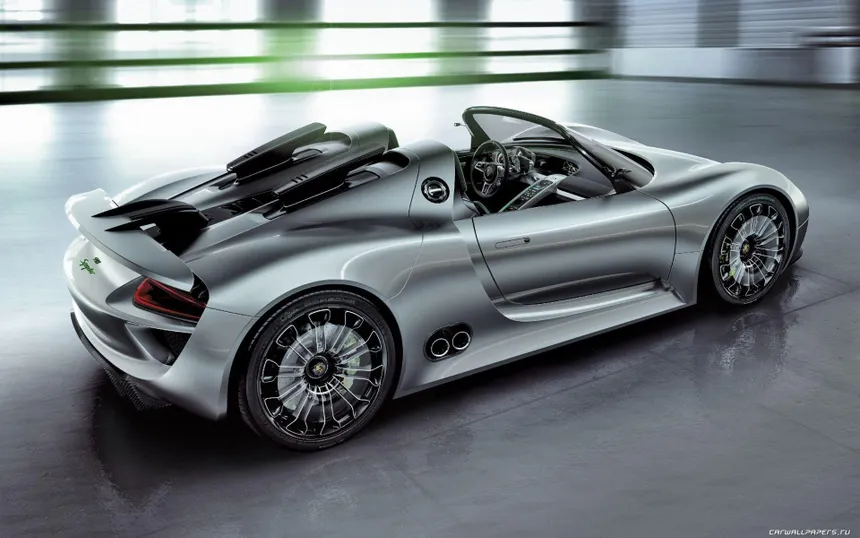
Values and the Collector Market
Porsche produced 918 units of the 918 Spyder — a numbered production run that would make any collector market analyst salivate. The numerical coincidence of building 918 examples of the 918 was deliberate, because Porsche understood that exclusivity is as much about narrative as it is about numbers.
The base price was approximately 770,000 euros in Europe, with the Weissach Package pushing past 830,000 euros. Fully loaded with paint-to-sample colours and every available option, the final price could approach a million euros before the car left the factory. At these prices, the 918 was more expensive than the LaFerrari but less expensive than the McLaren P1 in most markets, positioning it squarely in the middle of the Holy Trinity on price while arguably offering the broadest capability.
Today, 918 values have settled into a range between 1.2 and 2 million euros depending on specification, mileage, and options. The Weissach Package cars command the highest premiums, particularly in rare colours like the Liquid Metal finishes that were exclusive to the Weissach specification. Unlike many hypercars that spike dramatically and then correct, the 918 has shown steady, sustained appreciation that suggests genuine collector confidence rather than speculative froth.
The reason is straightforward: the 918 is the last Porsche that combined a high-revving naturally aspirated engine with cutting-edge hybrid technology in a no-compromise package. The next Porsche hypercar — whenever it arrives — will almost certainly be fully electric or at minimum a plug-in hybrid with a much greater emphasis on electric propulsion. The 918 represents the final moment when internal combustion and electrification shared equal billing, when neither technology dominated the other, and when the combination produced something greater than either could achieve alone.
Where It Fits in the Porsche Pantheon
The 918 Spyder completes a trilogy of Porsche halo cars that spans three decades and three completely different engineering philosophies:
The 959 (1986) proved that technology could tame the 911 platform, using turbocharging, all-wheel drive, and electronic ride height adjustment to create the world’s fastest production car from what was fundamentally a modified 911.
The Carrera GT (2004) proved that Porsche could build an uncompromised analogue supercar, stripping away every electronic aid and trusting the driver completely with a V10 engine and a manual gearbox.
The 918 Spyder (2013) proved that the future didn’t have to abandon the past — that a hybrid powertrain could enhance rather than diminish the driving experience, and that electrification was an evolution of the performance car rather than its replacement.
Each car was a statement of what Porsche believed at that moment in time. The 959 believed in electronics as the solution to mechanical limitations. The Carrera GT believed in purity as its own reward. The 918 believed in synthesis — the idea that the best car wasn’t purely analogue or purely digital, but a combination that took the best qualities of both approaches.
For a brand built on the idea that evolution beats revolution, the 918 might be the most Porsche car ever made. It didn’t reject the past or fear the future. It married them — at 887 horsepower and 345 km/h — and proved that the marriage could work.
The purists who mourned the Carrera GT’s replacement learned something unexpected: the hybrid wasn’t the end of the Porsche soul. It was the beginning of its next chapter.
Whether you like that chapter is up to you. But the 918 made it impossible to ignore.
4 thoughts on “Porsche 918 Spyder”