Mercedes-Benz 300 SLR: The Silver Monologue Nobody Could Answer

Some cars win races. Some make history. And then there’s the Mercedes-Benz 300 SLR, which did both in the same season and then walked away forever. No farewell tour. No victory lap. A clean slam of the door that left the motorsport world speechless and sick to its stomach.
- One single year. Five outright victories. A World Championship. The most immortal record ever set on open roads. And the worst tragedy motorsport has ever known. All of it with nine cars built. Nine. You can count them on your fingers and still have one left over.
This isn’t an article about a racing car. This is the autopsy of a legend.
A Formula 1 Car with Headlights
If you want to understand the 300 SLR, forget everything you know about 1950s sports cars. This wasn’t a road car that got a bigger engine. It was a Grand Prix single-seater that got an extra seat and a pair of headlights.
The base was the W196 R — the Formula 1 car with which Juan Manuel Fangio won two consecutive World Championships. Rudolf Uhlenhaut — the engineer who could match his own factory drivers’ lap times — took that platform and reconfigured it for endurance racing. The welded steel tube spaceframe chassis was stretched 160 mm in wheelbase (from 2,210 mm to 2,370 mm), the rear track was widened by 22 mm, and the driving position was reconfigured for two occupants.
The result carried a marketing name — “300 SLR,” Sport Leicht Rennen — that suggested kinship with the iconic 300 SL. That was a lie. The 300 SL was a production car with a six-cylinder engine derived from the 300 sedan. The 300 SLR was a completely different animal: a Formula 1 car in a sports car costume.
The M 196 S Engine: Engineering Without Compromise
This is where German engineering stops being a cliché and becomes a statement of intent.
The M 196 S is a straight-eight of 2,982 cc, with square bore and stroke dimensions of 78 x 78 mm. Directly derived from the 2.5-litre F1 engine, displacement was increased by lengthening the stroke (from 68.8 mm to 78 mm) to comply with World Sports Car Championship regulations, which imposed no displacement limit.
Peak declared power is 310 hp at 7,400 rpm, with 311 Nm (235 lb-ft) of torque at 5,950 rpm. There’s a discrepancy between sources: Mercedes-Benz’s official archive cites 306 hp at 7,500 rpm, while most specialist technical publications record 310 hp. The difference comes down to measurement standards of the era (PS vs. bhp) and dynamometer conditions. What isn’t up for debate is that this engine produced over 100 hp per litre in 1955, running on commercially available 98 RON Super petrol. Not race fuel. Petrol you could fill up at a regular pump.
Compression was dropped from the F1 engine’s 12.0:1 to 9.0:1, because this motor had to survive endurance races lasting up to 24 hours, not Grand Prix sprints.
And here’s what separates this engine from everything else that existed at the time: desmodromic valve actuation. Invented in 1896, this technology uses a second set of rocker arms and cam lobes to mechanically close the valves instead of relying on springs. In 1955, at the sustained revolutions this engine turned for hours on end, conventional valve springs would have overheated and floated. Desmodromics eliminated that risk entirely. Today, Ducati still uses this principle in its motorcycles. In 1955, Mercedes had it in a competition straight-eight.
The engine was longitudinally mounted, canted 33 degrees from horizontal to lower the centre of gravity. This created the distinctive asymmetric bonnet bulge on the passenger side. Power takeoff was from the centre of the crankshaft via a gear — not from the end — to reduce crankshaft torsion at high revs. Direct fuel injection was by Bosch, using an eight-plunger inline injection pump, technology derived from the Messerschmitt Bf 109 fighter of World War II.
Dry-sump lubrication. Double magneto ignition. Chrome-plated aluminium cylinder liners. Every detail of this engine was an engineering solution to a real problem, not an exercise in over-engineering.
Chassis, Brakes, and the Invention of the Air Brake
The chassis was a multi-tubular spaceframe of welded steel tubes, carrying bodywork made from Elektron magnesium alloy. Elektron has a relative density of 1.8 — less than a quarter that of iron. The result: a competition roadster weighing just 900 kg with fluids. A power-to-weight ratio approaching 350 hp per tonne. In 1955.
Front suspension was double wishbones with torsion bars. Rear was a single-joint swing axle with longitudinal torsion bars. Telescopic dampers all round.
The brakes deserve their own paragraph because they were a piece of technical insanity. Finned light-alloy drums, mounted inboard — not at the wheels, but alongside the differential and transmission. They were so enormous (350 mm front, 275 mm rear) they couldn’t fit inside the 16-inch wheel rims. They were mounted inboard to reduce unsprung weight and to allow that colossal size. Originally, this short-halfshaft brake system was designed for a planned four-wheel-drive system that never materialized.
But even with those monstrous drums, Mercedes had a problem: the direct rival was the Jaguar D-Type, which ran disc brakes. More modern, more effective, less prone to fade. The solution from Alfred Neubauer, Mercedes’ motorsport director, was brilliant in its simplicity: the air brake. A light-alloy spoiler of 0.7 square metres that rose behind the occupants like an aircraft’s spoiler on landing. In testing, it slowed the car dramatically and improved stability under braking. At Le Mans, where the car had to decelerate from 290 km/h to 40 km/h repeatedly, it was the difference between finishing the race with brakes or without them.
Mille Miglia 1955: The Greatest Day
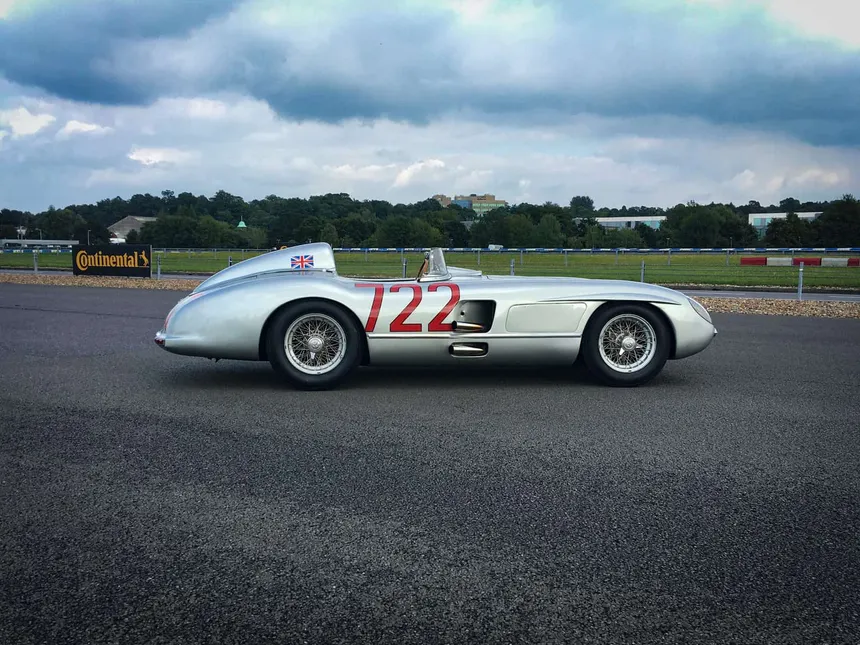
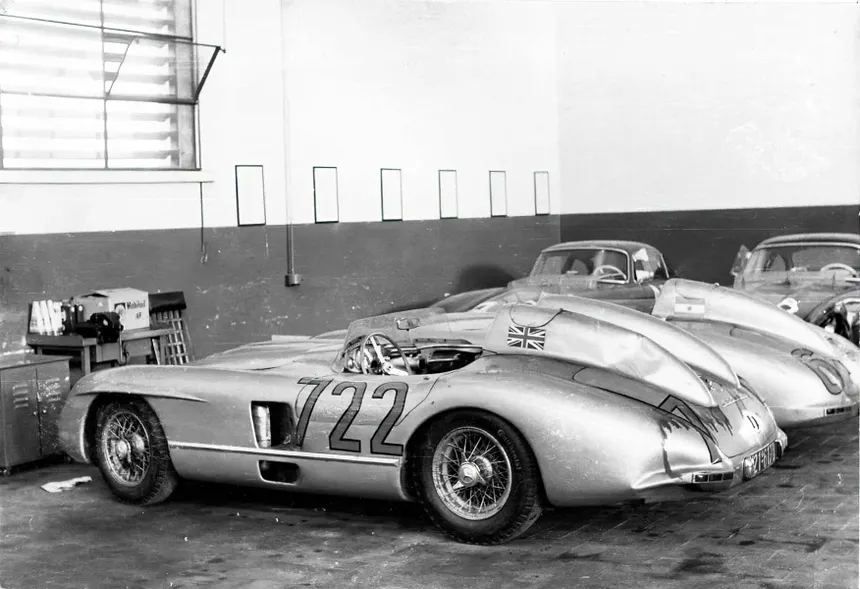
May 1, 1955. Brescia, Italy. 534 cars set off to cover nearly 1,600 kilometres of open Italian public roads, from Brescia to Rome and back. At 7:22 in the morning, 300 SLR number 722 leaves the line with Stirling Moss at the wheel and Denis Jenkinson as co-driver.
Moss was 25 years old. Jenkinson was a motorsport journalist — short, bearded, and with more determination than common sense. Together they had spent months driving the route in a 300 SL, compiling what Jenkinson called his pace notes — written on a handmade paper scroll 18 feet long inside a metal box bolted to the dashboard. Every corner described as “saucy,” “dodgy,” or “very dangerous,” communicated to Moss with pre-arranged hand signals. The system had been invented when Karl Kling and Hans Klenk won the 1952 Carrera Panamericana, but Moss and Jenkinson took it to another level entirely.
Moss’s trust in Jenkinson was total. Absolute. The car actually went airborne — roughly 200 feet through the air after a crest at over 170 mph — and Moss didn’t lift. Because Jenkinson had told him the road was straight on the other side. And it was straight.
Castellotti, in his Ferrari 735 LM with a 4.4-litre engine, bolted ahead early. Two minutes clear at Ravenna. But he drove with his heart instead of his head, and the mechanicals gave up. Taruffi, in another Ferrari, also threw everything at it. But at pit stops, the Mercedes crew was faster. And on the road, Jenkinson’s paper scroll gave an advantage that no local knowledge could match.
At Rome, the halfway point, Moss led by one minute and fifteen seconds. On the final stretch, Cremona to Brescia, the 300 SLR hit 170 mph. At 5:29 PM, Moss and Jenkinson crossed the finish line in Brescia. Time: 10 hours, 7 minutes and 48 seconds. Average speed: 98 mph on open roads with villages, blind crests, level crossings, and spectators standing inches from the tarmac.
Fangio — five-time F1 World Champion — driving alone, without a co-driver, in an identical 300 SLR, finished second. Thirty-two minutes behind.
Moss became the first and only Briton to win the Mille Miglia. The average speed record was never beaten. The last competitive Mille Miglia ran in 1957. When Moss saw the times, he said: “We’ve rather made a mess of the record, haven’t we?” He wasn’t wrong. Nobody has touched it since. Nobody ever will.
Le Mans 1955: The Wound That Never Healed
June 11, 1955. Circuit de la Sarthe. An estimated 250,000 spectators. Mercedes, Jaguar, Ferrari, Aston Martin, Maserati. The best cars and drivers on the planet, on a circuit that hadn’t substantially changed since 1923 — when top speeds were around 60 mph. By 1955, they exceeded 170 mph.
Neubauer paired Fangio with Moss in the lead car. Karl Kling with André Simon. And American John Fitch with Pierre Levegh, a 49-year-old French veteran whose epic 23-hour solo stint at Le Mans in 1952 — failing only in the final hour — had earned him a factory seat.
Lap 35. 6:26 PM. The first pit stops. Mike Hawthorn, leading in his Jaguar D-Type, overtook Lance Macklin’s Austin-Healey 100S and braked sharply to dive into the pits. The Jaguar had disc brakes — it stopped far shorter than any car on drums. Macklin, caught by surprise, swerved left. Directly into the path of Levegh’s 300 SLR, which was arriving at over 150 mph.
Levegh’s right-front wheel rode up the left-rear of the Austin-Healey. The Healey’s aerodynamic rear acted as a ramp. The 300 SLR went airborne, tumbled end over end for 80 metres, hit an earthen embankment and disintegrated against a concrete stairwell. The engine block, radiator, and front suspension shot into the grandstand at lethal speed. The bonnet scythed through spectators. The Elektron bodywork, with its high magnesium content, ignited. Fire crews poured water onto the wreck, which only intensified the magnesium fire. The car burned for hours.
Levegh died instantly. The exact death toll remains debated: between 82 and 84 spectators were killed. More than 120 were injured. It remains the deadliest accident in the history of motorsport.
The race continued. Mercedes, with Fangio and Moss leading, withdrew their cars after midnight — a decision by the Daimler-Benz board. Not for track safety. For dignity.
Mercedes-Benz withdrew from competition at the end of the 1955 season. They didn’t return until 1989. Thirty-four years of silence. Switzerland banned circuit racing entirely. That ban wasn’t lifted until 2022.
The Full 1955 Season: Total Domination
Despite Le Mans, the 300 SLR won the 1955 World Sports Car Championship with crushing authority. Only the best four results from six races counted. Mercedes skipped the first two overseas rounds (Buenos Aires and Sebring). They won the rest:
Mille Miglia: 1-2 (Moss/Jenkinson, Fangio). Eifel Race at the Nürburgring: victory. Swedish Grand Prix: victory. RAC Tourist Trophy at Dundrod, Ireland: 1-2-3 (Moss/Fitch, Fangio/Kling, von Trips/Simon/Kling). Targa Florio in Sicily: 1-2 (Moss/Collins, Fangio/Kling).
Five races entered. Five victories. Four one-two or one-two-three finishes. A championship won by a margin that made any calculation unnecessary.
The Uhlenhaut Coupés: The Impossible Epilogue
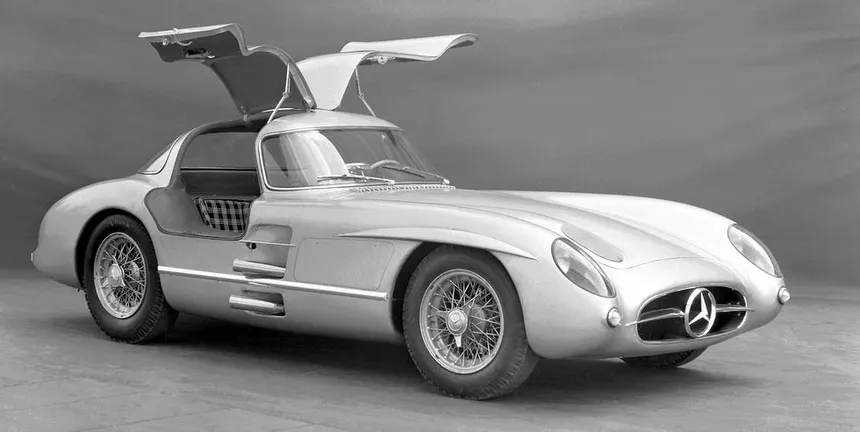
Of the nine W196 S chassis built, seven were competition roadsters. The other two became something else entirely. Rudolf Uhlenhaut had two chassis set aside and transformed them into closed coupés with sculpted bodywork and gullwing doors — required because the spaceframe’s high sill beams made conventional doors impossible. They were intended for the Carrera Panamericana, but the race was cancelled after Le Mans.
The Uhlenhaut Coupé weighed 1,117 kg and reached 290 km/h. Uhlenhaut used one as his daily driver. He covered the 230-kilometre commute between Stuttgart and Munich in under an hour when running late for meetings. Mercedes staff could hear him arriving at work when he was still several minutes away.
They never raced. And they became the most coveted cars on Earth.
On May 5, 2022, at a private auction organized by RM Sotheby’s at the Mercedes-Benz Museum in Stuttgart, one of the two Uhlenhaut Coupés sold for €135 million. The most expensive car ever sold — by a margin of over €90 million above the previous record (a 1962 Ferrari 250 GTO, sold for $48.4 million in 2018). The proceeds went to the Mercedes-Benz Fund, a scholarship programme in environmental science and decarbonization. The buyer, represented by British dealer Simon Kidston, had spent 18 months convincing the Mercedes board to consider the sale.
The second Uhlenhaut Coupé remains in the Mercedes-Benz Museum. It probably will never leave.
VERIFIED TECHNICAL SHEET — Mercedes-Benz 300 SLR (W 196 S)
| Data | Specification |
|---|---|
| Designation | W 196 S |
| Year | 1955 |
| Engine | M 196 S — Inline 8-cylinder |
| Displacement | 2,982 cc |
| Bore x Stroke | 78 x 78 mm (square) |
| Valve train | DOHC, 2 valves per cylinder, desmodromic |
| Fuel system | Bosch direct injection (8-plunger inline pump) |
| Compression ratio | 9.0:1 |
| Peak power | 310 hp (228 kW) @ 7,400 rpm |
| Peak torque | 311 Nm (235 lb-ft) @ 5,950 rpm |
| Lubrication | Dry sump |
| Fuel | Standard 98 RON Super petrol |
| Transmission | 5-speed, dry single-plate clutch |
| Chassis | Welded steel tubular spaceframe |
| Body | Elektron magnesium alloy |
| Front suspension | Double wishbones, torsion bars |
| Rear suspension | Swing axle, longitudinal torsion bars |
| Brakes | Inboard drums (350 mm front / 275 mm rear) |
| Weight (roadster) | ~900 kg |
| Weight (Uhlenhaut Coupé) | ~1,117 kg |
| Wheelbase | 2,370 mm |
| Top speed | ~290 km/h (180 mph) |
| Units built | 9 (7 roadsters, 2 coupés) |
Note on power figures: Mercedes-Benz’s official archive cites 306 hp (225 kW) at 7,500 rpm. Most specialist technical publications record 310 hp (228 kW) at 7,400 rpm. The difference is due to measurement standards (PS vs. bhp) and dynamometer conditions. Both figures are correct within their respective measurement contexts.
Why the 300 SLR Matters More Than Any Number
You can memorize the data. The 310 hp. The 900 kg. The desmodromics. The air brake. But the data doesn’t explain why this car raises the hair on your arms.
What explains the legend of the 300 SLR is the absolute concentration of everything motorsport can be — the genius, the glory, the tragedy, the dignity — in a single season. In nine cars. In a year that began with Moss flying across Italian roads at 170 mph trusting blindly in a short journalist with a paper scroll, and ended with Mercedes closing the door of the competition department for thirty-four years.
The 300 SLR never aged. It never had later versions. It never evolved. It appeared, it annihilated, and it left. The exact definition of going out on top.
Check you’re still alive.