Karma Doesn’t Make Cars: Why It Bought a 27-Year-Old Software Company Before Its First Electric Vehicle

There’s a sentence Marques McCammon repeats every time someone asks him what Karma Automotive actually is. He doesn’t say “we’re an electric car manufacturer.” He doesn’t say “we compete with Porsche” or “we want to be the next Tesla.” He says: “We are a technology company that manufactures ultra-luxury vehicles.”
And when you understand who McCammon is and what his very first move as Karma’s president was, that sentence stops sounding like a corporate tagline and starts sounding like a declaration of intent.
The Guy Who Ran Automotive Software at Intel
McCammon is not a car salesman or a suit from a hedge fund. He’s a product engineer with three decades in the industry — he came through powertrain development at Chrysler, helped create the Dodge SRT-4, held executive roles at Saleen and the electric startup Aptera. But what matters for this story is what came next.
From 2014 to 2019, McCammon was vice president of global automotive and general manager at Wind River, the Intel subsidiary that develops embedded systems software running inside a car’s ECUs. He directed global teams in product development, engineering, and strategy for connected and autonomous automotive software.
When Karma named him president in April 2023, they didn’t hire a car salesman. They hired the person who understands that the future of the automobile is defined in the cloud, not under the hood.
And his first major move proves it.
100 Computers, 5,000 Metres of Wiring, 68 Kilograms of Problem
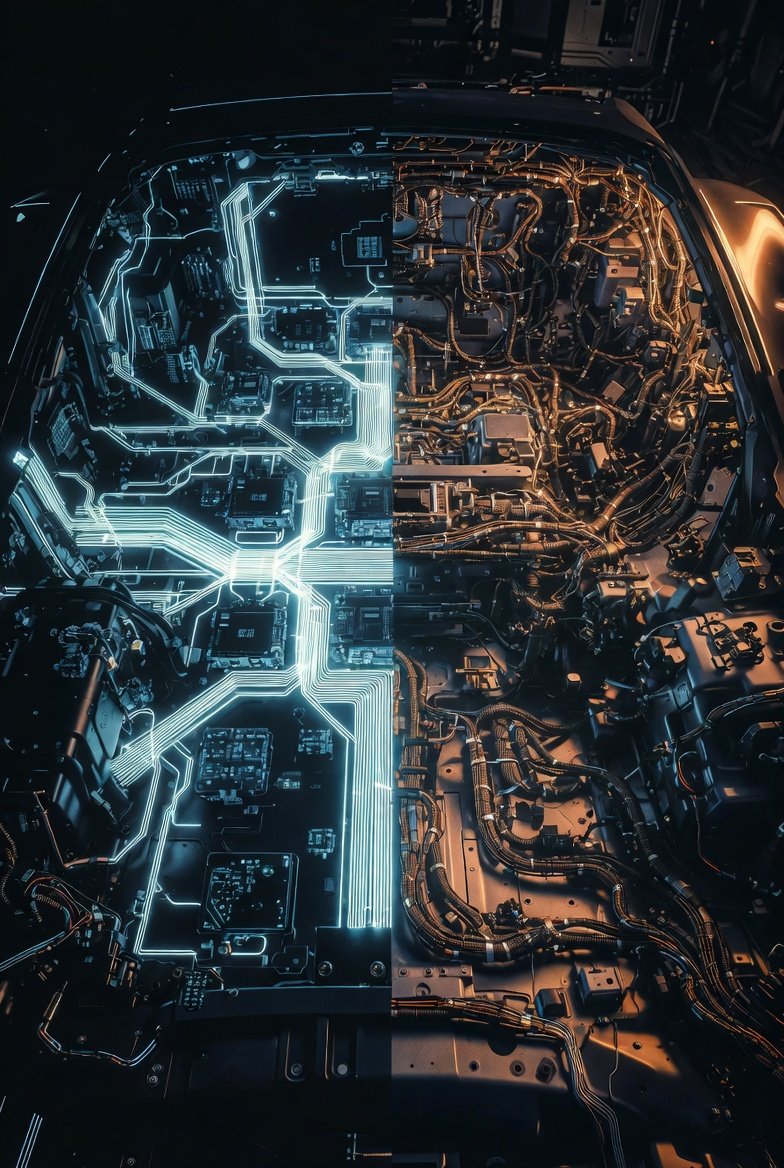
To understand why McCammon’s first big decision was buying a software company, you need to understand one number: 100. That’s how many ECUs — electronic control units — a modern premium car carries. One hundred small independent computers, each controlling a specific function: engine, brakes, airbags, climate, infotainment, driver assistance, lighting, steering, battery management.
Volvo, as a documented example, uses a superset of 120 ECUs across its models. They execute 100 million lines of source code. They contain 10 million conditional statements and 3 million functions. For perspective: that’s more software than an Airbus A380 carries if you strip out the cabin entertainment system.
And all of it needs to be connected. The wiring harness can contain over 1,500 wires totalling 5,000 metres in length and weighing more than 68 kilograms. Just in wiring.
Now imagine you need to update the software in ten of those ECUs. Previously, that meant taking the car to a workshop, plugging in diagnostic equipment, updating manually, and hoping the new version didn’t conflict with the other 90 units in the vehicle. Multiply that across thousands of cars in 60 countries with different configurations.
The industry knows this is unsustainable. The migration is already underway: from 100 independent ECUs to 5-10 powerful domain controllers, or even a central computing platform. Less hardware, less wiring, less weight, fewer failure points. But that means software becomes the actual product. The car becomes a platform that runs code — exactly like your phone, but with four wheels and responsibility for your life.
And managing that transition at scale, securely, without bricking cars mid-update — that’s exactly what Airbiquity did.
27 Years Building the Nervous System of the Connected Car
Airbiquity wasn’t a Silicon Valley startup with an MVP on a PowerPoint slide. It was one of the world’s pioneering automotive telematics companies, founded in 1997 in Seattle. When the industry still thought of cars as mechanical machines with some electronics bolted on, Airbiquity was already designing the infrastructure for vehicles to talk to the cloud.
Its flagship product was OTAmatic — an over-the-air software and data management platform built from scratch for the automotive sector. Not a generic IoT product adapted for cars. Automotive-grade software designed to handle the complexity of updating dozens of ECUs across millions of vehicles simultaneously.
It did things most articles about OTA simply ignore. It orchestrated multi-ECU updates with dependency policies, rollback, and automatic recovery — if an update failed, the system reverted to the previous version without bricking the car. Its Vehicle Configurator gave manufacturers complete visibility into exactly which hardware and software version every vehicle in their fleet carried, at any moment, in any market.
And then there was cybersecurity — the aspect that rarely makes headlines but can destroy an entire company if it fails. Updating a car’s software isn’t like updating a phone app. If someone intercepts or tampers with an update, the consequences range from personal data theft to remote control of the brakes. Airbiquity implemented the Uptane framework, a security standard for vehicular OTA updates originally developed with funding from the US Department of Homeland Security. It protects against substitution attacks, rollback attacks, package mixing, and compromised servers. It forms the basis of UNECE WP.29 regulation, which requires manufacturers to have a certified cybersecurity management system for new vehicle type approval in Europe.
Airbiquity’s investors included Toyota Motor Company and Denso — not exactly two names that bet on companies without technical substance. Its technology was deployed in over 60 countries, serving the sector’s largest OEMs.
And there are market numbers behind all of this that explain why McCammon moved fast. The automotive OTA updates market is worth nearly $6 billion in 2026, growing at 19% annually. It’s expected to exceed $11.6 billion by 2030. Mercedes already offers acceleration upgrades as subscriptions on the EQE and EQS. Rivian distributes smart charging features over the air. Stellantis reported 94 million OTA updates in 2023 alone. The car is no longer sold once. It’s sold continuously. And the platform managing those continuous sales is the most valuable asset a manufacturer can hold.
In February 2024, Karma acquired the technology assets, intellectual property, existing OEM contracts, and key technical personnel from Airbiquity. Not a concept. Not a patent. A functioning ecosystem with more than two decades of technical maturity.
Karma Connect and Karma Flash: The Double Play
McCammon didn’t buy Airbiquity to put it in a display case. He integrated it directly into Karma’s core under two brands that encapsulate the entire strategy.
Karma Connect is the B2B platform. Airbiquity’s technology — OTAmatic, development tools, data management, analytics — wrapped into Karma’s cloud services and offered as a product to other manufacturers and transport companies. Karma doesn’t just use the technology for its own vehicles: it sells it. The software continues servicing the OEM contracts Karma assumed with the acquisition.
Karma Flash is the customer-facing side. The OTA system that allows owners to receive updates and improvements without visiting a workshop. It’s the model Tesla popularised — your car improves after you buy it — but on a software foundation with 27 years of evolution and deployment across 60 countries, not on a platform built internally without that legacy.
146 Cars. And He’s Happy About It.
McCammon sold 146 cars in 2025. And he’s happy about it.
That sounds like failure if you think like a volume manufacturer. But Karma isn’t a volume manufacturer. Every one of those 146 cars is a node in a data network. With 146 cars you can validate the platform — every OTA update, every remote diagnostic cycle, every cloud interaction generates real information about how the system behaves in the hands of real customers, in real conditions. With 1,000 you can perfect it. With 5,000 you can sell it to other manufacturers as a turnkey solution.
Karma isn’t selling cars. It’s selling the operating system that makes them work. The 146 cars are the laboratory. And every single one of them is running Karma Connect — generating the operational data that no amount of simulation or bench testing can replicate.
And they can afford that pace because Karma is owned by Wanxiang Group, the Chinese clean energy conglomerate that manufactures components for half the vehicles produced in the United States, employs over 13,500 people, and operates in 26 states. A123 Systems is also part of the group. This isn’t a startup burning through investor cash. It’s a company with real industrial backing, access to a global supply chain, and none of a major OEM’s bureaucratic inertia. That combination is rarer than it sounds.
What’s Missing and What’s Already There
I’ll be straight with you: the Kaveya hasn’t arrived yet. Factorial Energy‘s solid-state batteries aren’t in commercial production. Karma Connect hasn’t demonstrated results at scale with external OEMs. There’s no “749 miles without stopping” to lay on the table as irrefutable proof. This article isn’t a story about results. It’s a story about pieces placed on a board.
But the pieces are real. A president who spent five years running automotive software at Intel. An OTA platform with 27 years of deployment across 60 countries, absorbed and integrated. A cybersecurity stack with Uptane certification that meets European regulatory requirements for type approval. An agreement with Factorial Energy to equip the Kaveya with the most advanced solid-state batteries on the market. And the industrial backing of Wanxiang Group, which is not exactly an angel investor with a cheque and a pat on the back.
The question nobody is asking out loud is whether Karma can execute all of this with fewer than 200 employees and a volume of 146 cars per year. The honest answer is that we don’t know. What we do know is that McCammon doesn’t need to sell 200,000 units to prove the thesis. He needs the Kaveya to work, he needs Karma Connect to sign B2B contracts with other manufacturers, and he needs the platform to demonstrate it can scale beyond the Karma ecosystem. If that happens, the story changes category entirely. And the automotive industry will have to reckon with the fact that a niche manufacturer in Irvine, California, built what their billion-dollar software departments couldn’t.
If you’ve read our article on Factorial Energy, you understand why Karma chose solid-state batteries. If you’re reading this, you understand why it bought a software company before launching a single pure electric vehicle. Factorial gives Karma the energy cell of the future. Airbiquity gives it the digital nervous system. Together, they build something no other ultra-luxury manufacturer has — at least on paper.
When the Kaveya arrives in 2027 with FEST batteries and Karma Connect running underneath, the final product won’t be a thousand-horsepower super-coupé. It will be the proof that a California manufacturer with fewer than 200 employees can build the technology architecture that the giants have spent a decade trying to assemble.
Or it won’t. We don’t know that yet. But the bet has been placed, the pieces are on the table, and McCammon has spent his entire career preparing for this game. If it works, Karma won’t be making cars. It will be redefining what it means to be a carmaker. And if it doesn’t, at least it will have attempted something nobody else dared to try.
Check you’re still alive.